
Audit Readiness for Small Business Fee-Recovery Programs
Last Updated on November 10, 2026 by Dimitri Akhrin
TL;DR
- Audit readiness is a routine, not a project – Build a lightweight compliance file and review it quarterly so you can respond to any card-brand or processor review within one business day, not one frantic week.
- Your program label must match your program structure – A “cash discount” that operates as a surcharge creates compliance exposure regardless of what your processor called it during setup. Verify your actual model and document it clearly.
- Monitor three sources quarterly – Card-brand merchant portals, state attorney general pages and your processor’s update communications. This catches rule changes before they become violations.
- Verify live operations against your documentation – Signage, receipts, checkout disclosures and surcharge rates must match your compliance file. Drift between setup and current operations is the most common audit failure.
- Start with one step today – Write down your program type, your rate and your state exposure. That 15-minute exercise reveals whether your current setup matches reality and gives you the foundation for everything else.
Guide Orientation: What This Covers and Who It’s For
This guide builds a practical audit readiness routine for small and midsize business owners who run dual-pricing, surcharging, or zero-fee payment programs. If you accept credit cards and pass processing costs to customers in any form, card-brand rules and state-level regulations directly affect your revenue, your risk exposure and your customer relationships.
By the end, you will understand how to monitor regulation changes before they trigger fines, build a lightweight compliance file that satisfies card-brand reviews and maintain ongoing compliance support without hiring a dedicated compliance officer. This guide is written for owners, managers and finance directors, not enterprise compliance teams.
We exclude PCI DSS deep dives, international payment regulations and industry-specific frameworks (HIPAA, SOX). The focus stays on the payment-program compliance layer that most small businesses overlook until it becomes expensive.
Why Regulatory Compliance Matters for Fee-Recovery Programs
Card-brand compliance reviews rarely announce themselves with a calendar invite. Reviews of surcharge and dual-pricing programs usually come through your processor or acquirer, often after a customer complaint. When documentation is missing, the consequences can be fast: fines passed through from the card brands, a forced program shutdown or a processor-initiated account hold that freezes your cash flow.
The landscape is shifting faster than most owners realize. In the Q4 2024 MetLife and U.S. Chamber of Commerce Small Business Index, 42% of small businesses said keeping up with regulatory and compliance requirements is difficult. State legislatures continue to revise surcharging rules, card networks typically publish rule updates twice a year and the gap between “what you set up” and “what’s currently required” widens with every cycle you skip.
The cost of inaction is not theoretical. A merchant who keeps surcharging after a state prohibits it faces customer disputes, card-brand rule violations and potential legal exposure. A business that cannot produce signage records, receipt samples, or rate-cap documentation during a review risks losing the program entirely, reverting to absorbing full processing costs overnight.
In the same survey, 47% of small businesses reported spending too much time fulfilling compliance requirements. The irony is that most of that time is spent reacting. Audit readiness inverts the equation: a small, repeatable investment in documentation removes the scramble and protects the margin gains your fee-recovery program was designed to deliver.
Core Concepts: The Compliance Layer Most Merchants Miss
Surcharging vs. Dual Pricing vs. Cash Discounting
These three terms describe different legal and operational structures for recovering processing costs. Surcharging adds a fee to credit card transactions and is governed by card-brand rules and state law. Dual pricing displays two prices (cash and card) at the point of sale. Cash discounting frames the lower price as a discount rather than the higher price as a fee. Each carries distinct disclosure, signage and receipt requirements. Under Visa’s rules, a cash discount program must show the card price in full; if a card payment shows an added fee at checkout, it may be treated as a surcharge.
The common misconception is that these programs are interchangeable. They are not. A program labeled as “cash discount” but structured as a surcharge can trigger a card-brand violation. Your compliance obligations depend on which model you actually operate, not which label your processor used during setup.
Card-Brand Operating Regulations
Visa and Mastercard publish rules that govern surcharge caps, disclosure requirements and notification procedures. Today, Visa caps credit card surcharges at the lower of your merchant discount rate or 3% and Mastercard caps them at the lower of your average effective merchant discount rate or 4%. Neither allows surcharges on debit or prepaid cards and both require at least 30 days’ advance notice before you start. These rules change and a disclosure practice that was optional may become mandatory. Merchants are bound by the current version, not the version in effect when they launched their program.
State-Level Surcharge Laws
Several U.S. jurisdictions restrict or prohibit credit card surcharging. Visa’s merchant guidance (current as of February 2024) lists Connecticut, Maine, Massachusetts, Oklahoma and Puerto Rico as prohibiting surcharges and Colorado, Minnesota, New Jersey and New York as having their own requirements. These laws evolve through legislation and court decisions. A merchant operating in multiple states (or selling online to customers in restricted states) must track each jurisdiction independently. “We’ve always done it this way” is not a compliance strategy.
The Audit Readiness Mindset
Audit readiness is not a binder on a shelf. It is a living discipline: the ability to produce current, accurate documentation on demand. Think of it as a preflight checklist for your payment program. The goal is not perfection. The goal is evidence that you are monitoring, adjusting and documenting your compliance posture continuously.
The Framework: Four Pillars of Merchant-Level Audit Readiness
This guide organizes audit readiness into four interconnected pillars. Each pillar represents a category of work, not a one-time task. Together, they form a repeatable cycle that keeps your fee-recovery program defensible.
- Pillar 1: Regulation Monitoring – Tracking changes to card-brand rules and state laws before they affect your program.
- Pillar 2: Documentation Architecture – Building a lightweight compliance file that proves what you do and why.
- Pillar 3: Operational Verification – Confirming that your live program (signage, receipts, rates) matches your documented policies.
- Pillar 4: Review Cadence – Scheduling recurring check-ins so nothing drifts out of compliance between reviews.

Monitor, document, verify, review, repeat. A clean review is validation, not permission to stop.
These pillars are sequential when you build the system for the first time. After that, they operate as a cycle: monitor, document, verify, review, repeat.
Step-by-Step Breakdown: Building Your Audit Readiness Routine
Step 1: Map Your Current Program Structure
Objective: Establish a clear, written record of exactly what fee-recovery model you operate, in which locations and under which processor agreement.
Start by answering four questions in writing. What program type are you running (surcharge, dual pricing, or cash discount)? Which states do you operate in, including eCommerce sales? What is your current surcharge or price-differential rate? What processor agreement governs the program?
Pull your original processor agreement and any setup documentation. Compare the program label in your agreement to the program you actually run at the register or checkout page. If your agreement says “cash discount” but your receipts show a line item labeled “surcharge,” you have a structural mismatch that needs correction before anything else.
Review your merchant discount rate to confirm that any surcharge you apply does not exceed your actual cost of acceptance. Card-brand rules don’t allow a surcharge above your cost of acceptance or the network cap, whichever is lower, so this number belongs in your file.
Anti-patterns: Assuming your processor set everything up correctly and never revisiting. Relying on verbal descriptions of your program instead of written documentation. Ignoring eCommerce transactions when mapping state exposure.
Success indicators: You have a one-page summary of your program type, rate, jurisdictions and processor agreement reference. Any mismatch between your label and your operations has been identified.
Step 2: Build a Regulation Monitoring Feed
Objective: Create a reliable, low-effort system for learning about card-brand rule changes and state law updates before they take effect.
You do not need regulatory technology software to accomplish this. You need three information sources and a calendar reminder. First, subscribe to your card brands’ merchant notification channels. Visa and Mastercard both publish merchant rule information on their business sites and your acquirer relays changes that affect you. Second, bookmark your state attorney general’s consumer protection page for each state where you have customers. Third, ask your payment processor directly: “How will you notify me when surcharge rules change?”
According to the Chamber’s survey release, 44% of small businesses already outsource compliance tasks, which signals that external support is not a sign of weakness but a practical allocation of limited resources. If your processor does not proactively communicate rule changes, that is a gap worth filling, either by switching to a processor that does or by adding a quarterly check to your own calendar.
Set a recurring quarterly reminder to review your monitoring sources. Card-brand rule changes are often published on a spring and fall cycle, so ask your processor when the next updates take effect. State legislative sessions follow their own schedules, but a quarterly sweep catches most changes within one cycle.
Anti-patterns: Relying solely on Google searches when a problem surfaces. Assuming your processor will always notify you. Monitoring federal regulations but ignoring state-level changes.
Success indicators: You can name your three monitoring sources. A quarterly calendar reminder is set. You know when the next card-brand rule changes take effect.
Step 3: Create Your Compliance File
Objective: Assemble the core of your audit readiness: a single, accessible folder (digital or physical) containing every document a card-brand reviewer or processor auditor could request.
It doesn’t need to be elaborate, just current and complete. At minimum, include these items: your processor agreement, your program type classification (from Step 1), your current surcharge or dual-pricing rate with the calculation showing it does not exceed your effective cost of acceptance, photos of your in-store signage (point of entry and point of sale), a sample receipt showing proper fee disclosure, a list of states where you operate or sell, confirmation of the 30-day surcharge notices sent to your acquirer (and Mastercard) if you surcharge and a log of any program changes you have made with dates.
For eCommerce merchants, add screenshots of your checkout page showing the fee disclosure before the customer completes the transaction. Card-brand rules require that the surcharge or price differential is visible before the final purchase decision, not buried in a confirmation email. Mastercard also requires the receipt to show the surcharge as both a percentage and a dollar amount.
This file is your evidence trail. When a reviewer asks, “How do you ensure your surcharge does not exceed your effective rate?” you point to the rate calculation. When they ask, “How do you disclose the fee?” you show the signage photos and receipt samples.
Your effective rate includes more than interchange, so review these hidden payment processing costs. Assessment fees, gateway fees and processor markup all factor into the cap calculation.
Anti-patterns: Storing compliance documents across multiple platforms with no central index. Keeping the original setup documents but never updating them.
Success indicators: Your compliance file contains every item listed above. You can produce it within five minutes of a request.
Step 4: Verify Your Live Operations
Objective: Confirm that what happens at the register, terminal, or checkout page matches what your compliance file describes.
Audit readiness depends on more than paperwork. Documentation means nothing if your live operations have drifted. This step is a physical (or digital) walkthrough of your customer-facing payment experience. Visit your own store or website as a customer would. Check that entry-point signage is visible, legible and accurate. Run a test transaction and examine the receipt. Verify that the surcharge line item (or dual-price display) matches your documented rate.
For businesses with multiple locations, this verification must happen at each site. A franchise or multi-location retailer cannot assume that signage installed during the initial rollout is still in place, still accurate and still compliant with current rules. Passing a check at one location doesn’t mean the others pass.
Compare your findings against your compliance file. If the signage in-store says 3.5% but your file says 3.0%, something changed without being documented. Update whichever is incorrect, document the change and note the date.
Anti-patterns: Treating verification as a one-time setup task. Delegating verification without providing a checklist. Skipping eCommerce checkout verification because “the developer handled it.”
Success indicators: Your live program matches your compliance file on every point. Any discrepancies have been corrected and logged with dates. You have fresh signage photos and receipt samples in your file.
Step 5: Establish a Review Cadence
Objective: Lock in a repeating schedule that prevents compliance drift between now and the next time someone asks to see your documentation.
The entire system collapses without a cadence. Quarterly reviews are the minimum for merchants running fee-recovery programs. Each quarterly review should take 30 to 60 minutes and cover three questions: Have any card-brand rules or state laws changed since the last review? Does my compliance file reflect my current operations? Does my live program match my compliance file?
Build a simple checklist (a spreadsheet row or a task in your project management tool) with those three questions, a date field and a notes column. Complete it every quarter. That checklist becomes part of your compliance file, demonstrating to any reviewer that you maintain continuous monitoring rather than point-in-time compliance.
In the Chamber’s Q4 2024 index, 69% of small businesses said they spend more per employee on regulatory compliance than larger competitors. A structured cadence can reduce that burden by cutting redundant effort, panic-driven research and the expensive corrections that follow a failed review.
For merchants who want to reduce this burden further, working with a processor that provides ongoing compliance support as part of the relationship is one of the most effective investments available. BAMS merchants work with a dedicated account representative who can answer questions about their program setup and help pull the statements a compliance file needs. Rule interpretation for your state should still come from qualified counsel.
Anti-patterns: Setting a cadence but not assigning ownership. Reviewing annually instead of quarterly. Treating the review as optional when business is busy.
Success indicators: You have a recurring calendar event for quarterly reviews. Your checklist is documented and stored in your compliance file. At least one person is accountable for completing each review.
Step 6: Prepare for the Actual Review
Objective: Know what to expect when a card-brand compliance review or processor audit occurs, so you respond with confidence instead of panic.
Card-brand compliance reviews for surcharging merchants usually arrive through your processor, not directly from Visa or Mastercard. Your processor may request documentation, conduct a site visit, or ask you to complete a self-assessment questionnaire. The review may be triggered by a customer complaint, a random audit, or a rule-change enforcement sweep.
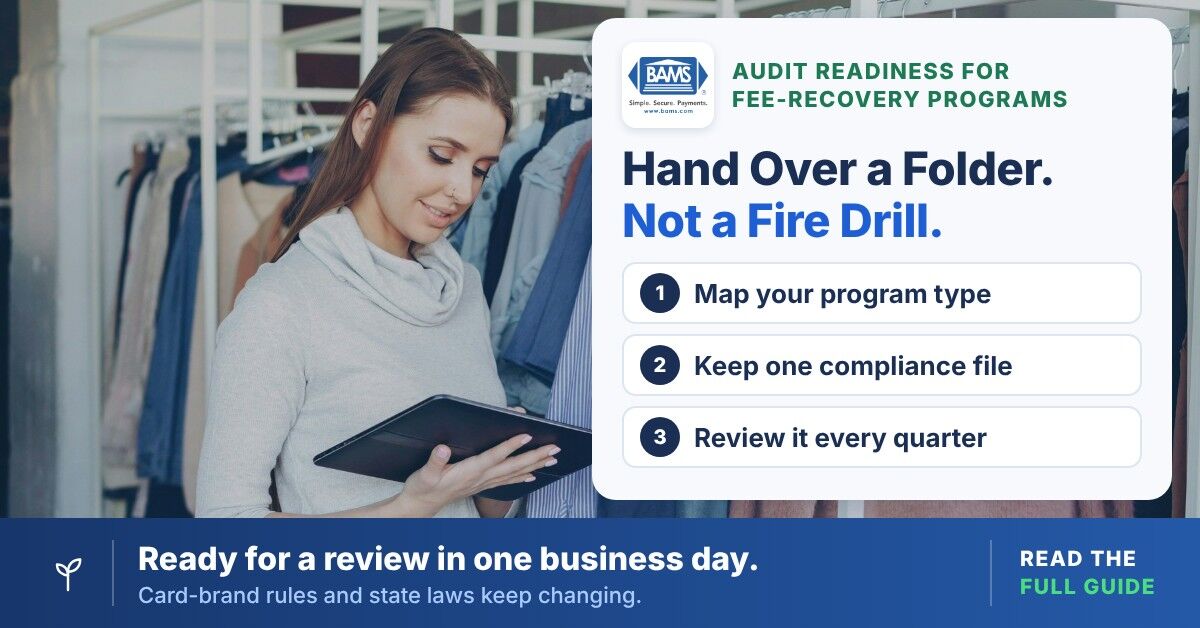
If you have followed Steps 1 through 5, your audit readiness work pays off here. Your response is straightforward: hand over your compliance file. The file contains your program classification, rate calculation, signage evidence, receipt samples, state-jurisdiction list, change log and quarterly review checklists. This is exactly the evidence a reviewer needs to confirm your program is compliant.
Prepare a brief cover summary (half a page) that describes your program in plain language: what type it is, what rate you apply, how you disclose it and how often you review it. Attach this to the front of your compliance file. It gives the reviewer immediate context.
Review your merchant services checklist to ensure that your broader account configuration (batch timing, volume declarations, PCI compliance cadence) does not create secondary issues during a review. Compliance reviews sometimes expand scope when initial findings raise questions.
Anti-patterns: Waiting until a review notice arrives to start gathering documents. Arguing with the reviewer about rule interpretations instead of producing evidence. Assuming that a clean review means you can stop monitoring.
Success indicators: You can produce your complete compliance file and cover summary within one business day of a request. The typical review process and your role in it are clear. You treat a clean review as validation of your system, not as permission to stop.
Practical Examples: What This Looks Like in Action
Scenario A: Single-Location Coffee Shop with a Surcharge
A coffee shop owner in Ohio adds a 3% surcharge to credit card payments. At setup, 3% matched the owner’s effective credit card processing rate and Visa’s cap. Six months later, the owner renegotiated processing fees and the effective rate dropped to 2.6%. The surcharge setting and signs were never updated.
Without a review cadence, this gap persists indefinitely. The owner is now charging a surcharge that exceeds the actual cost of acceptance. During a quarterly review, the owner catches the discrepancy, lowers the terminal setting to 2.5%, updates the signs and receipt template and logs the change with the date. Total time: 45 minutes. Cost of not catching it: a potential card-brand violation and forced program shutdown.
Scenario B: E-Commerce Merchant Selling Across State Lines
An online retailer based in Florida sells nationwide and applies a credit card surcharge at checkout. Two states in the retailer’s customer base pass new legislation restricting surcharging. The retailer’s monitoring feed (a quarterly check of state AG pages) catches the change before enforcement begins. The retailer updates the checkout logic to exempt customers in those states, documents the change and adds the new state restrictions to the compliance file.
Without the monitoring feed, the retailer continues surcharging in restricted states, generating customer complaints that trigger a card-brand review. The retailer cannot produce documentation showing awareness of the law change. The likely result: refunds, possible fines and a processor-mandated program suspension.
Scenario C: Multi-Location Restaurant Group
A restaurant group with four locations assigns one manager per location to verify signage and receipts quarterly. During a review cycle, Location 3 reports that the point-of-entry sign was removed during a renovation and never replaced. The compliance file flags the gap, the sign is reinstalled within a week and a photo is added to the file. The quarterly checklist shows the issue was identified and resolved, demonstrating audit readiness rather than negligence.
Common Mistakes and Pitfalls
Confusing setup with compliance. Launching a surcharge or dual-pricing program is the beginning of your compliance obligation, not the end. In the Chamber’s Q4 2024 survey, 39% of small businesses said the time or resources they spend on compliance increased over the past six months. What was compliant at launch may not be compliant today.
Trusting labels over structure. If your program is labeled “cash discount” but operates as a surcharge (adding a fee to card transactions rather than discounting cash transactions), the label does not protect you. Card brands evaluate what you do, not what you call it.
Ignoring eCommerce disclosures. In-store signage gets attention because it is visible. Online disclosures are often buried in terms of service or appear only on confirmation pages. Card-brand rules require pre-transaction disclosure and online merchants are held to the same standard as brick-and-mortar.
Treating compliance as a solo task. 53% of small businesses already spend a great deal or fair amount of time each year on cybersecurity, data protection and privacy compliance. Adding payment-program compliance to the same person’s plate without a system guarantees that something falls through the cracks. Assign ownership, build a checklist and use your processor’s support resources.
What to Do Next
Start with Step 1. Write down your program type, your rate and your state exposure. That single exercise takes 15 minutes and immediately reveals whether your current setup matches your understanding of it.
From there, build your compliance file one document at a time. You do not need to complete every step in a single afternoon. The goal is a working system by the end of your first quarter, not a perfect binder by Friday.
Revisit this guide at each quarterly review as a reference, not a checklist. Your program will evolve, rules will change and your compliance file will grow. That is the point. Audit readiness is not a destination. It is the discipline of staying current so that when the review arrives, your only task is handing over a folder you already built.
Frequently Asked Questions
When should a small business start focusing on compliance optimization for its payment program?
Immediately after launching any surcharge, dual-pricing, or cash-discount program. Compliance obligations begin the moment you start passing processing costs to customers. Waiting until a review notice arrives means you are already behind and retroactive documentation rarely satisfies a card-brand reviewer. Build your compliance file during setup and maintain it quarterly.
How can technology improve ongoing compliance processes for small merchants?
Technology helps in two practical ways: automation and monitoring. Point-of-sale systems can be configured to apply the correct surcharge percentage to credit cards only, reducing the risk of overcharging or surcharging a debit card. Calendar and task management tools ensure quarterly reviews actually happen. For merchants who want continuous monitoring of state-level regulation changes, asking your processor how it communicates rule changes reduces how much you have to track manually.
What happens if my surcharge rate exceeds my actual processing cost?
Card-brand rules don’t allow a surcharge above your cost of acceptance or the network cap (3% for Visa and 4% for Mastercard), whichever is lower. If your processing rate decreases (through renegotiation or volume changes) and you do not adjust your surcharge accordingly, you are in violation. Consequences can include fines from the card brand, forced refunds to affected customers and suspension of your surcharging program by your processor.
Which states currently prohibit or restrict credit card surcharging?
State surcharge laws change through legislation and court rulings, so any static list risks being outdated. Visa’s merchant guidance (current as of February 2024) lists Connecticut, Maine, Massachusetts, Oklahoma and Puerto Rico as prohibiting surcharges and Colorado, Minnesota, New Jersey and New York as having their own requirements. The landscape shifts regularly. The most reliable approach is to check your state attorney general’s consumer protection page quarterly and confirm current rules with your payment processor before expanding into new states.
Why is ongoing compliance important even after passing an initial review?
A clean review validates your compliance at a single point in time. Card-brand rules typically change twice a year, state laws change on their own schedules and your own operations (rates, locations, checkout flows) evolve continuously. Without ongoing monitoring and documentation, drift accumulates silently until the next review reveals gaps that could have been prevented with a quarterly check.
Do I need a dedicated compliance officer to manage payment-program compliance?
No. Most small and midsize businesses can manage payment-program compliance with an assigned owner (an existing manager or finance director), a structured checklist and quarterly reviews. Audit readiness comes from having a system, not a specialist. Businesses that want additional support can work with processors that include ongoing compliance guidance as part of their merchant services relationship, effectively outsourcing the monitoring burden without adding headcount.
Sources
- Visa: U.S. Merchant Surcharge Q&A
- Mastercard: Merchant Surcharge Rules
- U.S. Chamber of Commerce: Q4 2024 Small Business Index Quarterly Spotlight
- U.S. Chamber of Commerce: A Majority of Small Businesses Say Regulations Are Hindering Growth
- U.S. Chamber of Commerce: Q4 2024 Small Business Index Press Release

