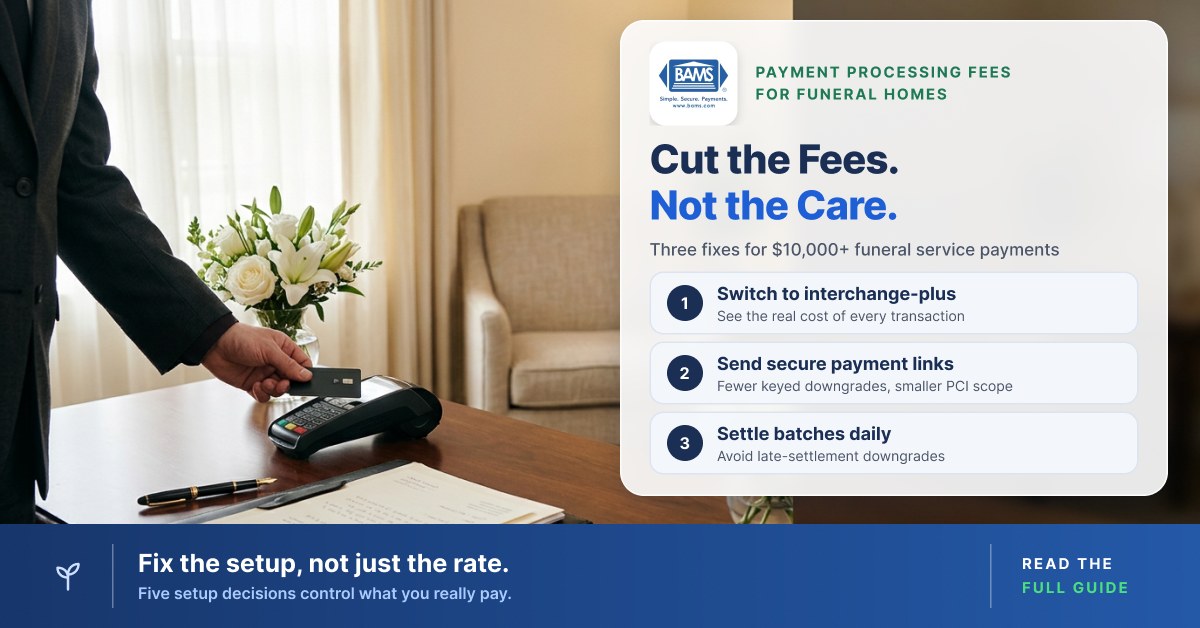
How to Cut Payment Processing Fees at Funeral Homes
Last Updated on November 10, 2026 by Dimitri Akhrin
Guide Orientation: What This Covers and Who It’s For
This guide walks funeral home operators through the specific merchant account setup decisions and payment processor options that determine PCI compliance costs and payment processing fees on high-ticket transactions. If you run one to ten locations and routinely process charges between $10,000 and $15,000, the configuration choices covered here directly affect your bottom line.
By the end, you’ll understand how your processor selection, account classification and transaction-entry method compound into thousands of dollars in hidden annual costs. You’ll also have a clear framework for auditing your current setup and making changes that protect both compliance standing and cash flow.
This guide does not cover the technical details of PCI DSS self-assessment questionnaires or network security architecture. It focuses on the business-level decisions that determine what you actually pay and how securely your payment environment operates.
TL;DR
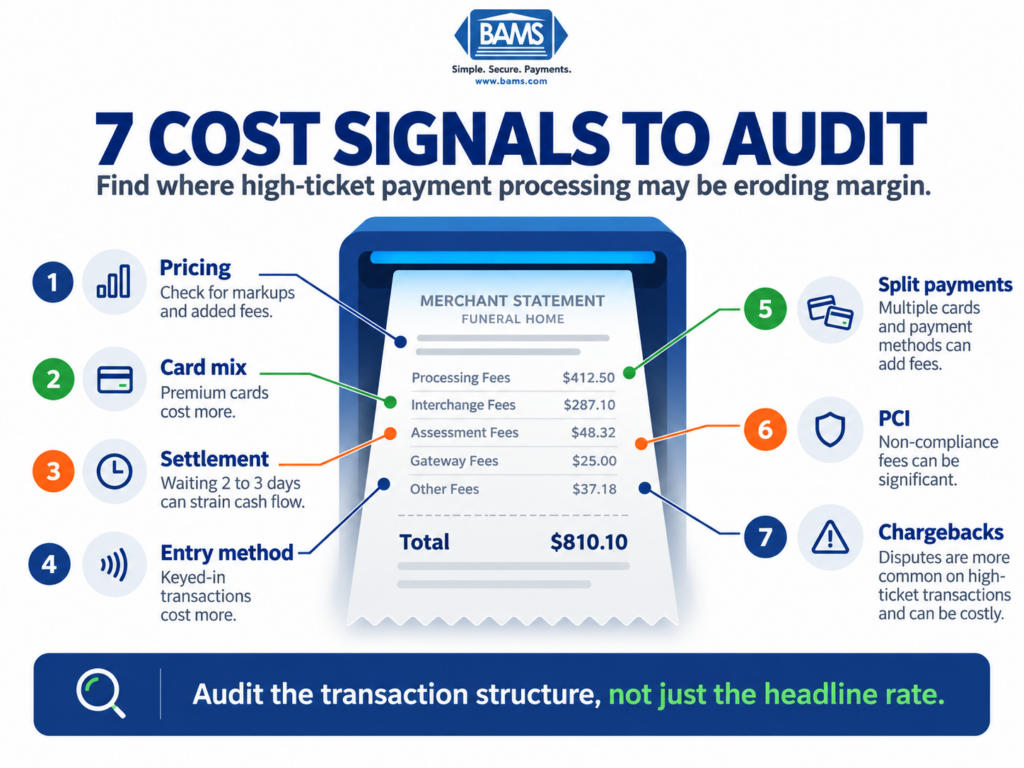
- Your payment processing fees have three layers – Interchange (to the bank), network fees (to Visa/Mastercard) and processor markup (the only negotiable part). Bundled pricing hides all three, making it impossible to identify overcharges on $10,000+ funeral service transactions.
- Card-not-present transactions cost more – Phone payments with manually keyed card numbers trigger interchange downgrades. Sending secure payment links and always collecting billing ZIP codes for AVS helps more phone payments qualify for better rates.
- Interchange-plus pricing is essential for high-ticket businesses – On a $12,000 transaction, the difference between tiered pricing and interchange-plus can exceed $100. Across 200 annual services, that’s $20,000 or more in recoverable costs.
- PCI compliance fees should cost $70 to $120 per year – If you’re paying more, your account setup needs attention. The same goes for non-compliance penalties when your processor never helped you complete the SAQ.
- Start by calculating your effective rate – Divide last month’s total fees by total volume. If the result sits well above your interchange costs plus your agreed markup, hidden fees or downgrades are inflating your costs. Each of the five steps in this guide addresses a specific cause.
Why PCI Compliance and Fee Structure Matter for Funeral Homes
Funeral service is one of the few industries where a single credit card transaction can exceed $10,000 as a matter of routine. U.S. merchants collectively paid an estimated $236 billion in interchange, network and processor fees in 2024. The businesses hit hardest were those processing high-ticket, low-volume transactions without optimized account configurations.
The problem compounds because funeral homes often take payments through multiple channels. Families pay at the arrangement office, by phone during a difficult week or through an online preneed portal. Each channel carries different fee structures, different PCI compliance requirements and different risk classifications. A phone payment keyed manually into a terminal is not priced the same as a chip-read transaction at a counter, even though both involve the same card and the same dollar amount.
Most processors never flag this. They quote a single percentage rate during onboarding and let the hidden cost layers (interchange downgrades, non-qualified surcharges, PCI non-compliance fees) accumulate silently. On a $12,000 funeral service package, the difference between an optimized and unoptimized setup can exceed $100 per transaction. The example later in this guide shows a gap of about $112. Multiply that across 150 to 300 annual services and you’re looking at roughly $17,000 to $34,000 in avoidable annual cost.
Getting this right is not about chasing the lowest advertised rate. It’s about understanding how your system is configured and making structural decisions that protect you at every layer.
Core Concepts: The Fee Layers Most Funeral Homes Never See
The Three-Layer Fee Stack
Every credit card transaction you process carries three distinct cost layers and understanding them is the foundation of every decision in this guide:
- Interchange fees go to the card-issuing bank. These are set by Visa, Mastercard and other networks. Rates vary by card type, merchant category and how the transaction was entered, as Visa’s published U.S. interchange reimbursement fees show.
- Network fees (also called assessment fees) go to the card network itself. In 2024, U.S. network fees totaled approximately $21 billion.
- Processor markup is what your payment processor charges on top. This is the only layer that’s negotiable and it’s where the widest variation exists. Markups vary widely by provider and fixed per-transaction fees sit on top.
When a processor quotes you a single “all-in” rate of 2.9%, they’re bundling all three layers together. That bundling obscures where your money actually goes and makes it nearly impossible to identify which costs are inflated.
Interchange Downgrades: The Silent Fee Multiplier
Interchange rates are not static. They shift based on how a transaction is processed. When a transaction doesn’t meet the card network’s criteria for the lowest rate category, it “downgrades” to a higher tier. Common triggers include manually keyed card numbers (phone orders), missing address verification data and settling batches more than 24 hours after authorization.
For funeral homes, where phone arrangements and delayed settlements are common, downgrades can push interchange costs toward the top of the range on many transactions.
PCI Compliance vs. PCI Compliance Fees
PCI compliance is a set of security standards that protect cardholder data and PCI compliance fees are what your processor charges you to maintain that compliance status. These are separate things. Many processors charge $20 to $30 per month for PCI compliance, plus an annual fee of $99 or more. Some add non-compliance penalties if you haven’t completed your annual self-assessment questionnaire. A legitimate PCI compliance program should cost $70 to $120 per year and it should include the tools and support you need to stay compliant.
The Framework: Five System-Level Decisions That Control Your Costs
Reducing payment processing fees at a funeral home is not about renegotiating a rate. It’s about making five interconnected decisions correctly at the system level. Each decision affects the others and getting one wrong can undermine the savings from the rest.
The five decisions form a sequence:
- Classify your transaction profile accurately
- Select a pricing model that exposes real costs
- Configure your payment entry methods to minimize downgrades
- Align your PCI compliance setup with your actual risk surface
- Audit your statements for compounding hidden fees
Each step builds on the previous one. Skipping ahead to statement auditing without understanding your pricing model, for example, means you won’t know which charges are legitimate and which are inflated. The sections below break each step into specific actions, anti-patterns and verification methods.
Step-by-Step Breakdown: Configuring Your Payment System for Compliance and Cost Control
Step 1: Classify Your Transaction Profile Accurately
Objective: Ensure your merchant account reflects how you actually accept payments, not how a generic application form categorized you.
Your merchant category code (MCC) determines the baseline interchange rates applied to every transaction. Funeral homes should be classified under MCC 7261 (Funeral Services and Crematories). If your processor set you up under a generic retail or professional services code, you may be paying interchange rates designed for an entirely different risk profile.
Beyond MCC, you need to document your transaction mix. What percentage of your payments are card-present (chip or tap at a terminal)? What percentage are card-not-present (phone orders, online payments, manually keyed entries)? Card-not-present fees exceeded card-present fees in 2024, so a funeral home that processes 40% of revenue over the phone is operating in a fundamentally different cost environment than one that takes most payments at a counter terminal.
Anti-patterns: Accepting whatever MCC your processor assigned without verification. Treating all transactions as equivalent when calculating expected fees. Ignoring the phone-payment percentage of your mix.
Success indicators: You can state your MCC, your card-present vs. card-not-present ratio and your average ticket size. Your processor has confirmed these match your account configuration.
Step 2: Select a Pricing Model That Exposes Real Costs
Objective: Move from a bundled pricing model to one that separates interchange, network fees and processor markup so you can identify exactly where your money goes.
Three pricing models dominate the industry:
- Tiered pricing groups transactions into “qualified,” “mid-qualified,” and “non-qualified” buckets. The processor defines these tiers and most high-ticket or keyed transactions land in the most expensive tier. This is the most common model and the least transparent.
- Flat-rate pricing charges a single percentage on every transaction regardless of card type or entry method. Simple, but expensive on high-ticket transactions because you pay the same rate on a $12,000 funeral package as on a $50 flower order.
- Interchange-plus pricing passes through the actual interchange cost and adds a fixed markup. This is the only model that lets you see the real cost of each transaction and verify that your processor’s margin is reasonable.
For funeral homes processing transactions above $10,000, interchange-plus is almost always the most cost-effective structure. Take a $12,000 transaction with a 1.8% interchange rate. A tiered model might charge 2.9% “non-qualified,” while interchange-plus costs 1.8% + 0.25% markup. The difference is $102 per transaction. Over 200 annual services, that’s $20,400.
Anti-patterns: Comparing processors solely on their quoted “qualified” rate. Choosing flat-rate pricing for convenience without calculating the cost on your actual average ticket. Staying on tiered pricing because switching feels complicated.
Success indicators: Your monthly statement separates interchange costs from processor markup. You can calculate your effective processor margin on any given transaction.
Step 3: Configure Payment Entry Methods to Minimize Downgrades
Objective: Reduce the number of transactions that downgrade to higher interchange tiers by adjusting how you capture payment data.
Interchange downgrades are one of the largest sources of hidden costs for funeral homes. Every time a transaction fails to meet the card network’s “best rate” criteria, it shifts to a more expensive tier. The most common triggers in funeral service operations are:
- Manually keyed card numbers without address verification (AVS). This is standard practice for phone arrangements, but it pushes every transaction to card-not-present rates.
- Delayed batch settlement. If you don’t close your batch within 24 hours of authorization, transactions downgrade automatically.
- Missing Level II data. For commercial cards (which families sometimes use for estate payments), failing to include tax amount and customer code triggers a downgrade.
The fix for phone payments is to always collect and enter the billing ZIP code and run AVS. This alone can prevent many card-not-present downgrades. For batch settlement, configure your terminal or gateway to auto-settle daily. For online payment gateway setup, ensure your batch cutoff time aligns with your business hours so transactions aren’t sitting open overnight.
Where possible, shift phone payments to a secure payment link sent via email or text. The family enters their own card details, so the transaction carries complete verification data and is more likely to qualify for the best available card-not-present rate. It also strengthens your PCI compliance posture by keeping card numbers out of your staff’s hands.
Anti-patterns: Keying card numbers over the phone without AVS. Settling batches manually “when we get around to it.” Ignoring Level II data fields on your terminal.
Success indicators: Your monthly statement shows fewer non-qualified transactions. Your batch settlement report confirms daily closures. Phone payments are migrating to secure link-based collection.
Step 4: Align Your PCI Compliance Setup with Your Actual Risk Surface
Objective: Achieve and maintain PCI compliance through a setup that matches your real payment environment, not a one-size-fits-all checklist.
PCI compliance requirements vary based on how you handle cardholder data. A funeral home that uses only point-to-point encrypted (P2PE) terminals and never stores card numbers has a simpler compliance path. Eligible merchants can use SAQ P2PE for a PCI-listed P2PE solution, or SAQ B or B-IP for standalone terminals. A business that keeps card numbers in a filing cabinet or unencrypted software faces a much longer path.
The first action is to map every place cardholder data enters, moves through, or is stored in your business. This includes terminals, phone systems (if staff write down card numbers), online portals and any paper forms. Every touchpoint expands your compliance scope and your risk.
The goal is to shrink your compliance scope by removing cardholder data from your environment wherever possible.
Use tokenization (where the processor replaces card numbers with non-sensitive tokens) and P2PE terminals that encrypt data at the point of entry. If your staff currently writes down card numbers for phone orders, replacing that process with a secure payment link eliminates an entire category of PCI risk.
A provider like BAMS can help funeral homes build PCI compliance support into their merchant account setup from the start. That includes confirming which encryption and tokenization options fit your terminals and gateway. It lowers both your compliance burden and your risk of a reputation-damaging data breach. Their dedicated account management model means you work with someone who understands your specific payment flow rather than navigating a generic support queue.
Anti-patterns: Paying PCI compliance fees without actually completing your annual self-assessment questionnaire. Storing card numbers on paper, in spreadsheets, or in unencrypted software. Assuming your terminal vendor handles all PCI requirements on your behalf.
Success indicators: You’ve completed the correct SAQ for your payment environment. You can identify every location where cardholder data exists in your business. Your PCI compliance fee is between $70 and $120 per year, not $240 or more.
Step 5: Audit Your Statements for Compounding Hidden Fees
Objective: Identify and eliminate fees that don’t correspond to actual services and verify that your effective rate matches what your processor promised.
With the previous four steps in place, you now have the knowledge to read your processing statement critically. Start by calculating your effective rate: divide total fees charged by total processing volume for the month. If your processor quoted interchange-plus 0.25%, but your effective rate is 3.1%, the gap represents hidden costs that need investigation.
Common hidden payment processing fees on funeral home statements include:
- PCI non-compliance fees ($19.95 to $39.95/month) charged to merchants who haven’t completed their SAQ, sometimes even when the processor never provided the SAQ tools
- Batch fees ($0.10 to $0.30 per batch) that add up when you settle daily as recommended
- Statement fees ($5 to $15/month) for mailing a paper statement
- Regulatory compliance fees or “network access fees” ($25 to $50/month) that have no clear corresponding service
- Annual fees ($79 to $199) buried in a single month’s statement
On a $12,000 transaction, an average U.S. credit card swipe fee of 2.24% alone represents $268.80, before your processor’s markup. If your effective rate on that transaction is 3.2%, you’re paying $384 and $115.20 of that is processor margin and ancillary fees. Across 200 annual transactions at that average ticket, the difference between 2.5% effective and 3.2% effective is $16,800 per year.
Request an interchange qualification report from your processor.
This report shows exactly which interchange tier each transaction qualified for and reveals whether downgrades are driving your costs up. If your processor can’t or won’t provide this report, that itself is a diagnostic signal about their transparency.
Anti-patterns: Looking only at the percentage rate and ignoring fixed monthly fees. Accepting “regulatory” or “compliance” fees without asking what specific regulation or service they correspond to. Reviewing statements only once a year instead of monthly.
Success indicators: Your calculated effective rate matches your expected rate within 0.1% to 0.2%. You can account for every line item on your statement. You receive and review an interchange qualification report monthly.
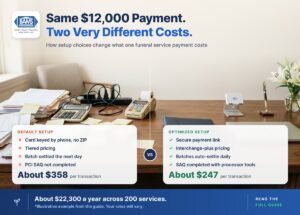
An illustrative $12,000 payment costs about $358 with a default setup and about $247 with an optimized one. That’s roughly $22,300 a year across 200 services. Your rates will vary.
Practical Examples: How Setup Choices Compound on a $12,000 Transaction
Scenario A: Default Setup (Unoptimized)
A funeral home processes a $12,000 service payment over the phone. The staff member keys the card number manually without collecting the billing ZIP code. Their terminal is on tiered pricing. The batch isn’t settled until the next afternoon, 26 hours after authorization.
- Transaction downgrades to the non-qualified tier (illustrative): 2.95% + $0.30 = $354.30
- Monthly PCI non-compliance fee (SAQ not completed): $29.95
- Statement fee (monthly): $12.00
- “Regulatory product fee” (monthly): $24.95
Effective cost on this single transaction, including the prorated share of monthly fees: approximately $358. At 200 services a year (about 17 a month), the $66.90 in monthly fees adds roughly $4 to each transaction. Annualized across 200 similar transactions with monthly overhead, total processing costs come to about $71,700.
Scenario B: Optimized Setup
The same funeral home switches to interchange-plus pricing and sends a secure payment link instead of keying the card. It also settles batches automatically each evening and completes its PCI SAQ with processor-provided tools.
- Transaction qualifies at a standard eCommerce interchange rate (illustrative): 1.80% + 0.25% markup + $0.10 = $246.10
- Annual PCI compliance fee (prorated monthly): $8.33
- No non-compliance fee, no statement fee (electronic statements), no unexplained regulatory fee
Effective cost on this transaction: approximately $247. Annualized across 200 transactions, total processing costs drop to about $49,300. The annual savings come to roughly $22,300, with no change in the services offered to families.
The Compounding Effect
The $22,300 difference is not the result of negotiating a lower rate. It’s the result of five structural decisions: correct MCC classification, interchange-plus pricing, proper transaction entry with AVS, daily batch settlement and active PCI compliance. Each decision contributes a portion of the savings and skipping any one of them leaves money on the table.
Common Mistakes That Inflate Payment Processing Fees
The most common mistake funeral home operators make is treating processor selection as a one-time decision. Your payment environment changes as you add online preneed portals, accept new card types, or shift your phone-to-in-person payment ratio. A setup that was optimal three years ago may be costing you thousands in payment processing fees today.
Other frequent pitfalls include:
- Comparing processors on advertised rate alone, without requesting a side-by-side analysis on your actual transaction data
- Assuming customer service quality doesn’t matter in payment processing, then discovering your processor has no one available when a $15,000 authorization is declined during a family arrangement
- Paying PCI compliance fees for years without ever completing the compliance process, effectively paying a penalty for a problem the processor never helped you solve
- Ignoring card-not-present costs because “we’ve always taken payments over the phone”
These are not signs of negligence. They’re the natural result of an industry that profits from complexity. Recognizing them is the first step toward fixing them.
What to Do Next
Start with one action: calculate your effective processing rate from last month’s statement. Divide total fees by total volume. If the number sits well above your interchange costs plus your agreed markup, or if you don’t know what pricing model you’re on, that’s your signal to dig deeper.
Request an interchange qualification report. If your processor can’t provide one, begin exploring payment processor options that offer interchange-plus pricing with transparent reporting. BAMS, for instance, provides dedicated account managers who can walk through your statement line by line, a service that matters when your business handles sensitive, high-value transactions.
You don’t need to overhaul your entire payment system in a week. Start with the effective rate calculation, then move through the five steps in order. Each one builds on the last and even implementing two or three of them can recover thousands in annual payment processing fees. Revisit this guide quarterly as your payment mix evolves and treat it as a reference rather than a one-time checklist.
Frequently Asked Questions
What is a payment stack and why does it matter for funeral homes?
A payment stack is the combination of hardware (terminals, POS systems), software (payment gateways, virtual terminals) and service providers (processors, banks) that handle your transactions. For funeral homes, the stack matters because each component affects your interchange qualification, PCI compliance scope and total processing cost. A misaligned stack, such as using a retail-configured terminal for phone payments, creates fee leakage on every transaction.
How can funeral homes ensure PCI compliance without dedicated IT staff?
Choose a processor that provides P2PE (point-to-point encryption) terminals and tokenization. These technologies remove cardholder data from your environment, which can qualify you for a much shorter PCI self-assessment questionnaire. Replace any process where staff write down or verbally collect card numbers with secure payment links sent via email or text. Your processor should provide the SAQ tools and walk you through completion annually.
Why are phone payments more expensive than in-person card transactions?
Phone payments require manually keying the card number, which classifies them as card-not-present transactions. Card networks assign higher interchange rates to these transactions because the fraud risk is greater when the physical card isn’t verified by a chip or tap reader. Collecting the billing ZIP code for address verification (AVS) can reduce, but not eliminate, this cost difference.
What should a funeral home’s PCI compliance fee actually cost?
A reasonable annual PCI compliance fee falls between $70 and $120 per year. This should include access to the self-assessment questionnaire, vulnerability scanning tools if needed and support for completing the process. If you’re paying $20 to $40 per month (or $240 to $480 per year), you’re likely overpaying, especially if your processor hasn’t helped you actually achieve compliance.
How do I know if my merchant category code (MCC) is correct?
Ask your processor to confirm your MCC in writing. Funeral homes should be classified under MCC 7261 (Funeral Services and Crematories). If your code is different, request a correction. An incorrect MCC can result in higher interchange rates and may also affect your eligibility for industry-specific processing programs.
Is interchange-plus pricing always better than flat-rate pricing for high-ticket transactions?
For funeral homes processing transactions above $5,000, interchange-plus pricing is almost always less expensive. Flat-rate pricing charges the same percentage regardless of card type or entry method, which means you overpay on debit cards, standard credit cards and card-present transactions. The only scenario where flat-rate might be competitive is extremely low volume (fewer than 20 transactions per month) with very small average tickets.
Sources
- CMSPI: State of the Industry Report 2025, U.S. card acceptance costs
- Visa: Visa USA Interchange Reimbursement Fees
- PCI Security Standards Council: PCI DSS v4.0.1 Self-Assessment Questionnaire Instructions and Guidelines
- Statista: Average merchant swipe fees for Visa, Mastercard, Discover and American Express credit cards in the U.S.