
How to Spot Interchange Overcharges on Your Statement
Last Updated on October 27, 2026 by Dimitri Akhrin
A step-by-step guide to reading processing statements, calculating your effective rate, and holding processors accountable
Learn how to identify interchange overcharges hiding in your credit card processing statements. This guide walks eCommerce managers through fee layers, effective rate calculations, and a framework for line-by-line statement reviews that drive real payment processing fees reduction.
TL;DR
- Calculate your effective rate first — Divide total processing fees by total volume. If the result exceeds your quoted rate by more than 0.3%, you are likely overpaying due to hidden fees or interchange downgrades.
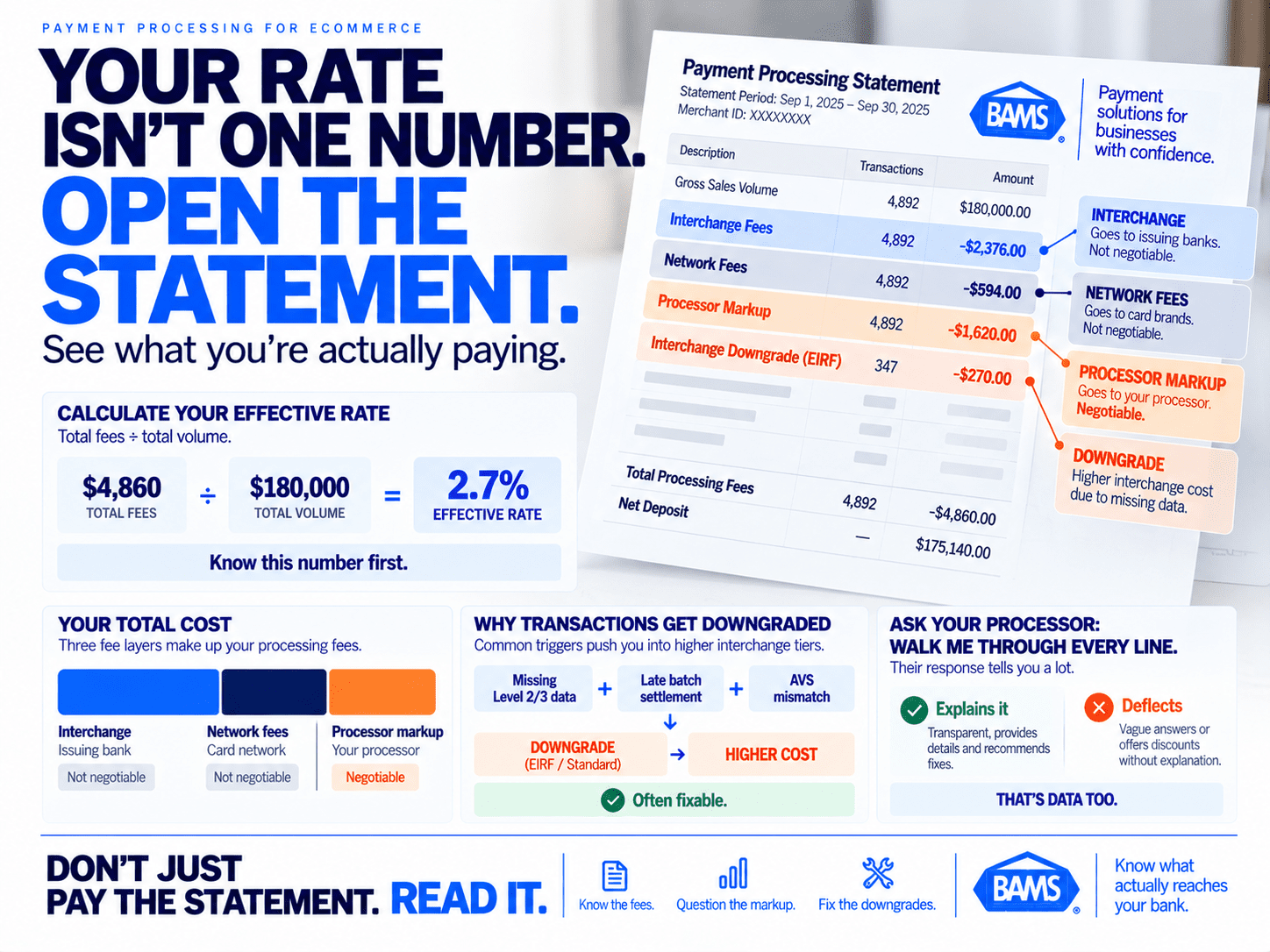
- Understand the three fee layers — Interchange (goes to issuing banks), network fees (goes to card brands), and processor markup (goes to your processor). Only the markup is negotiable, and it is where most overcharges hide.
- Interchange downgrades are fixable — Missing transaction data, delayed batch settlement, and AVS mismatches push your transactions into more expensive interchange tiers. Identifying and correcting these issues can recover meaningful savings.
- Your processor’s response to a statement walkthrough tells you everything — A partner who welcomes line-by-line reviews is invested in your success. A processor who deflects or offers discounts without explanation is profiting from your confusion.
- Review quarterly, not annually — Interchange rates change twice a year, processor markups can shift with minimal notice, and your transaction mix evolves constantly. A 60 to 90 minute quarterly review prevents cost creep from compounding into significant margin loss.
Guide Orientation: What This Covers and Who It’s For
This guide helps ecommerce managers identify interchange overcharges, read processing statements with confidence, and choose a payment partner who will answer for the numbers on every bill. If you manage payments for an online business with 10 to 50 employees, this is written for you.
By the end, you will be able to calculate your effective processing rate, isolate the three fee layers that make up your total cost, spot the most common overcharge patterns, and evaluate whether your current processor meets a clear accountability standard. You will also have a framework for conducting (or requesting) a line-by-line statement review.
This guide does not cover POS hardware selection, in-store terminal setup, or high-risk merchant underwriting. It focuses entirely on the cost transparency and partner accountability questions that determine whether you are overpaying and whether anyone is helping you stop.

YBAMS featured image showing an ecommerce payment processing statement broken into interchange, network fees and processor markup to identify potential overcharges.
Why Credit Card Processing Fees Demand Your Attention Now
Processing costs are rising faster than most ecommerce managers realize. U.S. merchants paid approximately $187.2 billion in card processing fees in 2024, equal to about $1.57 for every $100 in card payments accepted. Credit card fees alone reached $148.52 billion, up 9.3% from the prior year. These are not rounding errors. They are a structural drag on margin that compounds every month.
For ecommerce operators, the picture is even sharper. Online transactions routinely attract higher interchange rates than card-present sales, with industry estimates placing average ecommerce processing fees between 2.5% and 3.0%. That spread means a business processing $2 million annually online could be paying $50,000 to $60,000 in fees before accounting for chargebacks, gateway costs, or PCI compliance charges.
The cost of inaction is not abstract. Every month you operate without understanding your statement, you risk paying inflated rates on transactions that should qualify for lower interchange tiers. You risk absorbing processor markups that were never disclosed clearly. And you risk losing the leverage that comes from knowing exactly what you owe versus what you are being charged. Statement literacy is not a nice-to-have skill. It is the difference between managing your payments and letting your payments manage you.
Core Concepts: The Three Fee Layers Every Ecommerce Manager Must Understand
Interchange, Network Fees, and Processor Markup
Every card transaction generates three distinct cost layers. Understanding them is the foundation of identifying interchange overcharges and negotiating credit card processing fees that reflect your actual risk profile.
- Interchange fees go to the card-issuing bank. They are set by the card networks (Visa, Mastercard, etc.) and vary by card type, transaction method, and merchant category. Mastercard explains that interchange is one component of the Merchant Discount Rate and is generally paid by acquirers to card issuers. These rates are non-negotiable at the merchant level, but which rate your transaction qualifies for is often within your control.
- Network fees (also called assessments or scheme fees) go to the card networks themselves. They totaled approximately $21 billion in 2024. These are small per-transaction charges, but they add up and are rarely itemized on blended statements.
- Processor markup is the fee your payment processor charges on top of interchange and network costs. This is the only layer that is directly negotiable, and it is where most overcharges hide. Processor fees reached $32.4 billion in 2024.
Blended vs. Interchange-Plus Pricing
A blended (or flat-rate) pricing model rolls all three layers into a single percentage. It is simple, but it obscures whether you are paying a fair markup. Interchange-plus pricing separates the interchange cost from the processor’s margin, giving you visibility into both. If your current statement shows one flat rate with no breakdown, you cannot verify whether your fees are competitive. That opacity is not accidental.
The Effective Rate
Your effective rate is your total processing fees divided by your total processing volume for a given period. It is the single most important number for benchmarking your costs. A quoted rate of 2.2% means nothing if your effective rate is 3.1% after surcharges, batch fees, and downgrades are factored in.
The Accountability Framework: Four Phases of Payment Processing Fees Reduction
Reducing processing costs is not a one-time negotiation. It is a repeating cycle with four phases. Each phase builds on the previous one, and skipping any of them leaves money on the table.
- Phase 1: Statement Diagnosis — Learn to read your statement and calculate your effective rate.
- Phase 2: Fee Isolation — Separate interchange, network, and processor costs to identify where overcharges originate.
- Phase 3: Qualification Audit — Determine whether your transactions are landing in the correct interchange tiers or being downgraded to more expensive categories.
- Phase 4: Partner Evaluation — Assess whether your processor is helping you optimize costs or benefiting from your confusion.
These phases are not sequential in the sense that you complete them once and move on. They form a quarterly review cycle. Your transaction mix changes, card network rates adjust, and your processor’s behavior may shift. Ongoing vigilance is the only reliable cost control.
A processing statement becomes much easier to evaluate when you separate the fee layers, audit interchange qualification and compare your effective rate over time.
Step-by-Step Breakdown: From Confused to In Control
Step 1: Calculate Your Effective Rate
Objective: Establish a single, reliable benchmark for your total processing cost.
Pull your most recent processing statement. Find two numbers: total fees charged and total volume processed. Divide fees by volume. The result is your effective rate. For example, if you processed $180,000 last month and paid $4,860 in total fees, your effective rate is 2.7%.
Compare this to the rate your processor quoted when you signed. If the gap is more than 0.3%, you have a problem worth investigating. An effective rate that consistently exceeds your quoted rate is one of the clearest signals that hidden fees or interchange downgrades are inflating your costs.
Anti-patterns: Do not rely on the summary page alone. Many processors present a simplified overview that excludes batch fees, PCI non-compliance charges, or monthly minimums. Use the detailed line items to build your total. Do not average across multiple months without checking each month individually, because seasonal volume shifts can mask spikes.
Success indicator: You can state your effective rate for each of the last three months and explain any variance between them.
Step 2: Isolate the Three Fee Layers on Your Statement
Objective: Determine exactly how much you are paying in interchange, network fees, and processor markup.
If you are on interchange-plus pricing, your statement should separate interchange charges from the processor’s margin. Look for line items labeled “interchange,” “assessment,” “network,” “dues,” or similar terms. Group them into the three buckets described in the core concepts section. Then calculate what percentage of your total fees each bucket represents.
If you are on blended or tiered pricing, this step is harder because the layers are merged. You will need to request a cost breakdown from your processor. If they refuse or claim they cannot provide one, that refusal is itself a data point about their commitment to transparency. Mastercard explains that interchange is only one of multiple cost components included in the Merchant Discount Rate established by acquirers. If your processor’s margin appears unusually high relative to your overall processing costs, it is worth requesting a detailed explanation.
Anti-patterns: Do not assume every line item on your statement is interchange. Processors sometimes label their own fees in ways that look like pass-through costs. “Transaction fees,” “authorization fees,” and “gateway fees” are processor charges, not interchange. Misclassifying them inflates your perceived interchange cost and hides the markup.
Success indicator: You can produce a simple three-row table showing interchange, network, and processor costs as both dollar amounts and percentages of your total fees.
Step 3: Audit Your Interchange Qualification
Objective: Identify transactions that are being downgraded to more expensive interchange tiers than necessary.
Interchange rates are not uniform. They vary based on card type (rewards, corporate, debit), transaction method (card-present vs. card-not-present), and the data you submit with each transaction. Common interchange ranges run from about 1.10% to 3.15% depending on these factors. When a transaction fails to meet the criteria for its optimal tier, it “downgrades” to a higher rate. This is one of the most common sources of interchange overcharges for eCommerce merchants.
Common downgrade triggers for online transactions include missing or incomplete Level 2/Level 3 data (tax amount, customer code, line-item detail), delayed batch settlement (settling more than 24 hours after authorization), and mismatched AVS (Address Verification Service) responses. Each of these is fixable. Review your statement for transactions categorized as “EIRF” (Electronic Interchange Reimbursement Fee) or “standard” tier. These labels typically indicate downgrades.
Anti-patterns: Do not assume downgrades are inevitable for eCommerce. Many online merchants accept them as the cost of doing business without realizing that submitting enhanced transaction data can recover significant savings. Also, do not attempt to fix downgrades without understanding which card types are affected. Corporate and purchasing cards have different data requirements than consumer cards.
Success indicator: You can identify the percentage of your transactions that downgraded last month and name the specific cause for at least the top three downgrade categories.
Step 4: Request a Collaborative Statement Walkthrough
Objective: Test your processor’s willingness to sit with you, explain every line item, and recommend cost reductions that may lower their own revenue.
This step separates accountable partners from transactional vendors. Contact your processor and ask for a scheduled, line-by-line review of your most recent statement. Not a sales call. Not a retention offer. A detailed walkthrough where someone explains what each charge is, why it is at that level, and what (if anything) can be done to reduce it.
Pay attention to how they respond. A partner invested in your success will welcome this conversation because it builds trust and retention. A processor that profits from your confusion will stall, redirect you to a generic FAQ, or offer a temporary rate reduction without explaining the underlying charges. The distinction matters because choosing a payment processor is ultimately a decision about who you want in the room when something goes wrong.
This is where the difference between remote support and dedicated account management becomes tangible. A 1-800 number connects you to someone reading a script. A dedicated account manager knows your transaction patterns, your seasonal volume shifts, and your chargeback history. They can spot anomalies you would miss and recommend changes proactively. BAMS, for example, provides dedicated account managers who conduct in-person statement reviews, treating cost optimization as an ongoing collaboration rather than a one-time audit.
Anti-patterns: Do not accept a rate reduction offer without a full explanation of why your rate was high in the first place. A temporary discount that expires in six months is not optimization. It is a retention tactic. Also, do not let the walkthrough become a product pitch. The goal is understanding your current costs, not being upsold on new services.
Success indicator: You leave the walkthrough with a written summary of at least three specific changes that will reduce your effective rate, along with projected savings.
Step 5: Evaluate Contract Terms That Affect Long-Term Accountability
Objective: Ensure your agreement does not penalize you for leaving or lock you into terms that prevent cost optimization.
Review your processing agreement for three critical elements: early termination fees (ETFs), automatic renewal clauses, and rate adjustment provisions. The OCC notes that merchant-account contracts may require termination fees and may also specify a fixed contract term. An ETF of $500 or more creates a financial barrier to switching, even if your processor’s service deteriorates. Automatic renewals that extend your contract for 12 or more months without explicit opt-in remove your leverage. And agreements that allow the processor to adjust rates “at any time with 30 days notice” give them unilateral pricing power.
A processor confident in their value does not need to trap you in a contract. Look for month-to-month terms or agreements with ETFs that are capped and clearly disclosed. Ask whether rate increases require your written consent. These are not aggressive demands. They are baseline expectations for a relationship built on accountability.
Anti-patterns: Do not sign a processing agreement without reading the cancellation section. Do not assume that because a sales representative verbally promised “no cancellation fees,” the written contract reflects that promise. Verbal assurances that contradict written terms are unenforceable. Also, do not ignore the equipment lease. Some processors bundle hardware leases with processing agreements, creating separate cancellation penalties.
Success indicator: You can state your contract’s termination terms, renewal mechanism, and rate adjustment policy from memory.
Step 6: Build a Quarterly Review Cadence
Objective: Establish a repeating process that catches cost creep before it compounds.
Processing costs drift. Card networks adjust interchange rates twice a year (typically April and October). Processors may add or increase fees with minimal notice. Your own transaction mix evolves as product lines change, average order values shift, and customer payment preferences move toward different card types. A quarterly review catches these shifts before they become entrenched overcharges.
Each quarterly review should take 60 to 90 minutes and cover four questions: Has my effective rate changed? Have any new fees appeared on my statement? Are my transactions still qualifying at optimal interchange tiers? Has my processor proactively flagged any changes or opportunities? Document the answers. Over time, this log becomes your strongest negotiating asset because it demonstrates pattern awareness that most merchants lack.
If your processor offers proactive quarterly reviews as part of their service, that is a strong signal of alignment. If you have to chase them for basic information every quarter, that friction is telling you something about the relationship. BAMS structures its account management around regular cost reviews, which means the burden of vigilance does not fall entirely on the merchant.
Anti-patterns: Do not delegate quarterly reviews entirely to your processor without independent verification. Trust but verify. Also, do not skip reviews during high-volume seasons when you are busy. Those are precisely the months where volume-driven overcharges have the greatest dollar impact.
Success indicator: You have completed at least two consecutive quarterly reviews and can document the cost changes (positive or negative) identified in each.
Practical Examples: What Accountability Looks Like in Practice
Scenario A: The Silent Rate Increase
An ecommerce manager processing $150,000 per month notices her effective rate has climbed from 2.4% to 2.8% over six months. She did not receive any notification of a rate change. When she calls her processor’s support line, she is told the increase reflects “network adjustments.” No further detail is offered. She requests a statement walkthrough and is told that service is not available for her account tier.
The 0.4% increase costs her $600 per month, or $7,200 per year. She has no mechanism to verify whether the increase reflects actual interchange changes or an undisclosed markup adjustment. This is the adversarial cycle: the merchant suspects overcharges, the processor provides vague explanations, and the relationship erodes without resolution.
Scenario B: The Collaborative Review
A similar ecommerce manager at a comparable volume notices the same rate drift. She contacts her dedicated account manager and schedules a walkthrough. During the review, they identify two issues: a batch of corporate card transactions downgrading due to missing Level 2 data, and a new PCI non-compliance fee that was triggered by an expired SAQ. The account manager helps her update her gateway settings to include tax and customer code fields, and walks her through the PCI revalidation process.
Within one billing cycle, her effective rate drops back to 2.45%. The total recovery: approximately $525 per month. The difference between these two scenarios is not the merchant’s sophistication. It is the partner’s willingness to be held accountable.
Scenario C: The Contract Trap
An ecommerce operator decides to switch processors after identifying persistent overcharges. He discovers his agreement includes a $495 early termination fee, a 36-month auto-renewal that triggered three months ago, and a separate equipment lease with 18 months remaining. His total cost to exit: over $2,000. The overcharges he identified total $400 per month, meaning he would need five months just to break even on the switching cost. He stays, frustrated and trapped. This is why evaluating contract terms before signing is as important as evaluating rates.
Common Mistakes and Pitfalls
The most predictable failure is treating processing fees as a fixed cost. They are not. They are variable, layered, and influenced by decisions you make (or fail to make) every month. Accepting a blended rate without understanding what is inside it is the second most common mistake. It is the equivalent of paying a restaurant bill without looking at the check.
Other frequent errors include comparing quoted rates across processors without normalizing for fee structure (interchange-plus vs. tiered vs. flat), ignoring surcharge and convenience fee strategies that could offset costs legally, and assuming that the cheapest processor is the best value. A low rate with no support, opaque statements, and punitive contract terms often costs more over 24 months than a slightly higher rate with full transparency and proactive optimization.
Finally, many merchants wait until they are angry to investigate their fees. By then, months or years of overcharges have already cleared. The time to build statement literacy is before you suspect a problem, not after.
What to Do Next
Start with one action: calculate your effective rate for last month. Divide your total processing fees by your total processing volume. Write the number down. If it is below 2.5% and you understand every line item on your statement, you are in reasonable shape. If it is above 2.5%, or if there are charges you cannot explain, you have found your starting point.
From there, request a statement walkthrough from your current processor. Their response will tell you more about the relationship than any sales pitch ever could. If they engage openly, you have a partner worth keeping. If they deflect, delay, or offer a discount without explanation, you have the information you need to start evaluating alternatives.
This is not a checklist to complete once. It is a reference to revisit every quarter as your business, your transaction mix, and the payments landscape evolve. Understanding what merchant services should include is the first step. Holding your provider to that standard is the ongoing work that protects your margin.
Frequently Asked Questions
What is an interchange overcharge, and how do I know if I’m affected?
An interchange overcharge occurs when your transactions are processed at a higher interchange tier than they should qualify for, or when your processor adds undisclosed markups that inflate your costs beyond the actual interchange rate. You can detect this by calculating your effective rate (total fees divided by total volume) and comparing it to your quoted rate. A gap greater than 0.3% typically indicates overcharges worth investigating.
What is the difference between interchange-plus and flat-rate pricing?
Interchange-plus pricing separates the interchange cost (set by card networks) from your processor’s markup, giving you visibility into both components. Flat-rate pricing combines everything into a single percentage. Interchange-plus is generally more transparent and often less expensive for businesses processing over $10,000 per month, because it prevents the processor from profiting on the spread between actual interchange and the blended rate.
Why are my eCommerce processing fees higher than in-store fees?
Card-not-present transactions (online sales) carry higher fraud risk than card-present transactions (in-store with chip or tap). Card networks set higher interchange rates for card-not-present transactions to compensate issuing banks for that risk. eCommerce merchants can partially offset this by submitting enhanced transaction data (Level 2/Level 3), using AVS and CVV verification, and settling batches within 24 hours of authorization.
How often do interchange rates change?
Visa and Mastercard typically update their interchange rate schedules twice per year, usually in April and October. However, your processor may adjust their markup at different intervals depending on your contract terms. This is why quarterly statement reviews are important: they help you distinguish between legitimate network rate changes and processor-initiated markup increases.
What should I look for in a payment processing contract before signing?
Focus on three elements: early termination fees (look for none or a low, clearly disclosed cap), automatic renewal clauses (prefer month-to-month or agreements requiring explicit opt-in for renewal), and rate adjustment provisions (ensure increases require written notice with a reasonable response window). Also check whether equipment leases are bundled separately, as they may carry independent cancellation penalties.
Can I negotiate my credit card processing fees?
You can negotiate your processor’s markup, but not interchange or network fees, which are set by the card networks. The key to effective negotiation is knowing your effective rate, understanding which portion of your fees is markup, and being able to demonstrate that you have done your homework. Processors are far more likely to offer meaningful concessions to merchants who can articulate exactly what they are paying and why it is too high.


