Ongoing Compliance Support: A Small Business Guide
Last Updated on November 10, 2026 by Dimitri Akhrin
TL;DR
- Three layers govern your program – State laws, card-network rules and processor agreements all apply simultaneously. Monitoring only one creates blind spots.
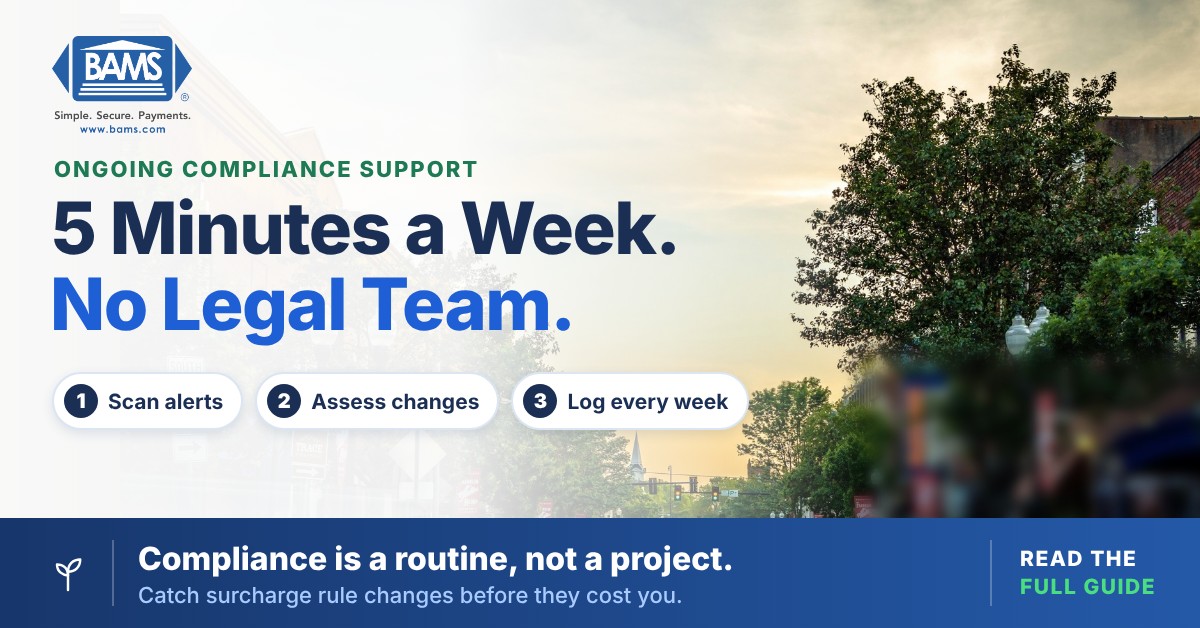
- A five-minute weekly scan helps prevent costly surprises – Subscribe to state legislature alerts, card-network updates and industry news, then triage incoming alerts every week using a simple relevant-or-not filter.
- Assess before you act – Not every proposed bill becomes law. Use three questions (Does it apply to my program type? My state? What is the timeline?) to avoid overreacting or under-reacting.
- Document everything, even “no change” weeks – A compliance log with unbroken weekly entries serves as evidence of good-faith monitoring and creates institutional memory for your business.
- Compliance is a routine, not a project – The businesses that treat regulatory monitoring as a weekly habit (like reconciling books) are the ones that never get caught off guard by a rule change.
Guide Orientation: What This Guide Covers and Who It’s For
If you run a surcharge, dual-pricing or cash-discount program at your small or midsize business, ongoing compliance support is not optional. State surcharging laws, card-network rules and disclosure requirements shift without fanfare and a single missed change can lead to fines, forced refunds or trouble with your merchant account.
This guide is for business owners, managers and finance directors who run fee-recovery payment programs and need a realistic way to track regulation changes without hiring a legal team. By the end, you will have a lightweight weekly monitoring system, a clear understanding of what to watch and where and a set of decision frameworks for responding when rules shift.
We will not cover enterprise-grade regulatory technology stacks, industry-specific compliance (healthcare, banking, maritime), or the initial legal setup of a dual-pricing program. The focus is narrow and practical: catching changes before they cost you.
Why Regulatory Compliance Monitoring Matters for Small Businesses
The regulatory landscape around surcharging and dual pricing is a patchwork. As a Lowenstein Sandler review of surcharge law explains, state rules vary on whether surcharging is permitted, how price differences must be disclosed and whether cash discounts are treated differently from credit-card surcharges. Connecticut, Maine and Massachusetts, for example, prohibit surcharges but allow cash discounts. New York has its own price-display rules. On top of state law, every merchant must stay within the card-network caps.
The cost of ignorance is disproportionate for smaller operations. In the Q4 2024 MetLife and U.S. Chamber of Commerce Small Business Index, 69% of small businesses said they spend more per employee on regulatory compliance than larger competitors. When a rule changes and you discover it through a penalty notice rather than a news alert, the financial and operational damage compounds fast: fines, refund obligations, reputational harm and the time cost of scrambling to fix signage, receipts and POS configurations.
Contrast that with the upside of early awareness. Early awareness pays off at the federal level too. The SBA Office of Advocacy reported an estimated $91.3 million in regulatory cost savings for small entities in FY 2023, largely because agencies changed rules after Advocacy weighed in early. The same principle applies to surcharge rules: if you know a change is coming, you can adapt your program before enforcement begins, negotiate with your processor, or adjust your pricing model with zero disruption to customers.
Proactive monitoring turns ongoing compliance support from a fire drill into a five-minute weekly habit. That is the system this guide builds.
Core Concepts: What You’re Actually Monitoring
Surcharging vs. Dual Pricing vs. Cash Discounting
These three terms describe different legal structures for recovering credit card processing costs. Surcharging adds a fee at checkout when a customer pays with a credit card. Dual pricing displays two prices (cash and card) for every item. Cash discounting frames the lower price as a discount for paying with cash rather than a penalty for using a card. The legal treatment of each varies by state and misclassifying your program can create liability even if the dollar amounts are identical.
The Three Layers of Rules
Small business owners often assume they only need to follow state law. In reality, three layers govern your program simultaneously:
- State statutes and regulations: Some states ban surcharging outright. Others permit it with specific disclosure requirements (signage at the door, line-item detail on receipts, percentage caps).
- Card-network rules: Visa, Mastercard and other networks set their own surcharge caps and notification requirements. Today, Visa caps credit card surcharges at the lower of your merchant discount rate or 3% and Mastercard caps them at the lower of your average effective merchant discount rate or 4%. Neither allows surcharges on debit or prepaid cards and both require 30 days’ advance notice. These rules can change independently of state law.
- Processor agreements: Your payment processor’s terms of service may impose additional restrictions or require advance notice before you implement a surcharge program.
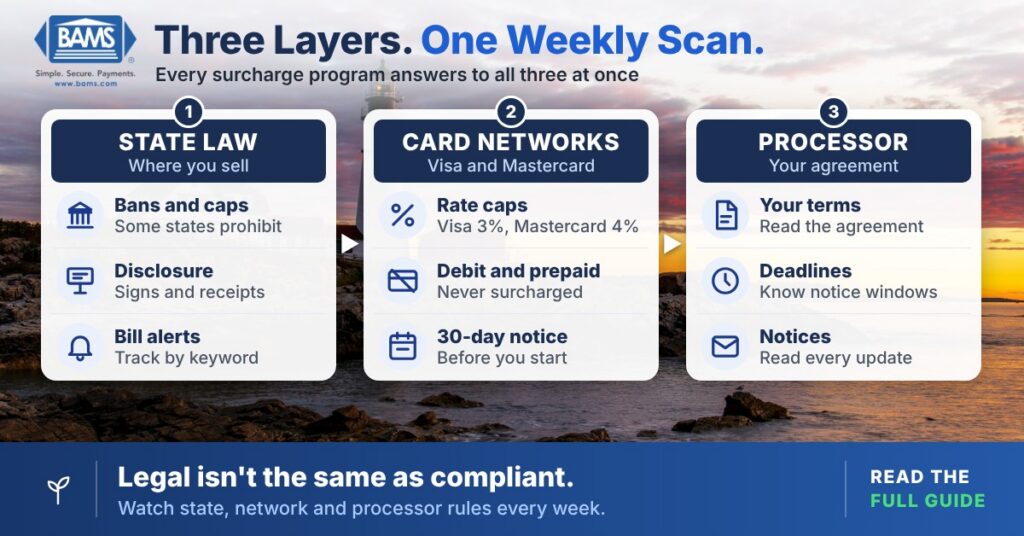
Legal isn’t the same as compliant. Watch state, network and processor rules every week.
A compliant program satisfies all three layers at once. Your monitoring system needs to watch all three.
Common Misconception: “My Processor Handles Compliance”
Many processors provide tools and initial setup guidance, but the responsibility for compliant signage, receipt formatting and adherence to state law rests with the merchant. Relying entirely on your processor is like assuming your accountant files your taxes without your input. You need to verify.
The Five-Part Monitoring Framework
This ongoing compliance support system is designed for a business owner or manager with no legal staff, no compliance software and roughly 15 to 20 minutes per week to dedicate to this task. It follows five stages:
- Stage 1: Source Setup (one-time, 30 minutes)
- Stage 2: Weekly Scan (recurring, 5 minutes)
- Stage 3: Change Assessment (triggered, 10 to 15 minutes)
- Stage 4: Adaptation (triggered, varies)
- Stage 5: Documentation (ongoing, 2 minutes)
Stages 1 and 5 are the foundation. Stages 2 through 4 form the recurring cycle. The entire system runs on free tools and a single spreadsheet.
Step-by-Step Breakdown: Building Your Ongoing Compliance Support System
Step 1: Set Up Your Source List (One-Time, 30 Minutes)
Objective: Lay the foundation of your ongoing compliance support by subscribing to every information source that will alert you when a relevant rule changes, so nothing reaches you as a surprise.
Start by listing every state where you operate or accept payments. For each state, locate the attorney general’s office website and the state legislature’s bill-tracking page. Many state legislatures offer free bill-tracking alerts, some by keyword. Set alerts for terms like “surcharge,” “credit card fee,” “dual pricing,” “cash discount” and “payment disclosure.” This takes five minutes per state.
Next, subscribe to Visa and Mastercard merchant notification channels. Both networks publish merchant rule information on their business sites and your processor typically forwards major changes. However, do not rely on forwarded summaries alone. Bookmark the primary source and check it monthly.
Add two to three industry news sources that cover payment regulation. Trade associations for your industry (restaurant, retail, service) often summarize legislative changes in member newsletters. The SBA Office of Advocacy publishes an annual report on federal rules affecting small businesses, which is a useful yearly cross-check for federal changes.
Finally, set a Google Alert for your state name combined with “surcharge law” and “dual pricing regulation.” These alerts are imperfect but serve as a safety net.
Anti-patterns: Do not subscribe to generic “compliance news” feeds aimed at enterprise or banking audiences. The signal-to-noise ratio will bury relevant updates. Do not assume a single source covers everything.
Success indicators: You have a written list of sources, active email subscriptions for each relevant state and card-network bookmarks saved in a dedicated browser folder.
Step 2: Run a Weekly Five-Minute Scan
Objective: Run the core habit of ongoing compliance support: review incoming alerts and flag anything that could affect your program, without getting pulled into research during the scan itself.
Pick a fixed day and time each week. Tuesday or Wednesday mornings work well because legislative news from the prior week has typically been published by then. Open your dedicated email folder or RSS reader and scan subject lines for your keywords. You are not reading full articles yet. You are triaging.
For each alert, make a binary decision: “Relevant to my program?” If yes, copy the headline and link into your tracking spreadsheet (more on this in Step 5) and tag it for assessment. If no, archive it. In the same Chamber survey, 73% of small businesses reported spending a great deal or fair amount of time on taxes and recordkeeping. This scan is designed to avoid adding to that burden by keeping the weekly habit under five minutes.
If you operate in multiple states, sort alerts by state so you can quickly see geographic clusters of activity. A flurry of bills in one state often signals a broader trend that neighboring states may follow.
Anti-patterns: Do not read every article during the scan. Do not skip weeks because “nothing ever changes.” Regulatory shifts are infrequent but high-impact and the habit of scanning is what keeps you prepared.
Success indicators: Your scan completes in under five minutes. Flagged items are logged with dates and links. You have not missed a week in the last month.
Step 3: Assess Flagged Changes (Triggered, 10 to 15 Minutes)
Objective: Determine whether a flagged change actually affects your program and, if so, what kind of response it requires.
When your weekly scan surfaces a relevant alert, set aside 10 to 15 minutes (not during the scan itself) to read the full source. Ask three questions in order:
- Does this apply to my program type? A bill targeting surcharging may not affect a cash-discount program and vice versa. Read the statutory language, not just the headline.
- Does this apply to my state(s)? National news outlets sometimes report on one state’s proposal as if it were a nationwide change. Confirm the jurisdiction.
- What is the timeline? Is this a proposed bill, a passed law awaiting a governor’s signature, or an already-effective regulation? Proposed bills require monitoring. Signed laws require action planning. Effective regulations require immediate review of your current setup.
If the change is a proposed bill, add it to your tracking spreadsheet with a “monitor” status and check its progress during future weekly scans. If it is a signed or effective change, move to Step 4.
For card-network rule changes, the same three questions apply, but the timeline question shifts to “When does the new rule take effect and does my processor need advance notification?” Network rule changes usually come with an effective date and starting a surcharge requires 30 days’ notice.
Anti-patterns: Do not panic over proposed legislation. Many bills are introduced and never advance. Do not ignore proposed legislation either; tracking it costs almost nothing and prevents surprises. Avoid relying on social media summaries of legal changes, as they frequently misstate scope or effective dates.
Success indicators: Each flagged item has a clear status (“monitor,” “action needed,” or “not applicable”) and a next-review date in your spreadsheet.
Step 4: Adapt Your Program When a Change Is Confirmed
Objective: Update your dual-pricing or surcharge program to comply with the new rule before its effective date, with minimal disruption to operations and customers.
Once you confirm that a change affects your program, build a short action list. Typical adaptation tasks include:
- Signage updates: New disclosure language or placement rules for entry and point-of-sale signage.
- Receipt formatting: Changes to how the surcharge or dual price appears on printed and digital receipts.
- POS configuration: Adjusting surcharge percentages, enabling or disabling surcharging in specific states, or switching from a surcharge model to a cash-discount model.
- Processor notification: Some changes require you to notify your processor or card network within a specific window. Missing this step can result in account flags.
If your payment processor offers compliance guidance as part of its merchant services, contact it as soon as a confirmed change surfaces. At BAMS, merchants work with a dedicated account representative who can help adjust POS settings and confirm what your terminal prints. Legal interpretation of a new statute should still come from counsel.
For changes that require legal interpretation (ambiguous statutory language, conflicting state and network rules), consult a payments attorney. This is not a weekly expense; it is a targeted, occasional investment that prevents far larger costs. A 30-minute consultation to clarify one rule usually costs far less than refunding a season of non-compliant surcharges.
Anti-patterns: Do not delay adaptation until the last day before a rule takes effect. Do not assume that because your program worked last month, it will work next month. Always test receipts and signage before POS changes go live.
Success indicators: All signage, receipts and POS settings reflect the new rule. Your processor has been notified if required. You have a dated record of the change and your response.
Step 5: Document Everything in a Compliance Log
Objective: Maintain a simple, dated record of your ongoing compliance support that proves you monitored regulations and responded to changes, creating audit readiness without bureaucracy.
Your compliance log can be a spreadsheet with five columns: Date, Source, Summary, Status and Action Taken. Every time you complete a weekly scan (even if nothing was flagged), add a row with the date and “No relevant changes identified.” This creates a timestamped record that you were actively monitoring.
When you do take action, record what changed, what you did and when you did it. Save screenshots of updated signage, revised receipt templates and any email confirmations from your processor. Store these in a cloud folder linked from your spreadsheet.
This log serves two purposes. First, if a customer or card network disputes your surcharge practices, you have documented evidence of good-faith compliance. Second, it creates institutional memory. If you hire a manager or sell the business, the log transfers knowledge that would otherwise live only in your head.
The Chamber survey also found that 59% of small businesses spend a great deal or fair amount of time on licensing, permits or recertification. A well-maintained compliance log works the same way for your payment program: when someone asks, the evidence is already organized.
Anti-patterns: Do not keep compliance records in email threads or sticky notes. Do not skip logging “no change” weeks, as the gap in records undermines the log’s value as evidence. Avoid over-engineering the system with complex software unless your operation genuinely requires it.
Success indicators: Your spreadsheet has an unbroken chain of weekly entries. Action items have corresponding documentation. You can explain your compliance posture to any auditor in under two minutes.
Practical Example: How This System Works in a Real Scenario
Scenario: A State Lowers Its Surcharge Cap
Imagine you run a retail store that adds a 3% surcharge to credit card payments, within Visa’s 3% cap and your own processing cost. During your Tuesday morning scan, you see an alert: your state legislature has passed a bill capping surcharges at 2%, effective in 90 days.
Step 2 (Scan): You flag the alert and copy the link into your spreadsheet.
Step 3 (Assess): You read the full bill text. It applies to all retail surcharges, confirms your state and has been signed by the governor. Status: action needed.
Step 4 (Adapt): You calculate the revenue impact of dropping from 3% to 2%. You contact your processor to adjust the POS surcharge setting. Door signage and receipt templates get updated to reflect the new cap. Then you consider whether a cash-discount model would make more financial sense and you schedule a 30-minute call with a payments attorney to confirm how the new law treats it.
Step 5 (Document): You log the change, your response timeline, screenshots of new signage and the processor confirmation email.
Total time invested: approximately 45 minutes spread over two weeks. Cost of missing this change: potential fines, forced refunds on every transaction that exceeded the new cap and possible suspension of your merchant account.
Scenario: Your Receipt Misses a Card-Network Requirement
During a weekly scan, you reread Mastercard’s surcharge rules and notice that receipts must show the surcharge as both a percentage and a dollar amount. Your receipt shows only the dollar amount.
You assess: this applies to every surcharge transaction on a Mastercard credit card. You contact your POS vendor to confirm the receipt template can display both fields. After a test receipt prints correctly, you update your compliance log. The entire process takes about 20 minutes and the gap is closed before a customer or acquirer notices it.
Ongoing Compliance Support: Common Mistakes and Pitfalls
The most common failure is not a lack of knowledge but a lack of habit. Business owners set up alerts, run the system for three weeks and then stop when nothing changes. The value of ongoing compliance support is precisely in the weeks when nothing happens, because it builds the muscle memory that ensures you catch the week when something does.
Another frequent mistake is conflating “legal” with “compliant.” Your program may be legal under state law but non-compliant with Visa’s rules, or vice versa. Monitoring only one layer creates a false sense of security. Watch all three (state, network, processor) every week.
Overreacting to proposed legislation is also common. A bill introduced in committee is not a law. Track it, but do not overhaul your program based on a proposal that may never advance. Conversely, do not dismiss proposals entirely. Early engagement can change outcomes: after the SBA Office of Advocacy recommended alternatives, the FDA changed a food traceability recordkeeping rule, an estimated $39.3 million in savings for small entities. Awareness of proposals gives you time to prepare or even participate in public comment periods.
Finally, do not assume your competitors are compliant. Copying another business’s signage or surcharge structure is not a compliance strategy. Their program may be non-compliant, outdated, or structured for a different state.
What to Do Next
Start your ongoing compliance support routine with Step 1 this week. Set aside 30 minutes, list your operating states and subscribe to the relevant alert sources. You do not need to build the entire system before it starts working. Even a partial source list with a weekly scan habit puts you ahead of many small businesses running fee-recovery programs.
If you already have a dual-pricing program in place, use your first scan session to verify that your current setup matches the latest rules for each state. Treat it as a baseline audit. Log the results in your spreadsheet and you will have both a compliance snapshot and the beginning of your ongoing record.
Revisit this guide whenever your business expands into a new state or when you change payment processors. Each of those events resets parts of the system and creates new monitoring obligations. The framework stays the same; only the inputs change.
Compliance is not a project with a finish line. It is a routine, like reconciling your books or reviewing your payment processing costs. The businesses that treat it as a weekly habit are the ones that never get caught off guard.
Frequently Asked Questions
Why is ongoing compliance important for businesses running dual-pricing programs?
State surcharging laws, card-network rules and disclosure requirements can change at any time. A dual-pricing program that was fully compliant six months ago may violate new rules today. Ongoing monitoring helps prevent fines, forced refunds and merchant account problems by catching changes before they take effect.
How can technology improve ongoing compliance processes for small businesses?
Free tools like Google Alerts, state legislature bill-tracking subscriptions and card-network merchant portals automate the detection side of compliance. Combined with a simple spreadsheet log, these tools replace the need for expensive compliance software or dedicated legal staff. The goal is not to eliminate human judgment but to ensure relevant changes reach you automatically.
When should companies start focusing on compliance optimization?
Immediately and ideally before launching a dual-pricing or surcharge program. However, if your program is already running, the best time to start a monitoring routine is now. Setting up source alerts and running your first baseline audit takes about 30 minutes and creates the foundation for ongoing protection.
Which industries benefit most from compliance and optimization tech solutions?
Any industry that processes credit card payments and uses surcharging or dual pricing benefits directly. Retail, restaurants, professional services and eCommerce businesses are particularly affected because they serve consumers directly and customer complaints are a common way surcharge problems come to light.
What happens if I discover my dual-pricing program is non-compliant?
Act quickly but methodically. Identify the specific rule you are violating, determine whether it is a state law, card-network rule, or processor requirement and make the necessary adjustments to signage, receipts and POS settings. Contact your payment processor for guidance and document every step you take. Prompt self-correction demonstrates good faith and is generally better than waiting for enforcement action.
Do I need a lawyer to stay compliant with surcharging regulations?
Not on a weekly basis. The monitoring system described in this guide is designed for business owners without legal staff. However, when you encounter ambiguous statutory language, conflicting rules across jurisdictions, or a major program restructuring (such as switching from surcharging to cash discounting), a brief consultation with a payments attorney is a worthwhile investment that prevents costly misinterpretation.
Sources
- Visa: U.S. Merchant Surcharge Q&A
- Mastercard: Merchant Surcharge Rules
- Lowenstein Sandler: B2B Credit Card Update
- U.S. Chamber of Commerce: Q4 2024 Small Business Index
- SBA Office of Advocacy: Report on the Regulatory Flexibility Act, FY 2023
- SBA Office of Advocacy: FY 2023 RFA Report Research Summary