7 Reserve Clauses That Quietly Drain Merchant Cash Flow
Last Updated on November 10, 2026 by Dimitri Akhrin
The Reserve Clauses Quietly Draining Your Merchant Cash Flow
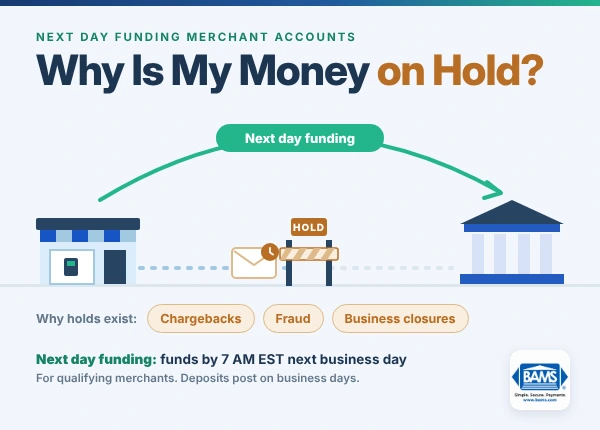
Your eCommerce store is growing. Revenue is climbing. And yet your operating account feels tighter than it did six months ago. The culprit is often hiding in the reserve clauses of your processing agreement: rolling reserves that withhold a percentage of every transaction, sometimes for 180 days, before releasing a cent back to you.
Most eCommerce operators sign processing contracts focused on rates and fees. The reserve clauses get skimmed. But those clauses determine how much of your own revenue you can actually use and when. Rolling reserves commonly withhold 5% to 10% of transaction volume, with each held batch locked on its own countdown timer. For a business doing $500K in monthly card sales, a 10% reserve holds back $50K a month. With a 180-day release window, the balance can build to roughly $300K before the first releases arrive.
This isn’t a guide for high-risk merchants trying to get approved. It’s for established eCommerce businesses that have outgrown their original reserve terms and need a practical plan to reduce them.
TL;DR
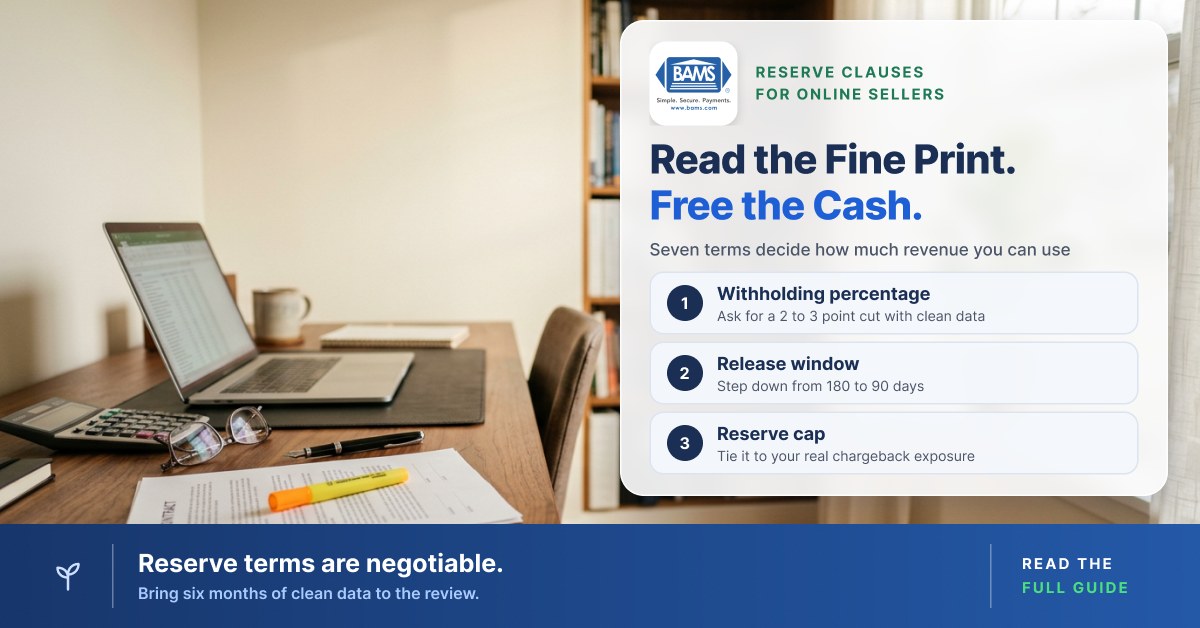
- Reserve terms are negotiable, not fixed – Your initial withholding percentage and release window were set based on assumptions before you had processing history. As your metrics improve, you have grounds to request reductions.
- Track cash flow separately from profit – Rolling reserves can withhold 5% to 10% of every transaction for 90 to 180 days, meaning your books can show profit while your operating account runs short. Build a reserve release calendar to forecast usable cash.
- Your chargeback ratio is your strongest lever – Maintaining a ratio below 0.5% for six consecutive months gives you concrete data to negotiate lower withholding percentages, shorter release windows and reserve caps.
- Negotiate caps and review triggers at signing – Without a reserve cap, your held funds scale indefinitely with revenue growth. Without a review trigger, your processor has no obligation to reassess your terms even as your risk profile improves.
- Start with three actions – Identify your current withholding percentage and release window, build a reserve release calendar and request a formal reserve review once you have 6+ months of clean processing data.
Who This Is For and What It Covers
If you manage payments for an online business doing consistent volume with a team of 10 to 50 people, you’ve likely encountered reserves during a growth phase, a product expansion, or a processor switch. This list is built for you.
We’re not covering how to get a merchant account approved or how to handle reserves in genuinely high-risk verticals. Instead, each item below isolates one of the reserve clauses or operational signals that directly impacts your reserve release schedule and working capital. The goal: give you diagnostic tools to evaluate your current agreement and a concrete path to negotiate better terms as your processing history strengthens.
How These Items Were Selected
Each item was chosen based on one criterion: does this clause or practice have a measurable, direct effect on how much cash your processor holds and for how long? Legal definitions were set aside in favor of cash flow impact. If a term doesn’t change the dollars available in your operating account, it didn’t make the list.
7 Reserve Clauses That Control Your Cash Flow (and How to Reduce Them)
1. The Withholding Percentage: Your Daily Cash Flow Tax
Why it matters: The reserve percentage (typically 5% to 10%) is the single biggest lever on your working capital. A 10% reserve on growing revenue doesn’t just hold a fixed amount. It scales with your sales, meaning the cash gap widens as you grow. Many operators assume this number is standard and non-negotiable. It’s neither.
What it looks like today: Processors set your initial withholding percentage based on perceived risk at the time of underwriting. But your risk profile changes as you build processing history. A business with 12 months of clean transactions is a fundamentally different risk than a new account.
How to apply it: Pull your current agreement and find the exact percentage. Then document your chargeback ratio, refund rate and average ticket size over the last 6 to 12 months. Use this data to request a formal reserve review. Target a reduction of 2 to 3 percentage points as a starting position. Even dropping from 10% to 7% on $400K monthly volume frees up $12,000 per month.
2. The Release Window: 90 Days vs. 180 Days of Trapped Revenue
Why it matters: The release period determines when each withheld batch returns to you. Typical release periods are 90 or 180 days and the difference between them is enormous. Under a 180-day reserve, you won’t see a single dollar released until day 181 of your agreement. Before that point, the reserve balance keeps climbing with every transaction.
What it looks like today: Many processors default to 180-day holds for newer accounts or businesses in categories they consider elevated risk. But 90-day terms are common for merchants with stable processing history and some processors offer even shorter windows.
How to apply it: If you’re on a 180-day window, negotiate a step-down. Propose 180 days for the first six months, then 90 days once your chargeback ratio stays below a defined threshold (e.g., 0.5%). Build the step-down into the contract language so it triggers automatically rather than requiring another negotiation.
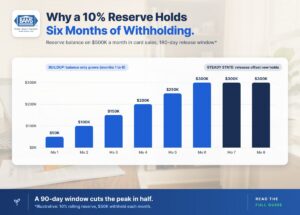
On $500K a month in card sales, a 10% reserve with a 180-day release builds to about $300K before releases begin. A 90-day window cuts that peak in half. The figures are illustrative.
3. The Steady-State Trap: Understanding When Releases Actually Begin
Why it matters: There’s a critical period between when reserves start being withheld and when the first releases arrive. During this buildup phase, your reserve balance only grows. After steady state, newly withheld funds are approximately offset by releases from prior transactions. But many operators don’t plan for the buildup period, which can last the full length of your release window.
What it looks like today: As CPA Jay Odi has pointed out, stores can appear profitable on paper while feeling cash-starved because rolling reserves keep revenue from reaching the operating account. Accounting profit and usable cash must be tracked separately.
How to apply it: Build a reserve release calendar that maps each daily withholding to its specific release date. Model the buildup period explicitly in your cash flow forecast. This doesn’t reduce the reserve itself, but it prevents you from making inventory or hiring commitments based on revenue you can’t access yet.
4. The Chargeback Ratio Clause: The Metric That Raises or Lowers Your Hold
Why it matters: Your chargeback ratio is the single most influential factor in whether a processor increases, maintains, or reduces your reserve. Most agreements include language allowing the processor to adjust reserve terms if chargebacks exceed a threshold. But the reverse is also true: a consistently low ratio is your strongest negotiation tool.
What it looks like today: Processors monitor chargeback ratios monthly. Card network programs trigger escalation at set thresholds. Visa’s Acquirer Monitoring Program (VAMP), for example, counts fraud reports plus disputes and set a 1.5% U.S. threshold for merchants from April 1, 2026. Processors often react at lower levels. A ratio below 0.5% signals a well-managed operation.
How to apply it: Implement proactive chargeback prevention including order confirmation workflows, clear billing descriptors and rapid refund policies for legitimate disputes. Track your ratio weekly, not monthly. When you’ve maintained a ratio below 0.5% for six consecutive months, present the data and formally request a reserve reduction. Processors respond to documented trends, not verbal assurances.
5. The Cap Clause: Whether Your Reserve Has a Ceiling
Why it matters: Some reserve structures include a cap (a maximum dollar amount the processor can hold). Others don’t. Without a cap, your reserve balance scales indefinitely with your revenue. For a growing eCommerce business, this means success actually increases the amount of cash locked away.
What it looks like today: Capped reserves are more common in negotiated agreements than in default terms. Many standard contracts use uncapped rolling reserves, which means the processor withholds the same percentage regardless of how large your reserve balance grows relative to actual risk exposure.
How to apply it: Ask your processor to set a reserve cap tied to a multiple of your average monthly chargeback and refund exposure. If your monthly chargebacks and refunds total $5,000, a reserve cap of $25,000 to $50,000 provides the processor adequate protection without holding $80,000 or more. If your current agreement has no cap language, this is one of the highest-impact terms to negotiate.
6. The Closure Clause: What Happens to Your Money If You Leave
Why it matters: Processors may hold remaining reserves for approximately 180 days after your last transaction to cover potential chargebacks from prior transactions. If you switch processors without understanding this clause, you could have tens of thousands of dollars locked in an account you no longer use, with no new revenue to offset the hold.
What it looks like today: Many operators discover this clause only when they try to leave. The post-closure hold period is separate from the active reserve window and can extend the total time your funds are inaccessible.
How to apply it: Before signing any processing agreement, find the post-termination reserve language. Negotiate a shorter post-closure hold (90 days instead of 180) or a declining balance release (e.g., 50% released at 90 days, remainder at 150 days). If you’re planning a processor switch, factor the post-closure hold into your transition timeline and cash flow projections.
7. The Review Trigger: Getting Reserve Terms Reassessed Proactively
Why it matters: Most processing agreements don’t include automatic reserve reviews. The processor has no obligation to lower your reserve just because your risk profile has improved. Without a defined review mechanism, you could operate under startup-level reserve terms for years after you’ve outgrown them.
What it looks like today: With many providers, a reserve review only happens if you ask. Working with a processor that provides dedicated account representatives, such as BAMS, gives you a direct contact for that request. One consultancy’s documented case reports more than $100,000 in reserve releases and processing rates cut by about 30% after a full payment review.
How to apply it: Negotiate a contractual review trigger at signing. Common structures include automatic review at 6- and 12-month intervals, or a review triggered when your chargeback ratio stays below a defined threshold for 90 consecutive days. If your current contract lacks this, request a review in writing and include your processing metrics. A dedicated account representative makes these conversations part of the ongoing relationship rather than a one-time negotiation.
The Pattern Across These Terms
All seven reserve clauses on this list share a common thread: reserve terms are set based on risk assumptions that were made before you had a processing history. As your business builds that history (low chargebacks, consistent volume, stable refund rates), the original assumptions become outdated. But the terms don’t update themselves.
The second pattern is that these reserve clauses interact. A shorter release window combined with a lower withholding percentage and a defined cap creates a fundamentally different cash flow profile than any single change alone. Treating reserves as an integrated treasury management decision rather than isolated contract terms is what separates operators who free up working capital from those who simply absorb the cost.
The tradeoff is real: processors use reserves to manage their financial exposure to chargebacks and fraud. Pushing for zero reserves isn’t realistic or productive. The goal is proportionality, ensuring the reserve matches your actual risk rather than a worst-case assumption from your first month of processing.
Where to Start
You don’t need to renegotiate all seven reserve clauses at once. Start with three actions: pull your current agreement and identify your withholding percentage, release window and whether a cap exists. Build a reserve release calendar so you can forecast usable cash accurately. Then, once you have 6+ months of clean processing data, request a formal reserve review.
If your processor won’t engage in a review conversation, that itself is a diagnostic signal. Transparent processors treat reserve terms as a living part of the relationship. If yours treats them as permanent fine print, it may be time to explore partners who view your growth as a reason to improve your terms, not a reason to hold more of your money.
Frequently Asked Questions
What is reserve and hold management in merchant services?
Reserve and hold management refers to how payment processors withhold a percentage of your transaction revenue to cover potential chargebacks, refunds, or fraud losses. The processor holds these funds in a separate account and releases them according to a defined schedule (typically 90 or 180 days after each transaction). Managing reserves means actively tracking withheld amounts, forecasting when releases occur and negotiating terms that match your actual risk profile.
Why do payment processors withhold reserves from merchants?
Processors withhold reserves to protect themselves from financial exposure. If a customer files a chargeback or requests a refund after the processor has already settled funds to you, the processor bears the loss. Reserves act as a buffer against that risk. The withholding percentage and duration are set based on your industry, transaction history, average ticket size and chargeback rate at the time of underwriting.
How do rolling reserves work in payment processing?
In a rolling reserve, the processor withholds a fixed percentage (commonly 5% to 10%) of each day’s transactions. Each withheld batch has its own release date, typically 90 or 180 days later. This means the reserve “rolls” continuously: new funds are withheld daily while older batches are released on their individual schedules. After the initial buildup period, the reserve reaches a steady state where daily withholdings are roughly offset by daily releases.
When can a merchant expect to have their reserves released?
Releases begin after the first withheld batch reaches the end of your release window. If you have a 180-day rolling reserve, the first release happens on day 181. Before that, your reserve balance only grows. After reaching steady state, you’ll receive daily releases that approximate your daily withholdings. If you close your account, the processor may hold remaining reserves for an additional 180 days to cover lingering chargeback exposure.
Which factors influence the percentage of reserves withheld by payment processors?
Key factors include your chargeback ratio, refund rate, industry category, average transaction size, monthly processing volume and length of processing history. Businesses with higher chargeback rates, large average tickets, or short processing histories typically face higher withholding percentages. Consistently low chargebacks (below 0.5%) and stable transaction patterns give you leverage to negotiate lower percentages over time.
How can merchants reduce their reserve requirements over time?
Build a documented track record of low chargebacks, stable refund rates and consistent processing volume over 6 to 12 months. Then request a formal reserve review from your processor, presenting specific metrics. Negotiate for a lower withholding percentage, a shorter release window, a reserve cap, or automatic review triggers written into your contract. Proactive chargeback prevention and clear communication with your processor are the two most effective ongoing strategies.