Risk Management Solutions Aren’t Just for Enterprise
Last Updated on November 10, 2026 by Dimitri Akhrin
TL;DR
- Compliance isn’t an enterprise problem – Small and midsize businesses running dual-pricing or fee-recovery programs face real regulatory exposure that changes state by state, often without warning.
- Monthly beats annual – A 30-minute compliance check at month-end (statement review, signage audit, regulatory scan) costs almost nothing and prevents expensive reactive cleanups.
- Think margin hygiene, not risk management – Reframing compliance as routine maintenance (like reconciling your books) changes when you do it, who does it and how much it costs.
- The real risk is doing nothing – A compliance gap can force you to pause your entire fee-recovery program, putting you back to absorbing 100% of processing costs until you remediate.
The Regulation You Didn’t Read Just Ate Your Margin
A surcharge cap changes in one state. A card brand updates its disclosure rules. Then a new signage requirement takes effect at the point of sale. None of it makes headlines and none of it waits for you to catch up. For small and midsize businesses running dual-pricing or fee-recovery programs, catching regulation changes isn’t a legal nicety. It’s the difference between a program that protects your margins and one that quietly destroys them.
The Enterprise Compliance Myth
Somewhere along the way, “risk management solutions” and “regulatory reporting” became enterprise vocabulary. The assumption took hold that compliance monitoring belongs to banks, pharmaceutical companies and publicly traded corporations with dedicated legal teams. For a restaurant owner or a retail operator, the thinking goes, you set up your program, trust your processor and move on.
That assumption made more sense when surcharging rules were relatively static and card brand policies changed slowly. But the regulatory landscape around payment surcharging and dual pricing has become a patchwork. States adopt, amend and sometimes reverse their rules on different timelines. In the Q4 2024 MetLife and U.S. Chamber of Commerce Small Business Index, 69% of small businesses said they spend more per employee on compliance than larger competitors. The cost of getting it wrong isn’t theoretical. It’s a fine, a forced refund, or a program you have to shut down overnight.
Compliance Isn’t a Department. It’s a Monthly Habit.
Here’s what we actually believe: the most effective risk management solutions for a fee-recovery program aren’t reserved for enterprises. They’re a margin protection habit that any owner can build into the last hour of their month.
Why the Monthly Close Is Where Compliance Actually Lives
Think about what already happens at the end of every month. You reconcile your books and review your P&L. You check your processing statement (or you should). Adding a compliance check to that routine takes minutes, not days and the payoff is disproportionate.
Consider a common pattern: a business launches a surcharge program, sees immediate relief on processing costs and never revisits the configuration. Then the rules move. When Visa lowered its maximum surcharge from 4% to 3% in April 2023, any merchant still charging 4% on Visa credit cards was over the cap. A state law change can do the same thing. The exposure accumulates silently until a customer complaint or a processor audit surfaces it.
This isn’t a hypothetical edge case. In the same Chamber survey, 39% of small businesses said the time or resources they spend on compliance had increased over the previous six months. A reactive model, waiting for a problem and then scrambling, tends to cost more than a proactive one.
The Proactive Monthly Model
The proactive model looks like this:
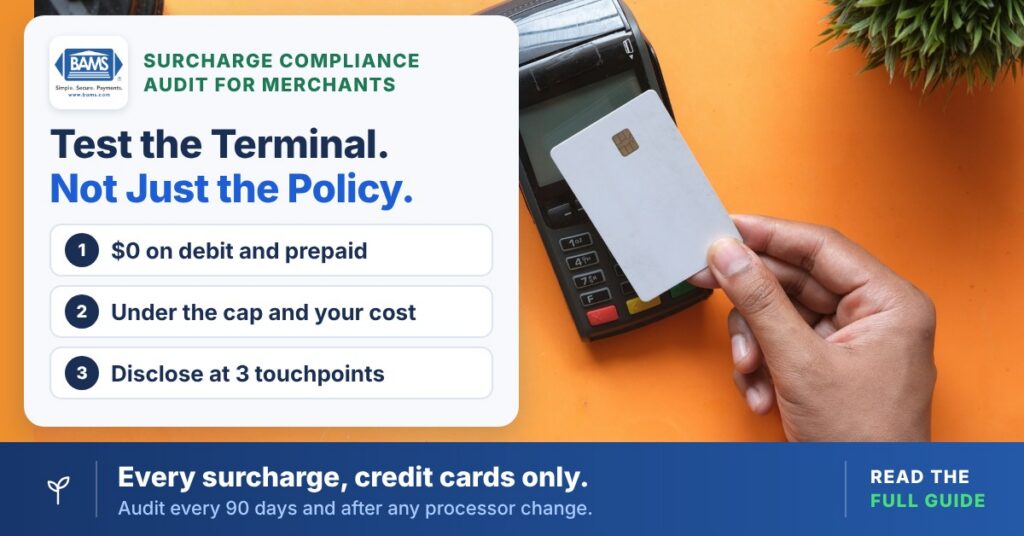
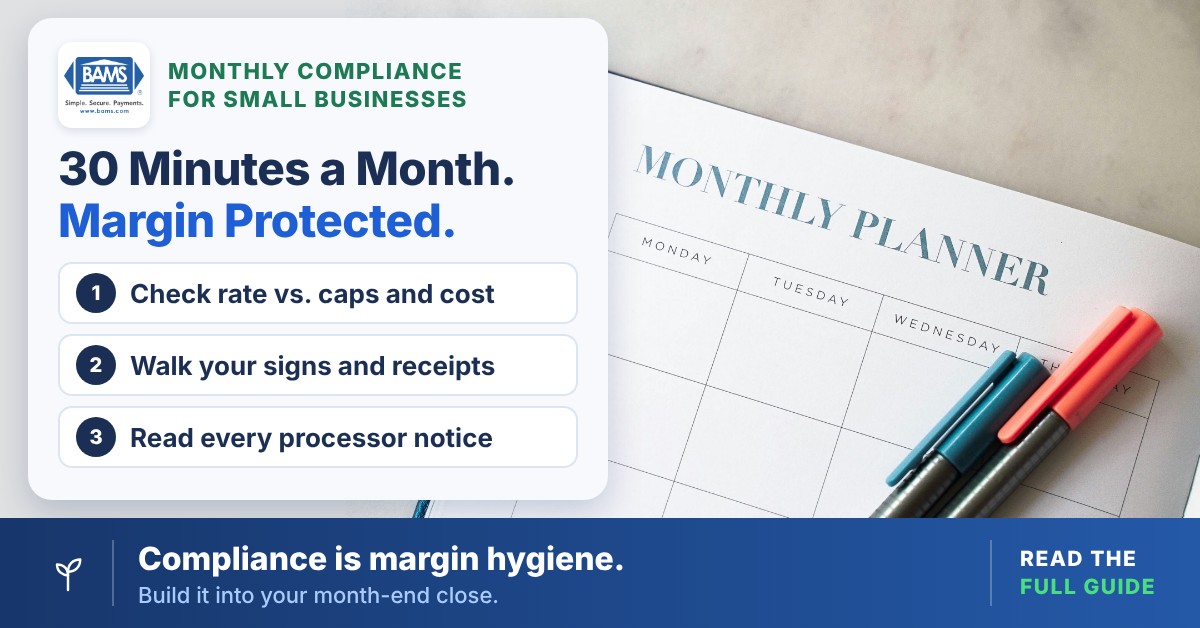
- Monthly statement review: Compare your surcharge percentage against your merchant discount rate, current state rules and the card-brand caps (the lower of your merchant discount rate or 3% for Visa, or 4% for Mastercard). Flag anything that doesn’t match.
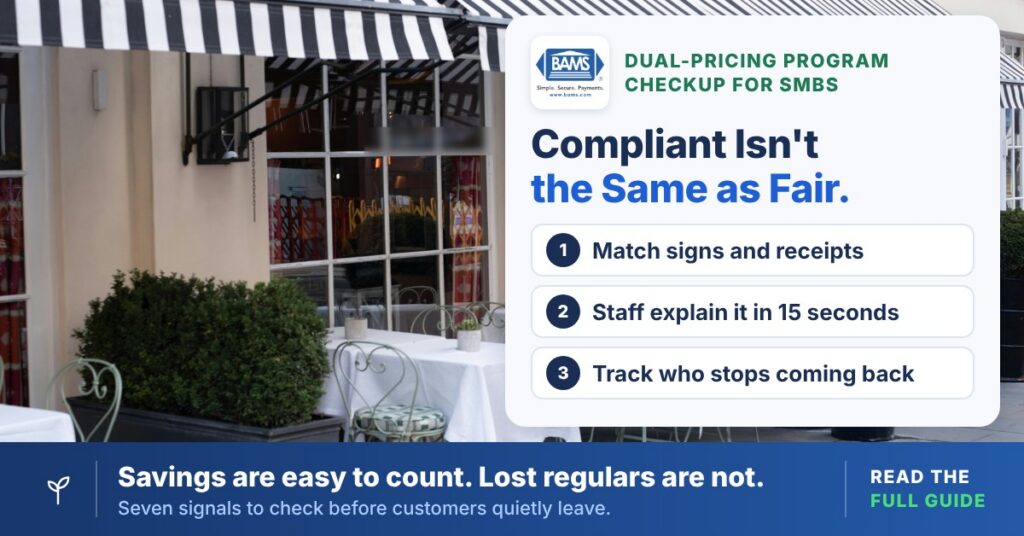
- Signage and disclosure audit: Walk your own checkout experience (in-store and online) quarterly. Are your disclosures still accurate? Do they meet current requirements for placement and wording at the point of entry, at the point of sale and on the receipt?
- Processor communication review: Read the notices your payment processor sends. These often contain advance warnings of rule changes buried in routine updates. If you plan to start or change a surcharge, remember that Visa and Mastercard require 30 days’ advance notice. If you work with BAMS, your dedicated account representative can walk you through any notice that affects your setup.
- State regulatory scan: A five-minute check of your operating states’ attorney general websites or a subscription to a surcharging regulatory digest can surface changes before they take effect.
Risk management solutions at this scale don’t require a compliance team. They require a checklist and 30 minutes.
Why Small, Regular Checks Cost Less
The same survey found that 47% of small businesses say they spend too much time on regulatory compliance. But the problem isn’t the time spent. It’s that the time is spent reactively, in bursts of panic, instead of being distributed into small, predictable increments. When you treat compliance as a monthly operating rhythm rather than an annual audit, the total time spent can drop. And the exposure drops with it.
We’ve also seen businesses overlook how default processor settings interact with compliance. A surcharge percentage or card-type setting that made sense at launch can stay in place long after the rules change. These aren’t dramatic failures. They’re slow leaks that erode the very margin your fee-recovery program was designed to protect.
What You Lose by Waiting
If this perspective is right, the implications are uncomfortable for anyone who set up a dual-pricing program and walked away. Every month without a compliance check is a month where your program might be out of bounds and you wouldn’t know it until the cost arrives as a penalty, a forced refund batch, or a card brand violation notice.
The financial exposure is real, but the operational exposure might matter more. A compliance failure can force you to pause your entire fee-recovery program while you remediate. During that pause, you’re absorbing 100% of processing costs again. For a business doing $50,000 a month in card volume at a 3% effective rate, a two-week pause means absorbing roughly $750 in processing costs. That’s about half a month of program savings, before the cost of refunds and cleanup.
The businesses that treat ongoing compliance as optional are, in effect, gambling their margin on the assumption that nothing will change. In a regulatory environment where states are actively legislating around surcharging, that’s a bet with poor odds.
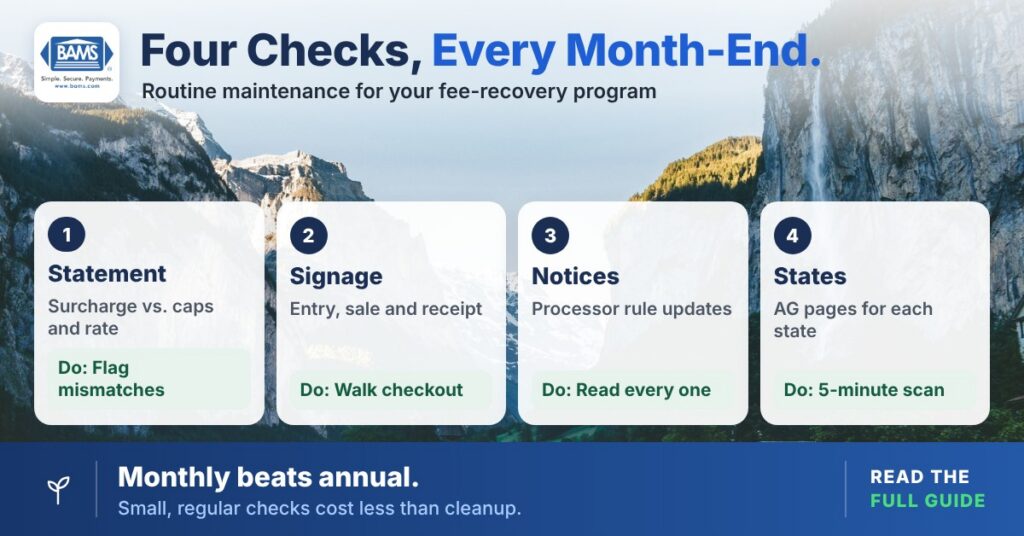
Monthly beats annual. Small, regular checks cost less than cleanup.
Reframe: Compliance as Margin Hygiene
Stop thinking of regulatory reporting and compliance monitoring as risk management. Start thinking of it as margin hygiene, the same category as reconciling your bank account or reviewing your processing costs before a seasonal spike.
Risk management implies you’re defending against something rare and catastrophic. Margin hygiene implies you’re maintaining something valuable through routine care. The mental shift matters because it changes when you do the work (monthly, not annually), who does it (the owner or manager, not an outside attorney) and how much it costs (nearly nothing, instead of thousands in reactive cleanup).
Compliance isn’t the price of running a fee-recovery program. It’s the practice that makes the program worth running.
The Owners Who Win This Game
The businesses that extract the most value from dual-pricing and fee-recovery programs aren’t the ones with the best legal counsel. They’re the ones who built a 30-minute monthly habit and stuck with it. They catch the regulation change before it costs them. They update their signage before a customer complains. Processor notices get read before they become mandates.
That’s not enterprise compliance. That’s just good ownership.
Frequently Asked Questions
Why is ongoing compliance important for businesses running fee-recovery programs?
Surcharging and dual-pricing rules vary by state and change without much notice. A program that was compliant at launch can fall out of bounds within months, exposing you to fines, forced refunds, or program suspension that wipes out your savings.
How can technology improve ongoing compliance processes for small businesses?
A processor that explains rule changes and helps you check your configuration reduces the burden on owners. Pairing that with a simple monthly checklist turns compliance from a reactive scramble into a predictable, low-cost routine.
When should companies start focusing on compliance optimization?
Immediately after launching a fee-recovery or dual-pricing program. The first month-end close is your first compliance checkpoint and every subsequent month should include the same brief review.