
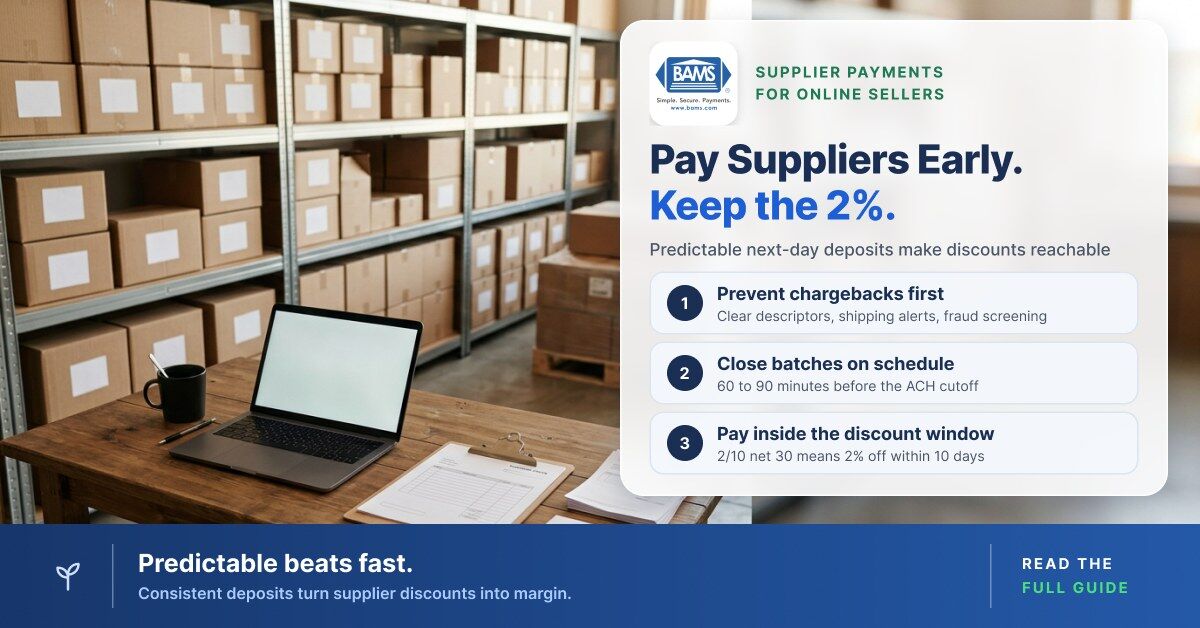
Supplier Payments: Turn Next-Day Funding Into 2% COGS Savings
Last Updated on November 10, 2026 by Dimitri Akhrin
Guide Orientation: What This Covers and Who It’s For
This guide shows eCommerce managers how to protect cash flow planning from chargeback disruptions so they can reliably access early-payment supplier discounts. If your business processes enough daily volume that a single batch of chargebacks can shift your deposit timing by even one day, this is for you.
By the end, you’ll understand how chargebacks erode deposit predictability and why that blocks you from capturing supplier payments discounts worth up to 2% of the cost of goods you buy. You’ll also learn how to build a system that keeps your funding schedule intact. We focus on operational frameworks, not chargeback litigation. We cover prevention, batching strategy and funding structure rather than dispute resolution.
TL;DR
- Chargebacks don’t just cost fees – They disrupt deposit timing through deductions, rolling reserves and batch holds, making it impossible to predict when cash arrives.
- Unpredictable deposits kill supplier discounts – 61% of suppliers are interested in taking early payments at least some of the time, but you can’t commit to paying early if you don’t know when your deposits will land.
- Prevention beats dispute management – A prevented chargeback keeps your deposit intact. A won dispute still disrupted it. Focus on billing descriptors, shipping notifications and fraud screening first.
- Batch timing is your most controllable lever – Align your batch cutoff with your processor’s ACH window and deposits become predictable within a 2-hour daily window.
- 2% COGS savings compound into real margin – Capturing early-payment discounts from your top suppliers, enabled by consistent daily deposits, can take up to 2% off what you pay them. If COGS runs 40% of revenue, 2% off all supplier spend adds about 0.8 percentage points of gross margin without changing a single price.
Why Predictable Deposits Matter More Than Fast Deposits
Speed gets the headlines. Next-day funding sounds like a convenience upgrade and most merchants treat it that way. But speed without consistency is just a faster version of the same problem: you still can’t commit to payment timelines you don’t control.
The real value of predictable daily deposits is what they unlock upstream. 61% of suppliers say they’re interested in taking early payments at least some of the time, yet only 3% of suppliers report being paid early. The gap isn’t supplier willingness. It’s buyer readiness. When your deposits arrive on an unreliable schedule, you can’t commit to early supplier payments because you don’t know when you’ll have the cash.
Chargebacks are a major disruptor of that schedule. A chargeback doesn’t just cost you the transaction amount and a fee. It can trigger rolling reserve increases, delay batch settlements and create a cascading timing gap between when you expected funds and when they actually arrive. That gap is where early-payment discounts die.
The compounding math is straightforward: a 2% discount on COGS, captured consistently across a year, can represent thousands to tens of thousands of dollars for a mid-size eCommerce brand. Miss the payment window by two days and the discount evaporates. This guide treats deposit predictability as a margin strategy, not a banking preference.
Core Concepts: The Mechanics Behind the Margin Loss
Early-Payment Discounts and Why They Exist
Suppliers offer discounts (commonly structured as 2/10 net 30, meaning 2% off if paid within 10 days) to get paid sooner. In fact, more than half of suppliers cite a cash-flow gap as their reason for taking early payment. They need liquidity to pay their own vendors. Your ability to pay early solves their problem and saves you money simultaneously.
Deposit Predictability vs. Deposit Speed
Deposit speed is how quickly funds move from processor to your bank account and deposit predictability is whether that speed stays consistent day after day. A processor offering next-day funding that occasionally holds batches for 48-72 hours due to chargeback reviews gives you speed without predictability. You need both.
How Chargebacks Break the Cycle
When a chargeback is filed, your processor may deduct the disputed amount from your next deposit, hold a portion of future deposits in a rolling reserve, or delay settlement while reviewing the transaction. Each of these actions shifts your deposit timing. Say you’ve committed to paying a supplier on day 10 based on expected deposits from days 1-9. A chargeback on day 5 can create a shortfall that forces you to draw on a credit line or miss the discount window entirely.
The Working Capital Trap
Most eCommerce brands compensate for deposit unpredictability by maintaining larger cash buffers or relying on short-term credit. Both carry costs. The buffer ties up capital that could be deployed. The credit line carries interest. Neither addresses the root cause: inconsistent deposit timing driven by preventable chargebacks.
The Framework: Four Stages of Cash Flow Protection
Protecting your deposit schedule from chargeback disruptions requires work across four connected stages. Each stage reduces a different source of unpredictability.
- Stage 1: Chargeback Prevention – Reduce the volume of disputes that reach your processor.
- Stage 2: Batch Timing Optimization – Align your transaction batching with your processor’s settlement windows to minimize delay exposure.
- Stage 3: Funding Structure Alignment – Ensure your merchant services agreement supports the deposit consistency you need.
- Stage 4: Supplier Terms Negotiation – Use your newly predictable cash position to schedule supplier payments early and capture discounts.
These stages are sequential in setup but operate simultaneously once established. A breakdown in Stage 1 creates problems in Stage 4. The system works as a whole.
Step-by-Step Breakdown: Building the System
Step 1: Map Your Chargeback Exposure to Deposit Impact
Objective: Understand exactly how each type of chargeback affects your deposit timing, not just your dispute costs.
Start by pulling three months of chargeback data alongside your deposit records. For each chargeback, note the date filed, the date your deposit was affected and how the effect manifested (direct deduction, reserve increase, or batch hold). Many eCommerce managers track chargeback rates as a percentage of transactions but never correlate them to deposit timing shifts.
Build a simple spreadsheet with columns for chargeback date, deposit impact date, impact type and dollar amount. Look for patterns. You may find that certain chargeback reason codes (especially fraud-related ones) trigger longer holds than service disputes. You may also discover that a hold landing right before payroll or a supplier payment is one of the chargeback triggers that force unnecessary borrowing, creating compounding pressure.
Anti-patterns: Don’t treat all chargebacks as equal-impact events. A $50 friendly fraud dispute and a $500 fraud chargeback affect your deposits differently. Don’t rely solely on your processor’s monthly summary; it won’t show you timing correlations.
Success indicators: You can predict, within one business day, how a new chargeback will affect your next deposit. You know which chargeback categories create the longest deposit disruptions.
Step 2: Implement Proactive Chargeback Prevention at the Transaction Level
Objective: Reduce the number of chargebacks that reach your processor and trigger deposit adjustments.
Prevention is more valuable than winning disputes. A won dispute still disrupted your deposit; prevention keeps the deposit intact. Focus on three common chargeback sources for eCommerce: unclear billing descriptors, delayed shipping notifications and subscription billing without adequate pre-charge communication.
Update your billing descriptor to include your brand name and a customer service phone number or URL. Set up automated shipping confirmation emails that trigger within one hour of fulfillment. For subscription businesses, send a pre-charge reminder 3-5 days before each billing cycle. These three changes address common root causes of “friendly fraud” disputes.
Layer in fraud screening at checkout. Use Address Verification Service (AVS) and CVV matching as baseline filters. Consider velocity checks that flag multiple orders from the same IP or shipping address within a short window. Each prevented fraudulent transaction is a chargeback that never touches your deposit schedule.
This is where your merchant services partner matters significantly. BAMS pairs next-day funding for qualifying merchants with Dispute Responder, which sends immediate chargeback notifications and a clear action plan so you can respond quickly and reduce losses.
Anti-patterns: Don’t over-tighten fraud filters to the point where you decline legitimate orders. A 1% chargeback reduction that comes with a 5% authorization rate drop is a net loss. Don’t assume chargebacks are inevitable and skip prevention in favor of dispute management.
Success indicators: Chargeback rate drops below 0.5% of transactions. Deposit deductions from chargebacks decrease in both frequency and magnitude over 60-90 days.
Step 3: Optimize Your Transaction Batching Schedule
Objective: Align your batch cutoff times with your processor’s settlement windows so deposits arrive on a consistent, predictable schedule.
Your batch cutoff time determines when your processor begins settling transactions. If your cutoff is misaligned with the processor’s ACH submission window, you lose a day. If you batch inconsistently (sometimes at 6 PM, sometimes at midnight), your deposits arrive inconsistently.
Contact your processor and ask for their exact ACH submission cutoff time. Then set your batch to close 60-90 minutes before that cutoff. This buffer accounts for processing delays without pushing your batch to the next day’s cycle. A well-timed batch cutoff is the single most controllable variable in your deposit schedule.
If your eCommerce platform or gateway settles batches automatically (Shopify, WooCommerce and BigCommerce setups all handle this differently), verify the default settings. A default settlement time may not align with your processor’s window. Manual override or plugin-based scheduling may be necessary.
Anti-patterns: Don’t assume your platform’s default batching schedule is optimized for your processor. Don’t batch multiple times per day unless your volume justifies it, as it creates multiple deposit events that complicate reconciliation. Finally, don’t ignore weekends and holidays; transactions batched Friday evening may not settle until Monday, or Tuesday after a holiday.
Success indicators: Deposits arrive at the same time (within a 2-hour window) every business day. You can predict tomorrow’s deposit amount within 5% accuracy by reviewing today’s batch.
Step 4: Align Your Funding Structure With Your Cash Flow Needs
Objective: Ensure your merchant services agreement provides deposit terms that support early supplier payments.
Not all next-day funding is equal. Some processors offer next-day funding but exclude weekends, holidays, or transactions above a certain threshold. Others impose rolling reserves that grow with chargeback volume, effectively converting your next-day funding into 3-5 day funding for a portion of your revenue.
Review your current merchant services agreement for three specific clauses. Start with rolling reserve triggers (what chargeback rate or volume activates a reserve). Next, check reserve release schedules (how long funds are held and under what conditions they’re returned). Finally, look at deposit exclusion rules (which transactions or transaction types are excluded from next-day settlement).
If your current agreement includes aggressive reserve triggers, you’re exposed to the exact problem this guide addresses. A single bad month of chargebacks can shift your effective funding speed from next-day to next-week, destroying your ability to meet early-payment windows. Seven specific signals indicate when your deposit timing is already costing you money and rolling reserve escalation is one of the clearest.
Anti-patterns: Don’t evaluate processors solely on their advertised funding speed. Don’t ignore the fine print on reserve requirements. Finally, don’t assume your current terms are fixed; most agreements are negotiable, especially if your chargeback rate is low.
Success indicators: Your rolling reserve (if any) is capped at a level that doesn’t interfere with supplier payment timing. Your next-day funding applies to at least 95% of your daily transaction volume.
Step 5: Build Your Supplier Discount Calendar
Objective: Map your suppliers’ early-payment discount windows against your now-predictable deposit schedule to identify capturable savings.
With predictable deposits in place, you can now work the supplier side. Start by listing your top 10 suppliers by annual spend. For each, document their current payment terms, whether they offer early-payment discounts (or would if asked) and the exact discount structure (percentage off, payment deadline).
42% of suppliers now accelerate payments monthly, up from 39% previously, indicating growing willingness to participate in early-payment arrangements. If your suppliers don’t currently offer formal discount terms, ask. Many will negotiate a 1-2% discount for payment within 10 days, especially if they’re managing their own cash-flow gaps.
Create a calendar that overlays your expected daily deposit amounts with supplier payment due dates and discount deadlines. Identify which discount windows you can reliably hit with your deposit schedule and which ones fall in gaps (weekends, holidays, or periods of historically higher chargeback volume). Costco suppliers that use C2FO’s early-payment program get paid an average of 22 days early, demonstrating that even modest acceleration creates significant value for both parties.
Anti-patterns: Don’t commit to early-payment terms before you’ve stabilized your deposit schedule for at least 60 days. Don’t negotiate discounts with suppliers who represent less than 5% of your COGS; the administrative overhead won’t justify the savings. Finally, don’t treat discount capture as all-or-nothing; even capturing discounts from your top 3 suppliers creates meaningful margin improvement.
Success indicators: You capture early-payment discounts from at least 3 suppliers within the first quarter. Your effective COGS decreases by 0.5-2% without changing suppliers or negotiating lower base prices.
Step 6: Create a Daily Reconciliation and Alert System
Objective: Detect deposit disruptions within 24 hours so you can adjust the timing of supplier payments before missing a discount window.
Even with strong prevention and optimized batching, disruptions will occasionally occur. The goal isn’t zero disruptions; it’s zero surprises. Build a daily reconciliation routine that compares expected deposits (based on yesterday’s batch) with actual deposits.
Set up a simple alert threshold: if the actual deposit is more than 10% below the expected amount, investigate immediately. Common causes include a chargeback deduction you weren’t notified about, a batch processing error, or a reserve adjustment. The faster you identify the cause, the faster you can decide whether to move supplier payments or draw briefly on a credit line.
Using next-day funding as a direct input for inventory and payment planning requires this kind of daily verification. Without it, you’re operating on assumptions that degrade over time.
Anti-patterns: Don’t reconcile weekly or monthly; by then, missed discount windows are unrecoverable. Don’t rely solely on your processor’s dashboard for alerts; build your own tracking to maintain independence. Finally, don’t panic over single-day variances; the system is designed to absorb occasional disruptions.
Success indicators: You identify deposit discrepancies within one business day. You’ve never missed a supplier discount deadline due to an undetected deposit disruption.

In the guide’s illustrative example, cutting chargebacks and removing a rolling reserve lets the brand capture supplier discounts worth about $10,200 a year. Your results will vary.
Practical Example: A Mid-Size eCommerce Brand’s Margin Recovery
Consider a direct-to-consumer brand doing $200,000 per month in revenue with monthly COGS of $80,000 ($960,000 a year) spread across five primary suppliers. Their processor offers next-day funding, but their chargeback rate of 1.2% triggers a 5% rolling reserve, holding back about $10,000 of each month’s deposits.
Their largest supplier, at $20,000 a month, offers 2/10 net 30 terms. But the brand can’t reliably pay within 10 days because the rolling reserve creates a $10,000 gap in their expected cash position. They miss the discount window roughly 7 out of 12 months, losing approximately $2,800 a year from just one supplier.
After implementing the framework above, they reduce chargebacks to 0.4% over 90 days. The processor agrees to remove the rolling reserve. Daily deposits become predictable within a 3% variance. They renegotiate early-payment terms with their top three suppliers and begin capturing discounts consistently.
Annual savings: approximately $8,400 in supplier discounts (2% on the largest supplier’s $240,000 a year, plus 1% on $360,000 a year from the next two), plus $1,800 in eliminated short-term credit interest they previously used to bridge deposit gaps. Total: about $10,200 a year, or roughly 1% of annual COGS, from a process change, not a pricing negotiation. On $2.4 million in annual revenue, that adds about 0.4 percentage points of gross margin.
Common Mistakes and Pitfalls
Treating chargebacks as a cost-of-doing-business line item. Most eCommerce managers account for chargeback fees and lost merchandise but never quantify the downstream deposit disruption cost. The fee is the visible cost. The missed supplier discount is the invisible one and it’s often larger.
Optimizing for funding speed without addressing consistency. Switching to a faster processor doesn’t help if their reserve policies or batch handling introduce new variability. Speed is necessary but insufficient.
Negotiating supplier discounts before stabilizing deposits. Committing to early-payment terms you can’t reliably meet damages supplier relationships and may result in losing the discount option permanently. Build the foundation first.
Ignoring platform-specific batching defaults. Your eCommerce platform’s default batch settings were chosen for the platform’s convenience, not yours. Verify and adjust them.
Assuming small percentages don’t compound. A 2% COGS savings sounds modest in isolation. Over three years, reinvested into inventory or marketing, it compounds into a material competitive advantage.
What to Do Next
Start with Step 1. Pull your last 90 days of chargeback data and map each dispute to its deposit impact. This exercise alone will reveal how much deposit unpredictability you’re currently absorbing and whether the downstream cost justifies building the full system.
If the data shows that chargebacks are shifting your deposits by even one day more than twice per month, you have enough disruption to warrant the complete framework. If not, focus on batch timing optimization (Step 3) as a lower-effort improvement that still increases deposit consistency.
Revisit this guide quarterly as your transaction volume grows. Higher volume amplifies both the disruption risk from chargebacks and the savings opportunity from early supplier payments. The framework scales, but the specific thresholds and alert parameters should evolve with your business.
Frequently Asked Questions
What is next-day funding in merchant services?
Next-day funding means your processor deposits the previous day’s credit card transactions into your bank account by the next business day. This is faster than the 2-3 day settlement some processors use. At BAMS, qualifying merchants can access funds in as little as ten hours after transactions are batched. The key distinction is that next-day funding only delivers value when it’s consistent. If chargebacks, rolling reserves, or batch timing issues delay deposits unpredictably, the “next-day” label becomes unreliable.
How do chargebacks affect my deposit timing?
Chargebacks can affect deposits in three ways: direct deduction from your next settlement, triggering or increasing a rolling reserve (where your processor holds a percentage of future deposits), or causing batch-level holds while the processor reviews flagged transactions. Each of these shifts when cash actually arrives in your account, even if your processor advertises next-day funding.
What is a 2/10 net 30 supplier discount and how much can it save?
The term means you get a 2% discount if you pay within 10 days; otherwise, the full amount is due in 30 days. On $80,000 in annual spend with a single supplier, that’s $1,600 in savings. Across multiple suppliers, the savings compound. The challenge is having predictable cash available within that 10-day window, which is why deposit consistency matters.
How can I optimize my batch timing for faster, more predictable funding?
Ask your processor for their exact ACH submission cutoff time, then set your batch to close 60-90 minutes before that window. Verify that your eCommerce platform’s default batch settings align with this timing. Consistency matters more than speed here: batching at the same time every day produces deposits that arrive at the same time every day.
When should a business consider switching to next-day funding?
Consider switching when your daily transaction volume is high enough that a one-day delay in deposits creates a measurable cash flow gap. It also makes sense if you’re drawing on credit lines to cover timing mismatches between revenue collection and supplier payments. The same goes if you’re missing early-payment discount windows because cash arrives too late.
What’s the difference between a rolling reserve and a holdback?
A rolling reserve holds a fixed percentage of each day’s deposits for a set period (commonly 5-10% for 180 days), then releases funds on a rolling basis. A holdback withholds a percentage until a specific threshold is met. Both reduce the cash available to you on any given day. Rolling reserves are more common for eCommerce merchants and are often triggered or increased by elevated chargeback rates, making chargeback prevention a direct path to freeing up held funds.


