Transaction Monitoring Tools for Funeral Home Revenue
Last Updated on October 27, 2026 by Dimitri Akhrin
Guide Orientation: What This Covers and Who It’s For
This guide shows family-owned funeral homes how to use transaction monitoring tools and a chargeback defense program to protect revenue on high-ticket payments — while staying PCI compliant across your payment systems. If you manage one to ten locations and routinely process charges above $15,000, this guide is for you.
By the end, you’ll know how to read payment data as a daily signal, not just a back-office report. You’ll also learn to build a chargeback defense workflow that recovers real dollars and to cut processing fees that quietly eat into your margin. We focus on integrated payment setups common in funeral services. We don’t cover card-present hardware setup or gateway API development.
TL;DR
- PCI compliance is the foundation — Map every system that touches card data, confirm tokenization is in place and complete your annual Self-Assessment Questionnaire. Non-compliance risks fines, data breaches and loss of card acceptance.
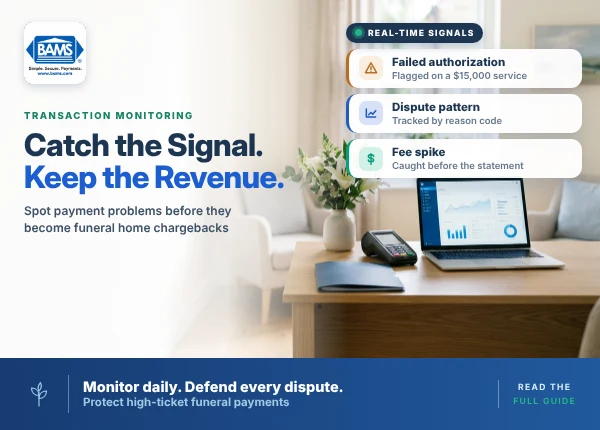
- Transaction monitoring tools turn payment data into clear signals — Use them to move past monthly statements to real-time dashboards that flag failed authorizations, dispute patterns and fee spikes before they cost you money.
- Prevent disputes at the point of sale — Clear billing descriptors, signed cardholder authorizations and itemized receipts eliminate the majority of friendly fraud chargebacks that plague high-ticket funeral transactions.
- Build a chargeback defense program that measures recovered dollars — Average net recovery is only 20%, but merchants using managed defense services recover 55% more. Track every dispute through final resolution, including second-cycle disputes.
- Optimize fees and funding speed with your own data — Calculate your effective processing rate, fix transaction downgrades and secure next-day funding to eliminate the cash flow gap between service delivery and supplier payments.
Why PCI Compliance and Transaction Monitoring Matter for Funeral Services
First, funeral homes occupy an unusual position in payments. Transactions are high-value, emotionally charged and often finalized under time pressure. A single chargeback on a $15,000 service doesn’t just cost you the revenue. It triggers fees, consumes staff hours and can push your merchant account toward monitoring programs that raise your processing rates permanently.
Moreover, the risk is growing. Nearly three-quarters of surveyed merchants reported an average 18% increase in friendly fraud over the preceding three years. Friendly fraud — when a real cardholder disputes a valid charge — is especially common in grief-driven purchases. A family member who didn’t approve the charge may contest it weeks later.
Meanwhile, PCI compliance isn’t optional. Failing to comply exposes cardholder data, triggers fines from card networks and can cost you the ability to accept cards at all. For a business where most families pay by credit card, that’s a survival issue. The cost of inaction is real — lost margin, delayed funding and disputes that pile up over time.
Core Concepts: Payment Data as an Operational Signal
PCI Compliance in Integrated Systems
PCI DSS (Payment Card Industry Data Security Standard) is the set of rules for how you store, process and send cardholder data. When your payment terminal, invoicing software and accounting system all share data, each connection is a weak spot. Every link in that chain must meet the standard — not just your card reader.
Transaction Monitoring vs. Transaction Reporting
Before choosing transaction monitoring tools, consider what you already have. Most funeral home operators receive monthly statements showing volume, fees and batch totals. However, that’s only reporting. Transaction monitoring tools go further. They flag anomalies in real time and track dispute patterns by reason code. They also surface trends (like recurring authorization failures on specific card types) that signal preventable losses before they become chargebacks.
Chargeback Defense as a System, Not a Reaction
A chargeback defense program is not the same as responding to disputes when they arrive. Instead, it’s a step-by-step workflow that starts at the point of sale with clear descriptors, signed authorization and itemized receipts. It then extends through representment (the formal process of fighting an invalid chargeback with evidence). Average net recovery from chargeback management sits at only 20%, which means most merchants lose the vast majority of disputed dollars. A systematic approach closes that gap and creates measurable financial impact.
The Friendly Fraud Problem
Friendly fraud accounted for an estimated 45% of chargebacks in a recent merchant survey. In funeral services, this often looks like a secondary family member disputing a charge they didn’t personally approve, even though your team already provided the service. Understanding this distinction matters because the defense strategy differs from true fraud prevention.
The Framework: From Compliance to Cash Flow Advantage
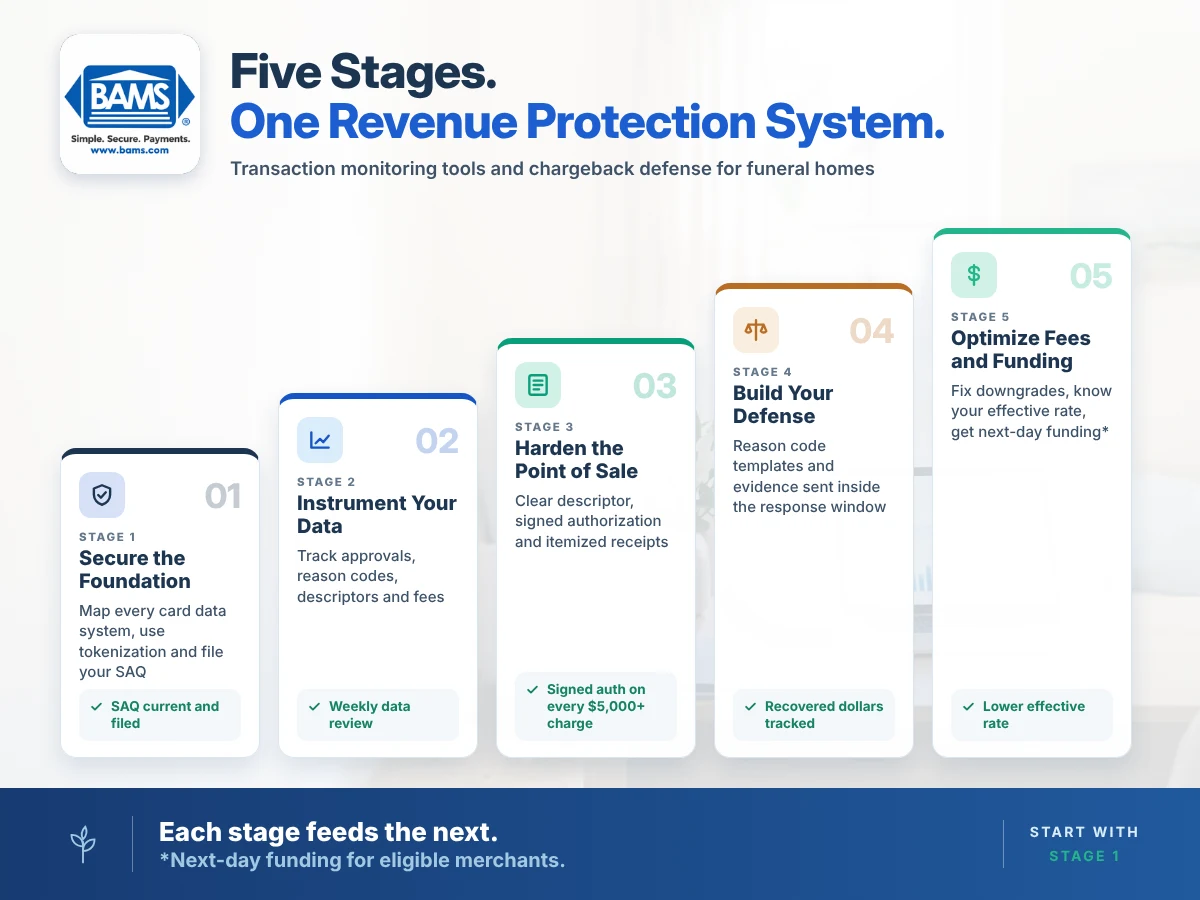
This guide follows a five-stage framework that treats every transaction as part of a connected system rather than an isolated event. The stages build on each other:
- Secure the Foundation (Stage 1) — Establish PCI compliance across your integrated payment stack.
- Instrument Your Data (Stage 2) — Configure transaction monitoring tools to capture actionable signals.
- Harden the Point of Sale (Stage 3) — Structure authorizations, descriptors and documentation to prevent disputes before they start.
- Build Your Defense Workflow (Stage 4) — Create a chargeback defense program that measures recovered dollars, not just win rates.
- Optimize Fees and Funding (Stage 5) — Use the data you’ve captured to reduce payment processing fees and accelerate cash flow.
As a result, each stage feeds the next. Compliance enables clean data capture. Clean data enables dispute prevention. Prevention reduces fees. The system compounds over time.
Step-by-Step Breakdown: Building PCI-Compliant Transaction Monitoring and Chargeback Defense
Step 1: Secure the Foundation with PCI-Compliant Integration
Objective: Ensure every system that touches cardholder data meets PCI DSS requirements. That eliminates compliance gaps at integration points between your payment terminal, funeral management software and accounting platform.
Execution guidance: Start by listing every system that stores, processes, or sends card data. This includes your POS terminal and your invoicing or funeral management software. It also includes any online payment portal you offer families and the accounting tool where transactions land. For each one, check if it is PCI-certified or uses tokenization (replacing card numbers with safe placeholders) to stay out of scope.
Let Tokenization Shrink Your Scope
Most funeral homes use a payment gateway between the family-facing payment method and the merchant account. When this gateway handles tokenization, your internal systems never see raw card numbers. That cuts your PCI compliance burden sharply. Confirm with your processor that tokens (not card numbers) are what flow into your funeral management and accounting software.
Complete your annual Self-Assessment Questionnaire (SAQ). Your SAQ type depends on how you accept payments. If you only take online payments through a fully hosted payment page, SAQ A is your simplest path. In-person terminals usually point to SAQ B, B-IP or P2PE, so confirm the right one with your processor. Document your compliance status and store it alongside your business licenses.
Anti-patterns: Do not store full card numbers in any system, including spreadsheets, paper files, or email. Do not assume your software vendor’s compliance covers your business. Your compliance obligation is separate from theirs. Avoid skipping the SAQ because “we’re too small to matter.” Card networks enforce regardless of business size.
Success indicators: You can name every system in your payment data flow. Each system either holds PCI certification or is out of scope via tokenization. Your SAQ is current and filed.
Step 2: Configure Transaction Monitoring Tools for Actionable Signals
Objective: Move beyond monthly statements to real-time visibility into authorization failures, dispute patterns and fee anomalies that signal preventable losses.
Execution guidance: First, ask your payment processor which transaction monitoring tools it offers and activate the dashboard. At minimum, you need visibility into four data streams: authorization approval/decline rates, chargeback reason codes, billing descriptor accuracy and per-transaction fee breakdowns.
Set alerts for specific triggers relevant to high-ticket funeral transactions. An authorization decline on a charge over $10,000 should notify you immediately so you can work with the family to resolve it before the arrangement conference ends. A chargeback filed within 48 hours of a transaction may indicate a family dispute rather than fraud. That calls for a different response than a chargeback filed 60 days later.
As Monica Eaton of Chargebacks911 has noted, chargeback data works as a key metric for smarter transaction decisions. Payment records, billing descriptors, refunds and dispute reason codes can reveal preventable losses — not just document them. In short, treat your transaction monitoring tools as operational instruments, not compliance artifacts.
Anti-patterns: Do not rely solely on monthly PDF statements from your processor. By the time you see the data, the dispute window has often closed. Avoid setting so many alerts that you ignore them all. Focus on the four data streams above and expand only when you have a process for acting on each alert.
Success indicators: You review data from your transaction monitoring tools weekly (not monthly). You can identify your top three chargeback reason codes. You know your authorization approval rate and whether it’s trending up or down.
Step 3: Harden the Point of Sale Against Disputes
Objective: Structure every transaction so that if a dispute arises, you have the documentation and descriptor clarity to win it.
Execution guidance: Three elements prevent the majority of friendly fraud disputes in funeral services: clear billing descriptors, documented authorization and itemized receipts.
Billing descriptors are the text your cardholder sees on their statement. If your descriptor reads “ACME LLC” instead of “Smith Family Funeral Home,” family members who didn’t attend the arrangement conference may not recognize the charge. Work with your processor to set a descriptor that includes your business name and phone number. In fact, this single change resolves a significant portion of “I don’t recognize this charge” disputes.
Authorizations and Receipts
Documented authorization means capturing a signed (physical or digital) agreement that specifies the cardholder’s name, the amount, a description of services and the cardholder’s explicit consent. For funeral services, this is especially important when the person signing the arrangement contract is different from the cardholder. Capture both signatures when possible.
List each service and merchandise item separately on your receipts. A single line reading “Funeral Services — $18,500” is far harder to defend than an itemized list showing casket, service fee, transportation and flowers as distinct charges. In addition, itemization helps families understand what they paid for, reducing buyer’s remorse disputes.
Anti-patterns: Do not process a card without a signed authorization, even under emotional time pressure. Do not use vague descriptors. Do not combine all services into a single line item on receipts.
Success indicators: Your billing descriptor matches your business name. Every transaction over $5,000 has a signed authorization on file. Receipts are itemized with at least four distinct line items for full-service arrangements.
Step 4: Build a Chargeback Defense Program That Measures Recovered Dollars
Objective: Create a repeatable workflow for responding to chargebacks that prioritizes net recovery (actual dollars returned) over gross win rate.
Execution guidance: When a chargeback arrives, your response window is typically 20 to 45 days depending on the card network. A structured defense program ensures you never miss that window and always submit the strongest possible evidence package.
Build a response template for each of your top three reason codes. For funeral services, these are typically “unauthorized transaction” (reason code 10.4 on Visa), “services not as described” and “credit not processed.” Each template should specify exactly which documents to include. Start with the signed authorization and itemized receipt. Then add proof of service delivery (such as a signed guest register or merchandise delivery confirmation) and any pre-service communication with the family.
When to Use a Managed Service
Merchants using representment software or managed services achieved a net recovery rate more than 55% higher than merchants managing chargebacks internally. This gap exists because managed services format evidence packages to card network specifications. They also include the specific data points adjudicators look for. If you’re handling more than two chargebacks per quarter, the math favors a managed approach.
Partners like BAMS offer proactive chargeback defense as part of their merchant services, with real-time dispute notifications and online dispute management from the first alert through resolution. For funeral homes processing high-ticket transactions, this kind of early intervention can recover thousands of dollars per incident.
Anti-patterns: Do not measure your chargeback program by win rate alone. A 70% win rate on $500 disputes is less valuable than a 40% win rate on $15,000 disputes. Nearly 40% of merchants do not track second-cycle disputes, which means they can’t measure whether their initial response actually resulted in recovered funds. Use your transaction monitoring tools to track every dispute through to final resolution.
Success indicators: You have a response template for each of your top three reason codes. Your average response time is under 10 business days. You track net dollars recovered (not just win/loss counts) and can report your recovery rate quarterly.
Step 5: Optimize Payment Processing Fees and Funding Speed
Objective: Use the transaction data you’ve captured to identify fee reduction opportunities and accelerate access to funds.
Execution guidance: Your payment processing fees aren’t fixed. They vary based on card type (rewards cards cost more to process), transaction method (keyed-in transactions cost more than chip-read) and your processor’s pricing model. Fortunately, the data from your transaction monitoring tools (Step 2) reveals exactly where your fees are highest.
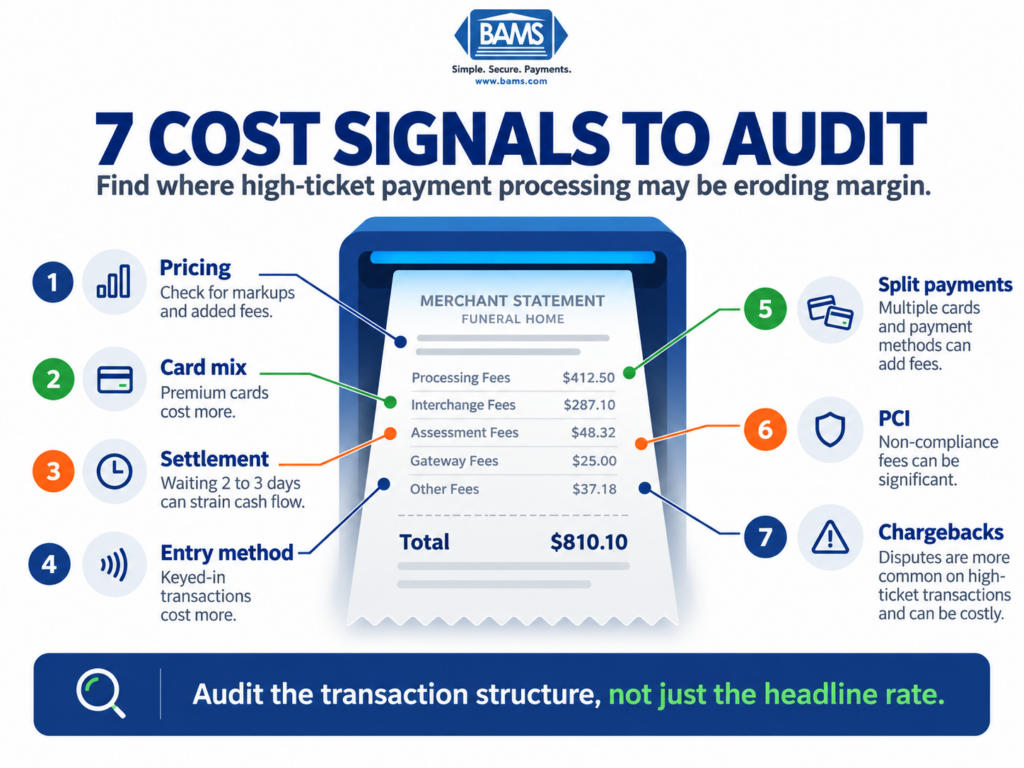
Review your per-transaction fee breakdown monthly. Look for three specific patterns. First, a high percentage of keyed-in transactions may mean your terminal isn’t reading chips properly. Second, a large share of rewards or corporate card transactions carries higher interchange rates. Third, watch for any fees labeled “non-qualified surcharge” or similar, which often indicate your processor is downgrading your transactions.
What Small Fee Differences Add Up To
For funeral homes, where average transaction values are high, even small percentage differences in processing fees compound quickly. A 0.3% difference on $15,000 is $45 per transaction. Across 200 services per year, that’s $9,000 in annual savings from fee optimization alone. Choosing a payment processor that offers interchange-plus pricing (where you see the actual interchange rate plus a fixed markup) gives you the transparency to identify these savings.
Speed Up Your Funding
Similarly, funding speed matters. In funeral services, you often pay suppliers (casket manufacturers, florists, vault companies) within days of the service. If your processor holds funds for three to five business days, you’re financing that gap out of pocket. Next-day funding eliminates that cash flow strain. BAMS, for example, offers next-day funding for eligible merchants and dedicated support specialists. As a result, funeral home operators can pay suppliers on time without maintaining large cash reserves.
Anti-patterns: Do not accept a flat-rate pricing model without understanding what interchange rates you’re actually paying. Do not ignore “miscellaneous” or “other” fee line items on your statement. These often contain the largest optimization opportunities. Avoid assuming your current rates are competitive without benchmarking them against what merchant services providers currently offer.
Success indicators: You can identify your effective processing rate (total fees divided by total volume) to two decimal places. Your keyed-in transaction rate is below 10% of total volume. You receive funds within one business day of batch settlement.
Practical Examples: How This Plays Out in Funeral Service Operations
Scenario 1: The Unrecognized Charge
A daughter arranges her father’s funeral and pays $17,200 with her mother’s credit card, with verbal permission. Six weeks later, the mother sees “ACME ENTERPRISES” on her statement and files a dispute. Because the funeral home has no transaction monitoring tools, clear billing descriptor or signed cardholder authorization, it loses the full amount plus a $25 chargeback fee.
With the framework applied: The billing descriptor reads “Smith Family Funeral — (555) 123-4567.” The arrangement contract includes the mother’s signature authorizing the charge. The receipt is itemized. When the dispute arrives, the funeral home submits the signed authorization, itemized receipt and proof of service within five business days. The card network reverses the chargeback. Net cost: staff time only.
Scenario 2: The Silent Fee Leak
A two-location funeral home processes $2.4 million annually. Their processor uses tiered pricing. The owner reviews monthly statements but sees only totals. However, their new transaction monitoring tools reveal that the processor downgrades 35% of transactions to “non-qualified” rates because of a POS configuration problem. Fixing the configuration saves 0.4% on those transactions, recovering $3,360 per year with no change in volume or pricing plan.
Scenario 3: The Compound Effect of Tracking Second-Cycle Disputes
A funeral home wins a chargeback representment on a $14,000 transaction. They mark it as “resolved” in their records. Two months later, the cardholder files a second-cycle dispute (pre-arbitration). Because the funeral home doesn’t track second-cycle disputes, they miss the response window and lose the $14,000 plus an additional arbitration fee. Tracking disputes through final resolution would have caught this and preserved the recovery.
Common Mistakes and Pitfalls
Overall, the most predictable failure in funeral home payment operations is treating compliance and chargeback defense as separate concerns. They are the same system. Compliance ensures clean data capture for your transaction monitoring tools. Clean data enables effective dispute defense. Defense reduces chargebacks. Fewer chargebacks keep your merchant account in good standing, which keeps your processing rates low.
Other common mistakes start with relying on verbal card approval during emotional meetings (always get a signature). Some operators also assume their software vendor handles PCI compliance for them (it doesn’t). Others measure chargeback results by win rate instead of net dollars recovered. Approximately 60% of merchants either used or planned to adopt AI-powered fraud prevention tools, while 25% used no prevention solution at all. The gap between those two groups will continue to widen.
Still, these are not signs of negligence. They’re the natural result of running a business where the primary focus is serving families, not managing payment infrastructure. The goal of this guide is to give you a system that runs in the background so you can keep your focus where it belongs.
What to Do Next
Before you add transaction monitoring tools, start with one action: pull your most recent processing statement and calculate your effective rate (total fees divided by total processing volume). That single number tells you whether your current setup is working for you or against you. If you don’t know what it should be, that’s the first conversation to have with your processor.
After that, work through the five stages in order. Compliance first, then monitoring, then point-of-sale hardening, then defense, then optimization. Each stage takes days, not months and each one delivers measurable results independently. Of course, you don’t need to overhaul everything at once.
Revisit this guide quarterly as your transaction monitoring tools mature. Over time, your transaction monitoring tools will reveal new patterns in your data. Then use those patterns to refine your approach. Payment operations are not a project with a finish line. They’re an ongoing system that improves with attention.
Frequently Asked Questions
What is PCI compliance and does it apply to funeral homes?
PCI DSS (Payment Card Industry Data Security Standard) applies to every business that accepts credit or debit cards, regardless of size or industry. If your funeral home processes, stores, or transmits cardholder data, you must comply. Most funeral homes can use a shorter Self-Assessment Questionnaire, especially if a hosted payment page or tokenized gateway keeps raw card numbers out of internal systems. Your processor can confirm which SAQ applies.
How do transaction monitoring tools differ from monthly processing statements?
Monthly statements show you totals after the fact: volume processed, fees charged and batch summaries. Transaction monitoring tools provide real-time or near-real-time visibility into authorization declines, chargeback reason codes, fee breakdowns per transaction and trend data. In other words, transaction monitoring tools turn a history book into a live dashboard. For high-ticket funeral transactions, real-time alerts on declines or disputes can save thousands of dollars per incident.
What is friendly fraud and why is it common in funeral services?
Friendly fraud occurs when a legitimate cardholder disputes a valid charge. In funeral services, this often happens when one family member uses another’s card (with verbal permission) to pay for arrangements. Later, the cardholder doesn’t recognize the charge or contests it. Friendly fraud accounts for an estimated 45% of all chargebacks. Clear billing descriptors, signed authorizations and itemized receipts are your primary defenses.
How can funeral homes reduce payment processing fees on high-ticket transactions?
Three strategies deliver the most impact. First, ensure your POS terminal reads chip cards rather than requiring manual key-entry, since keyed transactions carry higher rates. Second, use a processor with interchange-plus pricing so you can see exactly what you’re paying. Third, if you accept business or corporate cards, configure your system to transmit Level II data (tax amount and customer code), which can qualify those transactions for lower interchange rates. On a $15,000 transaction, even a 0.3% reduction saves $45.
How should a funeral home measure the success of its chargeback defense program?
Measure net dollars recovered, not just win rate. A program that wins 50% of disputes on $15,000 charges recovers more than one that wins 80% of disputes on $500 charges. Track every dispute through final resolution, including second-cycle disputes and pre-arbitration. Nearly 40% of merchants don’t track second-cycle disputes, which means they can’t accurately measure program ROI.
When should a funeral home consider switching to a managed chargeback defense service?
If you’re handling more than two chargebacks per quarter, or if your average disputed transaction exceeds $5,000, the economics favor a managed service. Merchants using managed representment services achieve net recovery rates more than 55% higher than those managing disputes internally. For high-ticket funeral transactions, that difference can represent tens of thousands of dollars annually.