An Introduction To BAMS’ Popular E-Commerce Integrations
Last Updated on September 4, 2026 by Dimitri Akhrin
Connecting Payment Processing With the eCommerce Tools You Already Use
We now live in a digital world, and online shopping has become a standard part of how people buy. A 2018 study cited by SmallBusiness.com found that 75% of Americans had purchased something online. That figure now serves more as historical context than a picture of today’s market. By 2026, eCommerce is no longer an emerging shopping channel. It is simply part of doing business.
That changes what merchants need from payment processing.
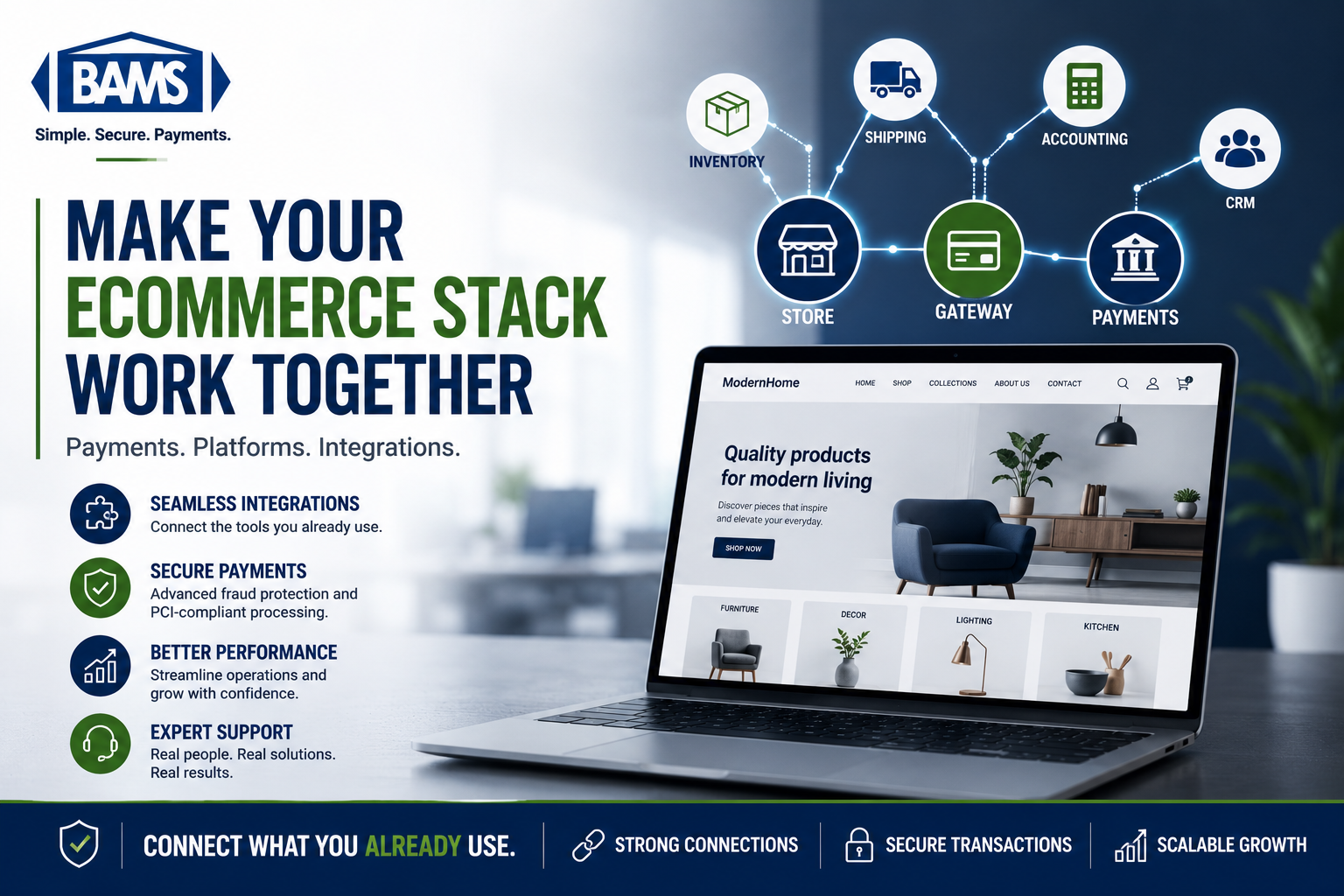
An online store may rely on a shopping platform, payment gateway, fraud tools, inventory software, shipping applications, accounting systems and several other services. Those pieces need to work together without making checkout unnecessarily complicated for the customer.
As a payment-processing provider, BAMS understands how important it is for merchants to keep the eCommerce technology they already rely on. The current BAMS integrations catalog includes payment gateways and commerce platforms ranging from Authorize.Net and CyberSource to Magento, BigCommerce, WooCommerce and Volusion.
Here is a current look at six of the eCommerce integrations available through BAMS and where each one fits.
TL;DR
- Your payment setup should work with the eCommerce tools you already use – BAMS supports integrations with platforms and gateways including Authorize.Net, Magento, CyberSource, BigCommerce, WooCommerce and Volusion so merchants do not necessarily have to rebuild their existing technology stack.
- Payment gateways and eCommerce platforms are not the same thing – Authorize.Net and CyberSource primarily handle payment technology, while Magento, BigCommerce, WooCommerce and Volusion manage the online store itself. Many merchants need both.
- The right integration depends on how complex your business is – A simple online store may need a straightforward hosted platform or gateway, while larger businesses may need APIs, custom workflows, advanced fraud tools or deeper ERP and inventory integrations.
- Integration flexibility matters more than platform popularity – Before choosing a solution, merchants should confirm compatibility with their payment processor, accounting tools, inventory systems, fulfillment software and future growth plans.
- PCI responsibilities still apply across the connected payment environment – Using a compliant third-party gateway can reduce direct exposure to card data, but merchants still need to understand where payment information enters the transaction and which security responsibilities remain with the business.
Authorize.Net
Authorize.Net is a long-established payment gateway that connects an online checkout with payment processing. It is now part of Visa Acceptance Solutions and supports major credit and debit cards, ACH/eChecks and digital payment methods including Apple Pay, Google Pay and PayPal.
That makes Authorize.Net useful for merchants that want to keep their existing shopping cart or eCommerce platform while connecting it to a separate merchant account and gateway.
BAMS maintains an extensive Authorize.Net integration ecosystem covering shopping carts, applications and other business tools.
Authorize.Net can also support recurring billing, customer payment profiles and virtual-terminal transactions, which makes the gateway useful beyond a simple one-time online checkout.
Who Should Consider Authorize.Net?
It can be a good fit for merchants that want a widely supported gateway without building the payment infrastructure themselves.
That includes businesses using established shopping carts, custom websites or hybrid operations that accept payments both online and through other channels.
The important distinction is that Authorize.Net is primarily a payment gateway. It does not replace the merchant’s entire eCommerce platform.
Magento
Magento remains one of the most customizable open-source eCommerce platforms available. Today, merchants generally encounter the ecosystem in two forms: Magento Open Source and Adobe’s commercial Adobe Commerce offering.
Magento Open Source remains actively maintained. Version 2.4.9 was released in May 2026, with regular support for that release line currently scheduled through May 2029.
The platform is especially useful for merchants that need a high degree of control over catalogs, checkout behavior, integrations and store functionality.
That flexibility comes with more technical responsibility than a fully hosted SaaS platform. Magento merchants generally need capable developers or technology partners to handle implementation, updates, extensions and infrastructure.
Businesses running older versions should also understand what Magento 1’s end of life means for security, support and migration. Magento 1 has been unsupported for years, so remaining on it creates a very different security and maintenance situation from running a current Magento 2 release.
Who Should Consider Magento?
Magento makes the most sense when the business needs the store to adapt around complex requirements rather than forcing those requirements into a predefined platform.
Large catalogs, B2B commerce, customized workflows and deep connections with ERP or inventory systems are all situations where that flexibility can be useful.
CyberSource
CyberSource is a Visa-owned payment platform and is now part of the broader Visa Acceptance Solutions family.
It is designed for more complex payment environments than a basic small-business gateway. CyberSource can process payments across multiple channels, support several gateway and acquiring-bank connections and provide consolidated reporting across payment activity.
Its fraud-management capabilities remain a major part of the platform. Visa currently offers Decision Manager as an AI and machine-learning-based fraud solution designed to help merchants identify risk while minimizing unnecessary declines.
CyberSource can therefore be particularly useful for larger eCommerce businesses that are concerned not only with accepting a transaction but with managing payment risk, global operations and increasingly complicated processing environments.
CyberSource vs Authorize.Net
Both sit within Visa Acceptance Solutions, but they generally address different levels of payment complexity.
Authorize.Net is designed around relatively straightforward merchant payment needs. CyberSource provides a broader enterprise payment infrastructure with APIs, global processing options and more extensive fraud and risk capabilities.
Which one makes sense depends less on which platform has more features and more on how complicated the merchant’s payment environment actually is.
BigCommerce
BigCommerce is a hosted SaaS eCommerce platform that allows merchants to build and operate an online store without managing the underlying commerce infrastructure themselves.
Hosting, platform maintenance and much of the underlying technology are handled within the BigCommerce environment. That gives merchants some of the operational simplicity associated with an all-in-one platform.
Where BigCommerce stands apart is its emphasis on APIs and extensibility.
The platform provides REST and GraphQL APIs that developers can use to connect external applications, automate store processes and create headless commerce experiences. That can make it attractive to merchants that want a managed SaaS platform without giving up the ability to connect specialized business systems.
BigCommerce also maintains a large ecosystem of third-party applications covering fulfillment, accounting, marketing, ERP and other functions.
Who Should Consider BigCommerce?
It can be a strong option for growing businesses that do not want to maintain their own eCommerce infrastructure but still need integrations and room to customize.
Merchants should compare the platform’s built-in tools, APIs and available payment integrations against the systems they already use rather than choosing based only on the feature count.
WooCommerce
WooCommerce is a free, open-source eCommerce platform built specifically for WordPress.
That relationship with WordPress remains one of its biggest advantages. Businesses can manage editorial content, landing pages, products and their online store inside one familiar environment.
WooCommerce also gives merchants considerable control over the store itself. Businesses can choose their hosting provider, theme, payment setup and extensions rather than operating entirely inside a closed SaaS ecosystem.
The platform supports physical products, digital goods, subscriptions, bookings and other commerce models through its core capabilities and extension ecosystem.
That flexibility also means the merchant is responsible for more of the technology environment. Hosting, plugins, updates, performance and compatibility need to be managed properly.
Who Should Consider WooCommerce?
WooCommerce is especially attractive for businesses already running WordPress or merchants that want significant control over the store without moving to a more technically demanding enterprise platform.
It also works well for content-heavy eCommerce businesses where search, editorial content and product discovery are closely connected.
Volusion
Volusion continues to operate as an all-in-one eCommerce platform for businesses that want to build and manage an online store without developing one from scratch.
Its current platform includes responsive storefront themes, a visual site builder, inventory management, payment collection and product-management tools.
Volusion also includes marketing features such as SEO management, newsletters and CRM functionality, allowing merchants to keep many common store-management tasks inside one platform.
That makes it a different proposition from something like WooCommerce or Magento. Instead of assembling hosting, commerce software and extensions separately, Volusion provides more of the environment as a managed service.
Gateway, Platform or Integration: Know What You’re Choosing
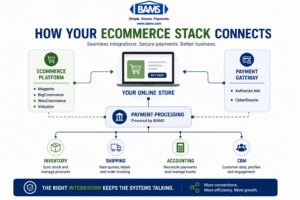
An eCommerce integration connects the online store with payment processing and the other systems a business depends on.
The products in this list do not all perform the same job.
Authorize.Net and CyberSource are primarily payment technology and gateway solutions.
Magento, BigCommerce, WooCommerce and Volusion are eCommerce platforms that help merchants build and operate the store itself.
The payment gateway sits between the checkout and the wider payment-processing environment. The eCommerce platform manages areas such as products, carts, orders and customer experience.
In many cases, merchants need both.
This distinction matters when comparing integrations because saying that two products both “accept payments” does not mean they are interchangeable.
Why Integration Flexibility Matters
The best payment setup is not necessarily the one that includes the most applications.
It is the one that connects the applications the business actually uses.
An online merchant might need payment processing to work with:
- Its existing shopping cart
- Inventory and fulfillment software
- Accounting or ERP systems
- Customer relationship management
- Subscription or recurring billing tools
- Fraud and chargeback management
- Shipping and order-management applications
Changing payment processors should not automatically mean rebuilding the rest of that technology stack.
This is one reason BAMS continues to maintain a broad integration catalog. A merchant can first identify the eCommerce platform or gateway that fits the business, then determine how payment processing can connect with it.
Payment Security Still Matters Across Every Integration
A connected technology stack is useful only if the payment environment remains secure.
PCI DSS applies to merchants that store, process or transmit payment account data and can also apply to systems that affect payment security.
Using a compliant third-party gateway can reduce the amount of card data a merchant handles directly, but it does not automatically eliminate the merchant’s PCI responsibilities.
Merchants should understand where payment information enters the transaction, which provider handles it and what responsibilities remain with the business.
Visa also emphasizes tokenization, fraud-management tools and flexible payment methods as important parts of modern online payment acceptance.
Which eCommerce Integration Is Right for Your Business?
| Integration | Type | Best Fit |
|---|---|---|
| Authorize.Net | Payment gateway | Businesses that want a widely supported gateway connected to an existing store or shopping cart. |
| Magento | Open-source / enterprise eCommerce | Businesses with complex commerce requirements and development resources. |
| CyberSource | Enterprise payment platform | Merchants that need global processing, APIs and advanced fraud management. |
| BigCommerce | Hosted SaaS eCommerce | Growing businesses that want managed infrastructure with strong API flexibility. |
| WooCommerce | Open-source WordPress eCommerce | WordPress businesses that want control over hosting, design and integrations. |
| Volusion | Hosted eCommerce platform | Businesses that want an all-in-one online store builder with built-in management tools. |
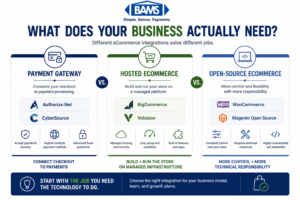
BAMS infographic comparing payment gateways, hosted eCommerce platforms and open-source eCommerce platforms.
Do Not Choose an Integration Based Only on Popularity
A platform can be widely used and still be the wrong fit for a particular business.
Before choosing an eCommerce platform or gateway, look at the systems you already have and the requirements you expect to have later.
Ask:
- Does it work with my preferred payment processor?
- Can I keep the checkout experience I already use?
- Does it support the payment methods my customers expect?
- Can it connect with my accounting, inventory or fulfillment systems?
- Who is responsible for maintaining the integration?
- Can I switch processors later without rebuilding the store?
- What happens as transaction volume grows?
The integration should remove work from the business, not create another system that employees have to manage manually.
Frequently Asked Questions
What is an eCommerce integration?
An eCommerce integration connects an online store with another business system. That can include a payment gateway, processor, accounting platform, inventory system, shipping service or marketing application.
Does BAMS integrate with major eCommerce platforms?
Yes. BAMS’ current integration catalog includes Authorize.Net, Magento, CyberSource, BigCommerce, WooCommerce and Volusion along with other payment and commerce solutions.
Is Authorize.Net an eCommerce platform?
No. Authorize.Net is primarily a payment gateway. It connects an online checkout with payment processing and supports cards, ACH/eChecks and several digital payment methods.
Is Magento still active in 2026?
Yes. Magento Open Source remains actively maintained. Version 2.4.9 was released in May 2026. Adobe also offers Adobe Commerce for businesses that need a commercial enterprise commerce platform.
Is BigCommerce open source?
No. BigCommerce is a hosted SaaS platform. It provides extensive APIs and customization options, but merchants do not host or control the underlying platform code in the same way they would with WooCommerce or Magento Open Source.
Is WooCommerce free?
The core WooCommerce platform is free and open source. Businesses still need hosting and may choose to pay for themes, extensions, development or other services.
Is Volusion still available?
Yes. Volusion continues to offer a hosted eCommerce store builder with themes, inventory management, payment tools, SEO features and other store-management capabilities.
Can I change payment processors without changing my eCommerce platform?
In many cases, yes, provided the platform supports a compatible gateway or processor integration. Compatibility should be confirmed before changing providers.
Build Around the eCommerce Platform That Works for You
Our long list of popular eCommerce integrations means that when you partner with BAMS for your merchant account, you may be able to keep the platform, shopping cart and checkout workflow your business already uses instead of starting over.
The goal is not to force every merchant onto the same technology stack. It is to connect payment processing with the tools that already make sense for the business.
Contact us today to find out how BAMS can help you save money and streamline your online payment processing.