Are You Running a Business and Looking for a Small Loan?
Last Updated on August 18, 2026 by Dimitri Akhrin
Know Your Small Business Financing Options Before You Borrow
Finding the right small business loan is not simply about getting approved. The amount available, repayment structure, speed, total cost and effect on cash flow can vary significantly depending on where the financing comes from.
That makes it worth comparing more than one option. A traditional bank loan may work well for one business while another may need a line of credit, investor capital or faster revenue-based financing.
Access to capital is one of the most pressing challenges for small businesses, especially during times of rapid growth. That makes the ability to find an affordable business loan and capital sources one of the keys to healthy growth and long-term success. But where can a small business go to get that much-needed capital in a pinch? Below we’ll look at three of the most popular options many businesses look to and one that most small businesses rarely think about, despite the fact that it might be the best of all.
Small Businesses Still Depend Heavily on Financing
The need for outside capital has not disappeared. The Federal Reserve Banks’ 2026 Small Business Credit Survey found that 86% of employer firms regularly use some type of financing. Credit cards and loans were the most common products.
Sixty percent of firms applied for financing during the previous 12 months. More than half of those applicants were looking for money to meet operating expenses while 46% wanted financing for expansion or a new opportunity.
Access is not guaranteed. Among businesses that applied for financing, 42% received the full amount requested while another 36% received only some or most of what they wanted.
That makes it useful for business owners to understand several possible funding paths before the need becomes urgent.
Bank Small Business Loans
Arguably the first place many small business owners will turn looking for small loans is the bank that they already do business with. There are certain advantages to the bank, the first of which is that you likely already have a relationship with them. The downside is that applying for traditional loans through local banks can come with higher barriers to entry than some other options and you may be unable to secure financing if the bank sees too much risk or if you’re unable to back the requested amount adequately.
Banks Can Still Be Worth Checking First
Traditional banks remain one of the largest sources of small business credit. They may offer term loans, lines of credit and other business financing products with repayment structures that are relatively familiar.
Approval can depend on business history, profitability, creditworthiness, available collateral and the amount requested.
The Federal Reserve also finds meaningful differences between lenders. In its 2025 review of small business credit, small banks approved at least some requested financing for a higher share of applicants than large banks in the underlying survey data.
If time allows, compare the bank you already use with at least one other provider. An existing banking relationship can be helpful but it should not automatically decide where the business borrows.
Angel Investment
Depending on the type of financing you’re looking for, angel investors might represent another possible source of capital. Angel investors are usually well-off individuals that provide capital to startups and while many will want equity in the company, there are some that provide loans (although they may require that debt to be convertible to equity at some point in the future.) Similarly, rather than going to angels, trusted family members can represent a good source for small loans, although it’s important to make sure any deals done with family are treated as professionally as they would be with an investor or bank.
Investor Capital Is Different From Borrowed Capital
Angel funding can reduce the immediate pressure of making traditional loan payments but it can introduce another cost: ownership.
If an investor provides capital in exchange for equity, the business is not simply borrowing money and repaying it later. The investor becomes an owner of part of the company.
Convertible debt can sit somewhere between the two structures. It may begin as debt but convert into equity under conditions defined in the agreement.
That makes angel investment more appropriate for some growth companies than for a merchant simply looking to cover a short-term inventory purchase.
Crowdsourcing
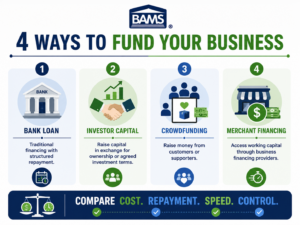
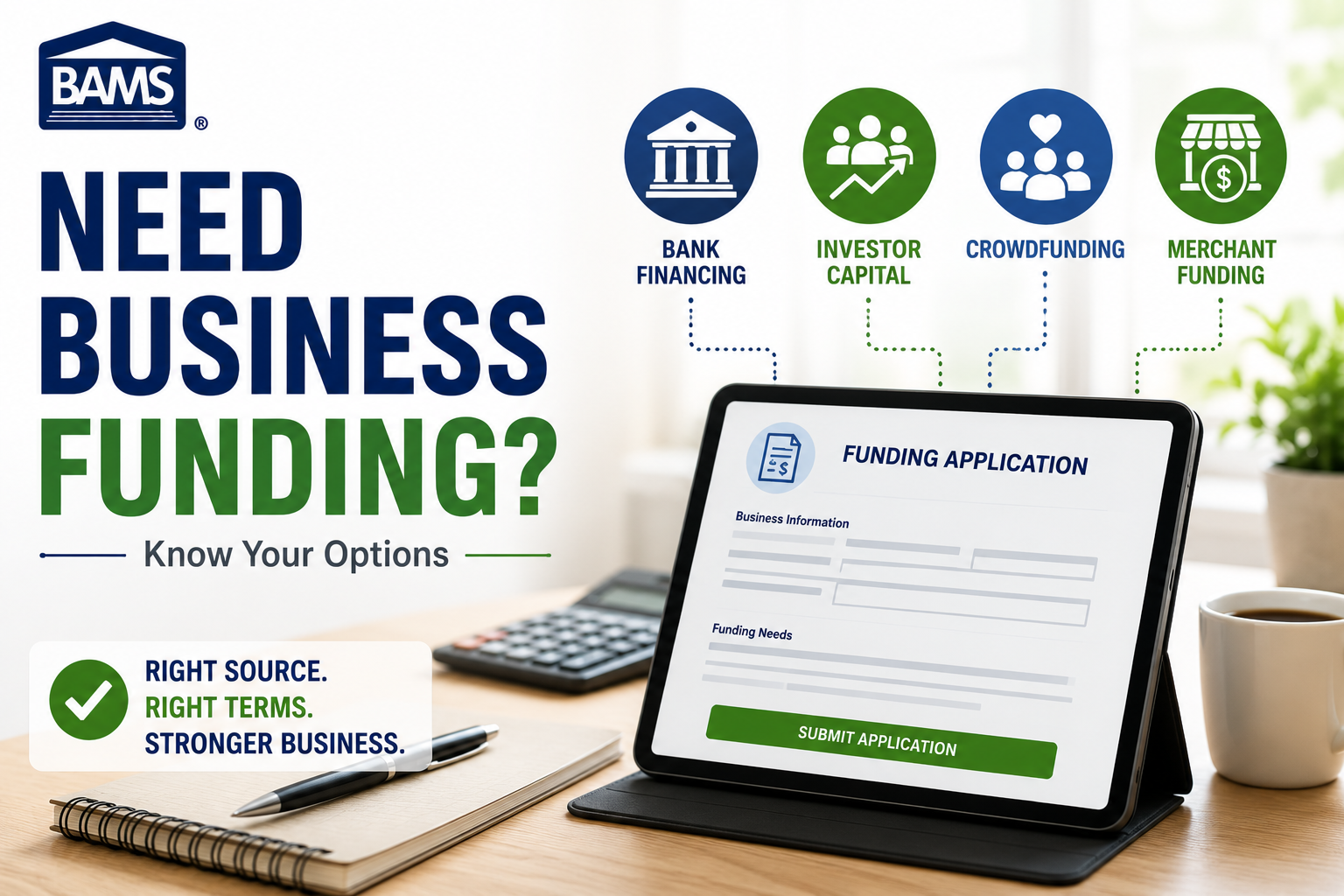
Small businesses can access capital through several channels and each option comes with different costs, repayment structures and tradeoffs.
Crowdsourcing is becoming a more and more popular source of funding in the digital age, especially for businesses looking to launch new products. Crowdsourcing essentially entails reaching out to your user base or your potential market and asking them to front the money for the business project you’re looking to finance. That often means an initial production run of products, but crowdsourcing has also been successfully used to generate initial capital for everything from artistic works to community projects and beyond.
Current terminology: Financing a business or product through contributions from a large group of people is generally described today as crowdfunding. Crowdsourcing is a broader term that can also refer to gathering ideas, work or information from a group.
Crowdfunding Can Avoid Traditional Debt
Reward-based crowdfunding can work well when a business has a product customers are willing to support before production begins.
Instead of borrowing money and making scheduled repayments, the business may promise products or rewards to supporters. That can provide capital while also testing demand.
It still carries obligations. A successful campaign may create hundreds or thousands of orders that need to be manufactured, fulfilled and supported. Businesses should understand those costs before treating every dollar raised as immediately available capital.
Look to Your Payment Processor
One source of capital that many small businesses overlook, if they even know it exists, is support from their payment processors. Some payment processors, like BAMS, are integrated with small business lenders, enabling businesses to apply for and receive capital infusions with extreme ease and speed, thanks in part to their relationship with the processor. BAMS, for instance, is integrated directly with Fundomate, a leading small business loan and cash advance provider. BAMS merchants can easily apply for loans of up to $500,000 with no collateral or personal guarantees required, at rates that are more affordable than 50% of alternative loan options. The Fundomate interface provides access to 20 pre-approved lenders, ensuring there is a financing option available for every company’s needs.
Current BAMS update: BAMS continues to partner with Fundomate but its current funding program describes a broader mix of merchant financing options rather than treating every product as a traditional small business loan.
BAMS currently lets merchants complete one online application and compare offers from more than 20 financing providers. Available solutions can include business loans and merchant cash advances with funding potentially available in as little as 24 to 48 hours.
The current BAMS program advertises funding advances of up to $500,000. Its published basic eligibility guidelines include at least three months in business, at least $10,000 per month in deposits and fewer than 10 nonsufficient-funds transactions per month.
Those guidelines do not guarantee approval or guarantee that every applicant will receive the same amount, rate or terms. The actual offer depends on the financing provider and the business.
A Small Business Loan and a Merchant Cash Advance Are Not the Same
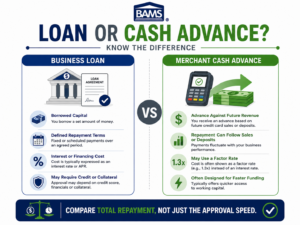
BAMS infographic comparing a traditional small business loan with a merchant cash advance.
This distinction is especially important when evaluating financing offered through nonbank providers.
A business loan generally provides borrowed capital under defined repayment terms. Depending on the loan, the borrower may make regular principal and interest payments over a specified period.
A merchant cash advance works differently. The provider advances capital in exchange for repayment tied to future business receivables or deposits. Pricing may also use a factor rate rather than a familiar interest rate.
The Federal Reserve warns that business financing disclosures can vary significantly because many consumer-credit disclosure requirements do not apply to commercial financing. Some offers use factor rates or other pricing structures that cannot be compared directly with an APR.
Before accepting either product, calculate what the business will repay in dollars and understand how often payments will leave the account.
Speed Should Not Be the Only Reason to Choose Financing
Getting money quickly is useful when an opportunity or unexpected expense cannot wait.
It can also make it tempting to focus on approval speed instead of cost.
The 2026 Small Business Credit Survey found that online lenders have become increasingly common. The share of applicants seeking financing from online fintech lenders rose from 17% in the 2020 survey to 29% in 2025.
But borrowers should still compare offers carefully. Among firms that borrowed from online lenders, 60% said their actual borrowing costs were higher than expected. High interest rates and unfavorable repayment terms were also among the most common problems businesses reported with online lenders.
Fast capital can be valuable. Expensive capital can create another problem if the repayment schedule puts too much pressure on the business afterward.
Understand the Total Cost Before Signing
Ask every financing provider to explain the offer in dollars.
How much money will the business receive?
How much will it repay in total?
What fees are included?
How often are payments collected?
Does the agreement require collateral or a personal guarantee?
What happens if sales slow down?
Can the financing be repaid early and does doing so reduce the cost?
The Federal Reserve specifically recommends that business owners review both the cost and terms of financing offers rather than comparing only the headline rate. Fees, collateral requirements and repayment flexibility can vary widely between products.
Match the Financing to the Reason You Need It
Not every capital need deserves the same financing product.
| Business Need | Financing Approach to Consider |
|---|---|
| Long-term expansion | A traditional term loan may provide a more predictable repayment schedule. |
| Short-term working capital | A line of credit or short-term financing may provide more flexibility. |
| Startup growth | Angel or equity investment may make sense when the business can trade ownership for capital. |
| New product launch | Crowdfunding may help raise capital while testing customer demand. |
| Urgent revenue-based need | Merchant financing or a cash advance may offer faster access but should be compared carefully on total cost. |
The objective is not to find the financing product with the easiest application. It is to find one whose cost and repayment schedule fit the economic benefit the business expects to receive from using the money.
Do You Actually Need Financing?
Before borrowing, consider whether the problem is capital or timing.
A business waiting several days for card-processing revenue may have money coming in but still experience a temporary cash-flow gap. In that situation, faster access to existing sales may help without creating a new financing obligation.
Qualifying BAMS merchants can also review next day funding, which accelerates access to eligible processed sales. That is different from a loan or cash advance because the merchant is accessing revenue it has already earned rather than borrowing new capital.
If the business genuinely needs additional capital beyond existing sales, financing may be appropriate. The distinction helps prevent borrowing simply to solve a payment-settlement timing problem.
How Current BAMS Merchant Funding Works
BAMS currently offers merchant financing through its Fundomate partnership. The process is designed around comparing several possible offers instead of submitting separate applications to multiple providers.
1. Complete one application. BAMS allows merchants to submit a simplified online funding application.
2. Compare available offers. Eligible applicants can review financing options from more than 20 providers.
3. Choose the appropriate structure. Options can include merchant account loans and merchant cash advances depending on qualification and business needs.
4. Review the full terms. Compare the funding amount, repayment structure, total cost and any other requirements before accepting.
5. Receive the funds. BAMS currently states that qualifying offers can fund in as little as 24 to 48 hours.
The amount available varies by business. BAMS currently advertises funding advances of up to $500,000 and cash advances that may be based partly on monthly credit-card sales or average bank deposits.
Frequently Asked Questions
Where can a small business get a loan?
Businesses can seek financing from banks, credit unions, online lenders and other nonbank financing providers. Other capital sources can include investors, crowdfunding and financing programs available through business-service providers.
How much small business financing do companies typically seek?
Financing needs vary considerably. Federal Reserve research has found that many small firms seek relatively modest amounts while others need substantially more for expansion, equipment or working capital.
Is a merchant cash advance a small business loan?
No. A merchant cash advance generally provides funding in exchange for repayment from future receivables or deposits. Its cost and repayment structure can differ significantly from a traditional business loan.
What is a factor rate?
A factor rate is a pricing method sometimes used for business financing. For example, a factor rate may be multiplied by the amount advanced to determine the total repayment amount. It should not be treated as equivalent to an annual percentage rate.
Should I choose the financing provider that approves me fastest?
Speed is one factor but it should not replace a comparison of total cost, repayment requirements and the impact those payments may have on business cash flow.
Does BAMS still work with Fundomate?
Yes. BAMS currently offers merchant financing through its Fundomate integration and says eligible merchants can compare funding offers from more than 20 providers.
How much funding can BAMS merchants apply for?
BAMS currently advertises funding advances of up to $500,000. Actual approval amounts and terms depend on the business and the financing provider.
How quickly can BAMS merchant funding arrive?
BAMS currently states that qualifying funding can become available in as little as 24 to 48 hours.
What are the basic BAMS merchant funding requirements?
BAMS currently lists basic guidelines that include at least three months in business, at least $10,000 in monthly deposits and fewer than 10 nonsufficient-funds transactions per month. Individual financing providers can apply additional underwriting requirements.
Is next day funding the same as a business loan?
No. Next day funding accelerates the deposit of eligible sales a merchant has already processed. A loan or merchant cash advance provides additional capital that the business must repay.
For more information on BAMS’ Fundomate integration and how partnering with BAMS for your payment processing can help you raise capital faster and at better rates, contact us today!