
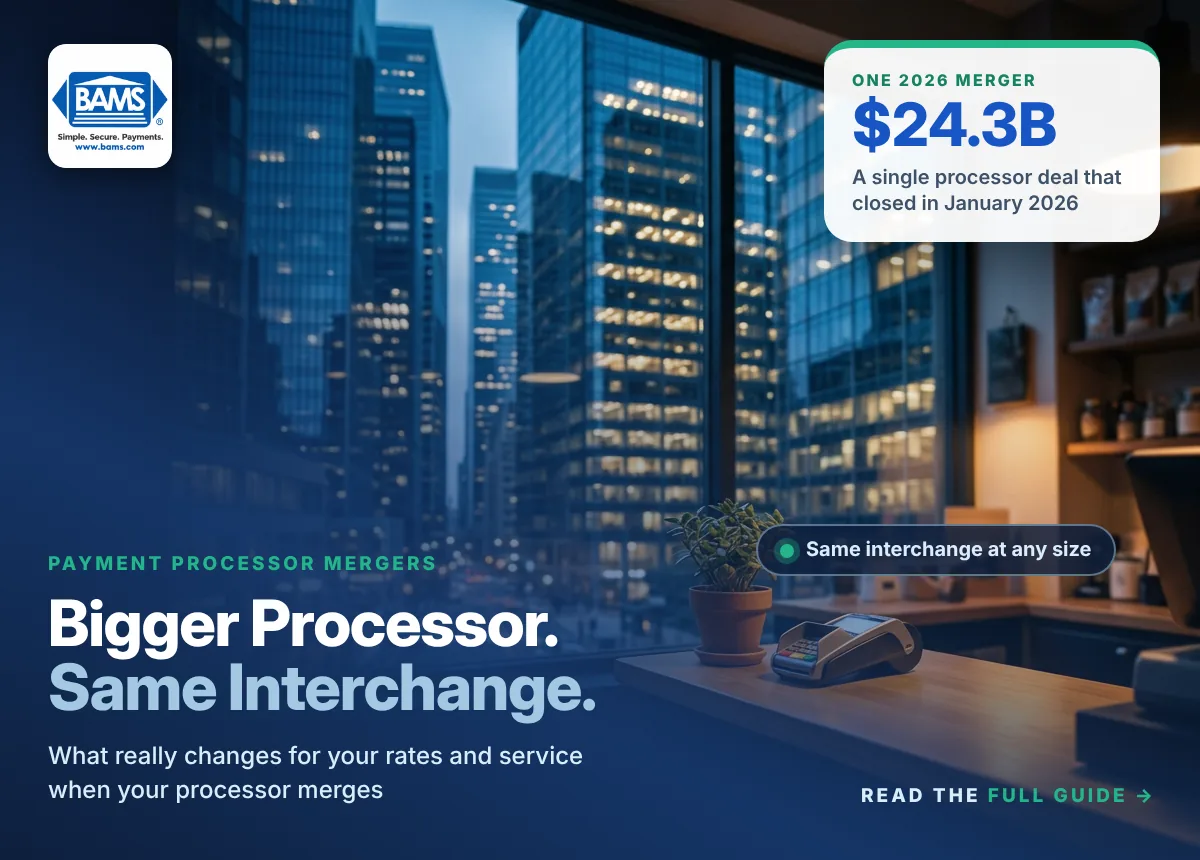
Does Size Matter? In an Age of Major Mergers, what do Merchants Gain from Going Big?
Last Updated on October 26, 2026 by Dimitri Akhrin
The payments industry keeps getting bigger at the top. Over the past decade, payment processor mergers have combined some of the largest names in merchant services into even larger companies. So does size matter for your business? And when your processor merges, what actually changes for you?
Below, we look at the biggest deals, what they can mean for merchants and how to protect your rates and service when your provider changes hands.
TL;DR
- Consolidation keeps going. In January 2026, Global Payments closed its $24.3 billion purchase of Worldpay.
- Bigger doesn’t mean cheaper interchange. Card networks set interchange, so every processor pays the same base cost.
- Mergers can change your account. Watch for new terms, fees, platforms and support contacts.
- Service is the real difference. Compare markup, funding speed and how easily you can reach a real person.
A Decade of Payment Processor Mergers
Here are some of the deals that reshaped merchant services:
- 2017: First Data bought CardConnect for $750 million.
- 2018: Vantiv combined with Worldpay in a deal valued at about $10.4 billion.
- 2019: Global Payments announced its $21.5 billion merger with TSYS.
- 2019: Fiserv completed its $22 billion acquisition of First Data on July 29.
- 2026: Global Payments closed its $24.3 billion purchase of Worldpay. At the same time, it sold its card issuer business to FIS for $13.5 billion.
The result is a handful of very large processors. For example, Global Payments says the combined company serves more than 6 million merchant locations in more than 175 countries.
What Payment Processor Mergers Mean for Merchants
Mergers can bring real benefits. Larger companies often have more money to invest in technology, security and new payment options. However, a merger can also change how your account works, sometimes with little notice.
After a deal closes, merchants may see:
- New terms or contracts that you need to review and accept.
- Platform migrations that move you to new terminals, gateways or reporting tools.
- Pricing changes, including new statement fees or a different pricing model.
- Support changes, such as new phone lines, longer wait times or a different account contact.
Not every merger brings these changes. Still, it pays to read every notice your processor sends during and after a merger.
Does Size Matter When You Choose a Processor?
When it comes to your base costs, size matters less than you might think. Interchange makes up the largest part of most card fees. Better yet, the card networks set it, not your processor. In fact, Mastercard publishes its interchange rates, which depend on factors like card type and transaction data rather than your processor’s size.
As a result, the biggest differences between processors come from three places:
- Markup: What the processor charges on top of interchange.
- Funding speed: How fast the money reaches your bank account.
- Service: How quickly you can reach someone who knows your account.
What to Check After Payment Processor Mergers
If your provider was part of a merger, run this quick check:
- Compare your effective rate. Divide total fees by total card volume and compare it with past months.
- Look for new line items. Flag any fee you don’t recognize and ask what it covers.
- Confirm your funding schedule. Make sure deposits still arrive when you expect them.
- Test your support. Call with a simple question and see how long it takes to get an answer.
- Review your contract. Check for new terms, renewal dates or early termination fees.
Why Many Merchants Choose BAMS
At BAMS, you get a dedicated support specialist instead of a general call center. BAMS also publishes its rates: 1.65% + 20¢ for in-person payments and 2.20% + 20¢ for online payments. Plus, eligible merchants get next-day funding at no extra cost.
Not sure if you’re overpaying after a merger? Request a BAMS five-point price comparison. We’ll review your current statement and show you where you stand.
Frequently Asked Questions
Why do payment processors merge?
Processors merge to gain scale, add technology and reach more merchants. Larger volume can also lower their own operating costs.
Will my rates change after payment processor mergers?
They might. Some merchants see new fees or pricing after a merger. So compare your effective rate before and after the deal closes.
Do bigger processors get lower interchange rates?
No. The card networks set interchange rates. Processors differ mainly in their markup, fees and service.
Can I switch processors after a merger?
Usually, yes. However, check your contract for termination fees and equipment terms before you switch.


