
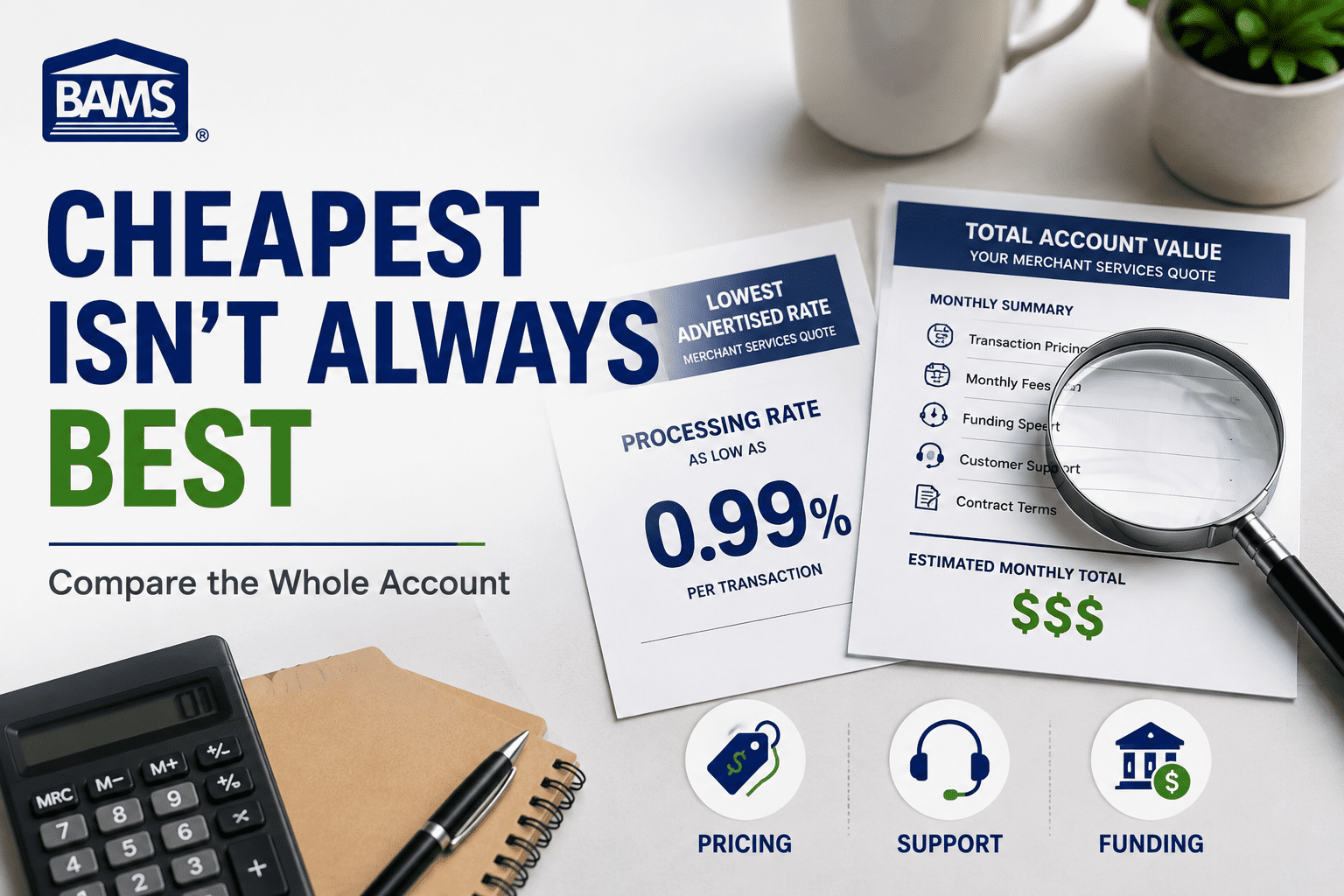
Should You Choose the Lowest-Priced Merchant Services?
Last Updated on August 17, 2026 by Dimitri Akhrin
Low Price Matters, but Look at the Whole Merchant Account
Low-cost merchant services can make a real difference to a business that processes hundreds or thousands of payments every month. But the cheapest advertised rate is not always the cheapest account once every fee, contract term and service requirement enters the picture.
The better question is not simply, “Which processor has the lowest rate?” It is, “What will this account actually cost my business and what am I getting for that cost?”
One of the hardest decisions to make as a merchant is which payment processing services to use. Most have arcane fee structures that make it hard to tell exactly what you’ll pay. There’s the discount rate, the transaction fee, the statement fee, and more. Even worse, some of the fee names are the opposite of what they sound like or are otherwise confusing.
Even with all of these nebulous terms, sufficient searching will eventually lead you to one or more merchant services that are clearly cheaper than the rest. The deal may seem so great that you wonder if there’s a catch! It’s almost impossible to find out just from the advertising, but the answer is “sometimes.”
The Advertised Rate Is Only One Number

The lowest advertised processing rate does not always produce the lowest total merchant services cost.
Payment processing does not have one universal cost. Different parts of the payment system can contribute to what eventually appears on a merchant statement.
Visa explains that interchange reimbursement fees operate between acquiring and issuing banks while the merchant negotiates its merchant discount with its financial institution. Modern Treasury also describes card-processing costs as a combination of interchange and other payment-related fees.
This matters when comparing processors. Two companies can advertise similar rates and still produce very different monthly costs.
One processor might charge less per transaction but add more monthly fees. Another may have a slightly higher headline number with fewer additional charges. Looking at either rate by itself leaves out part of the story.
Be Wary of “Just for You” Offers
When you get the contract to sign up for merchant services, be wary of clauses that indicate a much higher rate than what the salesperson tells you. Also be careful of high fees for canceling your account, adding or removing locations, and other such things. At the time you sign up, you might be told that the fees are waived “for you.” Don’t believe it. When you make a major change, expect the fees to be charged to your bank account, and to have to vehemently argue to get them removed.
Make the Contract Match the Conversation
If a salesperson promises a waiver, special rate or exception, look for it in the paperwork before signing.
Do not assume a verbal promise overrides the agreement. Ask where the special pricing appears. Check whether it expires after an introductory period. Look at what happens when transaction volume changes or the business adds another location.
If the explanation and the contract do not match, stop there and ask for clarification.
A good pricing discussion should become clearer as you ask questions, not harder to understand.
Compare the Pricing Model, Not Just the Percentage
Knowing the pricing structure makes it easier to understand what you are actually comparing.
A bundled or tiered model can group different transactions under processor-defined rates. Other structures expose more of the underlying transaction cost. If you want to know what the processor earns on top of card costs, that distinction matters.
BAMS offers transparent interchange plus pricing for businesses that want clearer visibility into how their processing costs are structured.
The Federal Reserve’s published debit-card data also shows why one headline percentage cannot describe every transaction. Interchange amounts can vary across networks and transaction categories.
When you compare quotes, ask each provider to explain the pricing model in plain language. Then ask how that model will appear on the monthly statement.
Look for High-Quality Providers
Good providers have good reviews, a professional attitude, and a straightforward fee structure. You won’t be given a contract that says one thing and has a “waiver” written in by the salesperson. In short, a high-quality merchant services provider should present itself as one.
Once you find some candidates, then go through their fees and choose the ones with the lowest prices. By putting quality first, you’ll avoid bad companies and still save money on your payment processing fees.
Price Should Not Come at the Expense of Support
A processor can look inexpensive while everything works perfectly. The real test often comes when something does not.
What happens if a terminal stops working on a busy afternoon? Who explains an unfamiliar charge on the statement? Is support handled by someone who can see the account or by a general queue that sends the merchant somewhere else?
Those questions have an economic value even though they do not appear beside the transaction rate.
One hour without the ability to accept payments can cost more than a small difference in processing fees. The same is true when a billing problem takes weeks to resolve because no one owns the account.
Look at support before you need it. Find out how merchants can reach the provider and whether the account includes a dedicated contact, technical support or an online help system.
Funding Speed Can Change the Value of the Account
The cheapest transaction rate is not necessarily the best deal if the business has to wait longer for its money.
Funding affects working capital. A restaurant still buys inventory. A retailer still pays suppliers. Payroll does not wait because a processor has not deposited last week’s card sales yet.
Ask each provider when ordinary batches reach the business bank account and whether faster funding carries an additional charge.
For qualifying merchants, BAMS offers guaranteed next day funding. That can be worth considering alongside the transaction rate when cash flow matters to the business.
Watch the Fees Outside the Transaction Rate
A quote can look inexpensive because the processor draws attention to one number.
Read everything else.
Depending on the account, merchants may encounter recurring charges, equipment costs, gateway charges or fees tied to specific account activity. The exact fee structure varies, which is why a side-by-side comparison works better than comparing one percentage from each proposal.
Make a list of every recurring and conditional charge you can identify. If you do not understand one, ask what triggers it.
The objective is not to find a provider with no fees at all. Payment processing is a service and it has a cost. The objective is to understand what you will pay before the charges reach the statement.
Calculate the Total Cost Using Your Own Business
An advertised example may not look anything like your transaction mix.
A business processing many small purchases has different economics from one processing a few large invoices. Online transactions can also behave differently from in-person payments.
Use your own merchant statement whenever possible.
Take a recent month and ask each provider to show how the same activity would have been priced under its proposal. Include transaction fees, recurring account charges and any other costs that would have applied.
Then compare the totals.
A difference that looks tiny on one transaction can become meaningful across a year. The reverse is also true: an impressive advertised rate may matter very little once the complete account cost is calculated.
What to Compare Before Choosing Merchant Services
You do not need a complicated spreadsheet to make a better decision. Start with the parts of the account that actually affect the business.
| What to Compare | What to Ask |
|---|---|
| Processing pricing | How is each transaction priced and how will the markup appear? |
| Recurring fees | What will I pay even in a month with little or no processing? |
| Conditional fees | Which charges appear only when something changes or happens? |
| Contract terms | What happens if I cancel, add a location or change my setup? |
| Funding | When will processed funds reach my bank account? |
| Support | Who helps when I have a billing, equipment or transaction problem? |
| Technology | Will the provider work with the payment setup my business needs? |
Cheap Merchant Services and Good Merchant Services Can Be the Same Thing
Compare pricing, fees, contract terms, funding, support and technology before choosing a merchant services provider.
There is nothing wrong with wanting the lowest possible processing cost. Businesses should question unnecessary fees and compare alternatives.
The mistake is assuming that “lowest priced” and “best value” always mean the same thing.
A good merchant services provider should be able to compete on price without making the merchant give up transparency, reliable technology or useful support. If one provider is dramatically cheaper than everyone else, find out why before assuming you discovered a bargain.
BAMS backs its pricing with a Competitive Price Guarantee. If a qualifying merchant receives a lower merchant account fee schedule from a registered financial service provider while working with BAMS, BAMS states that it will match or beat the qualifying offer.
Frequently Asked Questions
Should I choose the cheapest merchant services provider?
Not automatically. Compare the total account cost, contract terms, funding, technology and support. A low rate can be valuable, but only when the rest of the account works for the business.
Why can merchant processing quotes be difficult to compare?
Processors can use different pricing structures and fee schedules. One quote may emphasize the transaction rate while another separates more of the costs. Compare the complete monthly cost whenever possible.
What is interchange?
Interchange is part of the card-payment cost structure. Card networks establish interchange schedules that apply between issuing and acquiring sides of card transactions. It is separate from the processor or financial institution’s merchant pricing.
Why should I use my current merchant statement when comparing providers?
Your statement reflects your real transaction volume and payment mix. Asking providers to price the same activity can give you a more useful comparison than relying on a generic advertised example.
Does the lowest transaction rate always mean the lowest monthly cost?
No. Monthly fees, conditional charges, equipment, funding and other account costs can change the total. Compare the full fee schedule rather than one percentage.
How important is funding speed?
Funding determines how quickly processed sales become available to the business. Merchants that rely heavily on daily cash flow should compare deposit schedules alongside processing rates.
What should I look for in a merchant services contract?
Check the agreed pricing, recurring charges, cancellation provisions, equipment terms and any fees connected with changes to the account. Make sure special rates or waived fees appear in writing.
What is the BAMS Competitive Price Guarantee?
BAMS states that qualifying clients can request a price match when they receive an eligible merchant account offer with a lower fee schedule from a registered financial service provider.
For a merchant account that offers you great rates with no tricks, just contact us. We’ll be glad to serve your payment processing needs.


