The Best Payments Processing Service Provider For Restaurants
Last Updated on August 18, 2026 by Dimitri Akhrin
What Restaurants Need From Payment Processing in 2026
Restaurant payment processing has to work differently from payments in many other industries. A restaurant can have several employees taking payments at once, customers splitting checks, tips added after service and orders coming from the dining room, takeout counter or online.
The processor sitting behind that activity needs to do more than approve a card. It has to fit the restaurant’s POS, keep checkout moving during busy service and give management a clear view of what happened afterward.
From self-ordering kiosks to tabletop and handheld server tablets, restaurateurs are finding new ways to invest in customer experience. Having a point of sale (POS) and payment processing system that’s both reliable, secure, and flexible is one area, in particular, that’s of primary focus. Thanks to technology and the rise of digital, the restaurant industry has seen its fair share of evolution over the last decade.
You need to partner with a service provider you can trust when handling the payments of your customers, especially as POS data breaches become more commonplace.
For the sake of your customer’s satisfaction and the long-term success of your restaurant business, this is why BAMS is the best payments processing service provider for restaurants:
#1: It’s Easy to Integrate with Your Existing POS
Putting BAMS to work for your restaurant business shouldn’t require a change in your existing POS technology. After all, convenience and organization are key when it comes to managing payments successfully. This is why BAMS payment processing integrates seamlessly with a wide range of popular restaurant POS systems, including Braintree, MICROS, FreedomPay, and ShopKeep.
Best of all, when it comes to support, our specialists are experienced with a variety of systems, which allows for easy setup and troubleshooting throughout.
2026 integration update: Those options are still represented in BAMS’ current integration catalog. Restaurant integrations now span systems including Braintree, MICROS, Freedom Pay, ShopKeep, Clover, Aloha, LAVU, Lightspeed, Revel Systems and several others.
The number of integrations matters less than whether the processor works with the technology your restaurant actually uses. A restaurant should not have to replace a familiar POS simply to change processors if a compatible integration already exists.
Think Beyond the Register
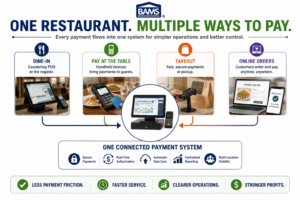
Modern restaurants can accept payments across several customer touchpoints while keeping processing and reporting connected.
A restaurant’s payment environment can stretch well beyond the countertop terminal.
Dine-in checks may come through fixed terminals or handheld devices. Takeout orders may originate online. Delivery transactions can enter through another system entirely. Some restaurants also operate several locations that need to roll up into one management view.
The processor and POS should be able to handle those channels without creating unnecessary reconciliation work afterward.
Before changing payment providers, map out where every type of transaction originates. Then confirm that each important workflow will still function after the transition.
#2: It Enables EMV POS Transactions
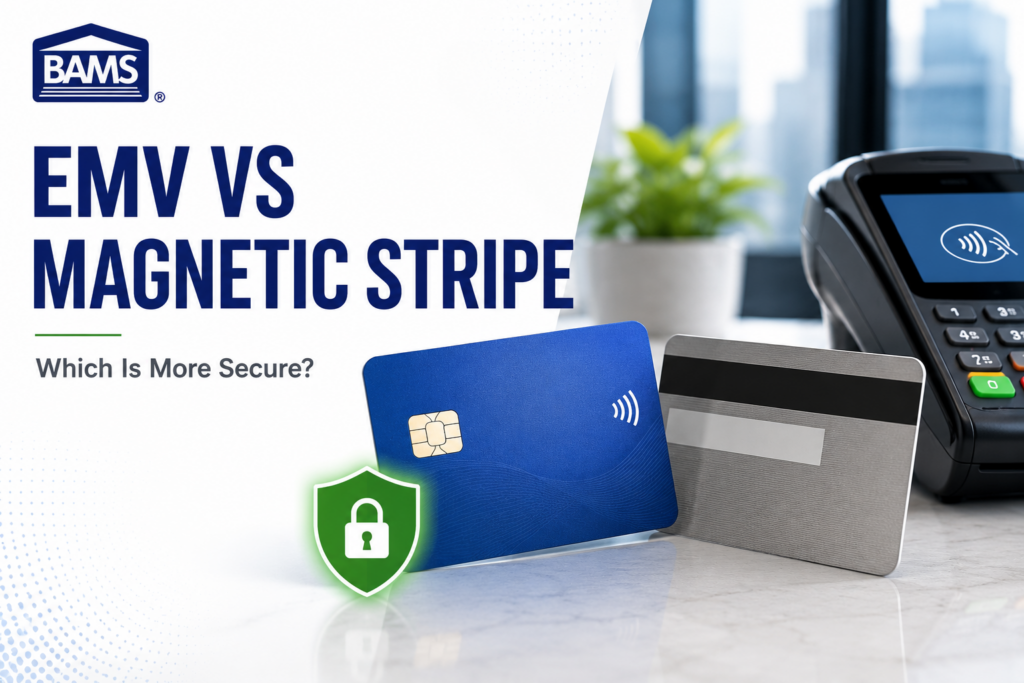
The shift to EMV (which stands for Europay, Mastercard, and Visa) has been gradually taking place across restaurants within the last five years.
Consumer cards have become globally equipped with computer chips in an effort to protect consumers and reduce the risk of fraud. And because of this, restaurants have had to keep up with emerging POS and payment processing technology that complies with new liability rules around consumer data.
If your current POS doesn’t read EMV chip transactions, you’re putting both your business and customers at risk. Along with our processing system, BAMS’ EMV POS solutions are easy to install, set up, and integrate into your current customer experience workflow.
2026 EMV update: EMV is no longer an emerging restaurant payment technology. Chip acceptance is now a standard part of card-present payments and modern terminals can also support contactless cards and mobile wallets.
That matters in restaurants because the checkout does not always happen at a traditional register. A server may bring a handheld terminal to the table. A quick-service restaurant may accept tap payments at the counter. A customer picking up an order may pay with a phone instead of a physical card.
A restaurant payment setup should support those experiences without forcing staff to create a different process for every payment method.
EMV Is One Part of Payment Security
EMV helps reduce counterfeit card-present fraud but it does not secure every part of the restaurant’s payment environment.
Restaurant operators still need to protect POS systems, networks and any other technology that can affect cardholder data. PCI DSS applies to entities that store, process or transmit cardholder data or that can affect its security.
That distinction matters when several systems connect to the POS. The card reader can use secure chip technology while another part of the environment still creates risk if it is poorly configured or maintained.
#3: It Centralizes Your Analytics
Storing your customer data is one thing, but making it easily accessible and actionable can change the way you do business. BAMS provides an easy-to-use analytics dashboard for restaurant businesses, providing an ongoing glimpse into business operations.
Additionally, BAMS e-commerce merchant accounts gain access to our proprietary portal — one that allows you to better streamline operations to maximize profit down the road. Storing all of this data in one CRM also helps you improve upon customer experience with easily searchable transaction history, as well as statements for simplified reconciliation.
The reporting side becomes increasingly useful as the restaurant grows. BAMS currently provides visibility into daily deposits, searchable transaction history, transactions broken down by card type and account statements.
Multi-location operators can also view several accounts from one place. That makes it easier to compare deposits or investigate a transaction without moving between separate systems for every restaurant.
Good reporting should answer ordinary questions quickly. Did yesterday’s deposit arrive? Which location processed the transaction? What card type was used? Does the statement match the restaurant’s internal records?
If finding those answers requires several exports and spreadsheets, the reporting system is creating work rather than removing it.
Restaurant Payments Have to Keep Moving During Service
A processor can look excellent on paper and still become a problem when something breaks at 7:30 on a Saturday night.
Restaurants have very little room for payment downtime. Customers are waiting to leave, servers need to close checks and tables need to turn over.
That makes support part of the payment product.
Ask what happens if the terminal or POS connection fails. Find out who staff can contact and whether backup payment options are available. BAMS currently offers troubleshooting support along with backup terminal and offline-processing options for compatible restaurant setups.
The best time to understand that process is before the restaurant needs it.
Faster Funding Can Matter More in Restaurants
Restaurants turn revenue back into operating expenses quickly. Food orders, payroll, supplies and other costs do not stop while card transactions work their way through the funding cycle.
BAMS currently offers next-day funding to many qualifying restaurant merchants and some may qualify for same-day deposits depending on their processing setup.
Next-day funding can make eligible card revenue available as early as the following business morning. That does not increase the restaurant’s sales. It simply reduces the amount of time the business waits to use money it has already earned.
For a restaurant with tight purchasing cycles or heavy weekend volume, that timing can make cash-flow planning easier.
Do Not Judge a Restaurant Processor Only by the Rate
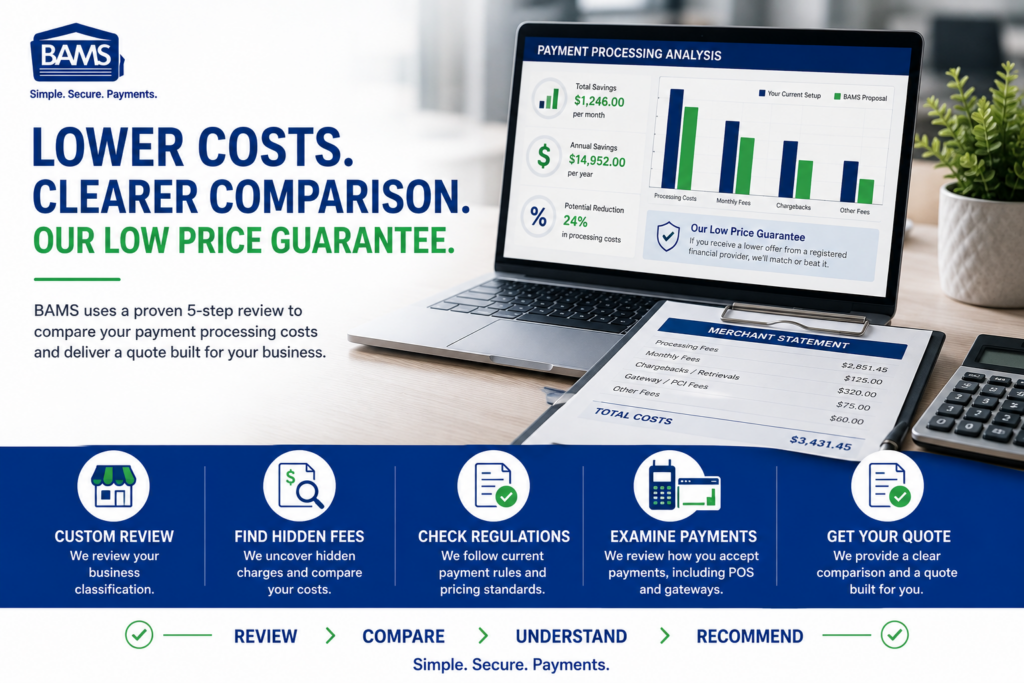
Processing cost matters. Restaurants can run thousands of card transactions each month so small pricing differences can add up.
But the lowest quoted percentage tells only part of the story.
Look at the pricing structure, recurring fees and funding schedule. Then consider what the restaurant receives for that cost. Does the processor support the existing POS? Can staff accept chip and contactless payments? Is reporting useful? Can someone help when service is disrupted?
The processor should make those questions easy to answer.
That is especially important when comparing a bundled restaurant POS with a separate processor. An all-in-one system may simplify setup while a more flexible arrangement may provide greater choice around processing and integrations. Neither approach is automatically right for every restaurant.
What to Compare Before Choosing Restaurant Payment Processing
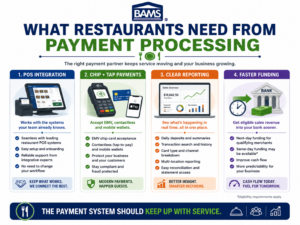
Restaurant payment processing should connect with the POS, support modern payment methods and give operators clear access to transactions and deposits.
| What to Compare | Why It Matters |
|---|---|
| POS compatibility | The processor should work with the restaurant technology you rely on. |
| EMV and contactless acceptance | Customers should be able to insert or tap cards and use compatible mobile wallets. |
| Pay-at-the-table options | Handheld devices can keep checkout closer to the customer and reduce unnecessary trips to a fixed terminal. |
| Reporting | Deposits, transactions and statements should be easy to review. |
| Funding speed | Know when processed revenue will reach the restaurant’s bank account. |
| Support | Restaurants need a clear plan for payment problems during operating hours. |
| Processing cost | Compare the complete fee structure rather than one advertised rate. |
Frequently Asked Questions
What should a restaurant look for in a payment processor?
Start with POS compatibility, reliable support, transparent pricing and modern payment acceptance. Restaurants should also consider reporting, funding speed and whether the processor can support dine-in, takeout and other important sales channels.
Can BAMS work with an existing restaurant POS?
BAMS currently supports a broad range of restaurant POS integrations. Its integration catalog includes systems such as Braintree, MICROS, Freedom Pay, ShopKeep, Clover, Aloha, LAVU, Lightspeed and Revel Systems among others.
Do restaurants still need EMV terminals?
Yes. EMV chip acceptance is a standard part of modern card-present payments. Current terminals can also support contactless cards and compatible mobile wallets.
Does EMV make a restaurant PCI compliant?
No. EMV protects an important part of card-present authentication but PCI DSS covers the wider payment environment. Restaurants still need to understand the PCI requirements that apply to their systems.
Does BAMS support pay-at-the-table payments?
BAMS currently offers restaurant payment options that include pay-at-the-table devices, mobile readers and EMV terminals.
Can BAMS support multiple restaurant locations?
Yes. BAMS currently provides multi-account reporting that can help restaurant groups review transactions, deposits and account information across several locations.
Can restaurants get faster funding?
Many qualifying BAMS restaurant merchants can access next-day funding. Some restaurants may also qualify for same-day funding depending on their processing setup and eligibility.
Why does restaurant payment reporting matter?
Clear reporting makes it easier to reconcile deposits, find individual transactions and review activity across locations. It can also reduce the time managers spend piecing information together from separate systems.
Final Thoughts: The Best Payments Processing Service Provider for Restaurants
When it comes to the success of your restaurant business, payment processing is one piece of the puzzle where you do not want to cut corners. For the sake of customer satisfaction, security, and peace of mind as a restauranteur, partner with a payment processing service provider you can trust.
The restaurant payment environment has become broader since this article was first written. Customers now move between countertop terminals, handheld devices, contactless payments and online ordering without thinking much about the technology connecting those experiences.
Your processor should make that complexity feel simple on the restaurant side too.
Eager to learn more about whether BAMS’ solutions are right for you? Contact our team today to request a free quote.