NYC Merchant Services Processing
Last Updated on September 23, 2026 by Dimitri Akhrin
NYC Payment Processing Has to Keep Up With the Way New York Businesses Operate
New York City businesses operate in one of the busiest commercial environments in the country. Restaurants can continue processing payments late into the evening, retailers may serve both local customers and online shoppers and professional service businesses may accept payments through invoices, recurring billing or virtual terminals.
That means choosing an NYC merchant services provider should involve more than finding someone who can process a credit card transaction.
Merchants need payment technology that fits the way customers pay, access to knowledgeable support when questions arise and a funding schedule that keeps processed revenue moving into the business.
BAMS is headquartered in Bay Ridge, Brooklyn and provides merchant services throughout Manhattan, Brooklyn, Queens, the Bronx and Staten Island while also supporting businesses nationwide.
TL;DR
- Local support can make merchant services easier to manage – An NYC based payment team operates alongside the same business day as local merchants and can provide a clear point of contact for account, equipment, funding and processing questions.
- Payment technology should match how your customers actually pay – NYC businesses may need a combination of EMV terminals, contactless payments, mobile acceptance, online checkout, recurring billing and other payment tools depending on their operation.
- Funding terms matter as much as transaction authorization – A successful card payment does not mean the revenue is immediately available in the merchant’s bank account, so merchants should compare settlement schedules and daily batch cutoffs.
- Local processing still needs modern security and eCommerce capabilities – Working with a nearby provider should not limit the business to countertop terminals. Merchants should also evaluate gateway compatibility, PCI responsibilities and online payment support.
- Compare the complete merchant relationship rather than one advertised rate – Pricing, support, funding, payment technology and reporting all affect how well a processor fits the business after the account is opened.
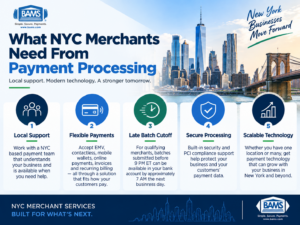
NYC merchants need payment processing that combines local support, flexible payment options, secure technology and funding terms that fit how their businesses operate.
1. Local Support Should Match the NYC Business Day
One of the most practical advantages of working with a local NYC merchant services provider is access to a payment team operating during the same business day.
This does not mean card transactions process differently because the provider is located nearby. Payment authorization and settlement systems operate electronically regardless of where the processor’s office is located.
The advantage appears when a person needs help.
A merchant may need assistance understanding a deposit, reviewing a transaction, replacing equipment, configuring payment technology or resolving an account question. Having a team based in the same region can make those conversations easier to coordinate.
BAMS is headquartered at 413 86th Street in Bay Ridge, Brooklyn. Its local NYC merchant services operation supports businesses throughout all five boroughs while its payment infrastructure supports merchants nationwide.
That combination can be useful for a business that wants accessible local account support without limiting where it can operate or sell.
2. Local Knowledge Means Understanding How the Business Accepts Payments
The original version of this article focused heavily on where customers’ cards were issued.
A more useful approach in 2026 is to focus on how the merchant actually accepts payments.
A Manhattan restaurant may process a significant portion of its volume during evening service. A Brooklyn retailer may combine storefront sales with eCommerce orders. A contractor may accept payments at customer locations while a professional services company may rely on invoices and recurring billing.
The payment setup should reflect those differences.
Before choosing a processor, merchants should review:
- Where customers pay
- Which payment methods customers prefer
- Whether the business sells online
- Whether recurring billing is needed
- What POS or business software is already in use
- When the majority of daily transactions occur
- How many locations need to be managed
Local knowledge is most valuable when it leads to a payment setup designed around the operation instead of a generic terminal package.
3. Modern NYC Payment Processing Goes Beyond the Countertop Terminal
Merchant services have expanded considerably beyond traditional card terminals.
Modern businesses may accept payments through:
- EMV chip cards
- Contactless cards
- Mobile wallets
- Online checkout
- Virtual terminals
- Recurring billing
- Invoices
- Mobile payment devices
Visa describes modern payment processing around secure transactions, efficient operations and payment technology that supports different customer experiences through a flexible processing environment. Its payment processing guidance also highlights cards, digital wallets and secure gateway technology as part of modern payment acceptance.
That flexibility matters in New York because many businesses no longer operate through one checkout channel.
A restaurant may accept payments at the table and through online ordering. A retailer may sell from a storefront and an eCommerce site. A service business may take payments in person while also sending customers digital invoices.
BAMS offers an integrated payment gateway for businesses that need to connect online, in-store or omnichannel payment environments.
4. eCommerce Matters Even for a Local NYC Business
Being a local New York business does not mean every customer is physically located in New York.
An NYC based merchant can sell to customers throughout the country through an online store while continuing to serve customers at a physical location.
That means the merchant services provider should be able to support both sides of the operation.
An eCommerce merchant account may need gateway integration, fraud controls, secure checkout, recurring billing and reporting that works alongside the merchant’s in-person payment activity.
Businesses should confirm compatibility with their existing website, shopping platform and other payment tools before changing providers.
The goal should be one payment environment that supports the channels the business actually uses rather than forcing the merchant to rebuild working systems around the processor.
5. Funding Timing Can Be Especially Important for Fast Moving Businesses
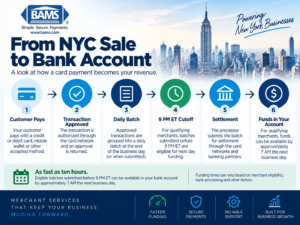
A step-by-step look at how an NYC card payment moves from checkout through settlement and into the merchant’s bank account.
Payment authorization and access to funds are two separate events.
A customer may successfully complete a purchase while the merchant still waits for the transaction to batch, settle and reach the business bank account.
That delay matters when card revenue is regularly used for payroll, inventory, food costs, advertising or other operating expenses.
The Federal Reserve Banks’ 2025 Report on Employer Firms found that 51% of surveyed employer firms cited uneven cash flow as a financial challenge while 56% cited paying operating expenses.
Faster funding cannot solve every cash flow problem but it can reduce the amount of time a business waits to access revenue it has already earned.
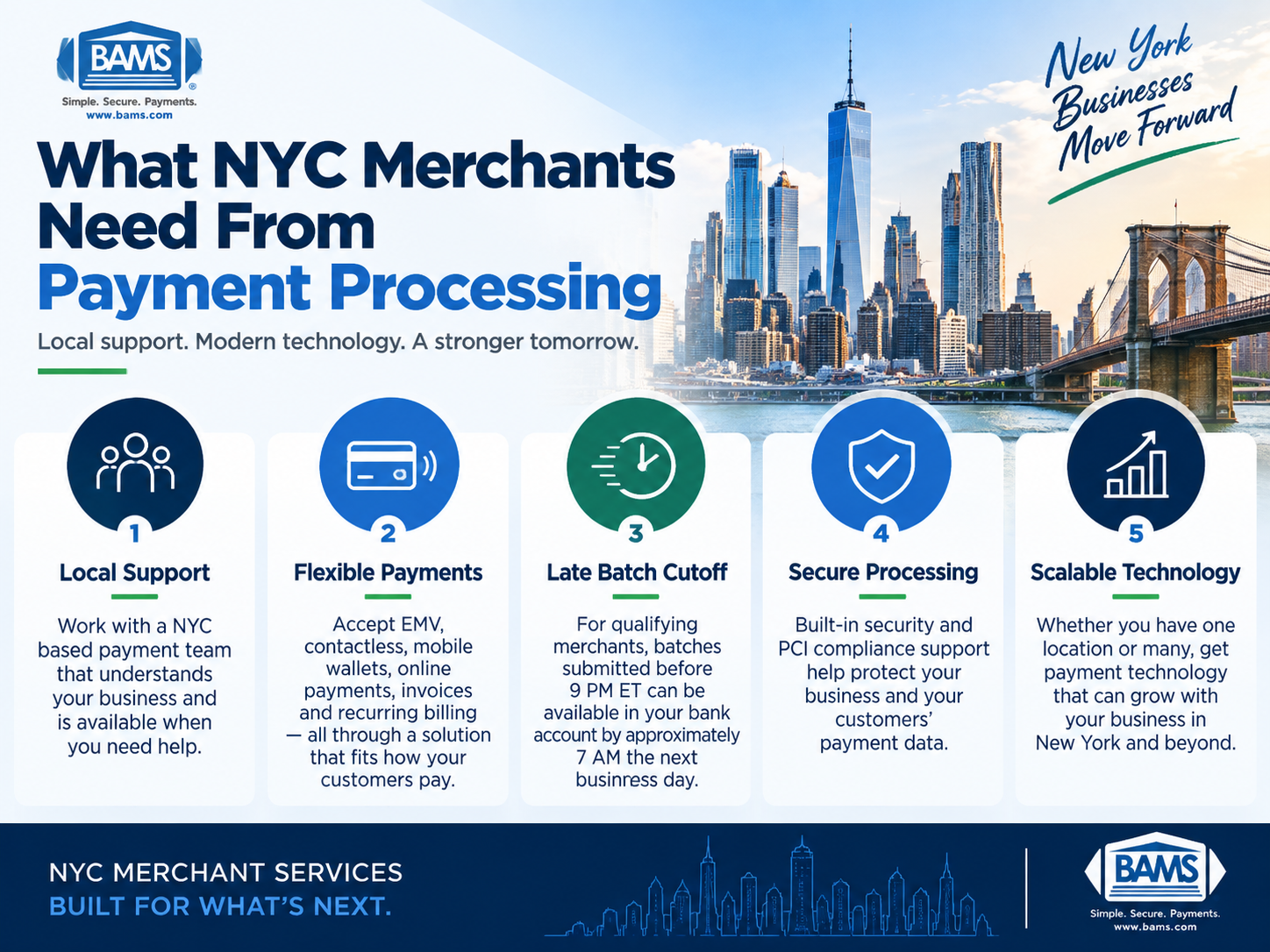
For qualifying merchants BAMS offers guaranteed next day funding with a 9 PM ET cutoff. Eligible batches submitted before that cutoff can be available in the merchant’s bank account by approximately 7 AM the following business day, allowing qualifying funds to arrive in as little as ten hours.
Why the Batch Cutoff Matters
A late cutoff can be particularly useful for businesses that continue processing meaningful sales into the evening.
Before choosing a merchant services provider, ask:
- What is the normal funding schedule?
- What is the daily batch cutoff?
- Does my business qualify for faster funding?
- Are additional fees charged for faster deposits?
- How are weekends and bank holidays handled?
- What circumstances can delay a deposit?
The answers can have a meaningful effect on how quickly processed sales become usable cash.
6. NYC Merchants Still Need to Compare Pricing Carefully
Working with a local provider should not mean paying without understanding how the account is priced.
A merchant should be able to identify the major costs associated with accepting payments.
Those can include:
- Processor markup
- Transaction fees
- Monthly account costs
- Gateway charges
- PCI related costs
- Chargeback fees
- Hardware or software expenses
The headline transaction percentage is only one part of the comparison.
BAMS offers transparent interchange plus pricing for businesses that need clearer visibility into the underlying transaction cost and processor markup.
Merchants should compare their complete effective processing cost instead of assuming that the lowest advertised percentage automatically represents the least expensive account.
7. Payment Security Should Be Part of the NYC Merchant Services Checklist
Convenience and local support should never replace payment security.
The Payment Card Industry Data Security Standard applies to businesses involved in payment processing regardless of merchant size or transaction volume.
The PCI Security Standards Council’s merchant resources explain that PCI DSS establishes technical and operational requirements designed to protect payment account data. The Council also notes that merchants can have different validation requirements depending on their payment environment.
That means a neighborhood retailer using countertop terminals may have a different PCI environment from an eCommerce merchant whose website accepts card information.
Merchants should understand which systems store, process or transmit payment data and what responsibilities remain with the business.
8. Reporting Becomes More Important as the Business Grows
Payment processing does not end when a transaction is approved.
Merchants also need to understand what happened after the sale.
Useful reporting should make it easier to review:
- Transactions
- Daily batches
- Deposits
- Refunds
- Statements
- Chargebacks
- Multiple merchant accounts or locations
This becomes particularly useful for businesses operating several restaurants, retail stores or service locations across New York City.
A centralized view can help management compare locations and investigate differences without logging into disconnected payment systems for every storefront.
9. A Local Processor Should Still Be Able to Scale Beyond New York
Choosing a provider with an NYC presence should not limit future growth.
A Brooklyn retailer may eventually open a location in another state. A Manhattan eCommerce business may already serve customers nationwide. A restaurant group may expand beyond the five boroughs.
The payment provider should be able to support those changes without forcing the business to replace its core processing relationship each time it grows.
That means looking at scalability from the beginning.
Ask whether the provider can support:
- Additional locations
- Higher transaction volume
- Online and in-person payments
- New payment methods
- Existing POS and software integrations
- Centralized reporting
What Should You Compare When Choosing NYC Merchant Services?
| Area | What to Ask |
|---|---|
| Local support | Who will help me when an account or payment issue occurs? |
| Pricing | What is my complete effective processing cost? |
| Payment technology | Can the provider support how my customers currently pay? |
| Integrations | Will my existing POS, website and business software continue working? |
| Funding | When will processed revenue reach my bank account? |
| Batch cutoff | How late can transactions be submitted for the fastest available funding? |
| Security | What PCI responsibilities apply to my payment environment? |
| Reporting | Can I easily review transactions, deposits and multiple locations? |
| Scalability | Can the processor continue supporting the business outside NYC? |
Frequently Asked Questions
What are NYC merchant services?
NYC merchant services include the payment processing, merchant accounts, terminals, gateways, funding, reporting and support businesses use to accept and manage electronic payments in New York City.
Does a payment processor need to be located in New York?
No. Payment authorization and settlement systems operate electronically. The advantage of an NYC based provider is primarily access to a local account team that works during the same business day and understands the operating environment of New York businesses.
Does using a local processor make card transactions process faster?
Not automatically. Transaction authorization depends on the payment infrastructure rather than the processor’s office location. Funding speed depends on settlement terms, batch timing, banking schedules and merchant eligibility.
Can an NYC merchant services provider support eCommerce?
Yes. A locally based provider can support online as well as in-person payments. Merchants should confirm gateway compatibility, online checkout requirements, security tools and integrations before choosing a provider.
Why does the batch cutoff matter?
The batch cutoff determines which transactions qualify for a particular funding schedule. A later cutoff can help businesses processing significant evening sales include more of those transactions in the same daily batch.
Do small NYC merchants need PCI compliance?
Yes. PCI DSS is intended for entities involved in payment processing regardless of business size or transaction volume. The exact validation requirements can vary according to the merchant’s payment environment.
What should an NYC merchant compare before switching processors?
Compare total processing cost, support, funding schedule, batch cutoff, payment technology, gateway and POS compatibility, reporting, security and the provider’s ability to support future growth.
Sources
- Visa Acceptance Solutions – Process Payments
- Federal Reserve Banks – 2025 Report on Employer Firms
- PCI Security Standards Council – Merchant Resources
NYC Merchant Services Built Around How Your Business Operates
New York businesses do not all process payments the same way. The right merchant services relationship should account for when customers pay, which payment channels the business uses and how quickly processed revenue needs to become available.
BAMS combines a local Brooklyn presence with payment technology and merchant services that can support businesses throughout New York City and nationwide.
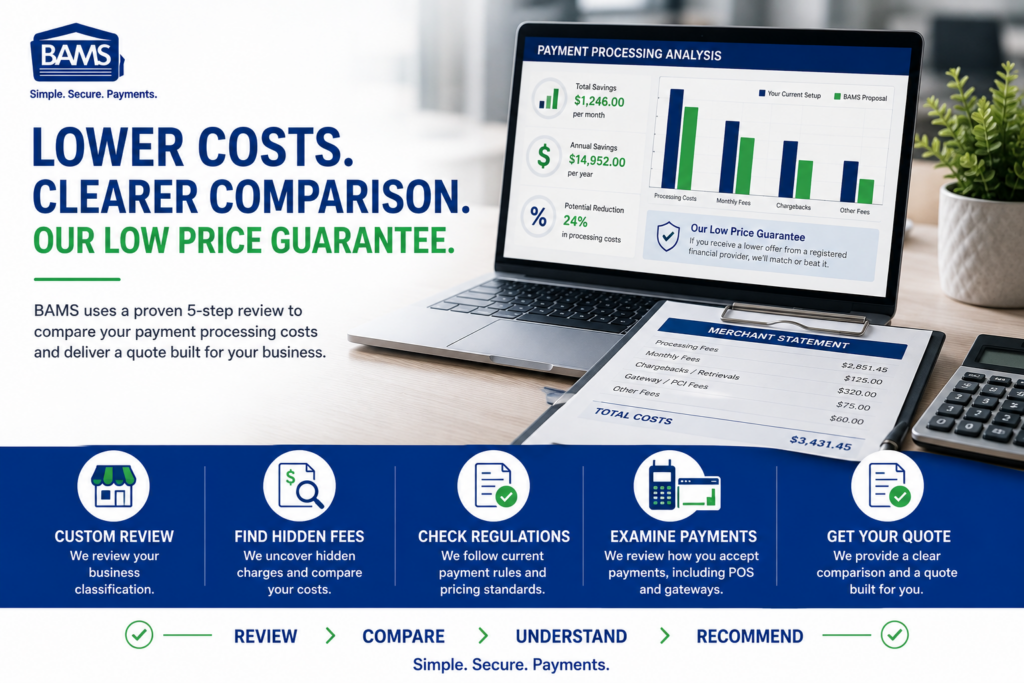
If you want to compare your current payment processing setup with BAMS, request a free five-point Merchant Account Price Comparison. The BAMS team can review your existing statement and compare your current processing costs, payment setup and available pricing options.