
Why Payment Processors Must Prioritize AI Search
Insights from Evan Bailyn, Founder of Generative Engine Optimization (GEO)
The payment processing industry is intensely competitive. Businesses constantly compare providers to find the best rates, fastest funding, and most reliable support.
For years, traditional search engine optimization (SEO) helped companies like BAMS reach merchants through Google search results. But the way business owners find information is rapidly changing.
Today, many decision-makers ask AI platforms such as ChatGPT, Claude, and Perplexity questions like:
- “What are the best payment processors for small businesses?”
-
“Which merchant services offer same-day funding?”
-
“Which payment processor has the best customer support?”
Instead of scrolling through search results, users now receive direct recommendations from AI systems. Businesses researching merchant services are also looking for ways to reduce credit card processing fees, which we explore in detail in our guide on how to reduce eCommerce payment processing fees.
At the same time, AI-driven search is rapidly changing how users discover companies online. Gartner predicts that traditional search engine volume could decline by 25% by 2026 as AI assistants become more widely used.
To understand how payment processors can stay visible in this evolving environment, we spoke with Evan Bailyn, CEO of First Page Sage and founder of Generative Engine Optimization (GEO) — a strategy designed to help companies appear in AI-generated recommendations.
Why Payment Processing Is Perfect for AI-Driven Search
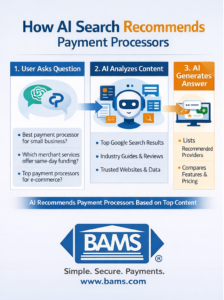
Payment processors are particularly well positioned for AI search visibility because businesses frequently ask AI tools for vendor recommendations.
BAMS: Payment processing is a complex and competitive industry. Is GEO really a good marketing channel for payment processors?
Evan Bailyn: Absolutely. In fact, payment processing is one of the best industries for GEO.
Business owners are increasingly asking AI tools for recommendations about vendors. Questions like:
-
“What’s the best payment processor for eCommerce?”
-
“Which merchant services offer same-day funding?”
When users ask these questions, AI systems generate answers based heavily on trusted sources and high-ranking content on Google.
That means if your company is already ranking well in search results or mentioned in authoritative content, AI tools are more likely to recommend you.
How Generative Engine Optimization Builds on Traditional SEO
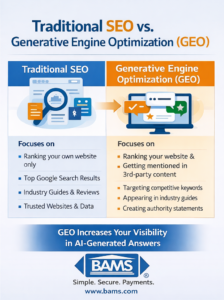
Traditional SEO focuses on ranking your website in search engines, while GEO expands visibility by ensuring your company appears in trusted third-party content that AI tools reference.
BAMS: We’ve invested heavily in SEO for keywords like “merchant services” and “payment processing.” How is GEO different?
Evan Bailyn: Traditional SEO is still extremely important. GEO actually depends on it.
AI platforms frequently pull information from pages that already rank on Google’s first page. Large language models and AI search systems rely heavily on publicly available web content and high-authority sources to generate responses.
However, GEO adds another layer to this strategy. Instead of focusing only on ranking your own website, GEO also emphasizes appearing in trusted third-party content — especially articles that compare vendors or recommend industry solutions.
Examples include:
-
“Best Payment Processors for Small Businesses”
-
“Top Merchant Services for eCommerce”
-
“Best Payment Gateways with Same-Day Funding”
If these types of articles rank highly and mention your company, AI systems are far more likely to surface your brand in their answers. These sources often publish comparison guides and educational content about merchant services. For example, understanding the key factors impacting eCommerce payment processing costs can help businesses evaluate payment processors more effectively.
The Importance of Authority Statements
BAMS: You mentioned something called an “authority statement.” What does that mean?
Evan Bailyn: An authority statement is a clear, consistent description of what your company does best.
For example, a payment processor might consistently be described as:
-
“A provider offering cost-effective payment processing with same-day funding.”
-
“A payment processor known for transparent pricing and personalized merchant support.”
The key is consistency.
When AI systems repeatedly see the same positioning across many trusted sources; blogs, directories, fintech publications, and industry guides. They begin to treat that description as an authoritative fact.
In other words, the internet is essentially training the AI on how to describe your company.
Why Third-Party Mentions Matter for AI Visibility
BAMS: So companies need to appear on other websites besides their own?
Evan Bailyn: Exactly.
One of the most important parts of GEO is earning mentions in high-ranking content across the web.
This often involves identifying publishers and blogs that produce comparison or recommendation articles related to payment processing.
Examples include:
-
fintech blogs
-
small business resource sites
-
payment technology publications
-
industry directories
Once you identify those sources, you can reach out and provide information about your company — including your authority statement and key differentiators such as:
-
same-day or next-day funding
-
transparent pricing
-
dedicated support
-
industry-specific payment solutions
When these publications include your company in their articles, it strengthens your presence in both traditional search results and AI-generated recommendations.
How Payment Processors Can Test Their AI Visibility
BAMS: If a payment processor wants to understand how visible they are in AI search today, what should they do?
Evan Bailyn: The first step is simple: test it yourself.
Ask AI platforms the same questions your potential customers would ask.
For example:
-
“Best payment processor for small businesses”
-
“Which merchant services offer next-day funding?”
-
“Best payment processor for eCommerce”
Then review the answers.
If your company isn’t appearing in those responses, it’s a sign that your SEO and GEO presence needs improvement.
Why AI Search Is the Next Marketing Frontier
The way businesses research vendors is evolving quickly. AI-driven search and recommendation engines are increasingly influencing how businesses evaluate software vendors, financial services providers, and other technology partners.
Instead of reading dozens of blog posts or product pages, many decision-makers now rely on AI-generated summaries and recommendations.
This means companies that want to stay competitive must optimize for both:
-
traditional search engines
-
AI-powered search platforms
Payment processors that understand this shift early will gain a major advantage in visibility, credibility, and lead generation.
The Bottom Line
AI-driven search is transforming how businesses discover vendors and service providers.
For payment processors, this means marketing strategies must evolve beyond traditional SEO.
Companies that combine strong search rankings, consistent authority messaging, and visibility across trusted third-party content will be far more likely to appear in AI recommendations.
In the years ahead, Generative Engine Optimization may become just as important as traditional SEO for companies that want to stay visible in an AI-first search environment.
Frequently Asked Questions
What is Generative Engine Optimization (GEO)?
Generative Engine Optimization (GEO) is a marketing strategy designed to help businesses appear in answers generated by AI platforms such as ChatGPT, Perplexity, and other generative search systems. GEO combines traditional SEO with visibility across trusted third-party content so that AI models recognize a company as a credible solution when answering user queries.
How does AI search impact payment processors?
AI search tools increasingly summarize recommendations for services like payment processing. Instead of browsing multiple websites, business owners often ask AI tools questions such as “What is the best payment processor for small businesses?” Companies that appear in trusted online content and rank well in search engines are more likely to be recommended in these AI-generated responses.
Why is SEO still important for AI search results?
Most AI systems rely heavily on information from high-ranking search engine results and authoritative websites. Businesses that already rank well in Google search results are more likely to be referenced in AI-generated answers. Strong SEO therefore increases the chances of appearing in AI search recommendations.
How can payment processors improve their AI visibility?
Payment processors can improve AI visibility by publishing authoritative content, earning mentions in reputable industry publications, and maintaining consistent messaging about their services. Appearing in high-ranking comparison articles and educational resources helps AI systems identify a company as a trusted provider.
What types of questions do businesses ask AI about payment processing?
Common questions include:
-
What is the best payment processor for eCommerce businesses?
-
Which merchant services offer next-day funding?
-
How can I reduce credit card processing fees?
-
What payment processor works best for small businesses?
Optimizing content around these questions increases the likelihood that AI platforms will reference your company when generating answers.
Sources
1. Gartner – Search Engine Volume Will Drop 25% by 2026
https://www.gartner.com/en/newsroom/press-releases/2023-02-06-gartner-predicts-search-engine-volume-will-drop-25-percent-by-2026-due-to-ai-chatbots
2. Google Search Documentation – How Search Works
https://developers.google.com/search/docs/fundamentals/how-search-works
3. Harvard Business Review – How Generative AI Will Change the Future of Search
https://hbr.org/2023/07/how-generative-ai-will-change-the-future-of-search