

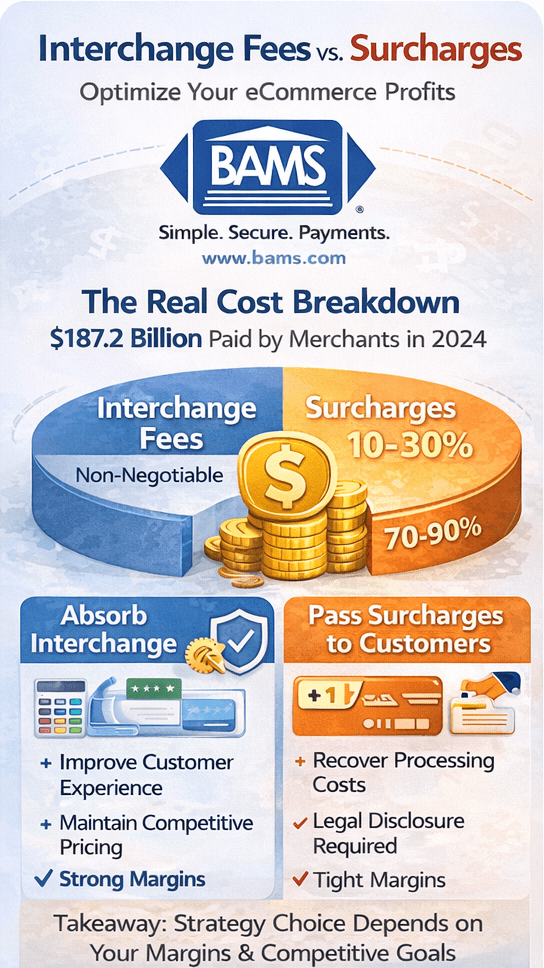
Interchange Fees vs. Surcharges: Optimize Your eCommerce Profits
Last Updated on October 2, 2026 by Dimitri Akhrin
Discover which cost structure impacts your profit margins and customer experience more.
Interchange Fees vs. Surcharges in eCommerce: Which Is More Profitable? Learn how interchange fees and surcharges affect your ecommerce profits. This guide helps you decide which strategy aligns with your business goals.
TL;DR
- Interchange fees drain 2.35% average per transaction and comprised 70-90% of the $187.2 billion merchants paid in 2024
- Surcharging recovers costs but adds friction and is restricted in some states, requiring compliance work and clear disclosure
- Absorb interchange if margins are healthy and customer experience drives your competitive advantage
- Implement surcharges if margins are thin or you serve B2B buyers who expect transparent processing costs
- Optimize your interchange rates first because reducing what you pay often beats choosing between absorption and surcharging
What Are Interchange Fees?
Interchange fees are non-negotiable charges set by card networks and paid to issuing banks for each credit card transaction.
What Are Credit Card Surcharges?
Surcharges are fees added to credit card transactions to recover processing costs from customers.
The Real Cost Decision: Interchange Fees vs. Surcharges

Interchange Fees vs. Surcharges: A breakdown of how each cost structure impacts eCommerce profit margins, recovery potential, and operational complexity.
Every time a customer checks out on your ecommerce site, money disappears before it reaches your account. The question isn’t whether you’re losing revenue to payment processing. It’s which cost structure is taking the bigger bite.
For ecommerce managers handling 10-50 employees and processing significant transaction volume, this choice shapes your profit margins more than most operational decisions. Interchange fees eat into every sale automatically. Surcharges shift costs to customers but risk cart abandonment.
This comparison breaks down both approaches so you can see exactly where your money goes and which strategy fits your business model.
Quick Verdict: Which Approach Wins?
Choose to absorb interchange fees if your average order value is high, your margins are healthy, and customer experience drives repeat purchases. The predictable cost becomes a marketing investment.
Choose surcharging if you operate on thin margins, sell commoditized products, and your customers expect transparent pricing. The fee recovery can save thousands monthly.
Neither option eliminates credit card transaction costs entirely. The right choice depends on your customer base, competitive landscape, and how much control you want over the checkout experience.
| Criterion | Interchange Fees | Surcharges | Winner |
|---|---|---|---|
| Customer Experience | Seamless checkout | Added friction | Interchange |
| Cost Recovery | 0% recovered | Up to 100% recovered | Surcharges |
| Implementation Complexity | None required | Compliance, disclosure, state laws | Interchange |
| Competitive Impact | Price parity maintained | May appear more expensive | Interchange |
| Profit Margin Protection | Margins absorb costs | Margins preserved | Surcharges |
| Legal Risk | None | State restrictions apply | Interchange |
Why These Comparison Criteria Matter
Before diving into the head-to-head breakdown, here’s why each dimension deserves your attention.
Customer experience directly impacts conversion rates and lifetime value. Any friction at checkout costs you sales.
Cost recovery determines how much of the $187.2 billion in swipe fees paid in 2024 you can offset. Even partial recovery adds up fast at scale.
Implementation complexity affects your team’s bandwidth. Some solutions require ongoing compliance work.
Competitive impact shapes how customers perceive your pricing against alternatives.
Profit margin protection is the bottom line. Which approach preserves more of what you earn?
Legal risk varies by state and card network rules. Getting this wrong means fines or terminated processing agreements.
Head-to-Head Breakdown: Interchange Fees vs. Surcharges
Interchange Fees: The Hidden Tax on Every Sale
Interchange fees are non-negotiable charges set by Visa, Mastercard, and other card networks. According to Modern Treasury’s analysis, these fees comprise 70% to 80% of your total card processing costs.
For a standard credit card transaction at a supermarket, a business owner would be looking at paying 1.65% plus $0.05 for card-present retail. Rewards cards push that to 1.65% to 2.40% plus $0.10. Ecommerce transactions typically fall into higher-risk categories, meaning you pay even more.
Strengths of absorbing interchange:
- Zero customer friction at checkout
- No compliance headaches or disclosure requirements
- Competitive pricing appears cleaner
- Works in all 50 states without restriction
Limitations:
- The average swipe fee rate rose to 2.35% in 2024, up from 2.02% in 2010
- You absorb 100% of rising costs with no recovery mechanism
- B2B transactions hit especially hard (Mastercard’s 2025 B2B VIP rate jumped to 2.95% plus $0.10)
- Premium rewards cards cost you more, but customers love using them
Surcharges: Passing Costs to Customers
A surcharge for credit card fees adds a percentage to transactions paid by credit card. This shifts processing costs from your margins to the customer’s total.
Done right, surcharging can recover most or all of your interchange fees. Done wrong, it drives customers to competitors or triggers compliance violations.
Strengths of surcharging:
- Recover up to 100% of credit card processing costs
- Transparent pricing shows customers exactly what they’re paying for
- Encourages use of lower-cost payment methods (debit cards, ACH)
- Protects margins regardless of card type used
Limitations:
- Banned or restricted in Connecticut, Massachusetts, and Puerto Rico
- Requires clear disclosure before checkout (card network rules)
- Cannot exceed your actual processing cost or 3% (whichever is lower)
- May increase cart abandonment, especially for price-sensitive customers
- Cannot apply to debit card transactions, only credit
Cost Recovery: The Numbers That Matter
Let’s make this concrete. Say you process $500,000 monthly in credit card sales.
At the 2024 average rate of 2.35%, you’re paying roughly $11,750 in interchange fees every month. That’s $141,000 annually disappearing from your revenue.
Absorbing interchange: You keep customer experience pristine but lose $141,000 yearly. If your net margin is 10%, you need $1.41 million in additional sales to offset those fees.
Implementing surcharges: You recover most of that $141,000. Even if 15% of customers abandon carts due to the surcharge, you still come out ahead financially, assuming those customers don’t return via competitors.
Verdict: Surcharges win on pure cost recovery. Interchange absorption wins on customer retention. Your margin structure determines which matters more.
Implementation and Compliance
Absorbing interchange fees requires nothing from your operations team. You pay what the processor charges, and that’s it.
Surcharging demands ongoing work:
- Notify Visa and Mastercard 30 days before implementing surcharges
- Display signage (physical stores) and clear disclosures (online)
- Show surcharge as separate line item on receipts
- Track state law changes (regulations shift regularly)
- Ensure surcharge never exceeds actual cost or 3%
Verdict: Interchange absorption wins on simplicity. If your team is stretched thin, surcharge compliance adds meaningful overhead.
Customer Experience Impact
This is where the decision gets personal. How do your customers react to fees?
B2B buyers often expect surcharges and factor them into purchasing decisions. Consumer ecommerce shoppers tend to react negatively to any added fee at checkout.
Research consistently shows that unexpected fees are a leading cause of cart abandonment. A surcharge for credit card fees, even when disclosed upfront, can feel like a bait-and-switch to customers who’ve already decided to buy.
Verdict: Interchange absorption wins for consumer-facing ecommerce. Surcharging can work for B2B if positioned as a cash/ACH discount alternative.
Use Case Mapping: Which Strategy Fits Your Business
If you sell high-margin products (40%+ gross margin): Absorb interchange. The cost is manageable, and customer experience drives repeat purchases.
If you operate on thin margins (under 15%): Consider surcharging or offering cash discounts. Every percentage point matters when margins are tight.
If you serve price-insensitive B2B buyers: Surcharging works well. Business buyers understand processing costs and often prefer ACH anyway.
If you compete primarily on price: Absorb interchange and build it into your pricing. Surcharges make you look more expensive than competitors.
If you process high volumes of rewards card transactions: Surcharging helps offset the premium interchange rates (2.40%+) that rewards cards carry.
What Neither Option Solves
Both approaches leave significant problems on the table.
Neither reduces the base interchange rates set by card networks. Those rates have climbed steadily, with no sign of reversal. Merchants paid a record $172 billion in processing fees in 2023, and that number jumped to $187.2 billion in 2024.
Neither addresses the assessment fees charged by Visa and Mastercard on top of interchange. Neither solves the problem of chargebacks, which cost you the transaction amount plus additional fees.
The payment processing industry is structured to extract maximum value from merchants. Your strategic choice is which costs to absorb and which to offset.
Migration and Switching Considerations
Already absorbing interchange and considering surcharges? Here’s what the switch involves.
Time investment: Plan for 4-6 weeks to implement properly. This includes card network notification, platform configuration, disclosure setup, and staff training.
Technology requirements: Your payment gateway must support surcharging. Not all do. You may need to switch processors or add middleware.
Customer communication: Announce the change before implementing. Surprise fees damage trust more than transparent policy changes.
Testing period: Monitor cart abandonment rates closely for 60-90 days. If abandonment spikes significantly, you may need to reverse course.
Switching from surcharging to absorption is simpler. Remove the surcharge logic, update disclosures, and adjust your pricing to account for the absorbed costs.
A Third Path: Optimizing Your Interchange Costs

Optimizing Interchange Rates: Reducing base interchange costs often delivers higher profit margins than choosing between absorption and surcharging.
Before choosing between absorption and surcharging, consider whether you’re paying more interchange than necessary.
Many ecommerce businesses qualify for lower interchange categories but don’t receive them due to processor configuration or missing transaction data. Address verification, Level 2/3 data for B2B transactions, and proper merchant category codes can reduce your base rates.
Working with a processor that offers interchange-plus pricing gives you visibility into exactly what you’re paying. Tiered or flat-rate pricing often hides interchange optimization opportunities.
A merchant services partner focused on cost reduction can audit your current rates and identify savings. Sometimes the best strategy isn’t choosing between interchange absorption and surcharging. It’s reducing the interchange you pay in the first place.
Final Recommendation
For most consumer-facing ecommerce businesses with healthy margins, absorb interchange fees and optimize your rates instead of surcharging. The customer experience benefit outweighs the cost recovery potential.
For B2B ecommerce or thin-margin operations, surcharging makes financial sense if implemented transparently and compliantly. Position it as a credit card fee with a corresponding cash/ACH discount to soften the perception.
Whichever path you choose, don’t accept your current interchange rates as fixed. The difference between a poorly optimized processing setup and a well-negotiated one can exceed the savings from surcharging, without any customer friction.
Your payment processor should help you see exactly where your money goes and offer strategies to keep more of it. If they can’t show you interchange-level detail, that’s a sign you’re overpaying.
Want to lower your interchange costs without adding surcharges?
BAMS provides transparent interchange-plus pricing and active rate optimization to help eCommerce processing businesses keep more of every sale.
Frequently Asked Questions
What are credit card processing fees?
Credit card processing fees include interchange fees (paid to the card-issuing bank), assessment fees (paid to card networks like Visa and Mastercard), and processor markup. Together, these typically range from 1.5% to 3.5% of each transaction. Interchange fees alone account for 70% to 90% of your total processing costs.
Why do merchants have to pay processing fees for credit card transactions?
Processing fees cover the infrastructure that makes card payments possible. Interchange fees compensate the cardholder’s bank for fraud risk and the interest-free period cardholders receive. Assessment fees fund the card networks. Processor fees pay for the technology connecting your store to the payment system.
How are credit card processing fees determined?
Interchange rates are set by card networks (Visa, Mastercard) and vary by card type, merchant category, and transaction method. Rewards cards cost more than standard cards. Card-not-present transactions (like eCommerce) cost more than in-person swipes. Business cards often carry higher rates than consumer cards.
When do interchange fees change, and what factors influence them?
Card networks update interchange rates twice yearly, typically in April and October. Factors include card type (rewards vs. standard), merchant category code, transaction size, and whether the card is present. The average swipe fee rate has risen from 2.02% in 2010 to 2.35% in 2024.
Which types of transactions incur higher processing fees?
Ecommerce and phone orders (card-not-present) cost more than in-person transactions due to higher fraud risk. Rewards and premium cards carry higher interchange than basic cards. B2B transactions on corporate cards often have the highest rates, with some Mastercard B2B rates reaching 2.95% plus $0.10.
How can businesses minimize their credit card processing fees?
Use interchange-plus pricing for transparency. Ensure proper address verification to qualify for lower rates. Submit Level 2/3 data for B2B transactions. Encourage debit card or ACH payments when possible. Work with a processor that actively optimizes your merchant category code and transaction routing.
Sources
- https://nrf.com/advocacy/policy-issues/swipe-fees
- https://www.moderntreasury.com/journal/what-are-interchange-fees-and-how-do-they-work
- https://usa.visa.com/content/dam/VCOM/download/merchants/visa-usa-interchange-reimbursement-fees.pdf
- https://www.merchantspaymentscoalition.com/credit-and-debit-card-swipe-fees-hit-new-record-1872-billion-driving-prices-american-families


