5 Key Factors Impacting Your E-Commerce Payment Processing Costs
Last Updated on March 6, 2026 by Dimitri Akhrin
Discover crucial insights to reduce credit card transaction fees and boost your cash flow.
Learn the top five factors that influence payment processing costs and how to optimize them for better cash flow and growth in your e-commerce business.
TL;DR
- Your transaction mix sets your baseline – Debit cards cost 1.5% less than credit cards to process, and rewards cards cost more than basic cards. Know what your customers are using.
- Pricing structure matters more than headline rates – Interchange-plus pricing shows you exactly what you pay for. Tiered and flat-rate pricing often hide higher effective costs.
- Chargebacks create cost multipliers – Exceeding 1% chargeback rates can push you into high-risk classification, where processing costs jump to 4% to 8% per transaction plus reserve requirements.
- Data quality affects what you pay – Missing transaction data causes automatic downgrades to higher interchange tiers. Proper gateway configuration prevents this.
- Start with one factor – Calculate your true effective rate first, then focus on pricing structure or chargeback management for the fastest impact on your bottom line.
The Hidden Math Behind Your Payment Processing Costs
You check your monthly statement and see thousands vanishing into processing fees. The percentage looks small, but multiply it across every transaction and the number stops feeling abstract. For established e-commerce operations processing significant volume, understanding payment processing costs is not a minor accounting detail. It directly determines your cash flow, your margins, and your ability to reinvest in growth.
Here is the problem: most merchants treat processing fees as fixed costs, like rent or software subscriptions. They are not. Average processing fees range from 1.0% to 3.0% per transaction, but that range represents real money. On $1 million in annual sales, the difference between 1.5% and 3.5% is $20,000. That is not rounding error. That is a full-time employee, a marketing campaign, or inventory for your next product launch.
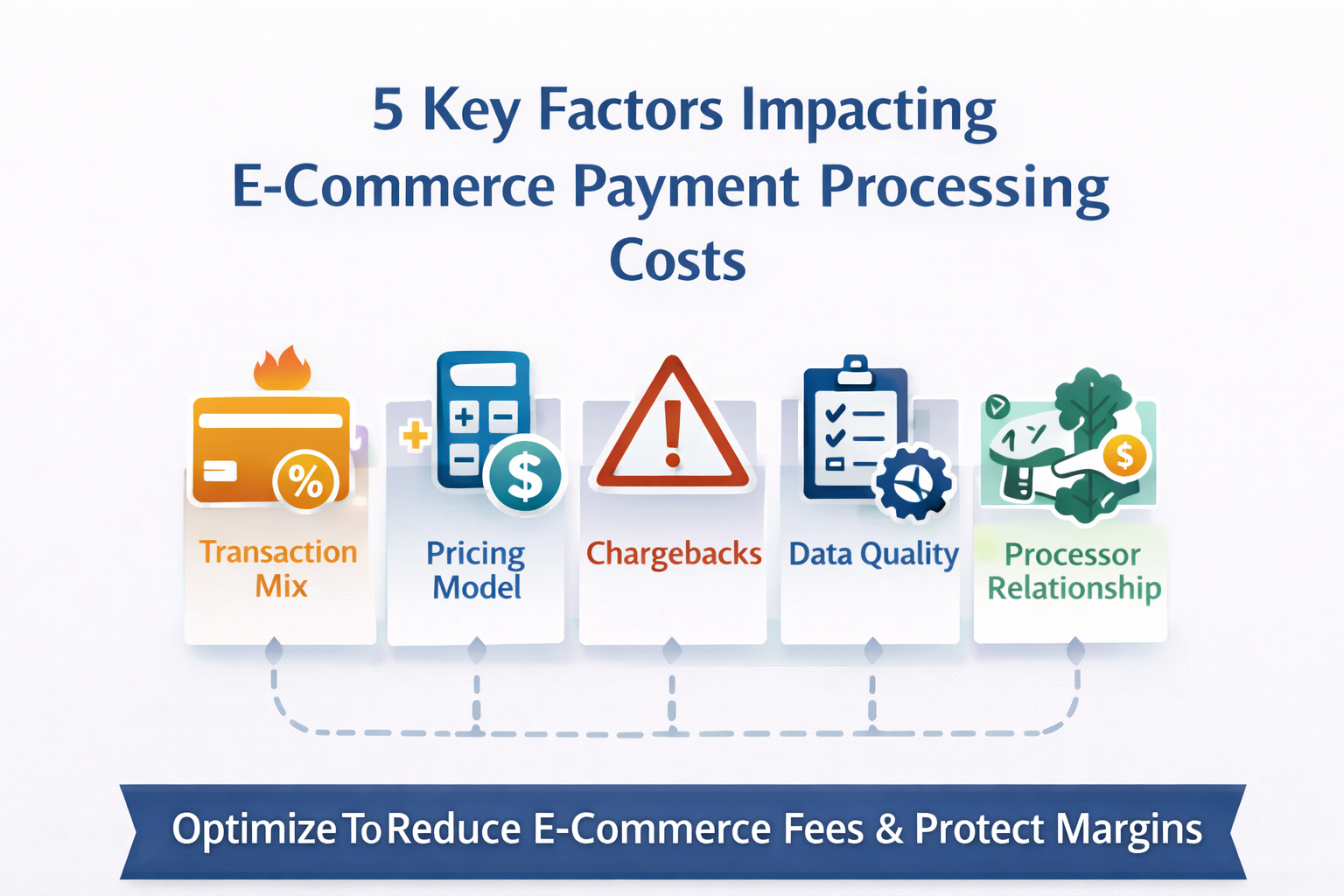
This guide breaks down the five factors that actually move the needle on your credit card transaction costs, and what you can do about each one. To understand where your credit card processing fees are coming from, you first need to identify the five structural drivers of your payment processing costs.

What This Guide Covers (And What It Skips)
This is for e-commerce managers at businesses processing enough volume that a 0.5% reduction in fees means something tangible. If you are just starting out, basic rate shopping matters more than optimization. If you are processing millions monthly, you likely have dedicated treasury staff for this.
We are not covering every variable that touches your statement. We are focusing on the five factors where your decisions and your processor relationship create the largest impact. Generic advice like “negotiate better rates” appears nowhere here. Instead, you will learn the specific levers that determine what rates are even possible.
How We Selected These Factors
Each factor meets three criteria: it meaningfully impacts your effective rate, you can influence it through operational or strategic choices, and most merchants either misunderstand it or ignore it entirely. We prioritized factors where small changes create compounding benefits over time.
1. Your Transaction Profile Determines Your Baseline Costs
Why It Matters
Card networks set interchange fees based on perceived risk. Your transaction profile, including the mix of card types, average ticket size, and how customers pay, establishes your baseline before your processor adds their margin. Many merchants focus exclusively on processor markup while ignoring the larger interchange component they can actually influence.
What It Looks Like Today
US average interchange fees sit at 1.8% for credit cards and 0.3% for debit cards. That 1.5% gap is substantial. Rewards cards cost more to accept than basic cards. Corporate and purchasing cards carry premium rates. Your customer base and their preferred payment methods shape your costs before any negotiation begins.
How to Apply It
Pull three months of transaction data and categorize by card type. Calculate what percentage of your volume comes from premium rewards cards versus standard cards versus debit. Consider whether checkout incentives for lower-cost payment methods make sense for your margins. Some merchants offer small discounts for ACH or debit payments and recover far more than the discount costs.
2. Pricing Model Structure Shapes What You Actually Pay
Why It Matters
The same underlying costs can look dramatically different depending on how your processor packages them. Tiered pricing bundles transactions into categories that often work against you. Flat-rate pricing offers simplicity but typically overcharges. Interchange-plus pricing separates the non-negotiable network costs from the processor markup you can actually compare.
What It Looks Like Today
Payment service providers charge merchants 2.5% to 3.5% per transaction for all-in-one solutions. That bundled rate obscures what you are actually paying for. With interchange-plus, you see the network cost (which is the same everywhere) plus a clear processor margin. This transparency lets you compare apples to apples and identify whether your processor is competitive.
How to Apply It
Request an interchange-plus quote from your current processor if you are on tiered or flat-rate pricing. Compare the processor markup, not the headline rate. A processor advertising “2.9% flat” might be cheaper or more expensive than one offering “interchange plus 0.3%” depending on your transaction mix. Do the math with your actual data.
3. Chargeback Rates Create Hidden Cost Multipliers
Why It Matters
Chargebacks cost far more than the disputed amount. Each dispute carries fees, staff time, and potential merchandise loss. Worse, elevated chargeback rates can push you into high-risk classification, where processing costs jump dramatically. High-risk e-commerce merchants pay 4% to 8% per transaction compared to 2% to 3% for standard retail.
What It Looks Like Today
E-commerce chargeback rates averaged 0.6% to 0.9% in 2023, with high-risk categories exceeding 1.5%. Cross the 1% threshold and card networks flag your account. That classification adds reserve requirements (5% to 10% of volume held back) and premium rates. Some merchants see total processing costs reach 10% to 12% of revenue once chargebacks, reserves, and elevated rates combine.
How to Apply It
Track your chargeback ratio monthly, not just the dollar amount. Implement fraud screening that catches suspicious orders before fulfillment. Use clear billing descriptors so customers recognize charges. Respond to disputes quickly with documentation. Consider working with a processor that offers proactive chargeback defense rather than just reactive dispute management.

Optimizing these payment processor variables can reduce your effective rate without adding friction to the customer experience.
Want to go deeper? Read our guide on reducing credit card transaction fees.
4. Transaction Data Quality Affects Interchange Qualification
Why It Matters
Card networks offer lower interchange rates for transactions that include specific data fields. Missing information means your transaction “downgrades” to a higher-cost category. Many merchants pay premium rates on transactions that could qualify for lower tiers simply because their checkout or integration does not pass the right data.
What It Looks Like Today
Level 2 and Level 3 data, including line-item details, tax amounts, and customer codes, can reduce interchange by 0.5% to 1% on qualifying transactions. This matters most for B2B e-commerce where corporate and purchasing cards are common. But even consumer transactions benefit from proper AVS (address verification) and CVV data that prevent downgrades.
How to Apply It
Audit your gateway configuration to confirm you are passing all available data fields. Ask your processor which transactions are downgrading and why. If you sell to businesses, verify your system supports Level 2 and Level 3 data submission. The technical setup work pays dividends on every future transaction.
5. Processor Relationship and Volume Leverage Your Position
Why It Matters
Processors have margin flexibility. What they offer depends on your volume, your risk profile, and whether they believe you will stay. Merchants who treat their processor relationship as transactional leave money on the table. Those who understand their leverage and use it appropriately pay less for the same service.
What It Looks Like Today
High-volume e-commerce operations can negotiate meaningful rate reductions, sometimes 0.2% to 0.5% below standard pricing. But volume is not the only factor. Low chargeback rates, stable processing history, and growth trajectory all strengthen your position. Processors also differentiate on service: next-day funding, dedicated support, and integration assistance have real operational value beyond the rate itself.
How to Apply It
Review your processing agreement annually, not just when problems arise. Come prepared with your metrics: monthly volume, average ticket, chargeback rate, and growth trend. Get competitive quotes to understand market rates. Evaluate the total relationship, including rates, funding speed, support quality, and technology, rather than optimizing for the lowest number alone.
The Pattern Across All Five Factors
These factors share a common thread: they reward merchants who treat payment processing as an operational discipline rather than a back-office afterthought. Transaction profile, pricing structure, chargeback management, data quality, and processor relationships all improve with attention and measurement.
The merchants paying the lowest effective rates are not necessarily processing the highest volume. They are the ones who understand what drives their costs and make intentional choices at each decision point. They also recognize that the cheapest processor is not always the best value when funding delays or poor support create hidden costs.
Where to Start
Do not try to optimize all five factors simultaneously. Start with visibility: pull your last three statements and calculate your true effective rate (total fees divided by total volume). Then pick one factor where you suspect the largest gap between current state and possible improvement.
For most established e-commerce operations, pricing model structure and chargeback management offer the fastest returns. Switching from tiered to interchange-plus pricing creates immediate transparency. Reducing chargebacks by even 0.2% can prevent the cascade into high-risk classification.
The goal is not perfection. It is building payment processing into a predictable advantage rather than an unpredictable cost center.
Frequently Asked Questions
What are credit card processing fees?
Credit card processing fees are the costs merchants pay to accept card payments. They typically include three components: interchange fees paid to the card-issuing bank, assessment fees paid to the card network (Visa, Mastercard), and processor markup paid to your payment processor. Together, these usually total 1.5% to 3.5% of each transaction for most e-commerce merchants.
Why do merchants have to pay processing fees for credit card transactions?
Processing fees compensate the multiple parties that make card payments possible. The issuing bank takes risk by extending credit to cardholders. The card network maintains the infrastructure connecting millions of merchants and banks. Your processor handles the technology, security, and settlement. Each party takes a small percentage, which adds up to your total fee.
How are credit card processing fees determined?
Interchange fees, the largest component, are set by card networks based on transaction risk factors: card type (rewards cards cost more), merchant category, and how the card is processed (card-present versus online). Your processor then adds their margin on top. Your specific rate depends on your industry, volume, average ticket size, and chargeback history.
When do interchange fees change, and what factors influence them?
Visa and Mastercard typically update interchange rates twice yearly, in April and October. Changes reflect network costs, competitive dynamics, and regulatory pressure. Individual transaction rates also shift based on data quality, with transactions missing required fields downgrading to higher-cost categories automatically.
Which types of transactions incur higher processing fees?
Card-not-present transactions (online, phone orders) cost more than in-person swipes due to higher fraud risk. Rewards and premium cards carry higher interchange than basic cards. Corporate and purchasing cards have their own rate schedules. International cards typically cost more than domestic. Keyed-in transactions cost more than chip or contactless.
How can businesses minimize their credit card processing fees?
Focus on factors you control: negotiate interchange-plus pricing for transparency, maintain low chargeback rates to avoid high-risk classification, ensure your checkout passes complete transaction data to avoid downgrades, and review your processor relationship annually with competitive quotes in hand. Small improvements across multiple factors compound into meaningful savings.
Sources
- https://www.investopedia.com/terms/m/merchant-discount-rate.asp
- https://www.progressivepolicy.org/the-unanticipated-costs-and-consequences-of-federal-reserve-regulation-of-debit-card-interchange-fees/
- https://www.swell.is/content/highrisk-industry-ecommerce-statistics