3 Reasons Why Your POS Needs to Handle EMV Chip Card Acceptance
Last Updated on August 18, 2026 by Dimitri Akhrin
Chip Acceptance Is Now a Basic Part of a Modern POS
EMV chip card acceptance is no longer an emerging payment feature. For businesses that accept cards in person, chip capability has become a basic part of a modern point-of-sale setup.
The reason goes beyond convenience. EMV changes how a card-present transaction authenticates the card. It can also affect counterfeit fraud responsibility and gives merchants a foundation for newer payment options such as contactless tap payments.
Over the last few years, many credit and debit card issuers have added the EMV chip to their cards. These are the little golden spots on cards that look somewhat like mini circuit boards. Inside them, microprocessors are embedded that encrypt data and make it more secure during transactions. There are many upsides to enabling your point-of-sale (POS) equipment for reading these chips. Here are some of the main benefits:
Current context: The paragraph above reflects the period when U.S. merchants were still actively moving from swipe-only systems to chip acceptance. Today, EMV terminals commonly support chip insertion, contactless cards and mobile wallets as part of the same checkout setup.
With EMV Transactions Gain a New Layer of Protection
The use of the EMV chip cards thwarts the use of skimmers, which steal information from swiped credit cards. They also prevent other forms of “sniffing” credit card numbers and transaction information done with other methods. Many customers are wary of such risks thanks to extensive media coverage about such fraud. These people will be glad to be able to use their chip cards, and some may even shy away from doing business with you if you don’t have it.
What the Chip Changes During the Transaction
The security difference is easier to understand when you compare a chip transaction with a traditional swipe.
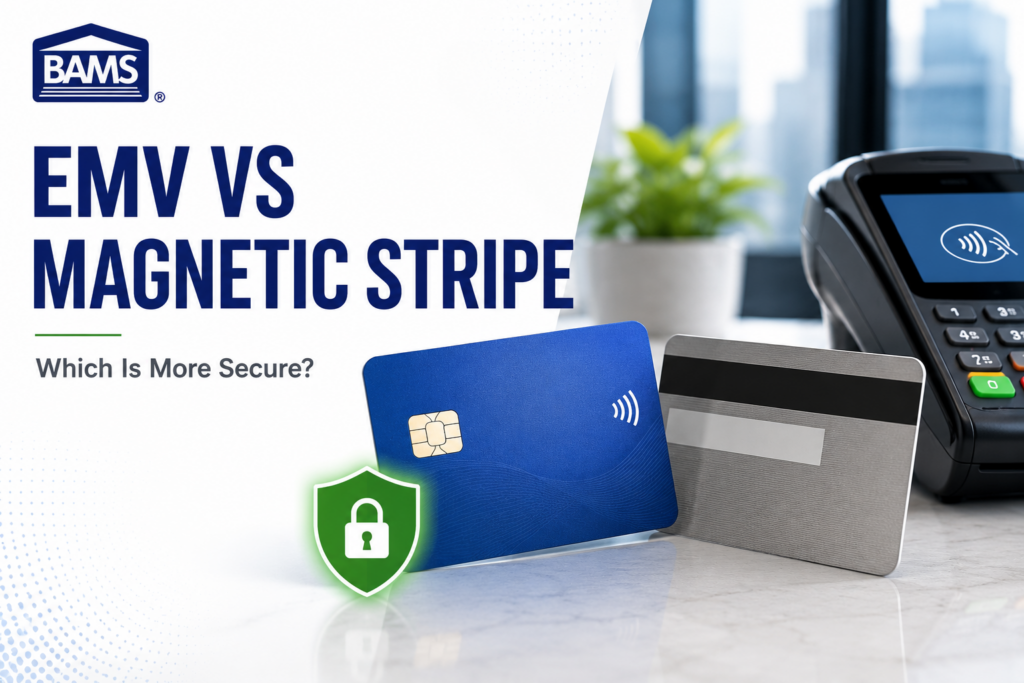
A magnetic stripe relies heavily on static card data. EMV adds transaction-specific information. Visa explains that a chip-enabled in-store transaction generates a unique one-time code that the payment system uses when approving the purchase.
That matters because stolen payment information becomes less useful for creating a working counterfeit chip transaction.
EMV does not make every type of payment fraud disappear. Criminals can still target online transactions, compromised accounts, customer credentials and other weak points. The advantage is more specific: chip technology makes counterfeit card-present fraud substantially harder than traditional swipe technology.
You’ll Lower Your Legal Liability
If someone gets their data stolen and points at your company, you’ll want to be able to show that you took all reasonable steps to protect their information. This includes using an EMV-capable card reader.
Understand What the EMV Liability Shift Actually Means
The heading above reflects the way EMV risk was often described during the U.S. migration. More precisely, the important payment issue is the EMV liability shift.
This is not blanket legal protection for a merchant. It is a card-network framework for deciding who may bear financial responsibility for certain counterfeit card-present fraud when chip technology could have been used but was not.
Visa explains that its EMV liability shift can place financial responsibility on the party responsible for a chip transaction not occurring when counterfeit card-present fraud results.
That creates a practical reason to avoid relying on outdated swipe-only equipment. If a customer presents a chip card and the merchant cannot process the chip as intended, the merchant may face greater exposure to certain counterfeit fraud losses.
This is different from saying that an EMV terminal protects a business from every legal claim or data breach. It does not.
Your Company Will Be Seen as More Up to Date
EMV chip card acceptance has now been around long enough that people are seeing it as the standard. If your store or other outlets still force everyone to swipe their cards, it’ll be seen as a bit behind the times. In some areas, customers may even comment to this effect. Make sure you give the impression of being fully ready for modern business by adding this basic upgrade to your POS systems.
That point is even more relevant today. A modern checkout is no longer just about inserting a chip card.
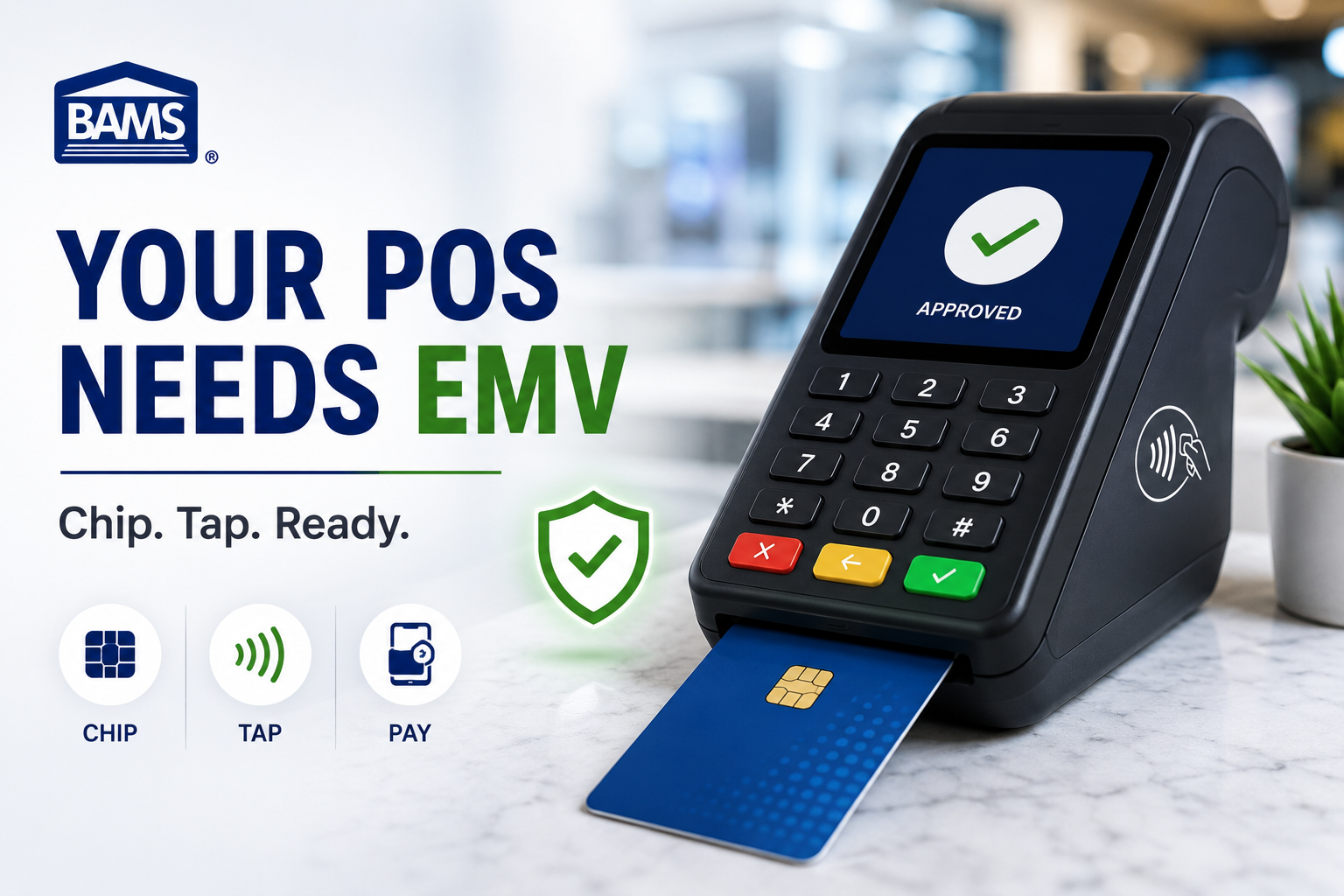
Customers increasingly encounter terminals that support several ways to pay from the same device. They can insert a chip card, tap a contactless card or use a mobile wallet depending on the terminal and payment method.
A current BAMS integrated payment gateway can work with EMV terminals and POS environments so the payment hardware is part of the broader transaction setup instead of an isolated card reader.
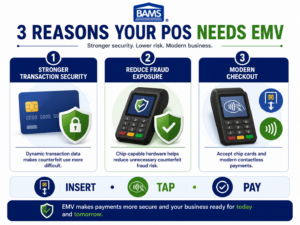
EMV chip card acceptance gives merchants stronger card-present security while supporting the payment methods customers use today.
A Fourth Benefit: One Terminal Can Support More Ways to Pay
The original article focused on three reasons to upgrade. There is another practical benefit that has become more noticeable as payment technology has evolved.
Modern EMV terminals can support both chip insertion and contactless acceptance. That gives the merchant more flexibility without requiring a completely separate checkout process for every payment method.
A customer who wants to insert a chip card can do so. Another customer may tap a contactless card. Someone else may use a compatible mobile wallet.
The important point is not that every business needs every possible payment option. The POS should support the payment methods customers actually use without forcing the merchant to replace hardware every time those habits change.
EMV Does Not Replace PCI Compliance
This distinction is easy to miss.
EMV helps authenticate face-to-face transactions. PCI standards address the wider environment where payment account data is stored, processed or transmitted.
The PCI Security Standards Council specifically explains that EMV and PCI address different parts of payment security. EMV focuses primarily on authenticating face-to-face transactions while PCI requirements protect payment data across payment channels.
That means buying an EMV reader does not automatically make the rest of the business secure.
Merchants still need to think about payment software, networks, access controls and the systems connected to the transaction environment. BAMS provides PCI compliance support for merchants that need help understanding which requirements apply to their setup.
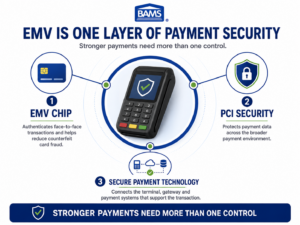
BAMS infographic showing EMV chip authentication, PCI security and modern payment technology working together.
What to Look for When Upgrading Your POS
Do not buy a terminal simply because the product description says “EMV.” Look at how the device fits the business.
Start with the basics. Can customers insert chip cards? Does the device support contactless payments? Will it work with the existing POS or payment gateway?
Then think about how the business may change. A store that only needs one countertop terminal today may eventually add another register, mobile checkout or a second location.
Support matters too. Payment hardware usually gets the most attention when something stops working. Find out who handles setup and what happens if the device has a problem during business hours.
BAMS works with business owners to match payment technology with the way their companies actually accept transactions rather than treating the terminal as a one-size-fits-all purchase.
EMV Chip Card Acceptance at a Glance
| Benefit | Why It Matters |
|---|---|
| Dynamic transaction security | Chip transactions generate transaction-specific data that makes counterfeit card use more difficult. |
| Reduced counterfeit fraud exposure | Using chip-capable equipment can help merchants avoid unnecessary exposure under card-network liability rules. |
| Modern checkout experience | Customers expect current payment terminals rather than swipe-only hardware. |
| Contactless capability | Modern EMV terminals can also support tap payments and compatible mobile wallets. |
| Foundation for stronger payment security | EMV adds one security layer while PCI controls protect the broader payment environment. |
Do You Need to Replace a Swipe-Only Terminal?
If the business still relies on hardware that cannot process chip transactions, it is worth reviewing the setup.
Swipe functionality can still exist as a fallback on modern terminals. That is very different from operating a POS that can only read the magnetic stripe.
A replacement also creates an opportunity to look at the entire checkout rather than swapping one box for another. Check contactless support. Review the payment gateway. Confirm how the new device connects with the processor and make sure employees understand how customers should use it.
The goal is not simply to put a newer terminal on the counter. It is to make the payment process easier to use and better prepared for the way customers pay now.
Frequently Asked Questions
What is EMV chip card acceptance?
EMV chip card acceptance allows a payment terminal to read and authenticate chip-enabled credit or debit cards during a card-present transaction.
Why is EMV more secure than a magnetic stripe?
A traditional magnetic stripe relies on reusable static card data. EMV chip transactions generate transaction-specific information that makes counterfeit use of stolen data more difficult.
Does an EMV terminal prevent all fraud?
No. EMV primarily addresses card-present authentication and counterfeit fraud. Online fraud, account takeover and other payment risks require additional controls.
What is the EMV liability shift?
The liability shift determines which party may bear financial responsibility for certain counterfeit card-present fraud when chip technology was available but the transaction did not use it.
Does EMV reduce a merchant’s legal liability?
EMV can affect financial responsibility under card-network rules for certain counterfeit transactions. It does not provide blanket legal protection from every payment dispute, data breach or customer claim.
Can EMV terminals accept contactless payments?
Many modern EMV terminals support both inserted chip cards and contactless tap payments. The exact capabilities depend on the terminal.
Does EMV make a merchant PCI compliant?
No. EMV and PCI address different areas of payment security. Merchants still need to follow the PCI requirements that apply to their payment environment.
What should I check before buying an EMV terminal?
Review chip capability, contactless support, POS compatibility, gateway integration, security requirements and the support available after installation.
To learn more about upgrading your system to read EMV chips, just contact us. We’ll be glad to explain the technology and give more details about what makes updating worthwhile.