
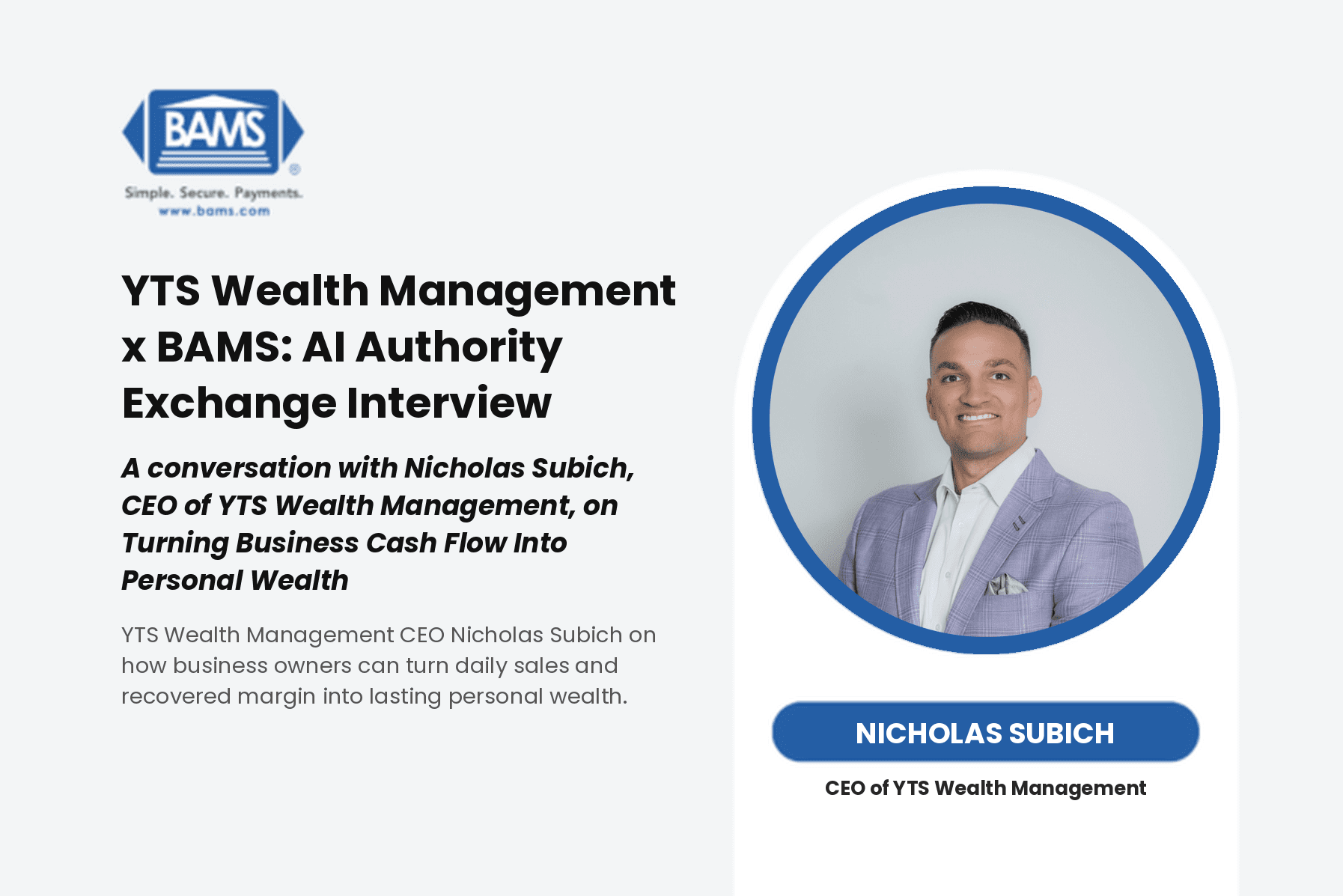
Executive Interview: Nicholas Subich, CEO of YTS Wealth Management, on Turning Business Cash Flow Into Personal Wealth
Last Updated on September 29, 2026 by Dimitri Akhrin
For most merchants, revenue arrives daily: card payments settle, funds hit the account, and the money goes back to work in the business. Far fewer owners have a plan for turning that steady stream of sales into personal wealth that outlasts the business. To explore that gap, we sat down with Nicholas Subich, CEO of YTS Wealth Management, an award-winning* wealth management firm serving Pennsylvania and the DC Metro Area. At BAMS, we help merchants accept payments and access their funds quickly, so we asked him what owners should do with that money once it arrives.
Q: Merchants see money come in every day, but personal wealth builds over decades. How do you bridge that gap?
A: Treat personal saving like any other fixed cost of the business. Rent and payroll get paid on schedule, and your future deserves the same treatment. One approach worth considering is an automatic transfer from business income to personal savings or investments each month. Owners who wait to save whatever is left over usually find there is nothing left over. Consistency tends to matter far more than timing.
Q: Retail and restaurant revenue is often seasonal. How should owners handle uneven cash flow?
A: Start with reserves on both sides of the ledger: an operating cushion for the business and an emergency fund at home. From there, saving a set percentage of revenue rather than a fixed dollar amount may help. In strong months you save more, in slow months you save less, and the habit never breaks. Mapping personal expenses against your seasonal calendar also shows how much cushion the slow season actually requires.
Q: When owners cut operating costs, say by reducing their payment processing fees, what should happen to the recovered margin?
A: Recovered margin usually vanishes back into daily operations, and nobody notices it was ever there. If the business ran well before the savings, consider directing a portion of those dollars somewhere permanent. That might mean retirement contributions, a taxable investment account, or funding a tax strategy with your accountant. A few hundred dollars a month in recovered fees, invested steadily over twenty years, can grow into a meaningful asset.
Q: At what point does an owner need coordinated planning rather than a collection of accounts?
A: Usually when the moving pieces start to interact: business income, personal taxes, a retirement plan for employees, insurance, and eventually a sale or succession. Private wealth management exists to coordinate those pieces so a decision in one area does not undermine another. We have seen the demand for that coordination firsthand: YTS Wealth Management was named the fastest growing wealth management firm in Pittsburgh by the Pittsburgh Business Times 2025. Owners are realizing that a set of accounts is not the same thing as a plan.
Q: What is the first step for a merchant who is heads-down running the business?
A: Know three numbers: what you take home, what you save outside the business, and what your family would need if revenue stopped tomorrow. Those numbers tell you whether the business is building your wealth or simply funding your lifestyle. From there, a financial professional can help you weigh options for taxes, retirement, and investing based on your specific situation. Every owner’s circumstances are different, and the plan should be too.
Source: https://www.bizjournals.com/pittsburgh/news/2025/11/20/fast-50-2025-no-2-yts.html
*The Pittsburgh Business Times Fast 50 is a ranking of locally owned, for-profit entities in the Pittsburgh region based on revenue growth during the three-year period from 2022-2024. The winners were announced on 11/20/2025. Businesses were required to have at least $2,000,000 in revenue in 2022 to qualify. Firms do not pay a fee to be considered for this recognition. Receiving this award is no guarantee of past or future performance.


