Payment Processor Changes: A Crisis-Ready Guide
How to evaluate merchant service providers based on what happens when checkout breaks, not just what they charge
Learn how to assess payment processor changes through the lens of operational resilience. This guide gives you a framework for evaluating support responsiveness, crisis accountability, and the real cost of staying with a provider who disappears during outages.
TL;DR
- Evaluate processors by crisis performance, not just pricing – Payment outages cost U.S. businesses $44 billion annually, and your processor’s real value shows up when something breaks, not when everything runs smoothly.
- Audit your current exposure first – Document every incident, funding delay, and support failure from the past 12 months. Quantify the revenue impact before you start comparing alternatives.
- Stress-test before you sign – Call support (not sales) on a weekend, ask for client references, and request a written incident communication process. This 30-minute exercise predicts years of relationship quality.
- Get commitments in the contract – Funding timelines, support response times, chargeback assistance scope, and reasonable termination terms should all be specific and documented, not verbal promises from a sales rep.
- Verify quarterly, not just at signup – Track deposit timing, support responsiveness, and chargeback outcomes every quarter. An accountable partner welcomes this scrutiny because they’re confident in the results.
Guide Orientation: What This Guide Covers and Who It’s For
This guide helps you evaluate payment processor changes through the lens that matters most: what happens when something breaks. It’s built for eCommerce managers at established online businesses (roughly 10 to 50 employees) who have already lived through the frustration of delayed deposits, opaque fees, or support tickets that vanish into a queue.
By the end, you’ll have a concrete framework for assessing whether your current processor can be held accountable during a crisis, a set of questions to ask prospective providers before you sign, and clear criteria for deciding when the cost of staying outweighs the effort of switching.
This is not a fee-comparison spreadsheet or a “top 10 processors” listicle. It’s a decision guide built around operational resilience, support responsiveness, and the measurable business impact of choosing a partner who actually picks up the phone.
Why Merchant Account Optimization Starts with Accountability
Most advice about choosing a payment processor focuses on basis points and interchange tiers. That math matters. But it becomes irrelevant the moment your checkout page stops accepting cards and you can’t reach a human being to fix it.
Payment system resilience has become a critical operational priority as businesses increasingly depend on uninterrupted electronic payment acceptance and settlement. The damage accelerates fast: between 8 and 13 minutes into an outage, vulnerable revenue bleeds at $1.2 billion per minute across affected merchants. After just 23 minutes of downtime, 70% of that revenue is gone for good.
For an eCommerce operation doing $2 million to $10 million in annual sales, even a partial outage during a peak traffic window can erase a week’s margin. And the real cost isn’t always the outage itself. It’s the hours you spend afterward trying to reconcile failed transactions, calm frustrated customers, and figure out whether your deposits are coming through.
As Bill Briggs, Deloitte’s global chief technology officer, has framed it: resilience isn’t about preventing every failure. It’s about continuing critical operations when failures happen. Your payment processor is either a partner in that continuity or a single point of failure you can’t control. The difference shows up when the system is under stress, not when everything is running smoothly.
The cost of inaction here is cumulative. Every unresolved support ticket, every delayed deposit, every chargeback you fight alone chips away at your operational confidence and your cash flow.
Core Concepts: What Accountability Actually Means in Payment Processing

During a checkout outage, the quality of your processor relationship is measured in minutes, not promises.
Accountability vs. Availability
Availability is whether the system is up. Accountability is whether someone answers when it goes down. Most processors publish impressive uptime numbers on public status pages, and those numbers are often real. But uptime statistics measure infrastructure, not responsiveness. A processor can be “available” while your specific merchant account is frozen, your deposits are held, or your integration is throwing errors that nobody on their side is investigating.
The Federal Reserve highlights the importance of resilient payment infrastructure that supports timely and reliable movement of funds across the U.S. financial system, reinforcing why merchants should evaluate providers beyond pricing alone.
The Support Tier Gap
Many processors offer tiered support: basic email for small accounts, phone access for mid-tier, and a dedicated rep only for enterprise clients processing millions per month. If your business falls in the middle (established, growing, but not Fortune 500), you often land in a dead zone. You’re too large for cookie-cutter answers, too small for a named contact. This is the tier gap, and it’s where most eCommerce managers experience the sharpest frustration.
Merchant Service Providers Brooklyn and Beyond: The Local vs. Remote Distinction
There’s a meaningful difference between a processor you can call and one you can visit. Merchant service providers Brooklyn businesses rely on, for example, offer something a national 1-800 number cannot: a relationship where someone knows your business by name, not by ticket number. This isn’t nostalgia. It’s a structural advantage during disputes, funding holds, and integration emergencies. The question isn’t “local or national” in the abstract. It’s “who will I be talking to at 7 a.m. when my checkout is broken?”
The Accountability Framework
Throughout this guide, we’ll evaluate processors across four dimensions: access (can you reach a decision-maker?), speed (how fast do they respond under pressure?), transparency (do they explain what happened and why?), and resolution ownership (do they fix the problem or just acknowledge it?). These four pillars separate a vendor from a partner.
The Method: A Crisis-First Evaluation Framework
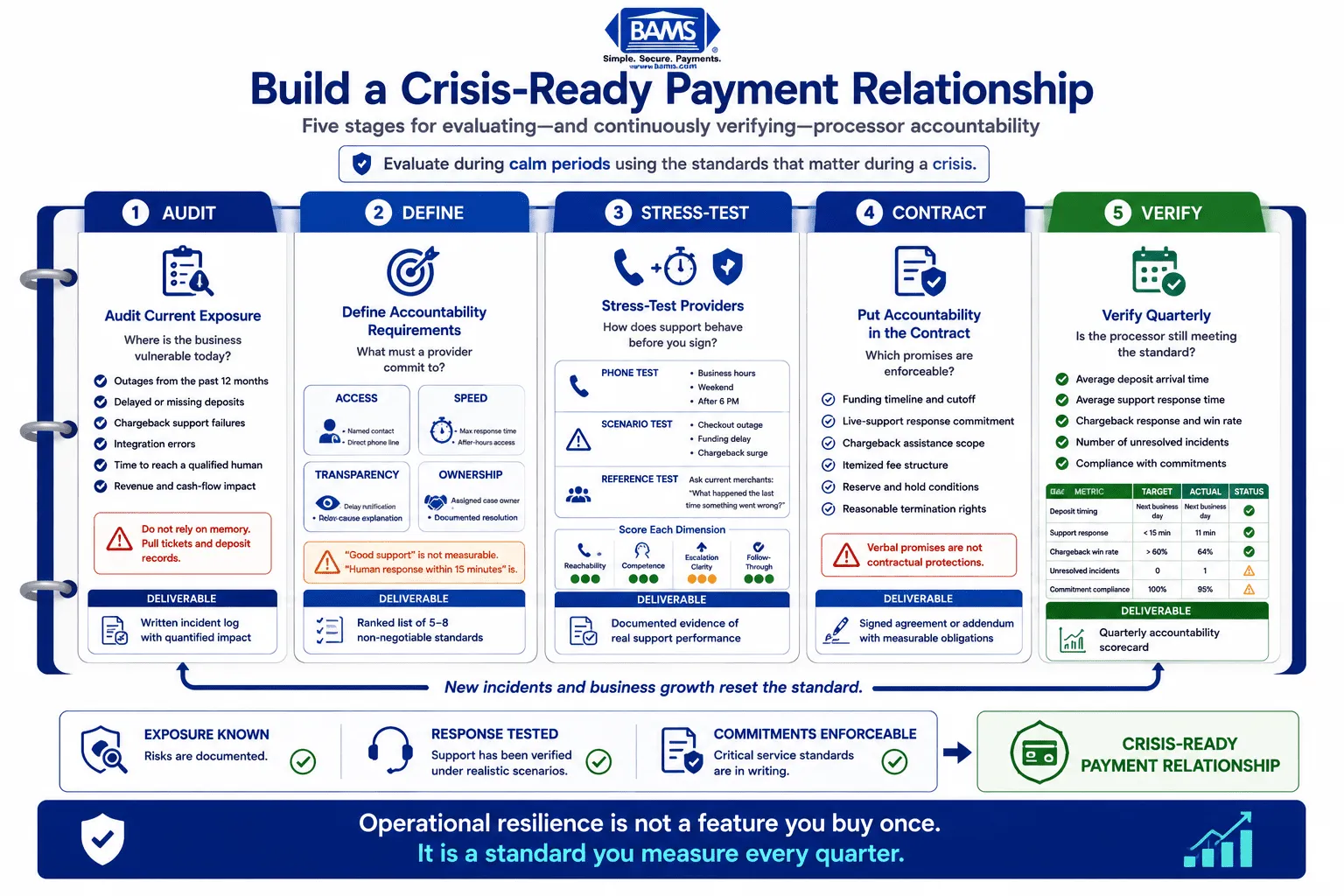
A resilient payment relationship is built through continuous auditing, testing, documentation, and performance verification.
Most businesses evaluate payment processors during calm periods. They compare pricing sheets, read reviews, and run test transactions. That’s useful, but it only shows you the sunny-day version of the relationship.
This framework flips the sequence. Instead of starting with fees and features, you start with crisis scenarios and work backward to determine which provider can actually support you when revenue is on the line.
The framework has five stages:
- Stage 1: Audit Your Current Crisis Exposure (understand where you’re vulnerable today)
- Stage 2: Define Your Accountability Requirements (set non-negotiable standards)
- Stage 3: Stress-Test Prospective Providers (evaluate before you sign)
- Stage 4: Negotiate Accountability Into the Contract (make commitments enforceable)
- Stage 5: Build Ongoing Verification Habits (confirm the relationship stays strong)
Each stage builds on the previous one. Skip the audit, and you won’t know what questions to ask. Skip the stress test, and you’re relying on sales promises. The stages are sequential for initial evaluation but become cyclical once you’ve chosen a partner, since verification should happen quarterly.
Step-by-Step Breakdown: How to Choose (and Hold Accountable) Your Payment Partner
Step 1: Audit Your Current Crisis Exposure
Objective: Identify the specific failure points in your current processor relationship so you know exactly what you’re solving for.
Start by documenting every incident from the past 12 months where your payment processing caused a business problem. This includes outages, delayed deposits, chargeback disputes where you lacked support, integration errors, and any instance where you needed help and couldn’t get it within a reasonable window. Be specific: note the date, the duration, the revenue impact, and how long it took to reach a person who could actually help.
Next, map your cash flow dependency on your processor’s funding schedule. If you’re receiving deposits on a two-day or three-day delay, calculate how much working capital is perpetually in transit. For many eCommerce businesses processing $500,000 or more annually, this float represents tens of thousands of dollars that could be deployed for inventory, marketing, or payroll. Understanding how your payment gateway affects cash flow is foundational to this audit.
Anti-patterns: Don’t limit your audit to “big” outages. The most damaging pattern is often a series of small issues (a deposit that arrives a day late, a chargeback notification you missed because it was buried in a portal) that collectively erode trust and cost real money. Don’t rely on memory alone. Pull your support ticket history and bank deposit records.
Success indicators: You’ve produced a written log of incidents with estimated revenue impact. You can quantify your average time-to-human-contact. You know your effective funding delay in hours, not the “standard” timeframe your processor advertises.
Step 2: Define Your Accountability Requirements
Objective: Translate your audit findings into a concrete list of non-negotiable standards for any processor you evaluate.
Your audit will reveal patterns. Maybe your biggest pain point is deposit timing and maybe it’s the inability to reach someone during weekend sales events. Maybe it’s chargeback losses that pile up because your processor offers no proactive defense. Whatever the pattern, convert it into a requirement with a measurable threshold.
For example: “I need to reach a named account manager by phone within 15 minutes during business hours” is a requirement. “Good customer service” is not. “Deposits must arrive next business day with a cutoff no earlier than 8 PM” is a requirement. “Fast funding” is not. The difference between great customer service in merchant services and adequate service is precisely this kind of specificity.
Organize your requirements across the four accountability pillars: access, speed, transparency, and resolution ownership. Rank them. Not every requirement carries equal weight for your business. A restaurant with high weekend volume will prioritize after-hours phone access. An eCommerce brand with thin margins will prioritize next-day funding and interchange clarity.
Anti-patterns: Don’t create a wish list of 30 requirements. Focus on the 5 to 8 that directly address the failures you documented in Step 1. Don’t assume that features listed on a processor’s website equal guaranteed service levels. A feature exists; a commitment is enforceable.
Success indicators: You have a ranked list of specific, measurable requirements. Each one traces back to a documented problem or risk. You can hand this list to a prospective provider and ask, “Can you meet these? How?”
Step 3: Stress-Test Prospective Providers
Objective: Evaluate how a processor actually behaves under pressure before you commit your revenue stream to them.
This is where most eCommerce managers skip ahead and regret it later. The sales process for payment processors is designed to feel reassuring. Everyone promises dedicated support, competitive rates, and seamless integration. The stress test reveals whether those promises hold up.
Start with the phone test. Call the provider’s support line (not the sales line) at three different times: during business hours, on a weekend, and after 6 PM on a weekday. Note how long it takes to reach a human. Ask a moderately complex question about deposit timing for split-funded accounts or chargeback representment procedures. Evaluate whether the person you reach can answer or needs to “escalate.” Payment outages can create significant operational disruption, making responsive support and clearly defined incident procedures essential when evaluating a payment processor.
Next, ask for references from businesses similar to yours in size, industry, and transaction volume. Not testimonials on a website. Actual contacts you can call. Ask those references one question above all others: “What happened the last time something went wrong, and how did they handle it?”
Finally, request a detailed walkthrough of their incident communication process. When an outage occurs, how will you be notified? By whom? How quickly? What’s the escalation path if the first response doesn’t resolve the issue?
Anti-patterns: Don’t evaluate providers solely based on the sales conversation. The salesperson is not the person who will answer your call during a Saturday outage. Don’t accept “we have 24/7 support” without testing it yourself. Don’t skip the reference calls because the demo looked polished.
Success indicators: You’ve spoken to support (not sales) at multiple times and documented response quality. You’ve talked to at least two current clients. You have a written description of their incident communication process.
Step 4: Negotiate Accountability Into the Contract
Objective: Ensure that the commitments made during the sales process are documented and enforceable in your merchant agreement.
Merchant processing agreements are notoriously dense, and most favor the processor. Your leverage is greatest before you sign. Use it. Take your ranked requirements from Step 2 and confirm that each one appears in the contract, the service level agreement (SLA), or a written addendum.
Key provisions to negotiate or verify include: funding timeline guarantees (next-day funding with a specific cutoff time, not “typically” next-day), support response time commitments (maximum time to reach a live representative), chargeback support scope (does the processor provide proactive alerts and representment assistance, or just notifications?), and fee transparency (interchange-plus pricing with itemized statements, not bundled rates that obscure markups). Understanding the differences between pricing models like interchange-plus versus flat-rate helps you negotiate from an informed position.
The Office of the Comptroller of the Currency’s Merchant Processing Handbook also outlines the operational responsibilities, settlement risks, and oversight practices involved in merchant acquiring relationships, making it a valuable reference when reviewing processor agreements.
Pay close attention to termination clauses. Some processors lock you into multi-year contracts with early termination fees that make switching prohibitively expensive. An accountable partner doesn’t need to trap you. They earn your business month over month.
Anti-patterns: Don’t sign without reading the SLA. Don’t assume verbal promises from the sales team are binding. Don’t accept vague language like “best efforts” for critical services like funding speed or support availability.
Success indicators: Your contract includes specific, measurable commitments for funding timing, support access, and fee structure. Termination terms are reasonable. You have a named contact (not just a department) for escalation.
Step 5: Build Ongoing Verification Habits
Objective: Confirm that your processor continues to meet its commitments after the honeymoon period ends.
Accountability isn’t a one-time evaluation. It’s an ongoing relationship practice. Set a quarterly review cadence where you measure your processor’s actual performance against the standards in your contract.
Track three metrics consistently: average deposit arrival time (compare to the contractual commitment), average support response time (log every interaction, not just the bad ones), and chargeback outcomes (win rate, response time, and whether you received proactive alerts). If any metric drifts below your threshold for two consecutive quarters, that’s your signal to initiate a conversation, or begin evaluating alternatives.
Merchants should also review guidance from the PCI Security Standards Council to better understand their ongoing responsibilities for protecting payment data and maintaining secure payment operations.
A provider like BAMS assigns a dedicated account manager who conducts periodic reviews with you, which builds this verification into the relationship rather than leaving it entirely on your shoulders. That kind of proactive structure is worth prioritizing, whether you choose BAMS or another provider that offers similar ongoing engagement.
Anti-patterns: Don’t assume that a good first six months means the relationship will stay strong. Don’t stop logging support interactions once you’re comfortable. Don’t wait for a crisis to discover that your processor’s support quality has degraded.
Success indicators: You have a quarterly scorecard with real data. Your processor knows you’re tracking performance. Any drift is caught early and addressed before it becomes a pattern.
Practical Examples: What Accountability Looks Like (and Doesn’t)
Scenario A: The Saturday Morning Outage
An eCommerce brand running a flash sale on Saturday morning discovers that card transactions are failing at 9 a.m. With their current processor, they submit a support ticket online (no phone option on weekends) and receive an auto-reply promising a response within 24 hours. By the time a human responds on Monday, the sale is over. Estimated revenue loss: $18,000. The processor’s post-incident summary is a one-line email: “The issue has been resolved.”
With an accountable partner, the same scenario plays differently. The eCommerce manager calls a direct line and reaches their account manager (or an on-call specialist) within 10 minutes. The issue is identified as a gateway routing error, a temporary fallback is activated, and transactions resume within 30 minutes. The processor sends a detailed incident report within 48 hours, including root cause and prevention steps. Revenue loss: under $2,000.
Scenario B: The Chargeback Cascade
A mid-size online retailer receives 14 chargebacks in a single week after a shipping delay affects a batch of orders. Their processor sends automated notifications but offers no representment support. The merchant misses two response deadlines because the notifications were buried in a portal they check weekly. Result: $4,200 in lost disputes, plus a chargeback ratio that triggers a monitoring program.
An accountable processor flags the spike proactively, calls the merchant, and provides pre-built representment templates with the evidence most likely to win. The merchant responds to all 14 within the deadline, wins 9, and avoids the monitoring threshold. The difference isn’t technology. It’s a human being who noticed the pattern and picked up the phone.
Scenario C: The Funding Delay During Payroll Week
A business processing $40,000 per week expects deposits on a two-day cycle. During a critical payroll week, deposits are delayed by an additional day with no explanation. The business owner calls support, waits 45 minutes, and is told “deposits are processing normally.” The funds arrive a day late. Payroll is covered by a short-term credit line, costing $300 in interest. No apology. No explanation.
Next-day funding eliminates this scenario almost entirely. When deposits arrive the next business day with a predictable cutoff, cash flow planning becomes reliable rather than hopeful. The cost of the credit line, the stress of the uncertainty, and the time spent on hold all disappear.
Common Mistakes and Pitfalls in Payment Processor Changes
Choosing on price alone. The cheapest processor is only cheap when everything works. A rate that’s 10 basis points lower saves you $500 a year on $500,000 in volume. One mishandled outage can cost you ten times that in a single morning.
Assuming all “dedicated support” is equal. Some processors assign a “dedicated” rep who handles 500 accounts. Others assign one who handles 50. Ask the number. It tells you everything about how available that person will actually be.
Waiting too long to switch. Inertia is the most expensive mistake. The longer you tolerate poor accountability, the more normalized it becomes, and the more revenue you quietly lose to slow funding, uncontested chargebacks, and unresolved issues.
Not testing support before signing. This is the single most predictive step in the evaluation process, and almost nobody does it. Ten minutes on hold before you sign tells you more than a 60-page contract.
Ignoring the contract’s termination clause. If your processor requires a three-year commitment with a $500 early termination fee, they’re betting you won’t leave even when the service degrades. Accountable partners offer month-to-month or low-friction exit terms.
What to Do Next
You don’t need to switch processors today. But you can start the audit today. Pull your support ticket history and bank deposit records from the past six months. Log every instance where you needed help and note how long it took to get it. Calculate your effective funding delay in hours.
That data will tell you whether your current relationship is working or whether you’ve been absorbing hidden costs out of habit. If the numbers confirm what your gut already suspects, use the stress-test framework in Step 3 to evaluate one or two alternatives before making any commitments.
Treat this guide as a reference you return to, not a checklist you complete once. Your accountability standards should evolve as your business grows, your transaction volume increases, and your tolerance for preventable losses decreases. The right payment partner earns your confidence every quarter. Start measuring whether yours does.
Frequently Asked Questions
How do I know if my current payment processor is actually accountable?
Run a simple test: call their support line on a weekend evening and ask a specific question about your deposit schedule or chargeback process. If you can’t reach a human within 15 minutes, or the person you reach can’t answer without escalating, your processor’s accountability is limited to business hours and simple issues. Then review your last 12 months of support interactions and deposit records for patterns of delay or non-response.
When should a business consider making payment processor changes?
The clearest signals are repeated funding delays, inability to reach support during critical moments, rising chargeback losses without proactive assistance, and fee increases that arrive without explanation. If you’ve experienced two or more of these in the past six months, it’s worth evaluating alternatives. Don’t wait for a catastrophic outage to discover your processor can’t support you.
What’s the real cost of a payment processing outage for an eCommerce business?
It depends on your revenue per hour and how long the outage lasts. After 23 minutes of payment downtime, 70% of vulnerable revenue is gone. For an eCommerce business doing $5 million annually, a two-hour outage during peak traffic could cost $5,000 to $15,000 in lost orders, plus downstream costs like customer service time, abandoned cart recovery, and reputational damage.
What should I look for in a merchant services provider’s contract?
Focus on four provisions: funding timeline guarantees (specific cutoff times, not vague promises), support response time commitments (maximum wait, not average), chargeback support scope (proactive alerts and representment help, not just notifications), and termination terms (month-to-month or reasonable exit clauses). If any of these are missing or use language like “best efforts,” push for specifics before signing.
Is it worth switching processors for next-day funding alone?
For many eCommerce businesses, yes. If you’re processing $30,000 or more per week and currently on a two-day or three-day funding cycle, you have $8,500 to $13,000 perpetually in transit. Next-day funding puts that money back into your operating account, improving cash flow for inventory, payroll, and marketing. The switch pays for itself quickly if your current funding delays have ever forced you to use credit or delay vendor payments.
How do I switch payment processors without disrupting my online store?
Run both processors in parallel during the transition. Set up the new processor, test it with a small percentage of transactions, verify that deposits arrive on schedule, and confirm that your integration (shopping cart, invoicing, reporting) works correctly. Only cut over fully once you’ve validated the new processor across at least one full business cycle. Most accountable providers will help you plan and execute this migration with minimal downtime.


