How to Cut Chargeback Costs With Tokenized Payments
Trace the line from merchant tokens and biometric authentication to measurable savings on your P&L
Learn how tokenization and biometric authentication reduce chargeback costs by disrupting the friendly fraud cycle. This guide helps you quantify dispute savings, identify cost levers, and build a case for operational changes that protect revenue.
TL;DR
- Tokenization cuts fraud dramatically — Tokenized transactions reduce fraud by 85–95% compared to non-tokenized payments, directly shrinking your chargeback volume and associated costs.
- Biometric authentication kills friendly fraud — Face ID and Touch ID create cryptographic proof the cardholder authorized the purchase, making “I didn’t do it” disputes far harder to file and win.
- Lower risk means lower processing costs — Tokenized transactions can qualify for better interchange rates due to their reduced risk profile, saving you money on every transaction, not just disputed ones.
- Fewer chargebacks unlock better cash flow — A cleaner chargeback ratio reduces reserve requirements and can qualify you for next-day funding, freeing working capital and accelerating reinvestment.
- Start by measuring what you’re losing — Audit your all-in cost per chargeback by reason code, then track chargeback rates by payment method to quantify exactly where tokenization delivers savings on your P&L.
Guide Orientation: What This Covers and Who It’s For
This guide shows you how to trace the line from tokenized payments and biometric authentication to measurable savings on your P&L. Specifically, it explains how merchant tokens and device-level security (the technology behind Apple Pay and similar wallets) reduce chargeback costs, shrink dispute volumes, and protect revenue you’re currently losing.
It’s written for eCommerce managers at established online businesses who already process a meaningful volume of card transactions and want to understand the financial mechanics, not just the security buzzwords. By the end, you’ll be able to quantify how tokenization disrupts the friendly fraud cycle, identify which interchange and dispute cost levers to prioritize, and build a case for operational changes that turn fewer chargebacks into real, recurring savings.
This guide does not cover how to set up Apple Pay on your website or compare digital wallet market share. It focuses on the money: where it leaks, why it leaks, and how to stop it.
Why Reducing Chargeback Costs Matters More Than You Think
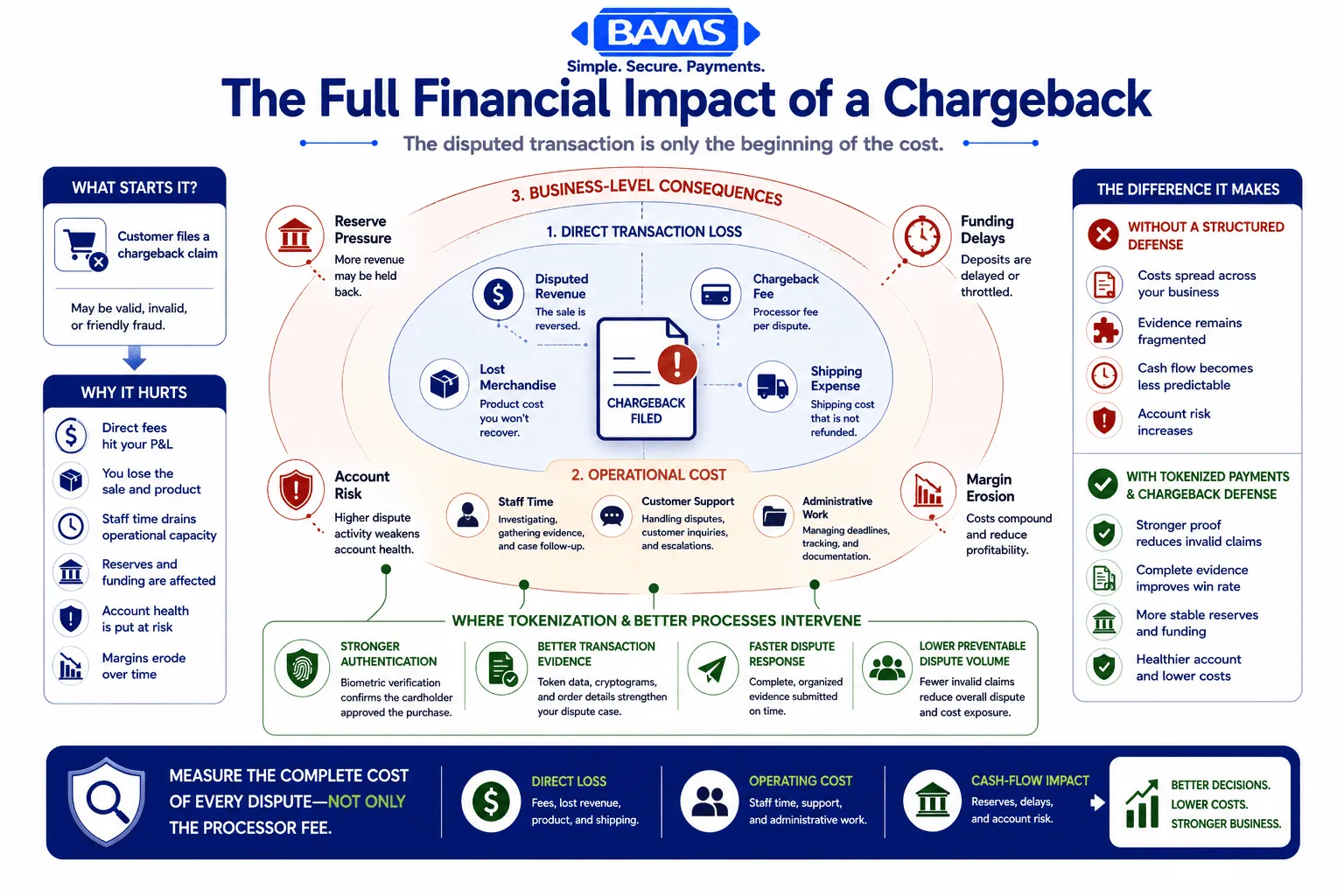
Chargebacks are not just a fraud problem. They are a compounding financial drain that erodes margin, consumes staff time, and quietly inflates your cost of doing business. Every disputed transaction carries a direct fee (typically $20 to $100 per incident), but the indirect costs are larger: lost merchandise, shipping expenses you’ll never recover, and the operational hours spent assembling evidence packets for disputes you may still lose.
The landscape is shifting. Network tokenization continues to expand across digital commerce, and merchants who haven’t adapted are absorbing disproportionate fraud exposure. Card networks are tightening chargeback ratio thresholds, and exceeding them triggers monitoring programs with additional per-transaction fees, reserve requirements, or outright account termination. For a business processing $500,000 a month, a chargeback rate that drifts from 0.6% to 1.2% doesn’t just double your dispute costs. It can jeopardize your ability to accept cards at all.
The cost of inaction is no longer theoretical. As more transactions shift to tokenized channels, fraud migrates toward merchants still relying on static card numbers. Understanding exactly how tokenization and biometric authentication reduce your dispute exposure is no longer a nice-to-have security conversation. It’s a financial imperative.
Core Concepts: Tokens, Biometrics, and the Friendly Fraud Problem
What a Merchant Token Actually Does
A merchant token (sometimes called an MPAN, or Merchant Primary Account Number) replaces the customer’s real card number with a unique, device-specific substitute. This token is useless outside the specific merchant-device pairing it was issued for. If intercepted, it cannot be replicated or used elsewhere. This eliminates the most common raw material for fraud: stolen card credentials.
How Biometric Authentication Changes the Dispute Equation
When a customer pays with Apple Pay, the transaction requires biometric verification (Face ID, Touch ID, or device passcode) before it’s authorized. This creates a critical distinction: the cardholder physically authenticated the purchase with their body. That authentication data travels with the transaction, making it significantly harder for a customer to later claim they didn’t authorize it.
Friendly Fraud: The Real Chargeback Driver
Most merchants assume chargebacks come from stolen cards. In reality, a large share of eCommerce disputes are “friendly fraud,” where the actual cardholder makes a purchase and then disputes it. Common reasons include buyer’s remorse, confusion about billing descriptors, or simply testing whether the bank will refund them. Traditional card transactions offer limited proof that the cardholder was present. Tokenized, biometrically authenticated transactions provide that proof by design.
The Key Distinction
Security features reduce fraud. But what matters for your P&L is how those features translate into fewer disputes filed, fewer disputes lost, and lower fees assessed. This guide focuses on that translation.
The Framework: From Authentication to Savings

Tokenization creates value beyond payment security. Stronger authentication and better evidence can reduce disputes, lower operating costs, and improve access to working capital.
The path from tokenized payments to lower chargeback costs follows four connected stages. Each stage represents a measurable financial lever.
- Stage 1: Stronger Authentication — Biometric verification and device-bound tokens make unauthorized transactions nearly impossible and “unauthorized” claims much harder to sustain.
- Stage 2: Better Interchange Qualification — Tokenized transactions often qualify for lower interchange tiers because they carry richer data and lower risk profiles.
- Stage 3: Dispute Prevention — The authentication evidence embedded in tokenized transactions deters friendly fraud before a dispute is filed and strengthens your position when one is.
- Stage 4: Operational Cost Reduction — Fewer disputes mean fewer staff hours spent on evidence gathering, less revenue held in reserve, and more predictable cash flow.
These stages are sequential but reinforcing. Improvement at any stage compounds savings downstream. The steps below show you how to execute at each one.
Step-by-Step: Turning Tokenization Into Measurable Savings
Step 1: Audit Your Current Chargeback Exposure
Objective: Establish a clear baseline of what chargebacks currently cost your business, including hidden costs most merchants overlook.
Start by pulling your chargeback data for the last six months. Don’t just count disputes. Calculate the full cost per incident: the chargeback fee itself, the lost product value, original shipping cost, return shipping (if applicable), and the labor hours your team spent responding. For most eCommerce businesses processing $200K+ monthly, the all-in cost per chargeback ranges from $50 to $190 when you include operational overhead.
Break your disputes down by reason code. You’ll likely find that “unauthorized transaction” and “product not received” dominate. The unauthorized category is where tokenization has the most direct impact, so quantify it separately. Also note your current chargeback ratio (disputes divided by total transactions). If you’re above 0.65%, you’re approaching the threshold where card networks begin monitoring.
What to avoid: Don’t rely solely on your processor’s dispute dashboard. It typically shows fees and outcomes but not the full operational cost. Build your own tracking that includes staff time and lost merchandise value. For a more detailed approach to structuring this audit, this chargeback management system guide walks through the process step by step.
Success indicator: You can state, with confidence, your average all-in cost per chargeback, your ratio by reason code, and the total monthly dollar impact on your P&L.
A chargeback costs more than the disputed sale. Merchandise loss, fulfillment expenses, staff time, reserve pressure, and delayed deposits can significantly increase its total financial impact.
Step 2: Understand How Tokenization Disrupts the Fraud Cycle
Objective: Map the specific mechanisms through which merchant tokens and biometric authentication prevent the disputes you identified in Step 1.
Traditional card-not-present transactions transmit the actual card number (PAN) across multiple systems: your payment gateway, your processor, the card network, and the issuing bank. Each transmission point is a potential breach vector. When credentials are compromised, fraudsters use them, and you absorb the chargeback.
Tokenized transactions eliminate this chain of exposure. In tokenized channels, fraud is significantly reduced compared to non-tokenized channels. compared to non-tokenized transactions. The merchant token is bound to a specific device and merchant relationship, so even if your systems are compromised, the token has no value elsewhere.
Biometric authentication adds a second layer that specifically targets friendly fraud. When a customer authenticates with Face ID or Touch ID, the issuing bank receives cryptographic proof that the device owner approved the transaction. This makes “I didn’t authorize this” claims far more difficult to sustain. Apple Pay combines tokenization with device authentication to strengthen payment security
What to avoid: Don’t assume tokenization eliminates all chargebacks. It primarily addresses unauthorized transaction claims and credential theft. Product quality disputes, delivery issues, and subscription confusion require different defenses. Understanding which dispute categories tokenization solves (and which it doesn’t) prevents false expectations.
Success indicator: You can identify which percentage of your current chargebacks fall into categories that tokenization directly addresses and estimate the potential reduction.
Step 3: Optimize Interchange Qualification Through Richer Transaction Data
Objective: Capture the interchange cost savings that tokenized transactions can unlock, beyond just fraud reduction.
This is the cost lever most merchants miss entirely. Card networks assign interchange rates based partly on transaction risk. Tokenized transactions carry a lower risk profile because they include device-level authentication, cryptographic verification, and (in many cases) richer data fields. This can qualify your transactions for lower interchange tiers, reducing your per-transaction processing cost.
The savings vary by card network and card type, but the principle is consistent: transactions that the network considers lower-risk cost less to process. For a business processing $500K monthly, even a 5-10 basis point improvement in average interchange qualification translates to $250-$500 in monthly savings, compounding alongside your chargeback reduction.
To capture this benefit, ensure your payment gateway is passing Level 2 and Level 3 data fields (line-item detail, tax amounts, shipping information) for qualifying transactions. Many gateways support this but don’t enable it by default. Talk to your processor about which data fields are being transmitted and whether your tokenized transactions are qualifying for the best available rates. For a deeper comparison of how these fee categories interact, this breakdown of chargeback fees versus interchange fees provides a useful decision framework.
What to avoid: Don’t assume your processor is automatically optimizing interchange qualification. Many processors batch all transactions at the same rate regardless of data quality. Ask specifically about interchange-plus pricing and whether tokenized transactions are being flagged for preferred rates.
Success indicator: You receive a clear answer from your processor about which interchange tiers your tokenized transactions qualify for, and you can compare your effective rate on tokenized vs. non-tokenized transactions.
Step 4: Build a Biometric-Backed Dispute Defense
Objective: Use the authentication evidence from tokenized transactions to win more disputes and deter friendly fraud.
When a chargeback does arrive on a tokenized transaction, you have stronger evidence than you’ve ever had on a traditional card-not-present sale. The transaction record includes cryptographic proof that the device owner authenticated the purchase biometrically. This is the digital equivalent of a signed receipt, and it fundamentally shifts the burden in dispute resolution.
Structure your dispute response process to highlight this evidence. When responding to “unauthorized transaction” chargebacks on tokenized payments, your evidence packet should lead with the authentication method (biometric verification via device token), the device identifier confirming the cardholder’s registered device was used, and any additional signals like matching IP address or delivery confirmation to the cardholder’s address.
Merchants using BAMS benefit from proactive chargeback defense that integrates these evidence workflows, helping you respond faster and with stronger documentation. This kind of support matters because dispute response windows are tight (typically 20-30 days), and incomplete evidence packets are the primary reason merchants lose winnable disputes.
What to avoid: Don’t treat all chargebacks the same. Tokenized transaction disputes require different evidence than traditional ones. If your team uses the same template for every response, you’re leaving your strongest evidence on the table. Also avoid ignoring low-value disputes. Card networks track your overall ratio regardless of dollar amount. For a broader look at why systematic defense matters, this overview of chargeback defense covers the strategic rationale.
Success indicator: Your win rate on disputed tokenized transactions is measurably higher than on traditional card transactions, and your team has a distinct evidence template for biometrically authenticated payments.
Step 5: Shift Transaction Mix Toward Tokenized Payments
Objective: Actively increase the percentage of your transactions processed through tokenized channels to compound your savings across all four stages.
Once you’ve confirmed the per-transaction savings from tokenization (lower fraud, better interchange, stronger dispute defense), the next move is increasing adoption. This doesn’t mean forcing customers into a single payment method. It means reducing friction for tokenized options and making them the path of least resistance at checkout.
Place Apple Pay and other tokenized wallet options as the first payment choice in your checkout flow, above manual card entry. Network tokenization helps protect payment credentials throughout the transaction lifecycle. Every transaction you shift from manual card entry to a tokenized wallet reduces your fraud exposure, improves your interchange profile, and strengthens your chargeback defense position.
Consider offering express checkout buttons on product pages (not just the cart page) to capture impulse purchases through tokenized channels. On mobile, where Apple Pay adoption is highest, ensure the payment button renders prominently above the fold. Test different placements and measure not just conversion rate but chargeback rate by payment method. The data will likely show that your tokenized transactions have both higher conversion and lower dispute rates.
What to avoid: Don’t hide traditional payment options or make customers feel forced. The goal is preference, not restriction. Also don’t neglect desktop. While mobile drives most wallet usage, browser-based Apple Pay (via Safari) captures a meaningful share of desktop transactions too.
Success indicator: Your tokenized transaction percentage increases month over month, and you can demonstrate a corresponding decline in your overall chargeback ratio and dispute costs.
Step 6: Connect Chargeback Savings to Cash Flow
Objective: Translate your reduced dispute exposure into faster, more predictable access to your revenue.
Chargebacks don’t just cost you the dispute amount and the fee. They create cash flow uncertainty. When a dispute is filed, the transaction amount is typically held in reserve until resolution, which can take 45 to 90 days. During that period, you’ve shipped the product, paid your supplier, and covered fulfillment costs, but the revenue is frozen.
As your chargeback ratio drops, two things happen to your cash flow. First, fewer transactions are held in reserve, meaning more of your daily revenue is available immediately. Second, processors and acquiring banks view lower-risk merchants more favorably, which can unlock benefits like next-day funding. Instead of waiting 2-3 business days for deposits, you get yesterday’s sales in your account the next morning.
This is where the compounding effect becomes tangible. Lower chargebacks reduce direct costs (fees, lost merchandise). Better interchange qualification reduces per-transaction costs. And improved cash flow timing means you can reinvest revenue faster, negotiate better supplier terms, and reduce reliance on credit lines. BAMS offers next-day funding as a standard feature for qualifying merchants, which means the cash flow benefit of a cleaner chargeback profile translates into real operational advantage immediately, not months down the road.
What to avoid: Don’t overlook the relationship between your chargeback ratio and your processor’s funding terms. Many merchants don’t realize that a high dispute rate is the reason their deposits are delayed or that reserves are being withheld. Ask your processor directly how your chargeback ratio affects your funding schedule.
Success indicator: You can document the dollar value of improved cash flow timing (faster deposits, lower reserves) alongside your direct chargeback cost savings, giving you a complete picture of the financial impact.
Practical Examples: Before and After
Scenario: Mid-Size eCommerce Apparel Brand
Before tokenization push: A brand processing $400K monthly with a 0.9% chargeback rate faces roughly 45 disputes per month. At an all-in cost of $120 per dispute (fee + lost merchandise + labor), that’s $5,400 monthly, or $64,800 annually. Their processor holds a rolling reserve of 5% due to the elevated ratio, tying up $20,000 at any given time. Deposits arrive in 2-3 business days.
After shifting 40% of transactions to tokenized wallets: The overall chargeback rate drops to 0.55%. Monthly disputes fall to roughly 27, saving $2,160 per month in direct costs. The lower ratio eliminates the rolling reserve requirement, freeing $20,000 in working capital. The processor approves next-day funding. Combined annual savings: approximately $25,920 in direct chargeback costs, plus $20,000 in freed reserves, plus the time-value benefit of receiving revenue 1-2 days faster on every transaction.
Scenario: Subscription Box Service
Subscription businesses face elevated friendly fraud because customers forget they subscribed or dispute charges they don’t recognize. A subscription box company processing 8,000 transactions monthly saw 1.1% of transactions disputed, almost entirely as “unauthorized.” After implementing tokenized checkout and updating billing descriptors, the unauthorized dispute rate dropped to 0.3%. The authentication evidence from tokenized transactions made the remaining disputes far easier to win, pushing their dispute win rate from 22% to 61%.
Common Mistakes and Pitfalls
The most predictable failure is treating tokenization as a “set it and forget it” solution. Enabling Apple Pay at checkout without tracking chargeback rates by payment method means you’ll never quantify the savings or identify where gaps remain.
Another common error is neglecting non-fraud chargebacks. Tokenization dramatically reduces unauthorized transaction claims, but disputes over product quality, delivery failures, or unclear billing descriptors require entirely different defenses. Merchants who focus exclusively on fraud prevention while ignoring operational causes of disputes see diminishing returns. A comprehensive chargeback defense strategy addresses all four pillars: prevention, monitoring, evidence submission, and analytics.
Finally, many merchants fail to renegotiate processing terms after their risk profile improves. A lower chargeback ratio and higher tokenized transaction percentage should translate into better interchange rates, lower reserves, and faster funding. If your processor doesn’t adjust terms proactively, ask. If they won’t, that’s a signal to evaluate alternatives.
What to Do Next
Start with one action: pull your chargeback data for the last six months and calculate your all-in cost per dispute, broken down by reason code. This single exercise will show you exactly how much money is at stake and which dispute categories tokenization can address.
From there, check what percentage of your current transactions are already tokenized. If it’s below 30%, there’s likely significant low-hanging fruit in checkout flow optimization. If it’s above 30%, your next lever is dispute evidence workflows and interchange qualification.
This guide is designed as a reference, not a one-time read. Revisit it as your transaction mix shifts, as your chargeback data evolves, and as you evaluate whether your payment processor is helping you capture the full financial benefit of lower-risk transactions. The savings are real, but they compound only when you measure them, act on them, and hold your partners accountable for delivering them.
Frequently Asked Questions
What fees do merchants incur when accepting Apple Pay?
Apple does not charge merchants a separate fee for accepting Apple Pay. You pay the same processing fees you would on any card transaction: interchange, network assessment, and your processor’s markup. The difference is that tokenized Apple Pay transactions may qualify for lower interchange tiers due to their reduced risk profile, potentially lowering your effective per-transaction cost compared to manually entered card numbers.
How does tokenization actually reduce chargebacks?
Tokenization replaces the real card number with a device-specific substitute that’s useless if intercepted. This eliminates credential theft as a fraud vector. Combined with biometric authentication (Face ID or Touch ID), it creates cryptographic proof that the cardholder’s registered device was used to authorize the purchase. This makes “I didn’t authorize this” claims far harder to file and even harder to win, directly reducing both the volume and success rate of friendly fraud disputes.
Why is Apple Pay beneficial for reducing fraud costs?
Apple Pay combines two powerful fraud prevention layers: device-bound tokenization and biometric authentication. Together, they produce a fraud rate roughly 60% lower than traditional card transactions. For merchants, this translates into fewer chargebacks, lower dispute fees, reduced merchandise losses, and less staff time spent on evidence gathering. The savings are measurable on your P&L, not just in your security posture.
How does Apple Pay compare to traditional credit card processing fees?
The base processing structure is the same (interchange plus network fees plus processor markup). However, tokenized transactions carry a lower risk profile, which can qualify them for preferred interchange rates. The indirect savings are often larger than the direct fee differences: fewer chargebacks, lower reserves, and faster funding eligibility. To see the full cost picture, compare your effective rate and chargeback rate on tokenized versus non-tokenized transactions side by side.
When should businesses promote Apple Pay to customers?
Promote tokenized payment options whenever they reduce friction and improve your financial outcomes. Place wallet buttons prominently in your checkout flow, especially on mobile where adoption is highest. Consider adding express checkout on product pages, not just the cart. The best time to start is now: every transaction you shift from manual card entry to a tokenized wallet lowers your fraud exposure, improves your interchange profile, and strengthens your dispute defense.
Can tokenization eliminate all chargebacks?
No. Tokenization primarily addresses chargebacks related to unauthorized transactions and credential theft. Disputes over product quality, delivery issues, subscription confusion, or unclear billing descriptors require separate defenses: better fulfillment tracking, clearer billing descriptors, proactive customer communication, and robust dispute response workflows. A complete chargeback defense strategy addresses all dispute categories, not just fraud.


