
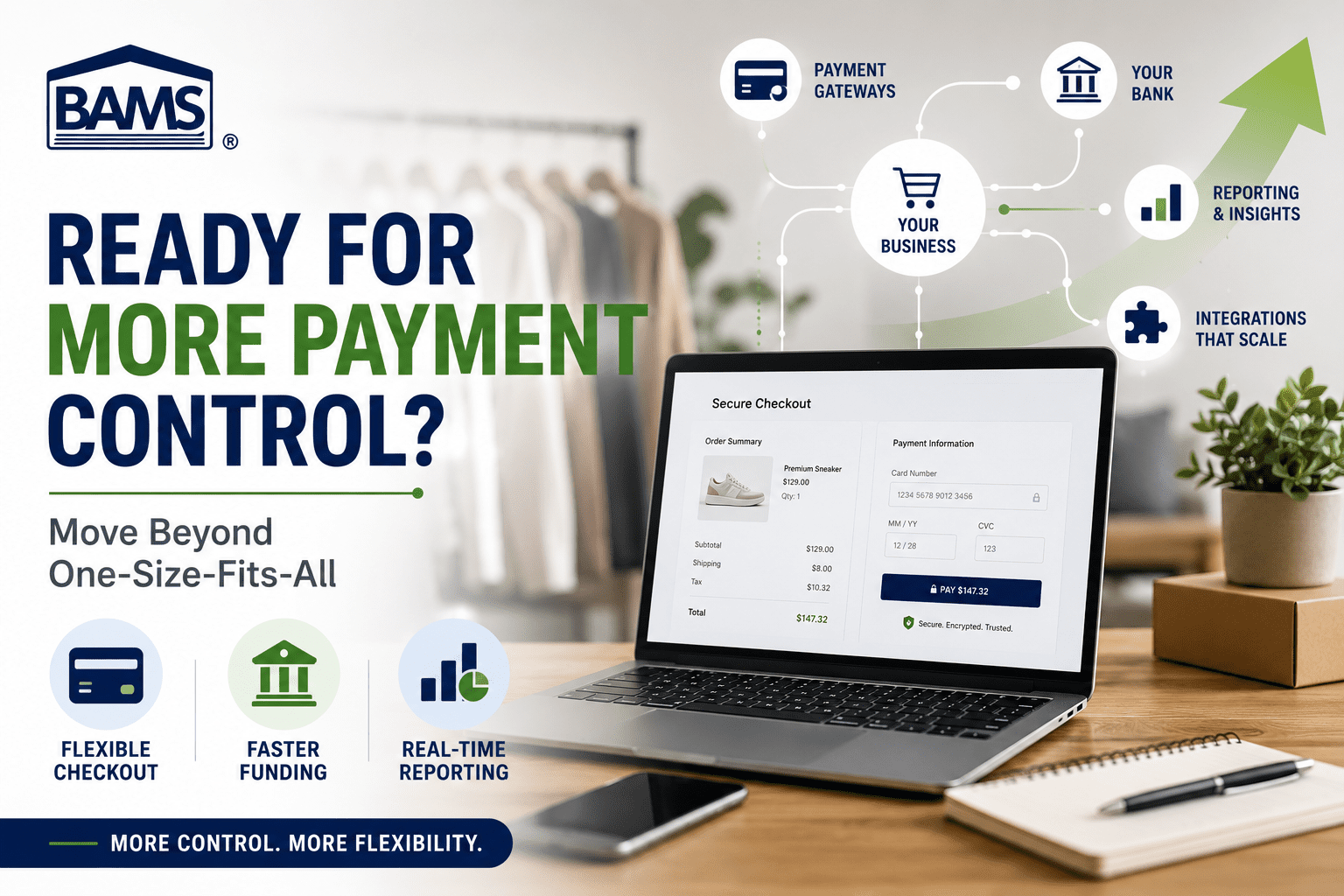
A Better Alternative to Stripe and PayPal
Last Updated on August 20, 2026 by Dimitri Akhrin
When an All-in-One Payment Provider Stops Being Enough
A PayPal and Stripe alternative becomes worth considering when an online business starts needing more control over checkout, processing, funding and the systems connected to its store.
PayPal and Stripe can make accepting payments relatively simple, especially for newer businesses. That convenience is useful. But the payment setup that works when a store is processing a small number of orders may not always be the setup the business wants as volume, operational requirements and payment complexity grow.
A dedicated merchant account gives the business another option. Instead of treating checkout, processing and the merchant relationship as one bundled decision, the company can build a payment setup around the way it actually operates.
Many new merchants sign up with PayPal or Stripe to accept payments but often find that they have high cart abandonment and generally lackluster sales. In many cases, it’s not the product or the newness of the merchant that’s the problem – it’s the lack of a “real” shopping cart. Eliminating this issue is as simple as switching to a BAMS merchant account. Here are some of the biggest reasons to do this:
2026 checkout clarification: The distinction between an outside payment provider and a “real” shopping cart has changed considerably since this article was originally published. Modern payment service providers can support both hosted and embedded checkout experiences. A customer does not necessarily need to leave the merchant’s website simply because the business uses a third-party payment provider.
The better question today is how much control the merchant has over the complete checkout and payment environment.
You Look More Professional
BAMS provides true merchant account capabilities that work within your shopping cart. This eliminates the switch to another provider’s site for transaction completion and thereby increases consumer confidence. Customers often get cold feet if they find themselves having to go through PayPal or another provider’s system when it comes time to buy. Outside checkout systems mark your store as that of an amateur, and this causes people to worry that things won’t go smoothly. A real merchant account reassures them that you’re actually ready to do business.
Brand Consistency Still Matters
The original point is still useful even though hosted checkout itself is no longer automatically a problem.
A customer should feel like the checkout belongs to the store they were already shopping with. The design, wording, order information and transition into payment should feel deliberate rather than patched together.
A redirect is not automatically unprofessional and an embedded payment form is not automatically better. What matters is whether the customer understands where they are, what they are buying and what will happen after they press the payment button.
Visa’s current acceptance work continues to emphasize secure and frictionless payment experiences. The less confusion a shopper encounters between cart and payment, the easier it is to complete the purchase with confidence.
Your Checkout Should Fit the Store
An eCommerce business should not have to design its entire shopping experience around one payment screen.
BAMS currently supports a range of payment gateway solutions and eCommerce integrations. That gives merchants more flexibility to connect processing with the shopping cart, gateway and business software that fit their operation.
This becomes more valuable as the store grows.
A merchant may eventually need subscriptions, customer payment profiles, recurring billing, fraud controls or a specific eCommerce integration. Another may need to connect payments with accounting, fulfillment or reporting.
The important part is having options rather than replacing the entire payment setup every time the business adds another requirement.
You Get Your Money Faster
PayPal is known for holding back funds from new accounts. This is supposed to reduce fraud, but in reality, it just makes it harder on you. If you run a dropshipping operation, or simply only buy the stock after someone has actually ordered it, you need to get your money and turn it around in short order. A real merchant account lets you have it within a day or two.
2026 funding update: Funding schedules vary by processor, account and merchant risk profile, so a traditional merchant account does not automatically guarantee faster deposits.
BAMS does currently offer guaranteed next day funding to qualifying merchants. Eligible batches submitted before the 9 PM ET cut-off can reach the merchant’s bank account by 7 AM the following business day. That can mean access to processed revenue in as little as ten hours.
For an eCommerce merchant that constantly turns sales revenue back into inventory, advertising or fulfillment, that timing can matter.
Funding Speed Is Really a Cash-Flow Question
The goal is not simply to move money quickly for the sake of speed.
A store might need to pay a supplier before another production run begins. A dropshipper may need available cash to fulfill an incoming order. A growing brand may be buying inventory every week while simultaneously paying advertising bills and shipping expenses.
The longer processed revenue remains unavailable, the more working capital the business needs to keep everything moving.
That makes funding schedule one of the questions merchants should ask before choosing a processor:
- When are transactions batched?
- What is the daily funding cut-off?
- When should the deposit reach the bank?
- Are faster deposits available?
- Does faster funding carry another fee?
- What happens to transactions processed over the weekend?
The answers can matter just as much as the headline processing rate.
You Don’t Have to Worry About Surprise Platform Updates
External payment processors sometimes update their platforms in ways that break their integration with their site. Then, you have to drop everything and rush to install a new code in order to take any orders at all. You won’t have to put up with this costly nonsense with a real merchant account.
2026 technology clarification: A merchant account does not make a website immune to software updates.
Payment gateways, eCommerce platforms, APIs, shopping-cart extensions and security requirements all change over time. Any integration can require maintenance.
The advantage of a more flexible merchant-services setup is different. When the processing relationship is not inseparable from one shopping platform or one checkout product, the business may have more choices when a technology component changes.
A merchant might change a gateway, update an integration or move to another compatible eCommerce platform without necessarily starting the entire payment relationship from scratch.
Do Not Ignore the Security Benefit of Hosted Payments
Keeping the checkout visually inside your website is not the only goal.
Sometimes allowing a compliant service provider to host payment elements can actually simplify the merchant’s security environment.
The PCI Security Standards Council explains that merchants can qualify for a narrower SAQ A validation scope when all payment-page elements originate from PCI DSS compliant third-party service providers and the merchant’s own website does not provide any payment-page elements.
That does not mean outsourcing checkout eliminates PCI responsibilities. PCI DSS still applies to merchants accepting payment cards regardless of business size or transaction volume.
The right setup balances customer experience with security. BAMS provides PCI compliance support for businesses evaluating the requirements that apply to their payment environment.
A Merchant Account Gives You More Payment Architecture Choices
Payment service providers have changed considerably since this article first appeared.
Modern Treasury describes today’s PSPs as broader platforms that can combine gateway functions, processing, payment methods and other infrastructure. For many merchants, that bundled model is convenient.
A dedicated merchant account takes a different approach.
The merchant can evaluate the processor alongside the gateway, shopping cart and other systems instead of assuming they all need to come from one provider.
That distinction becomes more valuable when the business starts asking questions such as:
- Can I use another payment gateway?
- Can I keep my current shopping cart?
- Can I change my processor without rebuilding the store?
- Can the gateway support recurring billing?
- Can I connect the transactions with other business software?
- Can I negotiate pricing as volume grows?
The point is not that bundled payment platforms are bad. The point is that growing merchants may eventually value choice more than simplicity.
Compare Processing Costs as Your Volume Grows
A simple flat-rate structure can be easy to understand when a business is starting out.
Once monthly card volume becomes meaningful, merchants should look more closely at what their processing actually costs.
Do not compare only the advertised percentage. Look at the total statement.
Consider transaction fees, monthly costs, gateway charges, funding fees and any pricing tied to specific services. Then compare that number against the value of the technology and support included with the account.
BAMS currently offers transparent merchant account pricing and volume-based options for online businesses. The right pricing structure depends on the merchant’s volume, transaction profile and payment environment.
Reporting Becomes More Important as the Store Grows
A small store may be able to check orders manually and know roughly what happened each day.
That becomes harder at scale.
Managers need to see deposits, find transactions, reconcile statements and understand where processing costs are coming from. If the payment data is difficult to access, every accounting question turns into another manual task.
BAMS eCommerce merchant accounts currently include centralized reporting and analytics tools alongside gateway and integration options.
The goal is not to collect more dashboards. It is to make the important numbers easier to find.
When Should You Consider Moving Beyond PayPal or Stripe?

Growing eCommerce businesses may need a different payment setup when costs, funding, integrations and reporting become more important.
There is no transaction count that automatically means a business has outgrown an all-in-one payment provider.
Look for operational signs instead.
You may want to compare merchant-account options when:
- Processing fees have become a meaningful line item.
- You want more control over your gateway or processor.
- Your current funding schedule creates cash-flow pressure.
- You need integrations your current payment setup does not support.
- You want more detailed reporting or account support.
- Your checkout requirements have become more customized.
- You are expanding into new sales channels or higher transaction volume.
If none of those issues exists, changing processors simply because the business has grown may create work without producing enough benefit.
Merchant Account vs All-in-One Payment Provider

All-in-one payment providers offer simplicity while dedicated merchant accounts can give growing eCommerce businesses more control over payments and integrations.
| What to Compare | All-in-One Provider | Dedicated Merchant Account |
|---|---|---|
| Setup | Often designed for quick onboarding | May involve underwriting and account configuration |
| Checkout | Can support hosted or embedded experiences | Can connect with compatible gateways and shopping carts |
| Payment stack | Often more tightly bundled | Can provide more choice between processor, gateway and platform |
| Pricing | Often uses straightforward standardized pricing | Can offer pricing based on volume and business profile |
| Funding | Depends on provider and account | Depends on processor and merchant qualification |
| Integrations | Built around the provider’s ecosystem | Can support a wider mix of compatible payment gateways and platforms |
Frequently Asked Questions
Is a merchant account better than PayPal or Stripe?
Not automatically. PayPal and Stripe can be practical choices for many businesses. A dedicated merchant account becomes more attractive when the merchant needs greater control over processing, gateways, funding, integrations or pricing.
Do PayPal and Stripe always send customers away from the merchant website?
No. Modern payment providers can support checkout experiences that are embedded into the merchant’s website. The older distinction between an outside checkout and a merchant-account checkout is no longer universal.
Does an embedded checkout reduce cart abandonment?
A consistent checkout can reduce unnecessary friction but checkout location is only one part of the customer experience. Page speed, security, payment options, shipping costs and checkout complexity can all influence whether a customer completes an order.
Does a merchant account mean faster funding?
Not necessarily. Funding depends on the processor and merchant account. Qualifying BAMS merchants can access guaranteed next day funding with eligible transactions deposited as early as the following business morning.
Can a merchant account work with an existing eCommerce platform?
Yes when a compatible payment gateway or integration exists. BAMS currently supports eCommerce merchant accounts alongside a range of gateways and commerce-platform integrations.
Does using an outside payment provider eliminate PCI compliance?
No. Using a PCI compliant third-party payment service can reduce the merchant’s PCI scope depending on the implementation but merchants still have PCI DSS responsibilities.
Why might a growing eCommerce business want a dedicated merchant account?
Greater payment flexibility can become useful as transaction volume and operational complexity increase. Merchants may want more control over pricing, gateway selection, funding, reporting and integrations.
Should a new business avoid PayPal or Stripe?
No. Simplicity can be valuable for a new business. The payment setup should change when the business has a clear operational or financial reason to change it.
These are just some of the reasons you should choose BAMS over a provider like PayPal or Stripe. To learn more, just contact us.


