Benefits of a Low Priced Yet Quality Merchant Account Provider
Last Updated on September 9, 2026 by Dimitri Akhrin
Benefits of Choosing a Low Priced Merchant Account Provider
A low priced merchant account provider is not automatically a low quality provider. At the same time, a low advertised processing rate does not automatically mean a merchant is getting the best deal.
The better question is what the business receives for the total amount it pays. Processing rates, account fees, security support, payment technology and customer service all contribute to the value of a merchant account.
Businesses should compare the complete account rather than assuming that higher pricing means premium service or that lower pricing means corners are being cut.
TL;DR
- Price alone does not determine quality – A lower priced provider can still offer reliable payment processing, useful tools and responsive support.
- Compare total processing costs – The advertised percentage is only one part of what a merchant may pay.
- Flat rate pricing is simple but not automatically cheaper – Monthly fees, gateway costs, PCI related charges and other account expenses may still apply.
- Security requirements still matter – Lower pricing does not reduce a merchant’s responsibility to protect payment data and meet applicable PCI DSS requirements.
- Pay for the services your business actually needs – A good merchant account should fit the way you accept payments without adding unnecessary features or costs.
Debunking the Myth That Higher Pricing Means Better Service
Merchants sometimes assume that an expensive payment processing account must provide better technology or service. Pricing alone cannot establish that.
A merchant services provider may offer competitive pricing while still providing secure processing, useful reporting tools and support for the payment methods a business depends on. A higher priced account may include additional services but those services only create value when the merchant actually needs them.
The same caution applies to unusually low advertised rates. Merchants should review what the quoted rate covers and what other charges appear elsewhere in the agreement.
The Federal Reserve’s debit card interchange data shows that interchange costs can vary by network and transaction status. That is one reason a single advertised processing percentage cannot explain the complete cost of accepting card payments.
The goal should be competitive pricing with an account structure that works for the business.
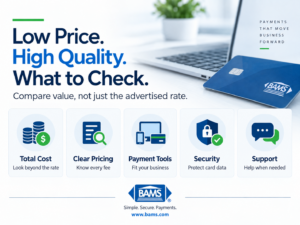
Low pricing can still deliver strong value when merchants compare total cost, pricing structure, payment tools, security and support.
Quick Estimates Start With the Complete Cost
One advantage often associated with flat rate pricing is simplicity. A standard processing rate can make basic monthly estimates easier. That does not mean the account will always be cheaper or that additional fees disappear.
Depending on the provider and account, merchants may still encounter monthly account charges, gateway costs, PCI related fees, chargeback fees, transaction charges or other costs.
Another option is transparent interchange plus pricing. Interchange plus separates the underlying interchange cost from the processor markup instead of combining the two into one blended processing rate.
Neither pricing model should be judged by the headline rate alone. A more useful comparison is the effective rate, which looks at the total processing fees paid relative to total processing volume.
When reviewing a quote, calculate what the account is likely to cost based on your actual transaction volume and payment mix. That produces a more realistic estimate than comparing one percentage from each provider.
Zero In on What Your Business Actually Needs
Merchant services can include far more than basic card processing. Depending on the business, an account may involve terminals, online checkout tools, reporting systems, recurring billing, virtual terminals and other payment technology.
You may not need all of it.
A retail business accepting payments at a counter has different requirements from an eCommerce merchant account. A business accepting payments through a website may need an integrated payment gateway while another merchant may primarily depend on point of sale hardware.
Paying for features that your team never uses adds little value. A better approach is to identify the payment channels your customers use and then choose the services that support those transactions effectively.
Quality Merchant Services Still Require Strong Security
Lower processing costs should never come at the expense of payment security.
The PCI Security Standards Council explains that PCI DSS is intended for entities involved in payment processing including merchants regardless of their size or transaction volume.
A merchant services provider may provide tools or guidance that help businesses address their compliance responsibilities. However, using a compliant processor does not automatically make the merchant itself PCI compliant.
Security also extends to the technology supporting payment acceptance. Visa’s payment processing guidance highlights secure transactions and efficient payment operations as important parts of modern processing infrastructure.
When comparing providers, merchants should therefore evaluate security support alongside cost.
Lower Pricing Should Still Come With Clear Account Terms
A quality merchant account provider should make it possible to understand what you are paying and why.
Before opening or switching an account, review the processor markup, transaction fees, monthly charges, gateway costs, PCI related costs, chargeback fees, contract terms and any funding charges that may apply.
Also consider what happens after the account is active. Find out how to reach support when a transaction, deposit or account issue needs attention. Confirm that the provider supports the hardware, software and payment channels your business relies on.
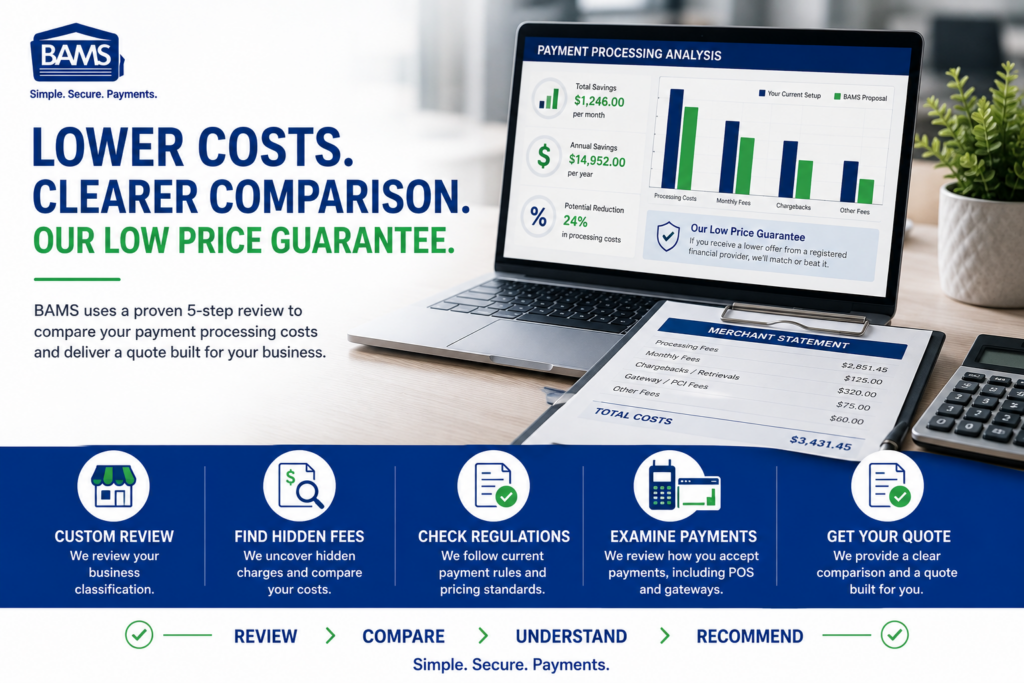
BAMS also maintains a Competitive Price Guarantee. Under its current terms, eligible price match requests must involve an official lower merchant account fee schedule from a registered financial service provider and must meet the conditions outlined by BAMS.
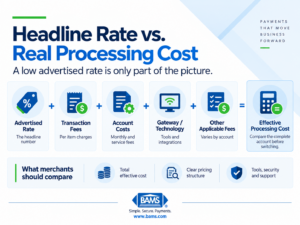
An advertised processing rate is only one part of the total cost of a merchant account.
What Should You Compare Before Choosing a Provider?
Rather than asking which provider advertises the lowest rate, compare the parts of the account that affect your actual operating cost and payment experience.
- Total effective processing cost: Look beyond the advertised percentage and include the other applicable fees.
- Pricing structure: Understand how processor markup and underlying payment costs appear on the account.
- Payment technology: Confirm support for the terminals, gateway or software your business needs.
- Security and PCI support: Determine what tools and guidance are available to help protect payment data.
- Customer support: Know who you can contact when you have questions about transactions, deposits or your account.
A low priced merchant account provider can offer strong value when competitive processing costs are paired with the services, technology and support your business actually needs.
Frequently Asked Questions
Is the lowest priced merchant account provider always the best choice?
No. Compare the complete account including processing costs, fees, support, security tools and payment technology. The lowest advertised rate may not produce the lowest total cost.
Is flat rate payment processing always cheaper?
No. Flat rate pricing can be easier to understand because transactions may use a standard blended rate but that does not mean it will produce the lowest effective cost for every merchant.
Does a lower priced merchant account have fewer PCI requirements?
No. PCI DSS applicability is based on the payment environment and how cardholder data is handled rather than how much a merchant pays its processor.
What fees should merchants compare?
Review transaction charges, processor markup, monthly fees, gateway costs, PCI related fees, chargeback costs, funding charges and applicable contract fees.
How can a merchant compare two processing offers accurately?
Compare the complete fee schedules using a similar transaction volume and payment mix. Calculating the effective rate can provide a clearer picture of overall processing cost than comparing advertised rates alone.
Sources
- Federal Reserve – Average Debit Card Interchange Fee by Payment Card Network
- PCI Security Standards Council – Merchant Resources
- Visa – Process Payments
Compare Your Current Merchant Account
Low pricing is most useful when you can see exactly what you are paying for. If you want to understand how your current rates, fees and payment setup compare, request a free five-point Merchant Account Price Comparison from BAMS.