5 Places Your Multi-Channel Setup Is Draining Cash
Last Updated on September 25, 2026 by Dimitri Akhrin
Hidden fee structures, delayed deposits, and timing gaps that quietly erode your eCommerce cash flow
Discover five specific spots where multi-channel fragmentation silently drains cash from your eCommerce operation. Learn actionable fixes for payment processing fees, funding delays, and pricing traps you can implement this week.
TL;DR
- Bundled pricing hides real costs – Request interchange-plus pricing to see exactly what your processor charges versus what card networks charge, and compare effective rates across channels.
- Deposit delays drain working capital – Next-day funding can free up tens of thousands in cash that standard two-to-three-day processing holds hostage. Prioritize it for your highest-volume channel first.
- Batch timing is a silent one-day tax – If your batch closes after your processor’s cutoff, every deposit is pushed back a full business day. Check and adjust this setting today.
- Chargebacks cost more than the transaction – Dispute fees, lost revenue, and potential rate increases compound fast. Proactive alerts and channel-level tracking prevent most of the damage.
- Fragmentation is the root cause – Separate processors, reports, and schedules create blind spots. Consolidate where possible, and build a monthly reconciliation habit where you can’t.
Your Multi-Channel Setup Is Quietly Draining Cash
If you run an established eCommerce operation across multiple sales channels, you already know cash flow management isn’t just about revenue. It’s about when that revenue actually hits your bank account and how much of it survives the trip. The gap between a customer clicking “buy” and you seeing usable funds is where money disappears.
U.S. merchants paid $187.20 billion in processing fees in 2024, up 8.7% from 2023. The problem isn’t that payments cost money. The problem is that multi-channel fragmentation turns a manageable cost into a compounding leak and most operators can’t see where it’s happening.
What This Guide Covers (and What It Doesn’t)
This is for eCommerce managers at businesses with 10 to 50 employees who sell across their own site, marketplaces, and possibly retail or pop-up channels. You don’t have a dedicated finance team. You make payment decisions alongside inventory, marketing, and fulfillment decisions.
This guide won’t cover enterprise-level payment orchestration or tokenization strategies. Instead, it identifies five specific places your multi-channel setup is leaking cash through payment processing fees, delayed deposits, and hidden pricing structures. Each one includes a fix you can act on this week.
How We Identified These Five Leaks
Each item was selected based on three criteria: it must be caused or worsened by multi-channel selling, it must be fixable without hiring a finance team, and it must have a measurable impact on either deposit speed or cost per transaction. These aren’t theoretical. They’re the patterns that show up repeatedly when eCommerce operators audit their payment stack.
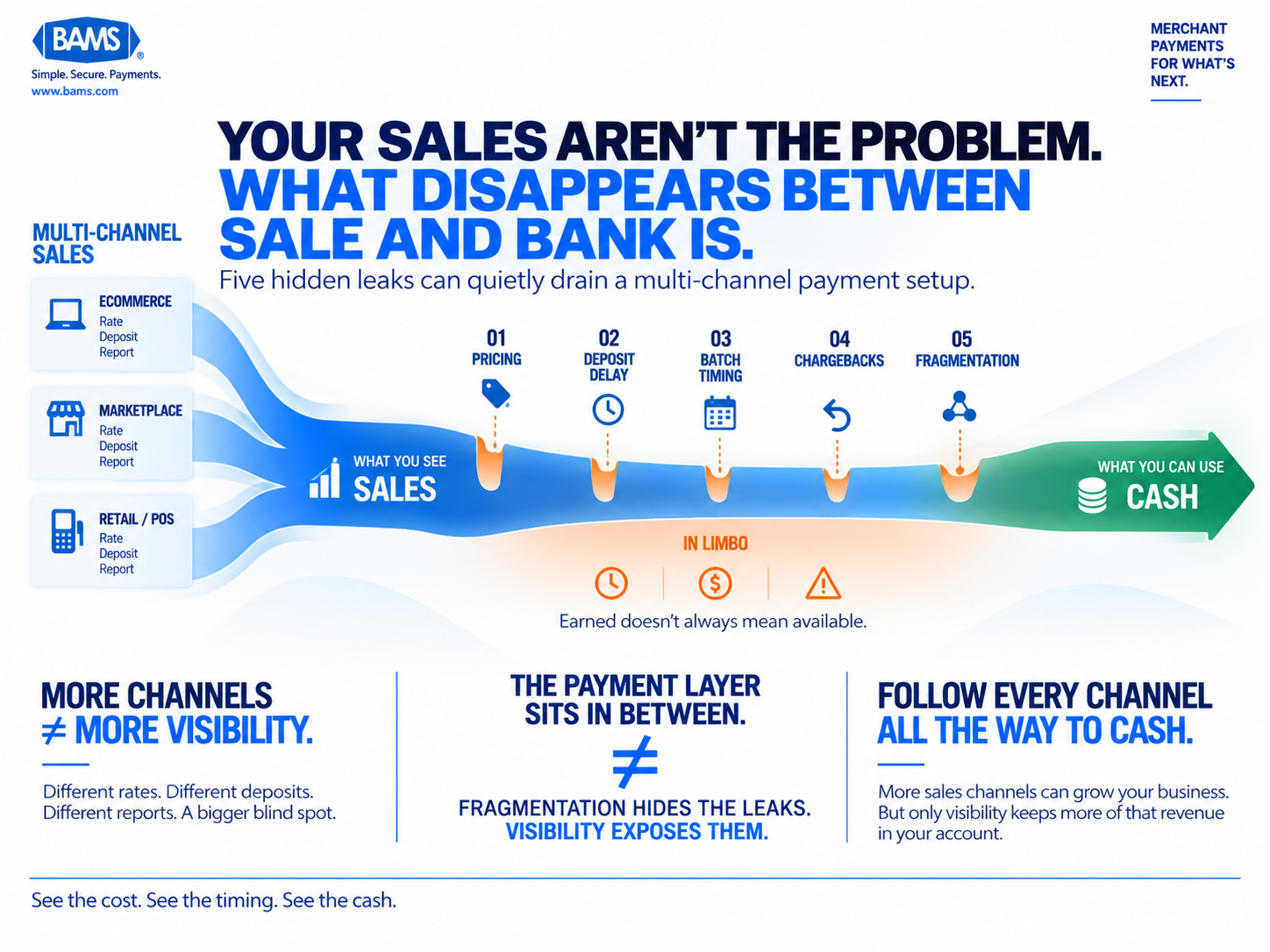
More sales channels can create more opportunities for hidden payment costs. Fees, deposit schedules, batch timing, disputes and fragmented reporting can all reduce how much revenue becomes usable cash.
5 Places Your Multi-Channel Setup Is Draining Cash Flow
1. Bundled Pricing That Obscures Your Real Cost Per Channel
Why it matters: Most multi-channel merchants start with a single processor offering a flat or tiered rate. That rate looks simple, but it bundles interchange fees, assessment fees, and processor markup into one number. You can’t see which channel is more expensive to operate. A card-not-present transaction on your Shopify store costs more to process than a tapped card at a pop-up, but bundled pricing hides that difference entirely.
What it looks like today: Mastercard explains that interchange is one component of the merchant discount rate and that applicable rates vary by product type and qualification criteria. Factors can include merchant category, the time between authorization and clearing, enhanced transaction data and transaction volume. When these costs are bundled together, it becomes harder to see how much of your total processing cost comes from interchange versus processor markup.
How to fix it: Request an interchange-plus pricing breakdown from your processor. If they won’t provide one, that’s a signal. Interchange-plus pricing separates the card network’s non-negotiable fees from your processor’s markup, giving you a clear view of what you’re actually paying per channel. Compare your online transactions against in-person ones to find where margin compression is worst.
2. Deposit Timing Mismatches That Starve Your Working Capital
Why it matters: When you sell on your own site, a marketplace, and a retail channel, each one deposits funds on a different schedule. Your site processor might hold funds for two to three business days. Your marketplace might pay out biweekly. Meanwhile, your supplier invoices, ad spend, and payroll don’t wait. The result is a cash flow gap that forces you to dip into credit lines or delay restocking.
What it looks like today: Standard processing deposits land in two to three business days. Friday sales often don’t arrive until the following Tuesday or Wednesday. For a business processing $50,000 per week across channels, that delay can mean $20,000 to $30,000 sitting in limbo at any given time.
How to fix it: Prioritize next-day funding for your highest-volume channel first. Next-day funding means card sales are deposited into your bank account by the following business day (weekends and federal holidays excluded). This alone can free up tens of thousands in working capital per month. Then audit your marketplace payout schedules and adjust inventory purchasing cycles to match actual deposit dates, not projected ones.
3. Batch Submission Timing That Costs You an Extra Day
Why it matters: Even if your processor offers next-day funding, you only get it if your daily batch closes before the processor’s cutoff time. Many eCommerce platforms default to a batch submission time that misses the window, pushing your deposit back by a full business day. Multiply that across a month, and you’ve lost access to capital for 20+ additional days over the course of a year.
What it looks like today: Most processors have cutoff times between 9 PM and 11 PM ET. If your platform batches at midnight, every day’s sales get treated as the next day’s batch. Some platforms let you configure this. Others don’t surface the setting at all.
How to fix it: Log into your payment gateway or processor dashboard and find your batch settlement time. Adjust it to close at least one hour before your processor’s cutoff. If your platform doesn’t allow manual batch timing, call your processor and ask them to set it. This is a five-minute change that can accelerate your deposit timeline immediately.
4. Chargebacks You’re Absorbing Instead of Preventing
Why it matters: Multi-channel selling increases your chargeback surface area. A customer buys online, returns in person, and the refund doesn’t sync. Or a marketplace order triggers a dispute that your processor penalizes you for, even though the marketplace handled fulfillment. Each chargeback costs you the transaction amount, a $20 to $100 dispute fee, and potential rate increases if your chargeback ratio climbs above 1%.
What it looks like today: Most small-to-midsize eCommerce operators treat chargebacks reactively. They get a notification, scramble for documentation, and often lose the dispute because they responded too late or with incomplete evidence. Proactive chargeback defense, including alerts that notify you before a dispute is filed, is available but underused at this business size.
How to fix it: Start by tracking your chargeback ratio by channel. Identify which channel produces the most disputes and why. Then look for a processor that offers proactive chargeback defense with dedicated support. BAMS, for example, provides proactive chargeback alerts and a dedicated account manager who helps you respond before disputes escalate, a practical option for teams without a fraud department. Even reducing chargebacks by 30% can save thousands annually in fees and preserved revenue.
5. Separate Processor Relationships That Prevent Visibility
Why it matters: Many multi-channel merchants end up with different processors for different channels: one for their eCommerce site, another embedded in their POS system, and a third dictated by a marketplace. Each processor has its own fee structure, reporting format, and deposit schedule. You can’t compare costs across channels because the data doesn’t live in one place. This fragmentation is the root cause of most cash flow blind spots.
What it looks like today: Operators spend hours each month reconciling deposits across platforms, often in spreadsheets. Discrepancies go unnoticed. Fee increases get buried in statements nobody reads. The OCC notes that merchant pricing may include separately charged interchange, authorization, chargeback and service fees and that merchant discount rates may change as underlying costs increase. When those costs are spread across multiple processors and statements, margin changes become harder to spot.
How to fix it: Consolidate where you can. If one processor can handle both your eCommerce gateway and your in-person transactions with transparent pricing and consistent deposit timing, that eliminates reconciliation overhead and gives you a single view of your payment costs. Where consolidation isn’t possible (marketplace-mandated processors, for example), build a monthly reconciliation habit that compares effective rate per channel: total fees divided by total volume. Evaluating gateways by deposit speed and fee transparency is a practical starting point.
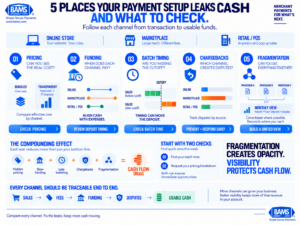
Multi-channel payment costs do not come from one place. Pricing, funding, batch timing, disputes and fragmented reporting can compound across channels and quietly reduce usable cash.
The Pattern Behind These Leaks
All five problems share a common root: fragmentation creates opacity, and opacity lets costs grow unchecked. When your payment stack is split across providers, platforms, and schedules, no single view shows you what you’re actually paying or when you’re actually getting paid. The fix isn’t always consolidation. Sometimes it’s just visibility.
Notice the compounding effect. Bundled pricing hides your true cost. Slow deposits reduce your working capital. Poor batch timing makes deposits even slower. Chargebacks drain revenue you’ve already earned. And separate processor relationships prevent you from seeing any of it clearly. Solving one leak improves cash flow. Solving three or more changes how your business operates.
Where to Start This Week
You don’t need to overhaul your entire payment stack at once. Start with the two changes that require the least effort and produce the fastest results: adjust your batch submission timing (item 3) and request an interchange-plus pricing breakdown (item 1). Both can happen in a single afternoon.
If your current processor can’t provide transparent pricing or next-day funding, that’s useful information. It tells you the relationship is costing more than it should. From there, prioritize chargeback tracking by channel and evaluate whether consolidating processors is practical for your setup. Small, specific changes to your payment infrastructure compound into meaningful cash flow improvements over weeks, not quarters.
Frequently Asked Questions
What are the common payment challenges faced by multi-channel eCommerce merchants?
The most frequent challenges are fragmented deposit schedules across channels, opaque fee structures that hide true processing costs, and increased chargeback exposure from inconsistent refund and fulfillment processes. These issues compound when each channel uses a different processor with its own reporting format and payout timeline.
How does next-day funding improve cash flow management?
Next-day funding deposits your card sales into your bank account by the following business day (excluding weekends and federal holidays). For a business processing $50,000 per week, this can free up $20,000 to $30,000 in working capital that would otherwise sit in a two-to-three-day processing limbo. That freed capital can cover payroll, restock inventory, or fund ad spend without touching a credit line.
When should eCommerce merchants conduct a payment processing audit?
Audit your payment processing costs at least quarterly, or whenever you add a new sales channel. Look at your effective rate (total fees divided by total volume) per channel. If your effective rate has crept above 3% on standard consumer card transactions, or if you can’t see a line-item breakdown of interchange, assessments, and processor markup, it’s time to ask questions.
What is interchange-plus pricing and why does it matter?
Interchange-plus pricing separates the card network’s fixed fees (interchange and assessments) from your processor’s markup. This transparency lets you see exactly what your processor charges versus what Visa or Mastercard charges. Without it, your processor can raise their margin without you noticing because the increase is hidden inside a bundled rate.
How do chargebacks affect payment processing fees over time?
Each chargeback costs you the original transaction amount plus a dispute fee ($20 to $100). If your chargeback ratio exceeds 1% of total transactions, card networks can place you in a monitoring program with higher fees, reserve requirements, or even account termination. Proactive chargeback prevention, including pre-dispute alerts and clear refund policies, is significantly cheaper than reactive dispute management.
Which factors affect the speed of payment deposits for eCommerce businesses?
Three main factors control deposit speed: your processor’s funding timeline (standard vs. next-day), your batch submission timing relative to the processor’s cutoff, and the day of the week (Friday batches typically don’t deposit until Monday). Adjusting batch timing and choosing a processor with next-day funding are the two fastest ways to accelerate deposits.