
Surcharge Compliance for Funeral Homes: A Complete Guide
Last Updated on September 28, 2026 by Dimitri Akhrin
How to recover credit card processing costs from families without violating the FTC Funeral Rule or state surcharge bans
Learn how to structure surcharging or dual pricing at your funeral home so it aligns with FTC regulations, state laws, and card network rules from day one. This guide covers GPL disclosure requirements, merchant account configuration, and the compliance architecture behind every fee decision.
TL;DR
- Surcharging is a compliance architecture decision, not just a fee decision — It requires coordinating your state’s laws, card network registration, terminal configuration, General Price List updates, and staff training as a single integrated system.
- Check your state law first — Several states ban surcharging entirely, and the rules differ for surcharging vs. dual pricing. Your state’s position determines which strategies are even available to you.
- Never surcharge debit cards — Debit and prepaid cards cannot be surcharged under any circumstances. Your terminal must automatically detect card type and suppress the fee. Manual surcharging by staff is the most common source of violations.
- Your General Price List is the compliance foundation — Whether you surcharge or dual-price, the strategy must be reflected in your GPL and disclosed before families consent to the total amount. Disclosure on the receipt alone violates FTC rules.
- Audit quarterly — State laws, card network caps, and your actual processing costs change over time. A compliant system today can become non-compliant within months without active monitoring and adjustment.
Guide Orientation: What This Covers and Who It’s For
This guide addresses a specific operational challenge: how funeral home operators can recover credit card processing costs from families without violating the FTC Funeral Rule, state surcharge bans, or card network regulations. Surcharge compliance in the funeral industry isn’t just a fee decision. It’s a compliance architecture decision that touches your General Price List, your merchant account configuration, and your state’s consumer protection laws simultaneously.
This guide is written for family-owned funeral service operators managing one to ten locations who process high-ticket transactions (often exceeding $15,000) and need to protect margins without creating regulatory exposure. By the end, you’ll understand how to evaluate whether surcharging or dual pricing fits your operation, how to structure either approach correctly from day one, and which technical and disclosure requirements must be in place before you collect a single payment.
This guide does not cover preneed trust accounting, ASC 606 funeral accounting standards, or insurance assignment processing. It focuses exclusively on the intersection of payment acceptance strategy and regulatory compliance.
Why Surcharge Compliance Matters for Funeral Home Merchant Services

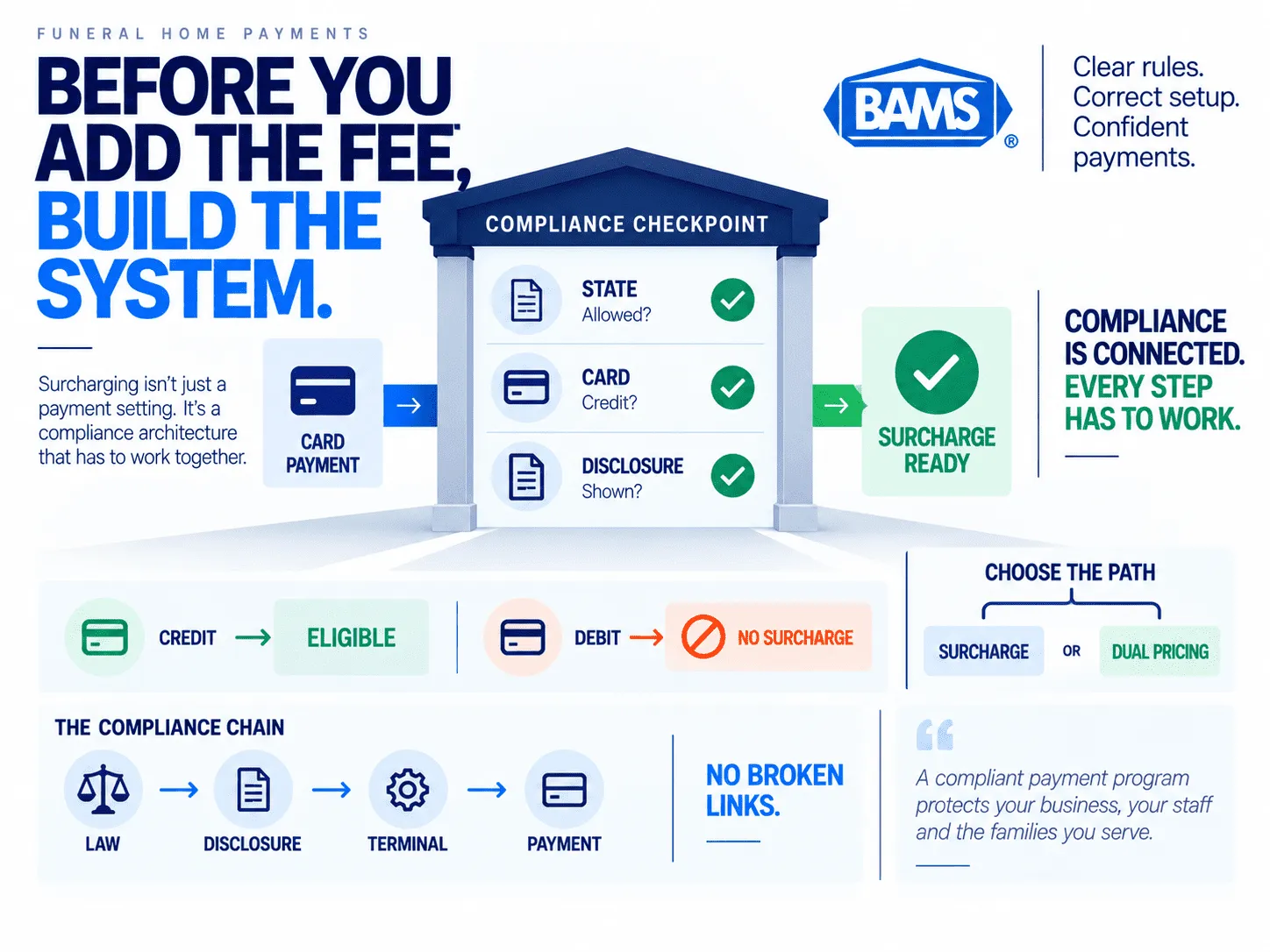
Adding a credit card surcharge is not a single payment setting. State rules, disclosures, card type and terminal configuration all need to work together before the first payment is collected.
Funeral operators absorb processing fees on transactions that routinely exceed $10,000. On a $15,000 arrangement paid by credit card at an effective rate of 3%, that’s $450 in processing costs, money that comes directly out of your margin on caskets, services, and cash advance items. Multiply that across dozens of arrangements per month, and the annual cost becomes significant enough to affect staffing, facility maintenance, and reinvestment.
The instinct to pass those costs to families is reasonable. But funeral services operate under a regulatory framework that most retail businesses don’t face. The FTC Funeral Rule restricts what fees you can charge and how you disclose them. Card network rules from Visa and Mastercard impose their own surcharging requirements. And state laws vary dramatically: some states ban surcharging entirely, others permit it with specific disclosure obligations, and a few have recently changed their positions.
Getting this wrong creates compounding risk. An improperly structured surcharge can trigger FTC enforcement action, card network fines, state attorney general investigations, or all three at once. The cost of inaction is margin erosion. The cost of incorrect execution is potentially worse. This guide helps you navigate the space between those two outcomes.
The operators who handle this well don’t treat surcharging as a line item to add. They treat it as an infrastructure decision that touches every part of how they accept and disclose payments.
Core Concepts: What You Need to Understand Before Making Any Changes
Surcharging vs. Dual Pricing: They Are Not the Same Thing
A surcharge adds a fee on top of the listed price when a customer pays with a credit card. Dual pricing displays two prices: a cash price and a card price. The legal and regulatory treatment of these two approaches differs significantly. Surcharging is governed by card network rules (Visa, Mastercard) and state law. Dual pricing is generally treated as a discount for cash rather than a penalty for card use, which changes the compliance picture.
Many operators conflate these two strategies. That confusion is where violations begin. If you post a single price and then add a fee at the register, that’s a surcharge, and it must comply with network registration requirements, disclosure rules, and state permissibility. If you post two prices from the start, you’re operating under a different set of rules.
The Funeral Rule’s Fee Restrictions
The FTC Funeral Rule prohibits funeral providers from charging any fee as a condition of furnishing funeral goods or services beyond three categories: the basic services fee, selected goods and services, and legally required items. A processing fee that appears as a separate line item on your itemized price list could be interpreted as a prohibited additional charge unless it’s structured correctly within the allowed categories or disclosed as part of the price itself.
Credit vs. Debit: A Non-Negotiable Distinction
Industry guidance confirms that debit and prepaid cards can never be surcharged, even when the cardholder selects “credit” at the terminal. Your payment terminal must automatically detect the card type and suppress the surcharge on debit transactions. This isn’t optional. It’s a card network requirement that, if violated, can result in fines and loss of processing privileges.
The General Price List Is Your Compliance Foundation
Every pricing decision you make about payment acceptance must ultimately be reflected in or compatible with your General Price List (GPL). The GPL isn’t just a consumer disclosure document. It’s the artifact that regulators, card networks, and attorneys will examine if your fee structure is ever challenged. Your payment strategy and your GPL must be designed together, not independently.
The Framework: Four-Stage Compliance Architecture
Surcharge compliance works as a connected system. Each stage, from checking state law to configuring payment technology and reviewing the program, needs to support the next.
Structuring payment cost recovery correctly requires moving through four connected stages. Skipping any stage, or completing them out of order, creates gaps that regulators and card networks can exploit.
- Stage 1: Legal Assessment — Determine what your state allows and what the card networks require before choosing a strategy.
- Stage 2: Strategy Selection — Choose between surcharging, dual pricing, or margin absorption based on your legal assessment and operational reality.
- Stage 3: Infrastructure Setup — Configure your merchant account, terminal, and disclosure documents to support your chosen strategy without gaps.
- Stage 4: Ongoing Compliance Monitoring — Maintain registration, disclosure, and technical compliance as laws, network rules, and your own pricing evolve.
These stages are sequential for initial setup but cyclical for maintenance. Every time a state law changes, a card network updates its rules, or you adjust your GPL, you re-enter the cycle at the appropriate stage.
Step-by-Step Breakdown: Building Your Surcharge Compliance Architecture
Step 1: Assess Your State’s Legal Position on Surcharging
Objective: Confirm whether your state permits credit card surcharges, permits dual pricing, or prohibits both before you invest in any structural changes.
Start by identifying your state’s current surcharging statute. Several states (including Connecticut, Massachusetts, and Puerto Rico) maintain outright bans on credit card surcharges. Others permit surcharging but impose specific disclosure requirements beyond what the card networks require. A few states have recently changed their positions through legislation or court rulings, so relying on guidance from even two years ago can be risky.
Contact your state funeral directors association for current guidance specific to funeral operations. The NYSFDA’s compliance guidance on surcharges is a useful model for understanding how state-level requirements layer on top of federal and network rules. If you operate across multiple states, you need a state-by-state assessment, not a single policy applied everywhere.
Anti-patterns: Assuming that because a neighboring funeral home surcharges, it’s legal in your state. Relying on your payment processor’s generic surcharging feature without verifying state law. Treating dual pricing and surcharging as interchangeable without confirming your state’s position on each.
Success indicators: You have a written summary of your state’s surcharging and dual pricing rules, including any funeral-specific restrictions, reviewed by legal counsel or your state association within the past 12 months.
Step 2: Choose Your Cost Recovery Strategy
Objective: Select the approach (surcharging, dual pricing, or absorption) that aligns with your legal assessment, your families’ expectations, and your margin requirements.
If your state permits surcharging, you’ll need to decide whether the operational and disclosure burden is worth the margin recovery. The practical surcharge cap is 3% when you accept both Visa and Mastercard (the lower of Visa’s 3% cap or Mastercard’s 4% cap). On a $15,000 arrangement, that recovers up to $450, which is meaningful.
Dual pricing for funeral services introduces a different complexity. The NYSFDA guidance on surcharge law notes that if you use dual pricing, each service or merchandise item on your General Price List needs to reflect both prices. That’s a significant documentation burden for a GPL that may already list dozens of items. But it avoids the card network registration requirements that surcharging triggers.
Margin absorption (building processing costs into your prices) is the simplest approach and carries zero compliance risk. The tradeoff is that cash-paying families subsidize card-paying families, and your listed prices are higher across the board. For some operators, the simplicity is worth the margin compression.
Anti-patterns: Choosing surcharging solely because a competitor does it. Implementing dual pricing funeral services without updating every item on your GPL. Selecting a strategy without modeling the actual dollar impact on your most common arrangement types.
Success indicators: You’ve modeled the financial impact of each option against your top five arrangement types by dollar volume, and your chosen strategy is compatible with your state assessment from Step 1.
Step 3: Register with Card Networks and Notify Your Processor
Objective: Complete all required pre-implementation notifications so your surcharging program is recognized and authorized before you collect the first surcharge.
Visa and Mastercard require at least 30 days’ advance notice before you begin surcharging. This notice goes to both the card networks and your acquiring bank (the bank behind your merchant account). Your payment processor should facilitate this registration, but you are responsible for confirming it’s complete.
If your current processor doesn’t support surcharge registration, can’t configure automatic debit card detection, or doesn’t understand the funeral industry’s unique compliance requirements, this is the stage where that gap becomes a problem. Processors that serve general retail may not understand how the Funeral Rule’s fee restrictions interact with surcharging, and a misconfigured system can expose you to violations on both fronts.
This is where your choice of funeral home merchant services partner becomes a compliance decision, not just a cost decision. A processor with dedicated account management, like BAMS, can help you verify that your surcharge configuration, batch timing, and disclosure setup align with both card network rules and funeral-specific regulatory requirements, reducing the risk of gaps between what you intend and what your system actually does.
Anti-patterns: Starting to surcharge before the 30-day notice period has elapsed. Assuming your processor automatically registered you when you enabled a surcharge feature. Failing to confirm that debit card detection is functioning correctly on every terminal.
Success indicators: You have written confirmation from your processor and/or acquiring bank that your surcharge registration is active with both Visa and Mastercard. You’ve tested debit card detection on every terminal and confirmed the surcharge is suppressed on debit transactions.
Step 4: Update Your General Price List and Disclosure Documents
Objective: Ensure that your GPL, Statement of Funeral Goods and Services Selected, and point-of-sale materials all reflect your payment cost recovery strategy in a way that satisfies both the FTC Funeral Rule and card network disclosure requirements.
The FTC Funeral Rule requires that families receive an itemized price list before discussing arrangements. If you’re surcharging, the surcharge must be disclosed at the point of entry to your establishment, at the point of sale, and on the receipt. If you’re using dual pricing, both prices must appear on the GPL itself.
The FTC’s 2024 Rule on Unfair or Deceptive Fees clarifies that processing fees can be disclosed separately from the total price only when credit card payment is not mandatory. Since funeral homes accept multiple payment methods, this typically means you can disclose the surcharge separately, but it must be visible before the family consents to the total amount.
Work with your funeral director association and legal counsel to draft disclosure language that satisfies all three layers: FTC Funeral Rule itemization requirements, FTC unfair fees rule disclosure requirements, and card network point-of-sale signage requirements. Generic surcharge signage from your processor may not be sufficient for funeral-specific compliance.
Anti-patterns: Using boilerplate surcharge disclosure language without adapting it to your GPL format. Disclosing the surcharge only on the receipt (too late). Adding a “processing fee” line item to your GPL without confirming it doesn’t violate the Funeral Rule’s fee restrictions.
Success indicators: Your GPL, arrangement room signage, and receipt templates all reflect consistent surcharge or dual pricing language. A compliance review (internal or external) confirms alignment across all three regulatory layers.
Step 5: Configure Your Terminal and Batch Settings
Objective: Ensure your payment terminal and merchant account settings technically enforce your compliance decisions, so human error at the arrangement desk can’t create violations.
Your terminal must be configured to automatically apply the surcharge to credit card transactions and automatically suppress it on debit and prepaid card transactions. This is not something your staff should be doing manually. Manual surcharge application is the single most common source of debit card surcharging violations, which can result in card network fines.
Batch timing also matters for cash flow. Funeral arrangements often close late in the day or on weekends. If your processor batches once daily at a fixed time and you miss the window, your deposit is delayed by a full business day. On a $15,000 transaction, that delay affects your ability to pay cash advance vendors (cemeteries, florists, obituary services) on time. Review your default processor settings to confirm that batch timing, volume thresholds, and fraud filters are configured for funeral industry transaction patterns rather than generic retail assumptions.
If your processor offers next-day funding, confirm that it applies to transactions of your typical size. Some processors advertise next-day funding but hold transactions above a certain dollar threshold for manual review, creating the exact cash flow timing gaps you’re trying to avoid. BAMS, for example, offers next-day funding designed for high-ticket transactions, which can reduce the lag between collecting a payment and having funds available to cover your cash advance disbursements.
Anti-patterns: Relying on staff to manually add surcharges at the terminal. Accepting default batch timing without verifying when deposits actually arrive. Assuming next-day funding applies to all transaction sizes without confirmation.
Success indicators: You’ve processed test transactions on both credit and debit cards and confirmed correct surcharge behavior. You’ve verified actual deposit timing on transactions matching your typical arrangement size. Your merchant account configuration has been reviewed against a funeral-specific checklist.
Step 6: Train Your Staff on Disclosure and Handling
Objective: Ensure every person who discusses pricing or processes payments understands the disclosure requirements and can handle family questions about surcharges or dual pricing with confidence and sensitivity.
Funeral arrangements are emotionally charged conversations. Introducing a surcharge disclosure requires tact. Your staff needs scripted language that’s clear, compliant, and compassionate. “We accept all major credit cards. A 3% processing fee applies to credit card payments, and we’re happy to discuss alternative payment options” is direct without being abrasive.
Train staff on the specific scenarios that create compliance risk: a family that switches from credit to debit mid-transaction (the surcharge must be removed), a family that asks why the fee exists (transparency builds trust, evasion erodes it), or a family that pays partially by check and partially by card (the surcharge applies only to the credit card portion).
Document your training. If a complaint reaches the FTC or your state attorney general, evidence that you trained staff on proper disclosure procedures demonstrates good faith compliance, which matters in enforcement decisions.
Anti-patterns: Leaving surcharge disclosure to individual staff judgment. Failing to prepare staff for pushback or emotional reactions. Training only front-office staff while neglecting anyone who might process a payment (including after-hours or weekend staff).
Success indicators: Every staff member who handles pricing or payments has completed documented training. You have written scripts for common scenarios. You conduct periodic spot-checks to verify disclosure consistency.
Step 7: Monitor, Audit, and Adapt
Objective: Maintain compliance as laws, card network rules, and your own pricing evolve over time.
Surcharge compliance is not a one-time project. Card network caps can change (Visa adjusted its cap in recent years). State laws evolve. The FTC periodically updates its guidance and enforcement priorities. Build a quarterly review into your operations calendar that covers three questions: Has my state’s surcharging law changed? Have Visa or Mastercard updated their surcharging rules or caps? Is my terminal still correctly detecting and handling debit vs. credit transactions?
Review your actual surcharge revenue against your processing costs. If your effective processing rate has changed (due to interchange adjustments, a new processor, or a shift in your card type mix), your surcharge percentage may need adjustment. Remember, the surcharge cannot exceed your actual cost of acceptance or the network cap, whichever is lower.
Monitor family feedback. If you’re receiving consistent pushback on surcharges, it may indicate a disclosure problem (families feel surprised) rather than a pricing problem. Adjust your disclosure timing or language before assuming the strategy itself is flawed.
Anti-patterns: Setting up surcharging and never reviewing it again. Ignoring state law changes because “nothing has happened yet.” Treating family complaints as isolated incidents rather than systemic signals.
Success indicators: You have a documented quarterly review process. Your surcharge percentage matches your current actual cost of acceptance. You have zero card network violations and zero regulatory complaints related to payment fees.
Practical Example: Two Funeral Homes, Two Approaches
Scenario A: Surcharging in a Permissive State
A three-location funeral home in Texas processes an average of 40 arrangements per month with an average card payment of $12,000. Their effective processing rate is 2.8%. They chose surcharging, registered with Visa and Mastercard through their processor, updated their GPL with surcharge disclosure language, and configured automatic debit detection on all terminals.
Monthly surcharge recovery: approximately $13,440 (40 × $12,000 × 2.8%). That covers their entire processing cost, effectively making card acceptance free to the business. The key to their success: they invested two weeks in staff training and scripting before going live, which reduced family complaints to near zero.
Scenario B: Dual Pricing in a Restrictive State
A single-location funeral home in Massachusetts (where surcharging is prohibited) chose dual pricing instead. They listed a cash price and a card price for every item on their GPL. The card price is 3% higher than the cash price. This required reformatting their entire GPL and retraining staff on how to present both prices during arrangements.
The upfront work was significant (approximately 20 hours of GPL revision and staff training), but the ongoing compliance burden is lower because dual pricing doesn’t require card network registration or automatic debit detection. Their margin recovery is comparable to surcharging, and they’ve had no regulatory issues because the price structure was built into the GPL from the start.
Common Mistakes and Pitfalls
- Surcharging debit cards. This is the most common and most penalized violation. If your terminal can’t automatically detect card type, you are not ready to surcharge.
- Treating surcharging as a fee decision instead of a system decision. Adding a surcharge without updating your GPL, registering with card networks, and configuring your terminal creates multi-layered exposure.
- Copying another funeral home’s approach. Your state law, your card mix, and your families’ expectations are different. What works for a competitor may violate your state’s rules or alienate your community.
- Disclosing too late. The FTC’s guidance on fee disclosure is clear: families must know about the fee before they consent to the total amount. Disclosure on the receipt alone is a violation.
- Forgetting to re-audit. Laws change, network rules change, and your processing costs change. A compliant system today can become non-compliant in six months without active monitoring.
These mistakes are common because the regulatory landscape is genuinely complex. Making an error doesn’t mean you’re negligent. It means the system wasn’t designed with enough layers of protection. That’s what this guide is designed to help you fix.
What to Do Next
Start with Step 1. Before you evaluate processors, configure terminals, or rewrite your GPL, confirm what your state actually allows. That single piece of information narrows your decision space dramatically and prevents you from investing time in a strategy you can’t legally implement.
If you’re already surcharging but haven’t completed all seven steps, use this guide as an audit checklist. Walk through each step and identify gaps. The most common gap is between Step 3 (registration) and Step 4 (disclosure), where operators have enabled surcharging technically but haven’t updated their GPL or signage to match.
Revisit this guide quarterly as part of your compliance review. Bookmark it, share it with your office manager, and use it as a reference when state laws or card network rules change. The goal isn’t to implement everything at once. It’s to build a system that protects your margins and your families’ trust at the same time.
Frequently Asked Questions
What is the FTC Funeral Rule and how does it affect surcharging?
The FTC Funeral Rule requires funeral providers to give families itemized price lists before discussing arrangements and restricts the types of fees that can be charged. It prohibits fees beyond the basic services fee, selected goods and services, and legally required items. A credit card surcharge must be structured carefully so it doesn’t appear as a prohibited additional charge. This means your surcharge disclosure must be integrated into your General Price List and pricing workflow, not treated as a standalone add-on.
Can funeral homes legally pass credit card processing fees to families?
Yes, in states that permit surcharging, funeral homes can pass processing fees to families who pay by credit card. However, the surcharge must not exceed your actual cost of acceptance or the card network cap (currently 3% if you accept both Visa and Mastercard), whichever is lower. You must also register with the card networks, provide proper disclosure at multiple points, and ensure debit cards are never surcharged. In states that ban surcharging, dual pricing (showing a cash price and a card price) may be an alternative.
What’s the difference between dual pricing and surcharging for funeral services?
Surcharging adds a fee on top of a single listed price when a family pays by credit card. Dual pricing displays two separate prices (cash and card) from the start. The compliance requirements differ significantly. Surcharging requires card network registration, 30-day advance notice, and automatic debit card detection. Dual pricing requires updating every item on your General Price List with both prices but avoids the network registration process. Your state’s laws may permit one approach but not the other.
Which payment methods can and cannot be surcharged?
Only credit card transactions can be surcharged. Debit cards and prepaid cards cannot be surcharged under any circumstances, even if the cardholder selects “credit” at the terminal. Your payment terminal must automatically detect the card type and suppress the surcharge on non-credit transactions. This is a card network requirement, and violations can result in fines and loss of processing privileges.
How do I disclose a surcharge without violating the FTC’s rules on deceptive fees?
The FTC requires that any processing fee be disclosed before the family consents to the total payment amount. For funeral homes, this means disclosure must happen at three points: signage at your entrance, verbal or written disclosure during the arrangement conference, and a line item on the receipt. The fee must also be compatible with your General Price List’s itemization requirements under the Funeral Rule. Generic surcharge signage from your processor may not satisfy funeral-specific disclosure obligations.
What happens if my state bans surcharging?
If your state prohibits credit card surcharges, you have two primary options. First, you can implement dual pricing by listing both a cash price and a card price for every item on your General Price List. Second, you can absorb processing costs into your prices, which is the simplest approach but means cash-paying families effectively subsidize card payments. Some operators in ban states find that the margin recovery from dual pricing justifies the GPL reformatting work, while others prefer the simplicity of absorption.
Sources
- https://www.ftc.gov/system/files/ftc_gov/pdf/565A_Complying%20with%20Funeral%20Rule_2023_508.pdf
- https://nysfda.org/images/2020_CompliancePDF/DOCS-23664-v1-Revisiting_the_Issue_of_Credit_Card_Surcharges_article.pdf
- https://nysfda.org/storage/app/media/uploaded-files/2024%20credit%20card%20surcharge%20law.pdf
- https://www.ftc.gov/system/files/ftc_gov/pdf/r207011_udf_rule_2024_final_0.pdf
- https://www.ftc.gov/business-guidance/resources/rule-unfair-or-deceptive-fees-frequently-asked-questions


