Rolling Reserves and Chargebacks: A Cash Flow Guide
Last Updated on September 25, 2026 by Dimitri Akhrin
How dispute-driven reserve holds disrupt deposit timing and what eCommerce operators can do to protect purchasing cycles
Learn how chargebacks trigger rolling reserve holds that quietly compress your usable cash flow. This guide shows eCommerce managers how to build system-level defenses that keep deposit timing predictable enough to support inventory reorder cycles.
TL;DR
- Chargebacks are a cash flow planning problem, not just a fraud issue — Rising dispute rates trigger rolling reserve increases and funding delays that compress your usable cash, disrupting inventory purchases and supplier payments.
- Rolling reserves quietly lock up significant capital — Even a 5% to 10% reserve on moderate transaction volume can mean tens of thousands of dollars inaccessible at any given time, with hold periods of 90 to 180 days.
- Prevention outperforms representment — Every chargeback you prevent protects your ratio, which protects your reserve terms, which protects your deposit predictability. The leverage is upstream.
- Settlement terms are negotiable — Your reserve percentage, hold period, and funding speed are variables you can improve by demonstrating strong dispute performance and actively requesting better terms.
- Build a weekly monitoring loop — Track your chargeback ratio, reserve balance, and deposit timing weekly. Catching drift early (before processor thresholds are crossed) is far cheaper than reacting to reserve increases after the fact.
Guide Orientation: What This Guide Covers and Who It’s For
This guide explains how chargebacks and rolling reserves quietly erode predictable cash flow, and what eCommerce managers can do to protect deposit timing from dispute-related disruptions. It’s built for operators at established online businesses (roughly 10 to 50 employees) who rely on consistent settlement deposits to fund inventory purchases, supplier payments, and day-to-day operations.
By the end, you’ll understand exactly how chargebacks trigger reserve holds, how both compress your usable cash, and how to build a system-level defense that keeps your reorder cycle intact. This guide does not cover fraud investigation techniques or card network arbitration procedures. It focuses on the financial planning side of chargeback exposure, not the legal mechanics of individual disputes.

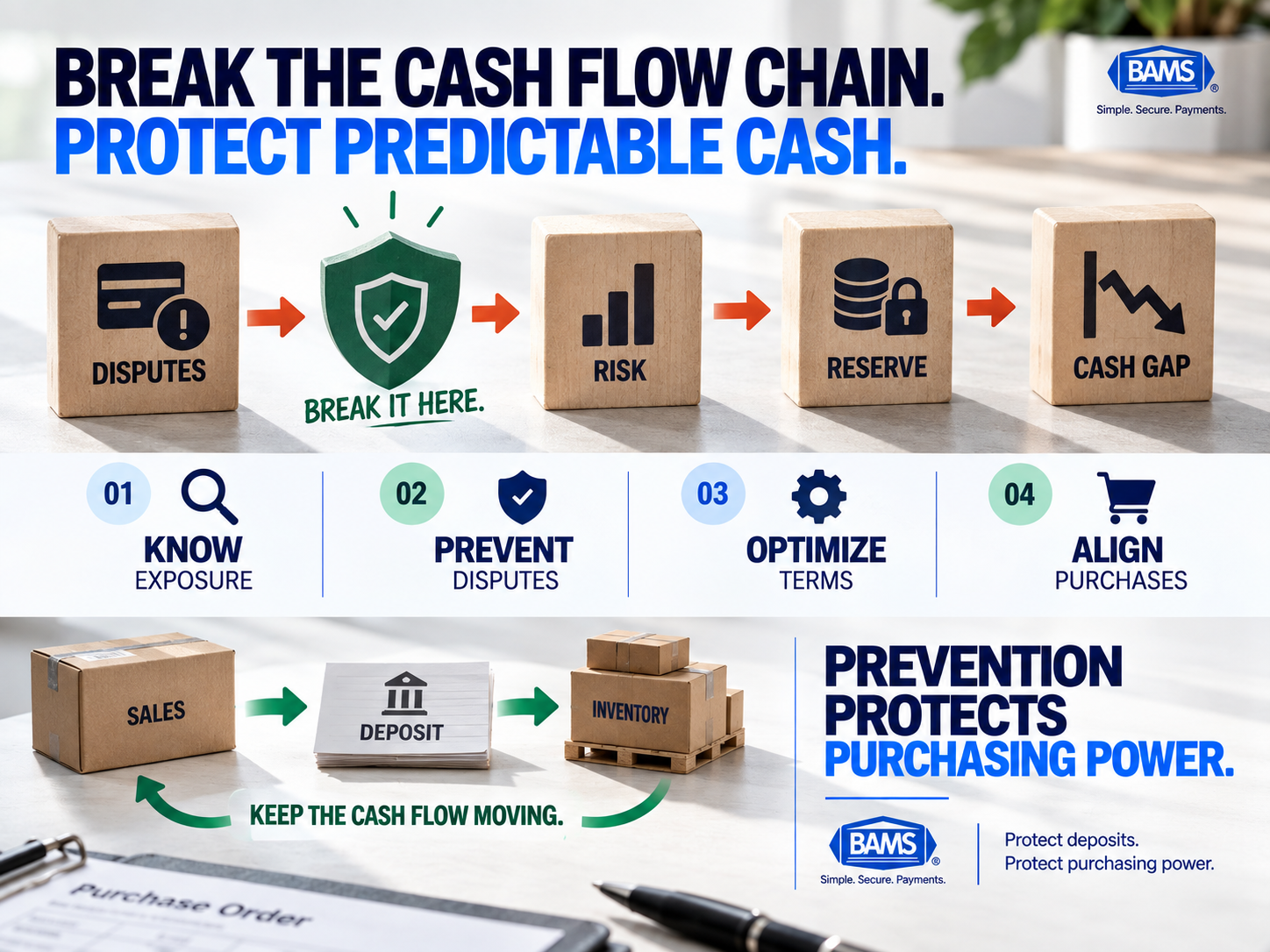
Chargebacks can affect more than individual transactions. Rising dispute risk can put pressure on reserve terms and reduce the cash available for inventory and supplier payments.
Why Predictable Cash Flow Is Under Threat From Chargeback Disruptions
Most eCommerce managers treat chargebacks as a customer service problem or a fraud issue. They’re both. But they’re also a cash flow planning problem, and that’s the dimension that causes the most operational damage when it goes unmanaged.
Here’s the landscape: Mastercard expects global chargeback volume to grow 37% from 2025 to 2029, reaching 359 million transactions annually. Rising dispute volume increases the importance of monitoring chargeback trends because elevated activity can affect how processors assess merchant risk.
When your processor holds back a portion of every settlement to cover anticipated disputes, the cash you expected to land in your account tomorrow doesn’t arrive in full. If you’ve timed an inventory purchase around that deposit, you’re suddenly short. If you’ve committed to a supplier payment, you’re scrambling for a bridge. The cost of inaction isn’t a single chargeback fee. It’s a compounding erosion of the deposit reliability your entire purchasing calendar depends on.
In 2024, cardholders disputed $9.8 billion in credit card charges, resulting in $5.9 billion in chargebacks. The scale of this problem is industry-wide, and it hits hardest at the businesses that haven’t built systems to absorb the impact. Reactive dispute management, responding to chargebacks one at a time after they arrive, leaves your cash flow exposed to timing disruptions you could have prevented.
Core Concepts: Rolling Reserves, Chargebacks, and Deposit Predictability
What Rolling Reserves Actually Do to Your Cash
A rolling reserve is a percentage of your daily transaction volume that your payment processor withholds from settlement. The processor holds this money for a set period (typically 90 to 180 days) as a buffer against future chargebacks, refunds, or fraud losses. It’s not a fee. It’s your money, held temporarily. But “temporarily” can mean three to six months of reduced access to funds you’ve already earned.
The OCC explains that acquirers may establish merchant reserve or holdback accounts to manage chargeback and credit risk and may fund them by withholding a portion of daily proceeds. In extreme cases, reserves can reach 35% of transactions for 90 days. Even a 5% reserve on $500,000 in monthly volume means $25,000 per month that’s earned but inaccessible.
Chargebacks as a Planning Disruption
A chargeback doesn’t just reverse a single transaction. It signals to your processor that your account carries elevated risk. As your chargeback ratio climbs, your processor may increase reserve percentages, extend hold periods, or slow your funding timeline. The individual dispute costs $25 to $100 in fees. The systemic response costs you weeks of deposit predictability.
The Distinction That Matters: Isolated Loss vs. Systemic Compression
Most merchants think about chargebacks as isolated losses. You lose the sale amount, pay a fee, and move on. The real damage is systemic: elevated dispute rates compress your usable cash flow by triggering reserve adjustments and funding delays. This guide treats chargebacks as planning disruptions, not payment problems, because that framing leads to better decisions about where to invest prevention effort.
The Framework: From Reactive Disputes to Predictable Deposits

Chargeback prevention protects more than individual sales. Better dispute performance can help protect reserve terms, deposit predictability and purchasing flexibility.
Protecting cash flow predictability from chargeback disruptions requires a system with four interconnected phases. Each phase addresses a different layer of the problem, from understanding your current exposure to building operational defenses that keep deposit timing stable.
- Phase 1: Exposure Mapping — Quantify how chargebacks and reserves currently affect your deposit timing and purchasing decisions.
- Phase 2: Threshold Defense — Build controls that keep your dispute ratio below the levels that trigger processor intervention.
- Phase 3: Settlement Optimization — Align batch timing, processor terms, and funding speed to maximize deposit predictability.
- Phase 4: Cash Flow Integration — Connect your payment operations to your purchasing calendar so deposit reliability directly supports inventory decisions.
These phases are sequential for initial setup but cyclical in practice. As your transaction volume, product mix, or customer base shifts, you’ll revisit earlier phases to recalibrate. The goal isn’t perfection. It’s building enough structural resilience that a single bad month of disputes doesn’t derail your next purchase order.
Step-by-Step Breakdown: Building Chargeback-Resilient Cash Flow
Step 1: Map Your Current Chargeback Exposure to Deposit Impact
Objective: Understand exactly how much of your settlement is currently at risk from disputes and reserves, measured in dollars and days, not just percentages.
Start by pulling three months of processor statements and isolating four numbers: your monthly chargeback count, your chargeback ratio (disputes divided by total transactions), your current rolling reserve percentage, and your average funding delay. Most processors report these figures in monthly statements or merchant dashboards, but few merchants actually calculate the cumulative cash impact.
Here’s the math that matters. If you process $400,000 per month with a 10% rolling reserve held for 90 days, you have $120,000 in earned revenue sitting inaccessible at any given time. If your chargeback ratio is trending toward Visa’s 0.65% dispute monitoring threshold, your processor may increase that reserve or add funding delays before you even receive a formal warning.
Anti-patterns: Don’t track chargebacks only by count. A business processing 10,000 transactions with 60 disputes looks different from one processing 5,000 transactions with 60 disputes. Ratios determine processor response, not raw numbers. Also avoid treating reserve holds as a fixed cost. They’re a variable that changes based on your dispute performance.
Success indicators: You can state your current chargeback ratio, reserve percentage, reserve hold period, and the total dollar amount currently held in reserve. You can calculate how a 1% increase in your reserve rate would affect next month’s available cash.
Step 2: Build Pre-Dispute Defenses That Keep You Below Threshold
Objective: Prevent disputes from reaching the chargeback stage, keeping your ratio below the levels that trigger processor risk adjustments.
The most effective chargeback prevention happens before a dispute is filed. This means investing in three areas: transaction clarity, customer communication, and fraud filtering. Transaction clarity means your billing descriptor (the name that appears on a customer’s credit card statement) matches your brand name. A surprising number of “fraud” chargebacks are actually confused customers who don’t recognize a charge.
Customer communication means proactive shipping notifications, easy-to-find contact information, and a returns process that’s simpler than calling the bank. When reaching you is easier than filing a dispute, customers choose the path of least resistance. Fraud filtering means using address verification (AVS), CVV matching, and velocity checks to catch fraudulent orders before fulfillment. Every fraudulent order you ship becomes a guaranteed chargeback 30 to 90 days later.
The Merchant Risk Council reports that nearly one-quarter of merchant refunds were fraudulent, which means even your refund activity can mask dispute leakage that processors are watching. Monitoring refund patterns alongside chargeback ratios gives you a more complete picture of your risk profile.
Anti-patterns: Don’t rely solely on post-dispute representment (fighting chargebacks after they’re filed). Win rates for representment average 20% to 40%, and even won disputes still count toward your ratio with some card networks. Prevention outperforms cure every time. Don’t set fraud filters so aggressively that you decline legitimate orders. Over-filtering creates its own revenue loss, and your transaction authorization rates become another risk signal processors watch.
Success indicators: Your chargeback ratio stays consistently below 0.5%. You can identify your top three chargeback reason codes and have a specific prevention measure for each. Your billing descriptor accurately reflects your customer-facing brand.
Step 3: Negotiate and Optimize Your Settlement Terms
Objective: Ensure your processor relationship and settlement structure support the fastest, most predictable funding possible given your risk profile.
Your rolling reserve terms, funding speed, and batch processing schedule are not fixed. They’re negotiable variables that reflect your processor’s assessment of your risk. If you’ve done the work in Steps 1 and 2 to reduce your chargeback ratio and understand your exposure, you have leverage to request better terms.
Start with your reserve. If your current reserve is 10% and your chargeback ratio has been below 0.3% for six consecutive months, request a reduction to 5% or ask for a shorter hold period. Processors adjust reserves in both directions. They raise them automatically when risk increases, but they rarely lower them proactively. You have to ask. Document your dispute history, your prevention measures, and your ratio trend when making the request.
Next, examine your batch timing. Most eCommerce platforms submit transaction batches to processors at a default time, often late evening. If your processor’s settlement cutoff is 5 PM and your platform batches at 11 PM, you’ve added an extra business day to every deposit. Aligning your batch submission to land before your processor’s cutoff can accelerate funding by a full day. For businesses exploring faster deposit strategies, this is one of the simplest operational wins available.
This is also where your choice of processor matters significantly. BAMS offers next-day funding and proactive chargeback defense as standard features, which means the settlement optimization many merchants spend months negotiating is built into the relationship from the start.
Anti-patterns: Don’t accept your processor’s initial terms as permanent. Don’t assume next-day funding is only available to low-volume merchants. And don’t overlook the interaction between batch timing and funding speed, because a fast processor paired with a poorly timed batch still results in slow deposits.
Success indicators: You know your processor’s settlement cutoff time and your platform’s batch submission time. You’ve reviewed your reserve terms within the last six months. Your funding timeline is documented and matches your expectations.
Step 4: Align Deposit Timing With Your Purchasing Calendar
Objective: Connect your settlement schedule to your inventory and supplier payment cycles so deposit predictability directly supports purchasing decisions.
This is where the work from the first three steps becomes operationally valuable. Once you know your deposits are reliable (consistent timing, consistent amounts after reserves), you can plan purchases around them instead of around credit lines or cash buffers.
Map your monthly purchasing obligations against your expected deposit schedule. If you place inventory orders on the 1st and 15th of each month, you need confidence that deposits from the prior week’s sales will be available. With next-day funding and a low reserve percentage, this alignment is straightforward. With three-day funding and a 10% reserve, you need a larger cash buffer to bridge the gap, and that buffer has a cost (either opportunity cost or interest on a line of credit).
Consider building a simple deposit forecast: take your average daily sales volume, subtract your reserve percentage, and project your available cash for each business day of the coming month. Compare this to your payment obligations. Where gaps appear, you have three options: adjust your purchasing schedule, negotiate different payment terms with suppliers, or reduce your reserve percentage by improving your dispute performance.
Some merchants use predictable deposits to negotiate early-payment discounts with suppliers. A 2% discount for paying 20 days early (common “2/10 net 30” terms) translates to an annualized return of over 36%. If reliable next-day deposits let you take that discount consistently, your payment operations are generating measurable margin improvement.
Anti-patterns: Don’t plan purchases around gross sales volume. Always calculate net of reserves, processing fees, and anticipated chargebacks. Don’t assume deposit timing will remain stable during high-volume periods (holiday seasons often trigger processor reviews and temporary reserve adjustments). Don’t treat your deposit forecast as static. Update it monthly.
Success indicators: You have a written deposit forecast that accounts for reserves and processing fees. Your inventory purchase dates align with predictable deposit windows. You can identify the financial cost of any gap between deposit timing and payment obligations.
Step 5: Build a Monitoring Loop That Catches Drift Early
Objective: Detect changes in chargeback rates, reserve terms, or deposit timing before they disrupt your purchasing cycle.
Cash flow predictability isn’t a one-time achievement. It’s a condition you maintain through ongoing monitoring. The merchants who get blindsided by reserve increases or funding delays are almost always the ones who stopped watching their dispute metrics after initial setup.
Build a weekly review that takes 15 minutes. Check three numbers: your trailing 30-day chargeback ratio, your current reserve balance, and your average deposit arrival time. If any of these shifts by more than 10% from your baseline, investigate immediately. A rising chargeback ratio might reflect a product quality issue, a shipping delay pattern, or a new fraud vector. A growing reserve balance might mean your processor adjusted terms without notification (it happens). A slower deposit arrival might indicate a batch timing change on your platform.
Set alerts for Visa’s dispute monitoring threshold of 0.65% or 75 disputes per month. Crossing this threshold doesn’t just risk fines. It triggers a formal monitoring program that can result in increased processing fees, mandatory reserve holds, and potential account termination. The cost of crossing the threshold is orders of magnitude larger than the cost of preventing the disputes that push you there.
BAMS provides dedicated account management and proactive chargeback defense that functions as an early warning system, flagging dispute trends before they reach threshold levels. Having a processor that actively monitors your risk profile, rather than one that simply reacts after thresholds are crossed, is a structural advantage in maintaining deposit predictability.
Anti-patterns: Don’t review chargeback data only when a problem surfaces. Don’t rely on your processor to notify you of reserve changes in advance (many contracts allow adjustments with minimal notice). Don’t treat a low chargeback month as evidence that your prevention system is working. Look at trends, not snapshots.
Success indicators: You have a weekly monitoring routine with defined metrics and thresholds. You can identify your chargeback ratio trend over the past 90 days. You’ve documented your processor’s contractual rights regarding reserve adjustments.
Practical Examples: How This Plays Out in Real Operations
Scenario A: The Inventory Shortfall
An eCommerce apparel brand processing $350,000 per month has a rolling reserve of 8% with a 90-day hold. That’s $28,000 per month withheld, or $84,000 inaccessible at any given time. The brand places monthly inventory orders of $120,000, timed to the first week of each month based on prior month deposits.
After a product launch generates a spike in “item not as described” chargebacks, the processor increases the reserve to 12%. The brand’s monthly withholding jumps to $42,000, and the total inaccessible cash climbs to $126,000. The next inventory order comes up $14,000 short. The brand either delays the order (risking stockouts) or draws on a credit line at 8% annual interest. Neither option was in the plan.
Scenario B: The Proactive Approach
A home goods eCommerce business processing similar volume monitors its chargeback ratio weekly and notices a trend from 0.3% to 0.45% over six weeks, driven by a single product category with unclear sizing information. The team updates product descriptions, adds a sizing guide, and implements a pre-shipment confirmation email for orders in that category. The ratio drops back to 0.28% within two months.
Because the ratio never crossed the processor’s review threshold, reserve terms remain unchanged. Deposits continue arriving next-day. The purchasing calendar stays intact. The total cost of the fix was roughly 10 hours of content and email workflow updates. The cost of inaction would have been a reserve increase affecting tens of thousands in monthly cash access.
Common Mistakes and Pitfalls in Chargeback Prevention and Cash Flow Protection
Treating chargebacks as a cost-of-doing-business line item. When you absorb chargebacks without investigating root causes, you’re not just losing individual transactions. You’re allowing your dispute ratio to creep toward thresholds that will reshape your entire settlement structure.
Ignoring the connection between reserves and purchasing power. Many merchants don’t calculate the real-dollar impact of their reserve hold. A 10% reserve sounds manageable until you realize it’s $50,000 of your cash locked away for 90 days.
Over-investing in representment, under-investing in prevention. Fighting disputes after they’re filed is important, but it’s the last line of defense. Every dollar spent on preventing a chargeback protects both the transaction revenue and your ratio, which protects your reserve terms, which protects your deposit predictability. The leverage is upstream.
Assuming your processor is optimizing for you. Processors optimize for their own risk exposure. Your reserve terms, funding speed, and batch processing schedule default to what’s safest for the processor, not what’s best for your cash flow. You have to actively manage these variables.
What to Do Next
Start with Step 1. Pull your last three months of processor statements and calculate your current chargeback ratio, reserve percentage, and the total dollar amount sitting in reserve right now. That single exercise will tell you whether your deposit predictability is solid or quietly eroding.
If the numbers surprise you, work through Steps 2 and 3 before your next inventory purchase cycle. Small improvements in dispute prevention and settlement optimization compound quickly. A 2% reduction in your reserve rate on $300,000 in monthly volume puts $6,000 per month back into your accessible cash.
Revisit this guide quarterly as your volume, product mix, and customer base evolve. The framework is designed to be a reference you return to, not a checklist you complete once. Cash flow predictability is a condition you maintain, and the merchants who treat it that way are the ones who can plan with confidence.
Frequently Asked Questions
How do rolling reserves affect my daily deposit amounts?
Your processor withholds a set percentage (typically 5% to 15%) of each day’s settlement and holds it for 90 to 180 days. This means your daily deposit is always less than your actual sales volume. The withheld amount eventually returns to you after the hold period expires, but at any given time, a significant chunk of earned revenue is inaccessible. For a business processing $300,000 monthly with a 10% reserve, that’s $30,000 per month withheld and up to $90,000 locked up at once.
What chargeback ratio triggers processor intervention?
Visa’s Dispute Monitoring Program activates at 0.65% of transactions or 75 disputes in a single month, whichever comes first. Mastercard’s threshold is similar. Crossing these levels can result in increased processing fees, mandatory reserve holds, formal monitoring programs, and in severe cases, account termination. The key insight is that processors often adjust your reserve terms or funding speed before you formally cross the threshold, based on trending data.
Can I negotiate my rolling reserve percentage with my processor?
Yes. Rolling reserve terms are negotiable, especially if you can demonstrate a sustained low chargeback ratio (below 0.3% for six or more months), strong fraud prevention measures, and stable transaction volume. Processors raise reserves automatically when risk increases but rarely lower them proactively. You need to initiate the conversation with documented evidence of your dispute performance.
How does next-day funding improve cash flow planning for online retailers?
Next-day funding reduces the gap between when a sale occurs and when the cash is available in your bank account to one business day. This shorter settlement cycle makes deposit timing more predictable, which lets you align inventory purchases and supplier payments to actual revenue rather than projections. It also reduces your dependence on credit lines or cash buffers to cover the gap between sales and available funds.
What’s the difference between fighting chargebacks and preventing them?
Fighting chargebacks (representment) happens after a dispute is filed. You submit evidence to reverse the chargeback, with typical win rates of 20% to 40%. Prevention happens before the dispute is filed, through clear billing descriptors, proactive customer communication, and fraud filtering. Prevention is more valuable because it protects both the transaction revenue and your chargeback ratio, which in turn protects your reserve terms and deposit predictability.
How can I optimize batch timing for faster deposits?
Check your eCommerce platform’s default batch submission time and compare it to your processor’s settlement cutoff. If your platform batches transactions at 11 PM but your processor’s cutoff is 5 PM, you’ve added an extra business day to every deposit. Adjusting your batch submission to land before the cutoff can accelerate funding by a full day. Most platforms allow you to configure batch timing in payment or settlement settings.
Sources
- https://files.consumerfinance.gov/f/documents/cfpb_consumer-credit-card-market-report_2025.pdf
- https://fscl.org.nz/case-studies/rolling-reserve-placed-on-business-account/
- https://merchantriskcouncil.org/learning/resource-center/member-news/news/2024/2024-chargeback-field-report-merchant-survey-reveals-latest-trends-impacts-of-friendly-fraud
- https://www.mastercard.com/us/en/news-and-trends/Insights/2025/what-s-the-true-cost-of-a-chargeback-in-2025.html
- https://www.occ.treas.gov/publications-and-resources/publications/comptrollers-handbook/files/merchant-processing/pub-ch-merchant-processing.pdf