Communication Strategy for Funeral Home Payment Talks
Last Updated on September 15, 2026 by Dimitri Akhrin
A repeatable framework that protects cash flow while honoring grieving families at every stage
Learn a structured communication strategy for discussing payments with grieving families. This guide gives funeral home owners a trainable framework for setting expectations, reducing overdue balances, and eliminating most collection calls.
TL;DR
- Move the money conversation forward, not backward — Discuss payment during the arrangement conference, not weeks later. Anchor the expectation during the first phone call so families arrive prepared to make financial decisions alongside service decisions.
- Present costs as components, not totals — Breaking down services into individual line items gives families a sense of control, reduces sticker shock, and mirrors how they actually fund funerals (using an average of 2.3 different sources).
- Co-create the payment plan — Ask families how they’d like to handle the financial side, offer multiple payment options (card, ACH, insurance assignment, payment plans), and document the agreement with a signature before services are rendered.
- Follow up with care language, not collection language — A post-service care call builds trust. Payment reminders should reference the plan “we put together” and offer to adjust, not demand. Automated recurring billing eliminates most reminders entirely.
- Track and refine — Monitor three metrics (conference agreement rate, days to full payment, reminders needed) and use payment processing data to spot patterns and improve your approach over time.
Guide Orientation: What This Covers and Who It’s For
This guide gives funeral home owners a complete communication strategy for discussing balances, payment timelines, and payment options with grieving families. It replaces guesswork and discomfort with a repeatable framework you can train your staff on and use across every arrangement.
It’s written for family-owned funeral service operators managing one to ten locations who regularly handle high-ticket transactions (often exceeding $5,000) and need to protect cash flow without damaging the trust families place in them.
By the end, you’ll be able to structure the payment conversation at every stage of the arrangement process, set clear expectations before a balance becomes overdue, and eliminate most follow-up collection calls entirely. This guide does not cover legal debt recovery, litigation, or third-party collections. It focuses on what happens before those steps become necessary.
Why Compassionate Payment Communication Matters
Funeral directors occupy a unique position in commerce. You provide an essential, time-sensitive service to people in acute emotional distress, and you often do so before payment is secured. That dynamic creates a tension most business advice ignores entirely.
The cost of a funeral continues to rise. In the U.S., high-ticket arrangements routinely exceed $7,000 to $10,000. Many families say they would need credit or crowdfunding to cover the balance.
When you lack a structured approach to payment conversations, two things happen. First, your staff avoids the topic or rushes through it, leaving families confused about what they owe and when. Second, unpaid balances accumulate, forcing you into awkward follow-up calls weeks or months later, calls that damage your reputation and rarely recover the full amount.
The cost of inaction is real: strained cash flow, staff burnout from uncomfortable phone calls, and families who remember your business not for the care you provided but for the collection notice that followed. A deliberate communication strategy transforms this dynamic. It moves the financial conversation to the front of the relationship, where it belongs, and frames payment as a collaborative plan rather than a demand.
Core Concepts: Reframing the Payment Conversation
Payment Communication Is Not Debt Collection
The first distinction to internalize is that discussing payment at the arrangement conference is fundamentally different from chasing an overdue invoice. One is proactive planning. The other is reactive recovery. Every technique in this guide exists to keep you in the first category.
The Transparency Principle
Families don’t resent paying for funeral services. They resent surprises. When costs are explained in clear, component-based language before services are rendered, resistance drops dramatically. Research from SunLife’s 2025 Cost of Dying Report shows that families use an average of 2.3 funding sources to cover funeral expenses, from prepaid plans (28%) to savings (25%) to current accounts (19%). Your job is to help them assemble a plan from the resources they already have, not to extract a single lump sum.
Emotional Timing vs. Financial Timing
Grief follows no schedule, but invoices do. The misconception many funeral directors hold is that “now isn’t the right time” to discuss money. In reality, the arrangement conference is the only time the family is focused, present, and expecting to make decisions. Delaying the financial conversation doesn’t show compassion. It creates the very awkwardness you’re trying to avoid.
The Relationship Ledger
Every interaction with a family either deposits trust or withdraws it. A clear, kind explanation of costs and payment options is a deposit. A vague promise of “we’ll work it out later” feels compassionate in the moment but sets up a withdrawal when the invoice arrives unexpectedly. This guide treats every payment touchpoint as a relationship-building opportunity.
The Compassionate Payment Framework: Four Phases
The framework that eliminates awkward follow-up calls has four phases, each tied to a specific moment in the family relationship. Think of them as a sequence, not a menu. Skipping a phase is what creates the collection problems you’re trying to solve.
- Phase 1: Anchor — Set financial expectations before the arrangement conference begins.
- Phase 2: Arrange — Present costs transparently and collaboratively build a payment plan during the conference.
- Phase 3: Confirm — Document agreements clearly and provide immediate written confirmation.
- Phase 4: Support — Follow up with care, not collection language, at pre-agreed intervals.
Each phase has specific language, tools, and decision points. When all four are executed, the need for a traditional “collection call” virtually disappears because the family has already committed to a plan they helped design.
Step-by-Step Breakdown: Executing Each Phase
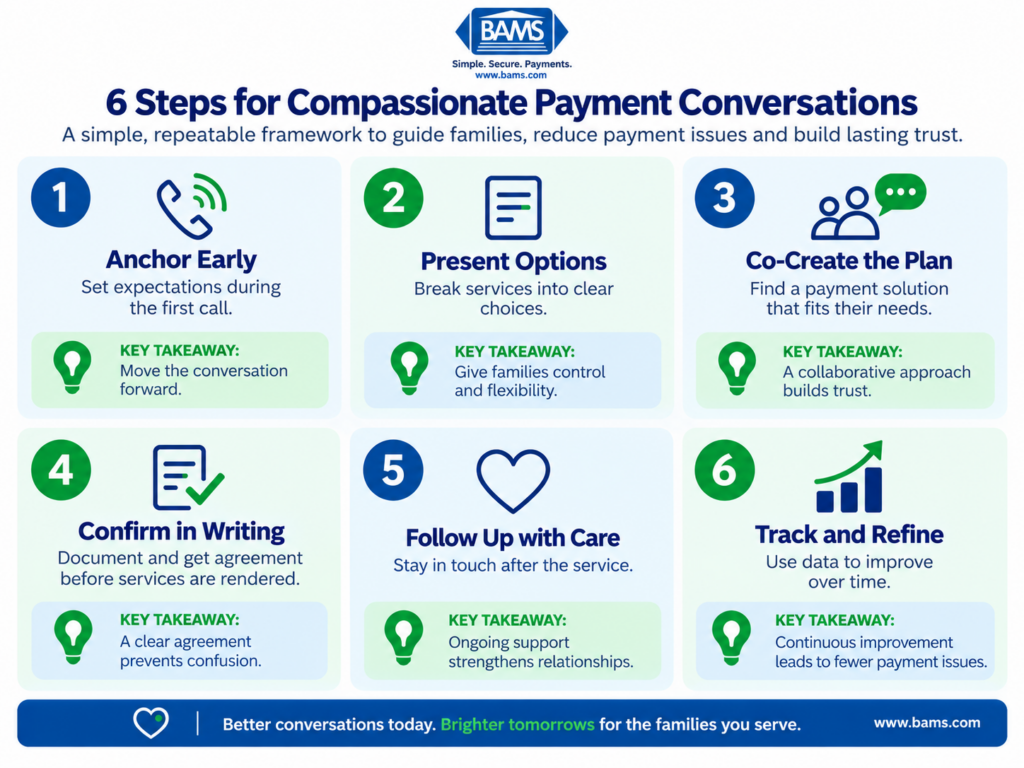
Step 1: Anchor Financial Expectations Before the Conference
Objective: Ensure the family arrives at the arrangement conference already aware that financial decisions will be part of the conversation, so the topic doesn’t feel sudden or intrusive.
The anchoring step happens during the first phone call or in-person visit, typically when the family contacts you to begin arrangements. Your staff should include a brief, normalized statement about what the conference will cover. A simple script works: “When we meet, we’ll walk through everything together, including the service options, timing, and the financial side. We want to make sure you have all the information you need to make decisions that feel right for your family.”
This single sentence does three things. It signals that money will be discussed (removing surprise). It frames the conversation as informational, not transactional. And it positions you as an ally in the decision, not an authority imposing costs.
If your funeral home has a website or sends a pre-conference email, include a general pricing guide or a link to your General Price List. Transparency before the meeting reduces sticker shock during it. Transparent pricing at every stage of the customer journey is a proven way to reduce friction and build trust.
Anti-patterns to avoid: Don’t quote specific prices over the phone before understanding the family’s needs. Don’t say “don’t worry about the money right now.” Don’t skip the anchoring statement because the family seems too emotional. Emotion is present at every stage; waiting doesn’t reduce it.
Success indicators: The family arrives at the conference expecting to discuss finances. No one says, “I didn’t realize we’d be talking about money today.”
Step 2: Present Costs in Component Language During the Arrangement Conference
Objective: Walk the family through each cost element individually so they understand what they’re paying for, can make informed choices, and feel ownership over the final number.
This is where most funeral directors either rush or over-apologize. Neither works. Instead, present your services as a series of components, each with a clear description and price. Professional service fees, facility use, transportation, preparation, merchandise, and third-party costs (cemetery, clergy, flowers) should each be named and explained.
Component-based pricing reduces the psychological weight of the total. A family hearing “$8,500” in a single figure feels overwhelmed. The same family hearing a sequence of individual decisions, each between $200 and $2,500, feels in control. This approach aligns with how families actually fund funerals. SunLife’s 2024 data shows 27% of funerals were at least partially funded by prepaid plans, 24% by savings, and 20% by current accounts. Families are mentally allocating different funding sources to different cost components. Your presentation should mirror that thinking.
Use a printed or digital worksheet the family can see and follow along with. Circle or highlight each item as you discuss it. Leave space for notes. This document becomes the foundation of the payment agreement in Phase 3.
Anti-patterns to avoid: Don’t present a single bottom-line number without context. Don’t use industry jargon (“alternative container” means nothing to a grieving spouse). Don’t rush through the pricing to “get it over with.” The time you invest here directly reduces collection calls later.
Success indicators: The family can explain back to you, in general terms, what they chose and approximately what it costs. They nod during the presentation rather than staring blankly at a total.
Step 3: Collaboratively Build a Payment Plan
Objective: Work with the family to match their available funding sources to the total cost, creating a realistic payment timeline they commit to before services are rendered.
This is the step that eliminates follow-up calls. After presenting the component costs, transition with a question, not a demand: “Let’s talk about how you’d like to handle the financial side. Some families pay in full at the time of service, some split it across a couple of payments, and some use a combination of insurance, savings, and a payment plan. What works best for your situation?”
This question accomplishes several things. It normalizes multiple payment options (so the family doesn’t feel ashamed for not paying in full). It positions you as flexible. And it invites the family to self-select into a plan, which dramatically increases follow-through compared to a plan imposed on them.
For families assigning life insurance benefits, insurance assignment can be a more reliable path to full payment than relying on savings or credit alone, since the funeral home is paid directly once the claim is processed. This means offering insurance assignment isn’t just compassionate; it’s often financially advantageous. Walk families through the assignment process step by step, and offer to handle the paperwork.
For families who need a payment plan, define the terms clearly: amount per payment, frequency, method, and end date. Offer card-on-file options for automatic payments. Let families know that ACH bank transfers, which settle through the ACH Network, are typically a lower-cost option than card payments.
Anti-patterns to avoid: Don’t assume the family can pay in full. Don’t offer only one payment method. Don’t leave the payment conversation open-ended (“just pay when you can”) because that phrase is the single largest driver of overdue balances in funeral services.
Success indicators: You leave the arrangement conference with a signed payment agreement that specifies amounts, dates, and methods. The family thanks you for making it easy.
Step 4: Document and Confirm Immediately
Objective: Provide the family with a clear, written summary of their service selections and payment agreement within 24 hours of the arrangement conference.
Memory is unreliable under grief. Families who clearly understood the payment plan on Tuesday may genuinely not remember the details by Friday. Your confirmation document protects both parties. It should include a line-item summary of services selected, the total cost, the agreed payment schedule, accepted payment methods, and contact information for billing questions.
Send this document via email and provide a printed copy. If your funeral home uses a client portal, upload it there as well. The format matters less than the speed. Sending the confirmation the same day as the conference reinforces the agreement while it’s still fresh and signals professionalism.
Include a brief, warm note at the top: “Thank you for trusting us with [name]’s arrangements. Below is a summary of everything we discussed, including the service details and payment plan. Please don’t hesitate to reach out if anything needs to change.” This positions the document as a service, not a bill.
Anti-patterns to avoid: Don’t wait a week to send the summary. Don’t use collection-style language (“amount due,” “remit payment,” “past due”). Don’t send the financial summary without the service details. Bundling them together keeps the focus on the care you’re providing, not just the cost.
Success indicators: The family acknowledges receipt. No one calls back confused about what they owe or when.
Step 5: Follow Up with Care, Not Collection Language
Objective: Maintain the relationship after the service while gently reinforcing the payment timeline, so that any remaining balance is resolved without a traditional collection call.
The post-service follow-up is where most funeral homes either go silent (hoping the check arrives) or shift into collection mode (destroying the relationship). Neither approach works. Instead, schedule two touchpoints.
The first touchpoint is a care call, five to seven days after the service. This call is not about money. It’s about the family. “We wanted to check in and see how you’re doing. If there’s anything else we can help with, we’re here.” This call deposits trust. It also reminds the family, indirectly, that your relationship is ongoing and that you’re a real person, not an invoice.
The second touchpoint, if a balance remains, is a gentle reminder timed to the agreed payment schedule. Use the language from the confirmation document: “Per the plan we put together, the next payment of $X is scheduled for [date]. If anything has changed on your end, let’s talk about adjusting the timeline.” Notice the framing. You’re referencing a plan “we put together” (collaborative), offering to “adjust” (flexible), and inviting a conversation (relationship-oriented).
If your payment processing supports automated recurring charges with card-on-file, this second touchpoint may not even be necessary. The payment processes automatically, and you send a simple receipt with a thank-you note.
Anti-patterns to avoid: Don’t skip the care call and go straight to a payment reminder. Don’t use the word “overdue” in your first reminder. Don’t send a form letter when a brief phone call or personal email would be more appropriate for your relationship with the family.
Success indicators: Balances are resolved within the agreed timeline. Families respond to reminders with cooperation, not defensiveness. Your staff doesn’t dread making follow-up calls.
Step 6: Build a Feedback Loop to Refine Your Process
Objective: Use data from your payment outcomes to continuously improve your communication strategy and reduce outstanding balances over time.
Track three metrics monthly: the percentage of arrangements with a signed payment agreement at the time of the conference, the average number of days to full payment, and the percentage of balances that require more than one reminder. These numbers tell you whether your framework is working.
- If agreements aren’t being signed at the conference, your anchoring (Step 1) or presentation (Step 2) needs work.
- If days-to-payment is creeping up, your payment options may be too limited or your confirmation documents unclear.
- If reminders are increasing, your follow-up language or timing may need adjustment.
Review your payment processing reports regularly. They reveal patterns you can’t see from individual transactions: which payment methods families prefer, average transaction sizes, and seasonal fluctuations in cash flow. These insights let you adjust your approach proactively rather than reacting to problems.
Anti-patterns to avoid: Don’t treat every unpaid balance as a communication failure. Some families face genuine hardship. Don’t change your entire framework based on one difficult case. Look for patterns across dozens of arrangements before making structural changes.
Success indicators: Your three key metrics improve quarter over quarter. Your staff reports feeling more confident in payment conversations. The number of “awkward calls” your team dreads drops measurably.
Practical Examples: Seeing the Framework in Action
Scenario A: The Prepared Family
A daughter calls to arrange her father’s funeral. He had a prepaid plan covering $4,000, but the family wants additional services totaling $7,200. During the anchoring call, your staff mentions that the conference will cover both service options and the financial plan. At the conference, you present costs component by component, and the daughter identifies the $4,000 prepaid plan plus $2,000 from her father’s savings account. The remaining $1,200 is placed on a credit card at the conference. Total follow-up calls needed for payment: zero.
Scenario B: The Financially Strained Family
A son arranges his mother’s funeral. He has no prepaid plan, limited savings, and a pending life insurance claim. During the arrangement conference, you present a direct cremation option at $1,557 alongside the full-service option at $6,800. He chooses a mid-range service at $4,200. You help him initiate the insurance assignment (which typically takes 30 to 45 days to process) and agree on a $500 deposit by credit card with the balance due upon insurance payout. The confirmation document specifies this clearly. When the insurance check arrives, you call to coordinate final payment. The son thanks you for making it manageable. Total awkward collection calls: zero.
Scenario C: The Silent Family
A family completes arrangements, agrees to pay the $5,500 balance within 30 days, but goes silent after the service. Because you completed Phase 3 (documentation), you have a signed agreement. Your care call on day seven gets voicemail. On day 25, you send a warm reminder referencing the agreement: “We know this is a difficult time. Per the plan we discussed, the balance of $5,500 is approaching the agreed date. If you’d like to adjust the timeline or set up a payment plan, we’re happy to help.” The family calls back, apologizes, and pays by card. Total calls that felt like “collection”: zero. Total calls that felt like care: two.
Common Mistakes and Pitfalls
Treating silence as agreement. When a family doesn’t object to a price, it doesn’t mean they’ve committed to paying it. Always secure explicit agreement with a signature or documented confirmation.
Over-relying on one payment method. Offering only “pay in full by check” ignores the reality that families use multiple funding sources. The more payment options you provide (credit card, ACH, insurance assignment, payment plans), the faster you get paid.
Confusing empathy with avoidance. Skipping the financial conversation because “it doesn’t feel right” is not compassionate. It’s a deferral that creates a harder conversation later. True empathy means helping the family plan realistically.
Using form letters for follow-up. A generic “your account is past due” letter destroys the trust you built during the arrangement. Every communication after the service should feel personal and reference the specific plan you created together.
Not training all staff. If only the funeral director knows the framework, it fails whenever someone else answers the phone or handles a walk-in. Train every team member who interacts with families on the anchoring language and payment presentation approach.
What to Do Next
Start with one change. Before your next arrangement conference, add the anchoring statement to your initial phone call script. That single sentence, letting the family know you’ll discuss finances as part of the conference, shifts the entire dynamic of the meeting that follows.
Then, over the next month, build your component pricing worksheet if you don’t already have one. Print it. Use it in every conference. Watch how families respond when they can see each element of the cost rather than hearing a single total.
This framework isn’t a checklist to complete once. It’s a practice to refine over dozens of arrangements. Each family will teach you something about timing, language, and flexibility. Pay attention to what works, track your metrics, and adjust. The awkward follow-up call isn’t inevitable. It’s a symptom of a missing conversation earlier in the process. Put that conversation in place, and the symptom disappears.
Frequently Asked Questions
How can funeral homes create an effective communication strategy for payment collection?
Build payment discussions into the arrangement conference itself rather than treating them as a separate, post-service activity. Use the four-phase framework (Anchor, Arrange, Confirm, Support) to set expectations early, present costs transparently, document agreements immediately, and follow up with care-oriented language. The goal is to secure a signed payment plan before services are rendered, which eliminates most collection scenarios entirely.
Which payment options should funeral homes offer to encourage timely payments?
Offer at least four options: credit or debit card (with card-on-file for recurring payments), ACH bank transfer, life insurance assignment, and structured payment plans. Research shows families use an average of 2.3 funding sources per funeral, so flexibility is essential. Insurance assignment alone generates significantly higher average revenue per arrangement compared to single-method payments.
When is the right time to discuss funeral costs with a grieving family?
During the arrangement conference, not after. Delaying the conversation doesn’t reduce the family’s grief. It only increases confusion and the likelihood of unpaid balances. Anchor the expectation during the first phone call by mentioning that the conference will cover both service options and the financial plan. Families expect to make decisions at this stage and appreciate clear guidance.
How do you follow up on an unpaid funeral balance without being insensitive?
Start with a care call five to seven days after the service that focuses entirely on the family’s wellbeing, with no mention of money. If a balance remains, send a reminder that references the specific plan you built together (“per the plan we discussed”) and offers to adjust the timeline if needed. Avoid words like “overdue,” “delinquent,” or “collections” in your first two communications.
How does payment processing technology help funeral homes with cash flow?
Modern payment processing enables card-on-file storage for recurring payments, automated billing on agreed schedules, and next-day funding so you receive money faster. These features reduce the manual follow-up burden on your staff and ensure that agreed-upon payment plans execute automatically, turning a potential collection call into a simple receipt and thank-you note.
What should a funeral payment confirmation document include?
Include a line-item summary of all services selected, the total cost, the agreed payment schedule (amounts, dates, and methods), accepted payment methods, and direct contact information for billing questions. Send it within 24 hours of the arrangement conference via email and print. Open with a warm note thanking the family for their trust, so the document reads as a service summary, not an invoice.