Choosing a Payment Partner You Can Actually Hold Accountable
Last Updated on September 14, 2026 by Dimitri Akhrin
Chargebacks drain revenue twice — once through the dispute itself, and again through the fee exposure and processing ris
Approaches chargeback losses as a diagnostic pattern across fees, funding stability, and account standing rather than isolated incidents, surfacing the compounding cost that eCommerce operators rarely
TL;DR
- Calculate your effective rate – Divide total fees by total volume. If it exceeds your quoted rate by more than 0.3%, interchange overcharges or downgrades are likely inflating your costs.
- Quantify your chargeback costs – At an average of $128 per dispute (before lost goods), chargebacks compound through fees, ratio increases, and reserve holds. Processors that only forward alerts aren’t defending you.
- Demand funding transparency – Unexplained holds disrupt cash flow. Review your agreement for vague reserve clauses and negotiate for defined thresholds and next-day funding commitments.
- Test your support access now – Call with a real question before a crisis hits. If you can’t reach a named person who knows your account, your escalation path during an actual problem is effectively nonexistent.
- Read your termination clause – Early termination fees and auto-renewal traps signal a processor that retains merchants through friction, not performance. Accountability starts with the freedom to leave.
Why Your Payment Partner’s Accountability Gap Is Draining Revenue
Most eCommerce operators treat payment processing fees as a fixed line item. You negotiate a rate, sign a contract, and move on. But the real cost of a payment partner shows up in the moments you can’t plan for: a chargeback spike that triggers a reserve hold, interchange overcharges buried in monthly statements, or a funding delay that stalls payroll. These aren’t isolated incidents. They’re diagnostic patterns that reveal whether your processor is working for you or simply billing you.
U.S. banks collected nearly $66 billion in interchange fees in 2025, up from $64 billion in 2024. And interchange is only one part of the cost merchants face when accepting card payments. It doesn’t include the compounding costs of disputes, the revenue lost to declined transactions, or the operational drag of chasing support tickets into a void. The gap between what you pay and what you should pay often traces back to one thing: a payment partner you can’t hold accountable.
Who This Is For (and What This Isn’t)
This guide is for eCommerce managers at established online businesses (roughly 10 to 50 employees) who have outgrown their first payment processor but haven’t yet found a partner that treats accountability as a feature. You’re processing enough volume that small rate differences compound into real money, and you’ve likely experienced the frustration of calling a 1-800 number during a funding delay only to get a scripted response.
This is not a “top 10 processors” roundup. It won’t rank platforms by feature count or star ratings. Instead, it isolates the specific signals that separate a payment partner you can hold accountable from one that hides behind fine print, tiered pricing, and automated support queues.
How These Signals Were Selected
Each item below targets a specific failure point in the processor relationship: fee transparency, dispute handling, funding reliability, and support access. The selection logic prioritizes signals that compound over time, meaning they cost more the longer they go unaddressed. If a signal applies to your current setup, it’s worth quantifying the damage before your next contract renewal.
7 Signals Your Payment Partner Lacks Real Accountability
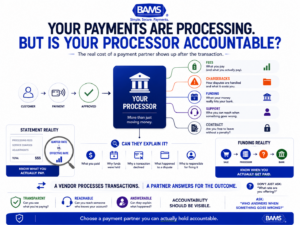
A processor can move every transaction successfully and still cost your business through unclear fees, weak dispute support, unpredictable funding and inaccessible support.
1. Your Effective Rate Doesn’t Match Your Quoted Rate
Why it matters: A quoted rate of 2.4% means nothing if your effective rate (total fees divided by total volume) lands at 3.1%. The gap usually comes from interchange overcharges, downgrades on transactions that don’t qualify for the quoted tier, and miscategorized card types. Processors that use tiered or bundled pricing models have little incentive to flag these discrepancies because the overages flow directly to their margin.
What it looks like today: Many eCommerce operators never calculate their effective rate. They see a monthly total, compare it loosely to expectations, and move on. Meanwhile, transactions involving corporate cards, international cards, or card-not-present entries quietly qualify at higher interchange tiers without notification.
How to apply it: Pull your last three monthly statements. Divide total fees by total processing volume. If the result exceeds your quoted rate by more than 0.3%, request an itemized interchange breakdown. A partner willing to walk through that breakdown with you is one worth keeping. One that deflects the question is telling you something. For a deeper diagnostic, this guide on identifying inflated credit card processing fees covers effective rate calculation in detail.
2. Chargebacks Are Treated as Your Problem Alone
Why it matters:U.S. merchants pay an average of $128 per chargeback in combined internal and third-party costs, excluding the value of lost goods. Of that, roughly $82 goes to internal costs (labor, investigation, fulfillment loss) and $46 to third-party fees. When your processor’s chargeback “support” consists of forwarding you a notification and a deadline, you absorb all of it.
What it looks like today: Most processors provide a chargeback alert and a portal to upload evidence. That’s it. No pre-dispute deflection, no representment guidance, no pattern analysis across your transaction data. The result is that disputes become a recurring tax on revenue rather than a manageable operational risk.
How to apply it: Ask your processor three questions: Do you offer pre-dispute alerts that allow resolution before a formal chargeback is filed? Do you assist with representment, or just provide a template? Can you show me my dispute patterns by reason code over the last six months? If the answer to all three is no, your chargeback defense is essentially self-service, and your costs reflect it.
3. Funding Delays Happen Without Explanation
Why it matters: For eCommerce businesses managing inventory cycles, ad spend, and payroll on tight margins, the difference between next-day funding and a 3-to-5-day hold isn’t a minor inconvenience. It’s a cash flow disruption that forces you to carry additional working capital or delay supplier payments. Unexplained holds, where funds are delayed without a clear reason or timeline, signal a processor that treats your revenue as their risk buffer.
What it looks like today: Many processors reserve the contractual right to hold funds for “review” without specifying triggers. You discover the hold when your bank balance doesn’t match your dashboard. Support tickets go unanswered for 24 to 48 hours. By the time you get a response, the damage to your cash cycle is already done.
How to apply it: Review your processing agreement for hold and reserve clauses. Identify the specific conditions that trigger a funding delay. If those conditions are vague (“at our discretion”), negotiate for defined thresholds. A partner that offers next-day funding with transparent hold policies gives you the predictability your cash flow depends on.
4. You Can’t Reach a Human When It Counts
Why it matters: The accountability gap becomes most visible during a crisis: a batch processing error, a sudden chargeback ratio spike, or an integration failure after a platform update. If your only recourse is a chatbot, a ticket queue, or a call center agent reading from a script, you’re not in a partnership. You’re in a vendor relationship with no escalation path.
What it looks like today: The industry standard for mid-market ecommerce support is a shared inbox and a 24-to-48-hour response SLA. Dedicated account managers, when offered, are often reassigned quarterly or shared across hundreds of accounts. The result is that no single person at your processor understands your business, your transaction patterns, or your risk profile.
How to apply it: Test your current support channel before you need it urgently. Call or email with a moderately complex question (“Can you explain the interchange category on my largest transaction last month?”) and measure response time, specificity, and follow-through. If you can’t get a named person who knows your account, that’s the signal. BAMS structures its accounts around dedicated managers who stay with your business, so when a chargeback spike or funding issue surfaces, you’re talking to someone who already understands your transaction history.
5. Your Statement Obscures More Than It Reveals
Why it matters: Payment processing fees reduction starts with visibility. If your monthly statement groups charges into opaque categories like “processing fees,” “service charges,” or “adjustments” without itemizing interchange, assessment, and markup separately, you can’t identify where you’re overpaying. This opacity is a feature for processors who profit from it, not a bug.
What it looks like today: Interchange-plus pricing, where you see the actual interchange cost plus a fixed markup, remains the most transparent model. Yet many processors still default to tiered or flat-rate pricing that bundles costs together. The difference can be significant: a transaction that qualifies for a 1.65% interchange rate might be billed at a 2.5% “mid-qualified” tier, with the spread going entirely to the processor.
How to apply it: Request a sample interchange-plus statement from your processor. If they can’t or won’t provide one, that’s a red flag. Compare your current effective rate against what interchange-plus pricing would look like for your transaction mix. This breakdown of strategies to lower credit card processing fees walks through how interchange-plus pricing works and why it matters for growing businesses.
6. Declined Transactions Aren’t on Anyone’s Radar
Why it matters: Every declined transaction is lost revenue, but it’s also a signal. High decline rates can indicate misconfigured fraud filters, incorrect MCC codes, or routing inefficiencies that your processor should be monitoring and optimizing. One payments optimization pilot on U.S. debit transactions produced 26% average cost savings and a 0.22% authorization-rate uplift through smarter routing alone. If your processor never mentions your decline rate, they’re leaving your revenue on the table.
What it looks like today: Most mid-market processors don’t surface decline analytics proactively. You might see a total approval rate in a dashboard, but without reason-code breakdowns, retry logic, or issuer-level data, you can’t act on it. The revenue leakage is invisible until you look for it.
How to apply it: Ask your processor for a decline-reason report covering the last 90 days. Identify the top three decline reasons by volume. If “do not honor” or “insufficient funds” dominate, there may be retry or routing optimizations available. If your processor can’t produce this report, they’re not equipped to optimize your credit card processing optimization at the level your volume demands.
7. Your Contract Penalizes You for Leaving
Why it matters: Early termination fees, liquidated damages clauses, and equipment leases that outlast the processing agreement are all signs that your processor’s business model depends on retention through friction, not performance. An accountable partner earns your business monthly. An unaccountable one locks you in annually.
What it looks like today: Three-year contracts with auto-renewal and $500+ early termination fees remain common in the industry, particularly among processors that sell through independent sales organizations. Some contracts include liquidated damages calculated as a percentage of projected future volume, creating five-figure exit costs for mid-market merchants.
How to apply it: Read your current agreement’s termination section in full. Note the renewal date, the notice window (often 30 to 90 days before auto-renewal), and the specific termination fee structure. If you’re approaching a renewal window, use it as leverage to renegotiate terms or transition to a partner that offers month-to-month agreements. The willingness to let you leave is, paradoxically, one of the strongest accountability signals a processor can send.
The Pattern Behind These Signals
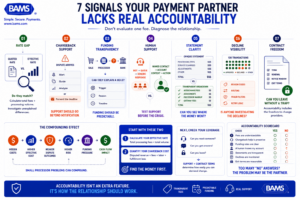 Processor problems rarely appear in isolation. Hidden fees, weak chargeback support, unexplained funding delays and inaccessible support can combine into a much larger drag on revenue and cash flow.
These seven signals share a common root: information asymmetry. Your processor knows your interchange qualifications, your decline patterns, your chargeback trajectory, and your funding risk profile. When they don’t share that information proactively, the asymmetry becomes a profit center for them and a cost center for you. Transaction fees and eCommerce margins are directly linked, and the link tightens as volume grows.
The compounding effect is what makes this dangerous. Interchange overcharges fund a processor’s margin. Undefended chargebacks raise your dispute ratio. A rising dispute ratio triggers reserve holds. Reserve holds disrupt funding. Disrupted funding forces you to carry more working capital. Each problem feeds the next, and the total cost far exceeds what any single line item on your statement reveals. Industry benchmarks suggest chargebacks cost businesses $3.75 to $4.61 for every $1 lost once fees, labor, and merchandise are factored in.
Where to Start: Prioritizing Accountability
You don’t need to address all seven signals at once. Start with the two that have the most immediate financial impact: calculate your effective rate (Signal 1) and quantify your chargeback costs (Signal 2). Together, these two exercises will tell you whether your current processor relationship is costing you hundreds or thousands per month more than it should.
From there, evaluate your support experience (Signal 4) and your contract terms (Signal 7). These determine how much leverage you have to demand change or make a transition. Accountability isn’t a feature you can add to an existing relationship. It’s a structural quality that’s either built into how your processor operates or it isn’t. The signals above help you tell the difference before the next funding delay or chargeback spike forces the question.
Frequently Asked Questions
How do I calculate my effective credit card processing rate?
Divide your total processing fees for the month by your total processing volume for the same period. For example, if you paid $3,100 in fees on $100,000 in volume, your effective rate is 3.1%. Compare this to your quoted rate. A gap of more than 0.3% suggests interchange downgrades, miscategorized transactions, or bundled fees that deserve investigation.
What’s the real cost of a chargeback beyond the disputed amount?
According to Mastercard’s research, U.S. merchants pay an average of $128 per chargeback in internal and third-party costs alone, not counting the value of lost goods or services. Internal costs (staff time, investigation, fulfillment loss) account for about $82, while third-party fees add roughly $46. These costs compound when dispute ratios rise and trigger reserve holds or rate increases.
What is interchange-plus pricing and why does it matter?
Interchange-plus pricing separates the actual interchange fee (set by card networks) from your processor’s markup. This transparency lets you see exactly what you’re paying for and identify where costs can be reduced. Tiered or flat-rate pricing bundles these together, often resulting in higher effective rates because transactions that qualify for low interchange tiers still get billed at a higher bundled rate.
When should a business consider switching payment processors?
Consider switching when your effective rate consistently exceeds your quoted rate, when you can’t reach a knowledgeable support contact during time-sensitive issues, when funding delays happen without clear explanations, or when your contract includes punitive early termination fees. These are structural problems that typically don’t improve through negotiation alone.
How do declined transactions affect my bottom line?
Every declined legitimate transaction is lost revenue. High false-decline rates also erode customer trust, since shoppers who experience a declined card often don’t retry. Smarter transaction routing and fraud-filter tuning can recover meaningful revenue. One optimization pilot on U.S. debit transactions achieved 26% cost savings and improved authorization rates by 0.22% through routing changes alone.
What should I look for in a payment processor’s chargeback support?
Look for three capabilities: pre-dispute alerts that let you resolve issues before a formal chargeback is filed, active representment assistance (not just a template upload portal), and pattern analysis that identifies recurring dispute triggers by reason code. If your processor only forwards notifications and deadlines, you’re handling chargeback defense entirely on your own.
Sources
- https://www.stlouisfed.org/on-the-economy/2026/apr/banking-analytics-credit-debit-card-fees-collected-banks-rose-2025
- https://www.mastercard.com/us/en/news-and-trends/Insights/2025/what-s-the-true-cost-of-a-chargeback-in-2025.html
- https://aiforbanking.org/case-studies/adyens-ai-powered-intelligent-payment-routing-delivers-26-cost-savings-on-us-debit-transactions