7 Payment Processing Cost Signals Funeral Homes Should Audit
Last Updated on September 16, 2026 by Dimitri Akhrin
A diagnostic framework for high-ticket merchant services built around death-care transaction structure
Learn which specific cost signals in your merchant services setup are quietly eroding margins on high-ticket funeral arrangements. This diagnostic guide helps operators audit processing fees through the lens of low-frequency, high-dollar transactions.
TL;DR
- Your effective rate hides the real cost – On high-ticket transactions ($10,000+), even a single basis-point difference in markup translates to meaningful annual losses. Request an interchange-plus breakdown and audit your ten largest transactions.
- Card type and entry method inflate fees silently – Premium credit cards and keyed-in (card-not-present) transactions both carry higher interchange rates. Track your card mix and shift payments to in-person collection when possible.
- Insurance assignment delays compound cash flow pressure – If you’re waiting 30 to 60 days on insurance while also waiting 2 to 3 days for card settlement, next-day funding from your processor can recover meaningful working capital.
- Hidden statement fees add up fast at low volume – PCI non-compliance penalties, authorization attempt fees, and split-payment surcharges hit low-volume merchants disproportionately hard. Audit the “other fees” section of your statement quarterly.
- Start with three data points, not a full overhaul – Calculate your true per-transaction effective rate, count keyed versus card-present transactions, and check for PCI fees. Those three numbers tell you whether your setup is costing you hundreds or thousands in avoidable fees.
The Real Cost Problem Hiding in Funeral Home Payment Processing
A family walks in during the most difficult week of their lives, authorizes a $12,000 arrangement, and assigns an insurance policy to cover most of it. You deliver the service. Then you wait. The insurance company takes 30 to 60 days. Meanwhile, your payment processing costs quietly erode what’s left of an already thin margin.
Most funeral homes absorb payment processing costs designed for retail environments with high transaction volume and low ticket sizes. But your business runs the opposite way: low frequency, high dollar amounts, and a payment timeline complicated by insurance assignments, pre-need trust disbursements, and families splitting costs across multiple cards. That mismatch creates cost signals most operators never audit.
This isn’t generic advice about shopping for lower rates. This is a diagnostic framework built around the specific transaction structure of death-care operations.
Who This Is For and What It Covers
This guide is for family-owned funeral service operators running one to ten locations who process a meaningful share of arrangements above $10,000. If you’ve never questioned whether your merchant services setup is costing you more per transaction than it should, start here.
We’re not covering e-commerce checkout optimization, retail POS hardware comparisons, or installment plugins designed for consumer goods. We’re focused on the cost signals embedded in how your processor handles high-ticket, low-volume transactions where insurance assignment delays and split payments create a completely different cost profile.
How We Selected These Cost Signals
Each item below targets a specific line item, fee structure, or operational gap that disproportionately affects high-ticket service businesses. The filter: does this cost signal behave differently when a single transaction exceeds $5,000? If yes, it made the list. If it applies equally to a coffee shop and a funeral home, it didn’t.
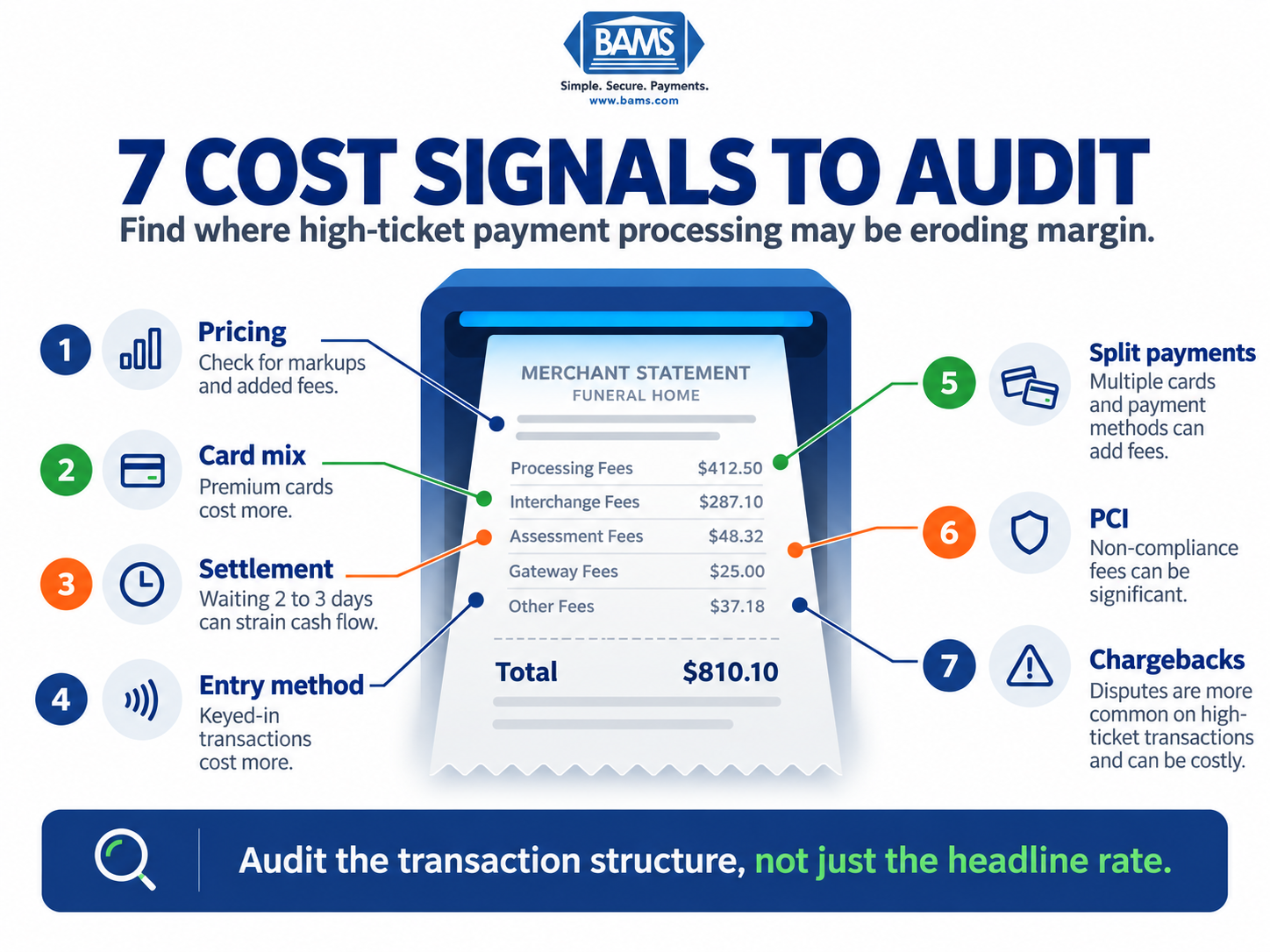
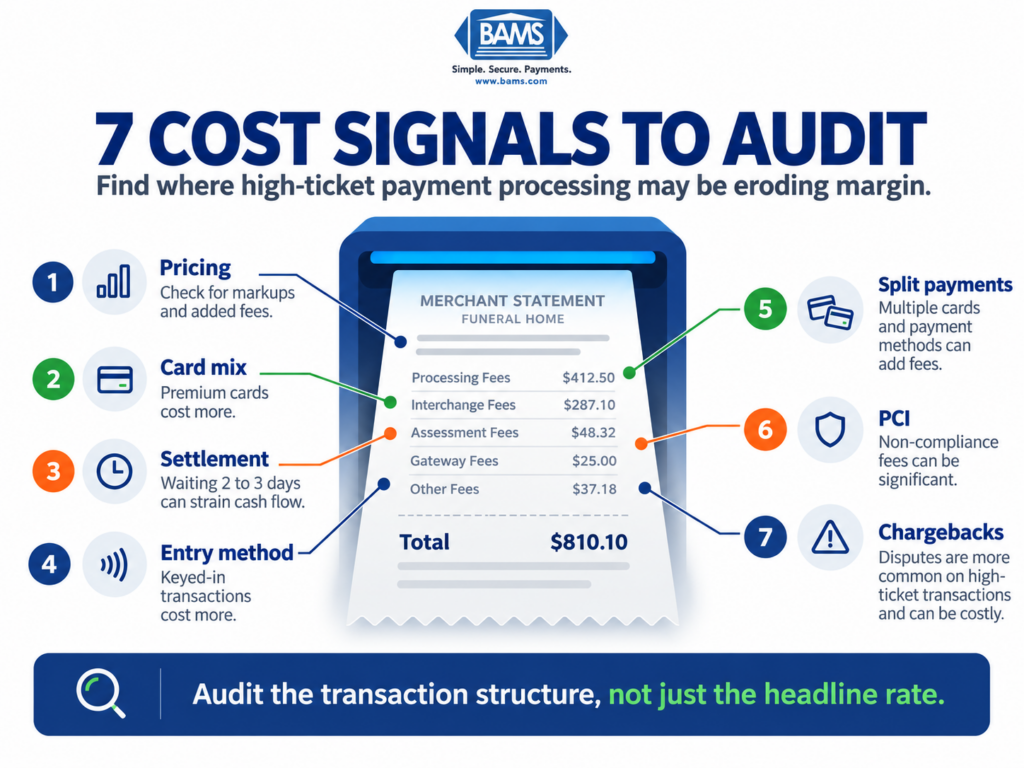
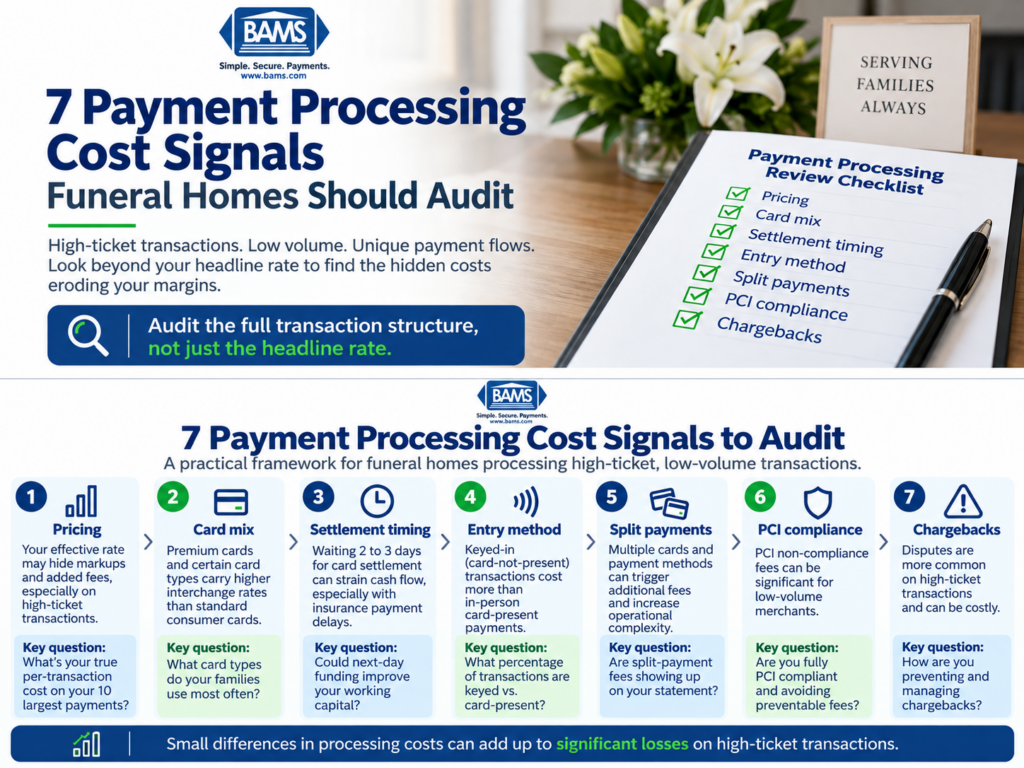
7 Payment Processing Cost Signals Every Funeral Operator Should Audit
1. Your Effective Rate Masks Per-Transaction Markups
Why it matters: Most operators glance at their monthly statement and see an effective rate around 2.2% to 2.5%. That looks normal. But when you process only 40 to 80 card transactions per month, fixed per-transaction fees ($0.10 to $0.30 each) barely register. What does register is the percentage markup on a $15,000 charge. A single basis-point difference at that ticket size equals $1.50 per transaction, or $1,800 annually on 100 arrangements.
What it looks like today: Many funeral homes sit on tiered or bundled pricing models where the processor’s markup is blended into a single rate. You can’t see what’s interchange and what’s profit margin.
How to apply it: Request a full interchange-plus breakdown from your processor. Compare the markup (the “plus”) across your ten largest transactions from the past quarter. If the markup exceeds 30 basis points above interchange on card-present transactions, that’s your first negotiation target. For context on why your statement may not be showing you the full picture, transaction-level analytics matter more than summary rates.
2. Credit Card Mix Is Inflating Your Costs Silently
Why it matters:Credit cards accounted for 79.34% of all merchant processing fees paid in 2024. Funeral arrangements skew heavily toward credit, especially premium rewards cards that families use to capture points on large charges. Those cards carry interchange rates 40 to 80 basis points higher than standard debit.
What it looks like today: A family pays a $14,000 balance on an airline rewards Visa. Your interchange cost on that single swipe could exceed $350. If your processor uses tiered pricing, that transaction may quietly land in a “non-qualified” bucket with an even higher surcharge.
How to apply it: Pull three months of statements and categorize transactions by card type. Calculate the percentage of revenue processed on premium credit versus standard debit. If credit exceeds 70% of your volume, explore whether your processor offers Level 2 data submission on keyed-in transactions to potentially qualify for lower interchange tiers. This is where interchange-plus pricing with proper data passthrough becomes a material cost lever.
3. Insurance Assignment Gaps Create a Cash Flow Tax
Why it matters: When a family assigns a life insurance policy to your funeral home, you’ve earned the revenue but can’t collect it for 30 to 60 days. During that window, you’re financing operations out of pocket. If you’re also waiting two to three business days for card settlement on the family’s out-of-pocket portion, the cash flow gap compounds.
What it looks like today: Most processors settle funds in 48 to 72 hours. For a funeral home carrying $80,000 in outstanding insurance assignments at any given time, even the card-funded portion sitting in a two-day settlement queue creates unnecessary working capital pressure.
How to apply it: Audit your average settlement timeline. If your processor doesn’t offer next-day funding, calculate how much operating cash you’re lending to the settlement cycle each month. For operators managing multiple locations, a merchant services partner like BAMS that provides next-day funding can compress the gap between the family’s card payment and your bank deposit, freeing cash while you wait on insurance disbursement.
4. Keyed-In Transactions Are Costing You More Than Swiped Ones
Why it matters: Funeral arrangements often involve phone authorizations, deposits taken before a family visits, or payments collected after services when the cardholder isn’t present. Every keyed-in (card-not-present) transaction triggers higher interchange rates than a chip-read or tap transaction because the card networks assign greater fraud risk.
What it looks like today:The average credit card processing fee in the U.S. hit 2.24% in 2024, but that’s a blended figure. Card-not-present rates can run 30 to 50 basis points higher. On a $10,000 keyed transaction, that’s $30 to $50 in avoidable cost if the payment could have been captured in person.
How to apply it: Track what percentage of your monthly transactions are keyed versus card-present. If keyed exceeds 25%, evaluate whether you can shift some of those to in-person collection at the arrangement conference. For payments that must remain card-not-present, ensure your terminal or gateway is submitting AVS (Address Verification Service) and CVV data, which can help qualify those transactions at lower interchange tiers.
5. Split Payments Multiply Your Per-Transaction Costs
Why it matters: Families increasingly split funeral costs across two or three cards, sometimes involving multiple family members. A $15,000 arrangement paid across three cards means three separate transactions, each carrying its own per-transaction fee, interchange assessment, and potential downgrade risk.
What it looks like today: Your processor charges a flat per-transaction fee (often $0.10 to $0.30) plus a percentage. Three transactions on a $15,000 arrangement cost more in aggregate fees than a single transaction for the same amount. If one of those cards declines and requires a retry, you’ve added a fourth authorization attempt.
How to apply it: Review your processor agreement for per-transaction fees and authorization fees (some charge for each attempt, not just successful ones). If split payments represent more than 15% of your arrangements, negotiate a lower per-transaction rate or explore whether your processor can batch split payments more efficiently. Also confirm you aren’t being charged for declined authorization attempts.
6. PCI Compliance Fees May Be Pure Margin for Your Processor
Why it matters: Many funeral homes pay a monthly PCI compliance fee ($10 to $30/month) or, worse, a PCI non-compliance fee ($30 to $100/month) without understanding what they’re getting. Some processors bundle a compliance “service” that amounts to a link to a self-assessment questionnaire you could access for free.
What it looks like today: Processors often bury PCI fees in the “other fees” section of your statement. For a low-volume merchant processing 50 transactions per month, a $99 monthly non-compliance penalty represents a per-transaction surcharge of nearly $2.00, an absurd cost that no one flags because it doesn’t appear in the rate calculation.
How to apply it: Check your last three statements for any line item containing “PCI.”
- If you’re paying a non-compliance fee, complete your SAQ (Self-Assessment Questionnaire) immediately.
- If you’re paying a compliance fee, ask your processor exactly what service it covers.
- If the answer is vague, that fee is negotiable or eliminable. Understanding how processors embed hidden fees into statements is the first step toward removing them.
7. Your Chargeback Exposure Is Higher Than You Think
Why it matters: Chargebacks in funeral services are rare but devastating per occurrence. A single chargeback on a $12,000 transaction doesn’t just cost you the revenue. It triggers a chargeback fee ($25 to $100), potentially increases your risk classification with the processor, and can raise your effective rate on all future transactions.
What it looks like today: Family disputes sometimes arise weeks after services, particularly when multiple family members disagree about who authorized the charge. Without proper documentation tied to the transaction (signed authorization, itemized contract, proof of service delivery), you have limited recourse.
How to apply it: Implement a consistent authorization protocol: signed payment agreement at arrangement, itemized receipt matching the card charge, and a clear refund policy disclosed before payment. Ask your processor whether they offer proactive chargeback defense or alerts that notify you before a dispute becomes a formal chargeback. Resolving a dispute at the alert stage costs a fraction of fighting a formal chargeback.
What These Signals Have in Common
Every cost signal above shares a root cause: your merchant services setup was configured for average transaction behavior, not yours. Retail-optimized pricing assumes high volume smooths out per-transaction costs. Funeral home economics work the opposite way. Each transaction carries outsized cost impact, and each day of delayed settlement compounds the cash flow pressure created by insurance assignment timelines.
The second pattern is visibility. Most of these costs hide in statement sections that operators never audit: non-qualified surcharges, PCI line items, authorization attempt fees, and settlement timing. The diagnostic frame isn’t “find a cheaper processor.” It’s “understand where your current setup penalizes high-ticket, low-frequency transactions and fix those specific levers.”
U.S. merchants paid $187.20 billion in card processing fees in 2024, an 8.7% year-over-year increase. Fee inflation isn’t slowing. The operators who audit these signals now protect margin that compounds over years.
Where to Start Without Overhauling Everything
You don’t need to renegotiate your entire merchant agreement this week. Start with three actions: pull your last three statements and calculate your true effective rate per transaction (not the blended monthly rate). Identify how many transactions are keyed versus card-present. Check for PCI non-compliance fees.
Those three data points will tell you whether your current setup is costing you hundreds or thousands per year in avoidable fees. From there, you can decide whether the fix is a conversation with your current processor or a conversation with a new one. Either way, the diagnostic comes first.
Frequently Asked Questions
What are the benefits of optimizing deposit and installment structuring for funeral home merchant services?
Structuring deposits and installments around your actual transaction patterns reduces per-transaction costs and improves cash flow timing. For funeral homes, this means collecting card-present deposits at the arrangement conference (lower interchange) rather than keying in payments over the phone later (higher interchange). It also means fewer split-payment scenarios that multiply per-transaction fees.
How can I improve authorization rates on high-ticket funeral transactions?
High-ticket transactions trigger fraud filters more often than small charges. Submitting complete AVS and CVV data with every transaction improves approval odds. If a family’s card declines on a $10,000+ charge, ask them to call their card issuer to pre-authorize the amount before you retry. Each failed authorization attempt may carry its own fee depending on your processor agreement.
When should I negotiate better settlement terms with my payment processor?
If your current settlement timeline exceeds 48 hours and you regularly carry outstanding insurance assignments, faster settlement directly reduces your working capital gap. The right time to negotiate is before signing a new contract or at your annual review. Come prepared with your average transaction size, monthly volume, and the dollar value of cash tied up in settlement delays.
Which factors affect the settlement timeline in funeral home merchant services?
Settlement speed depends on your processor’s funding schedule, your bank’s deposit processing, the card type used (debit settles faster than credit in some cases), and whether the transaction was flagged for review. Keyed-in transactions and unusually large amounts can trigger holds. Processors that offer next-day funding eliminate most of these delays for qualifying merchants.
Why does the FTC Funeral Rule matter for payment collection timing?
The FTC Funeral Rule requires itemized pricing disclosure and prohibits certain bundling practices. While it doesn’t directly regulate payment processing, collecting deposits before services are rendered can intersect with state-level pre-need trust requirements. If you collect payment in advance and hold it before service delivery, confirm your state’s trust and escrow obligations to avoid compliance risk.
How do I know if my processor’s pricing model is wrong for my transaction profile?
If you process fewer than 100 card transactions per month with an average ticket above $5,000, tiered pricing almost certainly costs you more than interchange-plus. Pull your statement and look for “non-qualified” or “mid-qualified” surcharge categories. If more than 10% of your transactions land in those buckets, your pricing model is penalizing your transaction profile.
Sources