How Next Day Funding Helps Merchants Eliminate the Waiting Game
Last Updated on November 10, 2026 by Dimitri Akhrin
Getting a Card Approved Is Not the Same as Getting the Money
When a customer completes a credit or debit card purchase, the transaction may be approved in seconds. That does not mean the money is already sitting in the merchant’s bank account.
Authorization, batching, settlement and merchant funding are separate parts of the payment process.
Depending on the processor, banking schedule, batch timing and merchant account, businesses may wait one or more business days before processed card revenue becomes available.
For businesses that rely heavily on daily card sales, that delay can affect how much working capital is available for payroll, inventory, supplier payments and other operating expenses.
That is where guaranteed next day funding can make a meaningful difference for qualifying merchants.
TL;DR
- Card authorization and merchant funding happen at different stages – A successful transaction does not mean the money immediately reaches the merchant’s bank account. The payment still moves through batching and settlement before funding occurs.
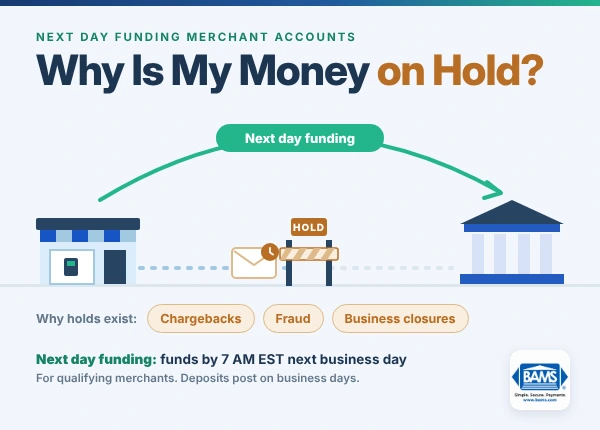
- Normal settlement timing should not automatically be called a payment hold – Routine funding schedules and risk based holds or reserves are different concepts. Actual holds may be used to manage fraud, chargeback or merchant risk.
- The daily batch cutoff can determine when funds become available – Merchants should compare both the advertised funding schedule and the time transactions must be submitted to qualify for it.
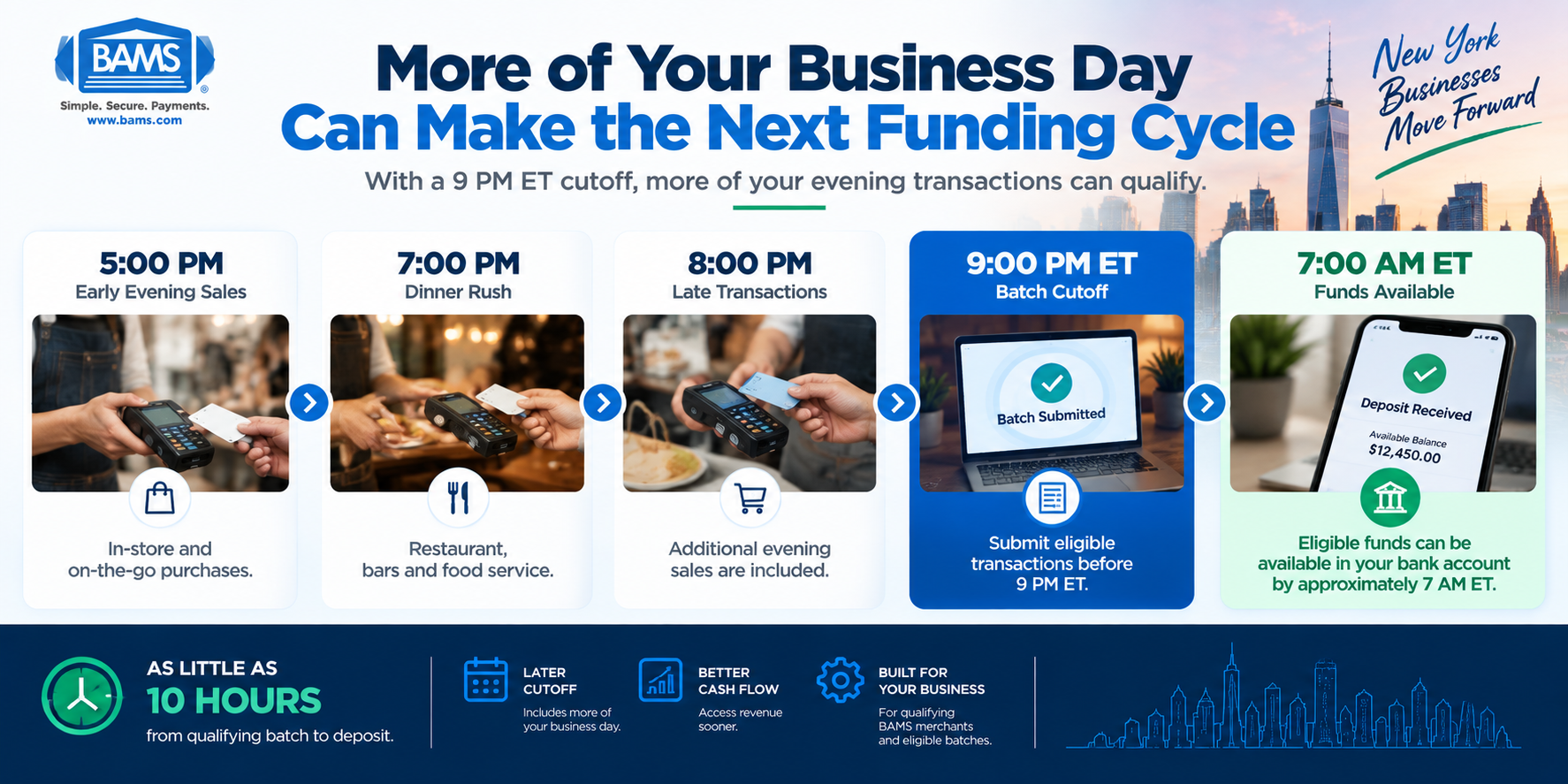
- BAMS offers qualifying merchants a 9 PM ET next day funding cutoff – Eligible batches submitted before the cutoff can be available in the merchant’s bank account by approximately 7 AM the following business day, which can mean access in as little as ten hours.
- Faster funding can improve access to working capital – Reducing the time between processing a sale and accessing the revenue can give businesses more flexibility when managing inventory, payroll, suppliers and other operating expenses.
BAMS guaranteed next day funding can make eligible batches submitted before 9 PM ET available by approximately 7 AM the following business day.
What Happens After a Customer Pays?
A card transaction involves several steps that happen behind the scenes.
Visa Acceptance Solutions explains that payment processors connect banks and card networks during authorization while settlement occurs after an approved transaction. Depending on the payment setup, funds may take one or two days to settle or move faster through real time payment systems.
A simplified card payment flow looks like this:
- The customer pays. Card or wallet information is submitted through the merchant’s payment technology.
- The transaction is authorized. The issuing bank approves or declines the payment.
- The merchant closes or submits the batch. Approved transactions are grouped for settlement.
- The transactions move through settlement. Funds move through the appropriate payment and banking relationships.
- The merchant is funded. The resulting deposit becomes available in the merchant’s bank account according to the applicable funding schedule.
This distinction matters because the customer seeing “Approved” does not tell the merchant exactly when the associated revenue will become usable cash.
A Normal Funding Schedule Is Not Necessarily a “Standard Hold”
The original version of this article described the typical delay between a card sale and merchant deposit as a standard hold.
That terminology is too broad.
A merchant can wait for funds simply because transactions still need to batch, settle and move through the processor’s normal deposit schedule.
A true hold or reserve is generally a separate risk management measure.
The Office of the Comptroller of the Currency’s Merchant Processing handbook distinguishes settlement proceeds from merchant holdback or loss reserves and discusses the use of held merchant funds to manage risks such as suspected fraud and potential losses.
That means merchants should distinguish between:
- Normal processing and settlement time
- A processor’s standard funding schedule
- Batch cutoff timing
- Account specific reserves
- Temporary risk or fraud related holds
They can all affect when money becomes available but they are not the same thing.
What Does a Standard Merchant Funding Process Look Like?
The exact timing varies by processor and account but a simplified example can help illustrate why authorization does not equal immediate funding.
Tuesday Morning: The Customer Makes a Purchase
The merchant submits the card transaction and the issuing bank approves it.
The customer can leave with the product or service but the transaction revenue has not necessarily reached the merchant’s bank account yet.
Tuesday Evening: The Merchant Submits the Batch
The day’s approved transactions are grouped and submitted for settlement.
The timing of that submission matters because processors establish cutoff times that determine which funding cycle the batch enters.
Following Business Day or Later: Funds Become Available
The deposit reaches the merchant according to the processor’s settlement and funding schedule.
Some accounts fund quickly while others operate on longer schedules. Weekends, bank holidays, risk reviews and other account factors can also affect availability.
How Next Day Funding Changes the Timeline
Next day funding shortens the normal gap between submitting eligible transactions and receiving the resulting deposit.
Rather than waiting through a longer funding cycle, qualifying transactions submitted before the applicable cutoff can become available the following business day.
BAMS currently offers qualifying merchants a 9 PM ET cutoff for guaranteed next day funding.
What the BAMS Next Day Funding Process Can Look Like
Tuesday 11:00 AM: A customer completes a card purchase and the transaction is approved.
Tuesday before 9:00 PM ET: The merchant submits an eligible batch before the BAMS cutoff.
Wednesday by approximately 7:00 AM: The qualifying deposit can be available in the merchant’s bank account.
From the 9 PM cutoff to approximately 7 AM the following business day is ten hours, which is why BAMS describes its next day funding turnaround as being available in as little as ten hours.
That ten hour figure should be understood as the potential funding window from batch submission or cutoff to deposit availability. It should not be interpreted to mean that every individual sale reaches the merchant’s account ten hours after the customer makes the purchase.
Why the 9 PM ET Cutoff Matters

A later batch cutoff can help businesses include more of their evening transaction volume in the qualifying next day funding cycle.
“Next day funding” does not tell the entire story.
The cutoff time determines which transactions qualify for that schedule.
Consider a restaurant that processes much of its daily card volume during dinner service.
If its processor requires an early evening batch, late transactions may fall into a later funding cycle. A 9 PM ET cutoff gives qualifying businesses more time to include transactions from the same operating day.
BAMS states that eligible batches processed before 9 PM ET can be available by approximately 7 AM the following business day.
When comparing processors, merchants should therefore ask both questions:
- How quickly do you fund eligible transactions?
- What is the daily cutoff for qualifying for that funding schedule?
One without the other does not provide a complete picture.
Why Faster Funding Can Matter to Cash Flow
Next day funding does not increase a merchant’s revenue.
It changes how quickly revenue the business has already earned becomes available for use.
That distinction can matter when a company regularly converts card sales back into operating expenses.
According to the Federal Reserve Banks’ 2025 Report on Employer Firms, 51% of surveyed employer firms reported uneven cash flow as a financial challenge while 56% reported difficulty paying operating expenses.
Faster deposits will not eliminate every cash flow problem but reducing the amount of revenue waiting in the funding cycle can give a business more immediate access to its own working capital.
That can be useful for expenses such as:
- Inventory replenishment
- Payroll
- Supplier invoices
- Food and materials
- Advertising
- Shipping and fulfillment
- Emergency expenses
Who May Qualify for Next Day Funding?
Faster funding is not necessarily available to every merchant account.
BAMS states that eligibility can depend on factors including operating history, business type, fraud exposure and chargeback history.
That is more accurate than describing next day funding simply as a reward for “trustworthy” businesses.
Risk profiles differ across merchants even when both companies are legitimate and well established.
Before switching processors, ask whether the business qualifies for the advertised funding schedule and whether any account specific conditions apply.
Does Faster Funding Cost More?
Funding programs can have different fee structures depending on the provider.
BAMS currently states that its guaranteed next day funding program carries no additional funding fee for qualifying merchants.
That does not mean merchants should evaluate funding separately from the rest of the account.
Processing rates, monthly charges, gateway costs, chargeback fees and other account expenses still affect the complete merchant relationship.
BAMS also offers transparent interchange plus pricing for merchants that want clearer visibility into payment costs.
A processor with fast funding but an unnecessarily expensive overall account may still be a poor value. Merchants should compare funding and pricing together.
What Should Merchants Compare Before Choosing a Funding Program?
| What to Compare | Why It Matters |
|---|---|
| Funding schedule | Determines when eligible processed revenue becomes available. |
| Batch cutoff | Determines which transactions qualify for the advertised schedule. |
| Eligibility | Not every merchant necessarily qualifies for accelerated funding. |
| Funding fees | Some providers may charge for faster access to deposits. |
| Weekend handling | Friday and weekend batches can follow different banking schedules. |
| Bank holidays | Nonbusiness days can affect deposit timing. |
| Risk holds | Fraud reviews, reserves or account restrictions may override normal funding timing. |
| Total processing cost | Faster funding should be considered alongside the complete merchant account. |
Next Day Funding Is About Predictability as Much as Speed
The benefit of faster deposits is not simply receiving money sooner.
A predictable funding rhythm can also make short term planning easier.
If a merchant knows that qualifying batches submitted before the cutoff are normally available the next business morning, management has a clearer picture of when processed revenue should enter the bank account.
That can make it easier to coordinate recurring expenses and investigate unusual funding delays.
Predictability is particularly useful for businesses processing substantial card volume every day because even a one or two day difference can represent a meaningful amount of working capital.
Frequently Asked Questions
What is next day funding?
Next day funding is a merchant funding arrangement that allows qualifying transaction batches to be deposited into the merchant’s bank account on the following business day instead of following a longer standard funding schedule.
Does a card payment go directly into the merchant’s bank account?
No. Card authorization happens first. The transaction then moves through batching, settlement and merchant funding before the resulting deposit becomes available in the merchant’s bank account.
Is every normal funding delay a payment hold?
No. Normal settlement and deposit timing should not automatically be described as a hold. Holds and reserves are separate risk management tools that may apply to particular merchants or transactions.
What is the BAMS next day funding cutoff?
BAMS currently uses a 9 PM ET cutoff for qualifying next day funding batches.
How quickly can BAMS next day funding arrive?
Eligible batches submitted before the 9 PM ET cutoff can be available by approximately 7 AM the following business day, which can mean a funding turnaround of as little as ten hours.
Does every merchant qualify?
No. Eligibility can depend on the merchant’s business type, operating history, fraud exposure, chargeback history and other account factors.
Does BAMS charge extra for next day funding?
BAMS currently states that qualifying merchants do not pay an additional fee for its next day funding service.
Why does the batch cutoff matter?
The cutoff determines whether a transaction batch enters the faster funding cycle. Transactions submitted after the cutoff may follow a later deposit schedule.
Can next day funding improve cash flow?
It can improve access to working capital by reducing the amount of time processed revenue remains in the funding cycle. It does not increase revenue but it can make earned funds available sooner.
Sources
- Visa Acceptance Solutions – Process Payments
- Office of the Comptroller of the Currency – Merchant Processing
- Federal Reserve Banks – 2025 Report on Employer Firms
Reduce the Time Between Processing and Accessing Your Revenue
Merchants should not have to guess when their processed card revenue will become available.
Understanding the funding schedule, cutoff time and eligibility requirements makes it easier to compare payment processors based on more than transaction rates alone.
BAMS offers qualifying merchants guaranteed next day funding with a 9 PM ET cutoff and eligible deposits available by approximately 7 AM the following business day.
BAMS also backs qualifying merchant account offers with its Competitive Price Guarantee.
If you want to compare your current processing costs and funding structure with BAMS, request a free five-point Merchant Account Price Comparison.