How Advanced Merchant Reporting Can Improve Business Intelligence
Last Updated on September 4, 2026 by Dimitri Akhrin
How Advanced Merchant Reporting Helps Businesses Make Better Decisions
Better Payment Data Gives Merchants a Clearer View of the Business
Merchant reporting should do more than tell you how much you processed yesterday. Good reporting helps connect the money moving through your payment account with the decisions you need to make around cash flow, reconciliation, fees and disputes.
That matters because payment data can become difficult to manage surprisingly quickly. One location becomes three. A few hundred transactions become thousands. Statements pile up. A chargeback appears from a sale made weeks earlier.
The information is there. The real question is how quickly you can find it when you need it.
Knowledge is power, yet many merchants operate with an incomplete picture of their payment processing, their transaction history, their ongoing and historical disputes, and more. Advanced merchant reporting tools offered by some payment processors are designed to provide merchants with insights into those key areas in a fast, efficient, and easily-digestible way.
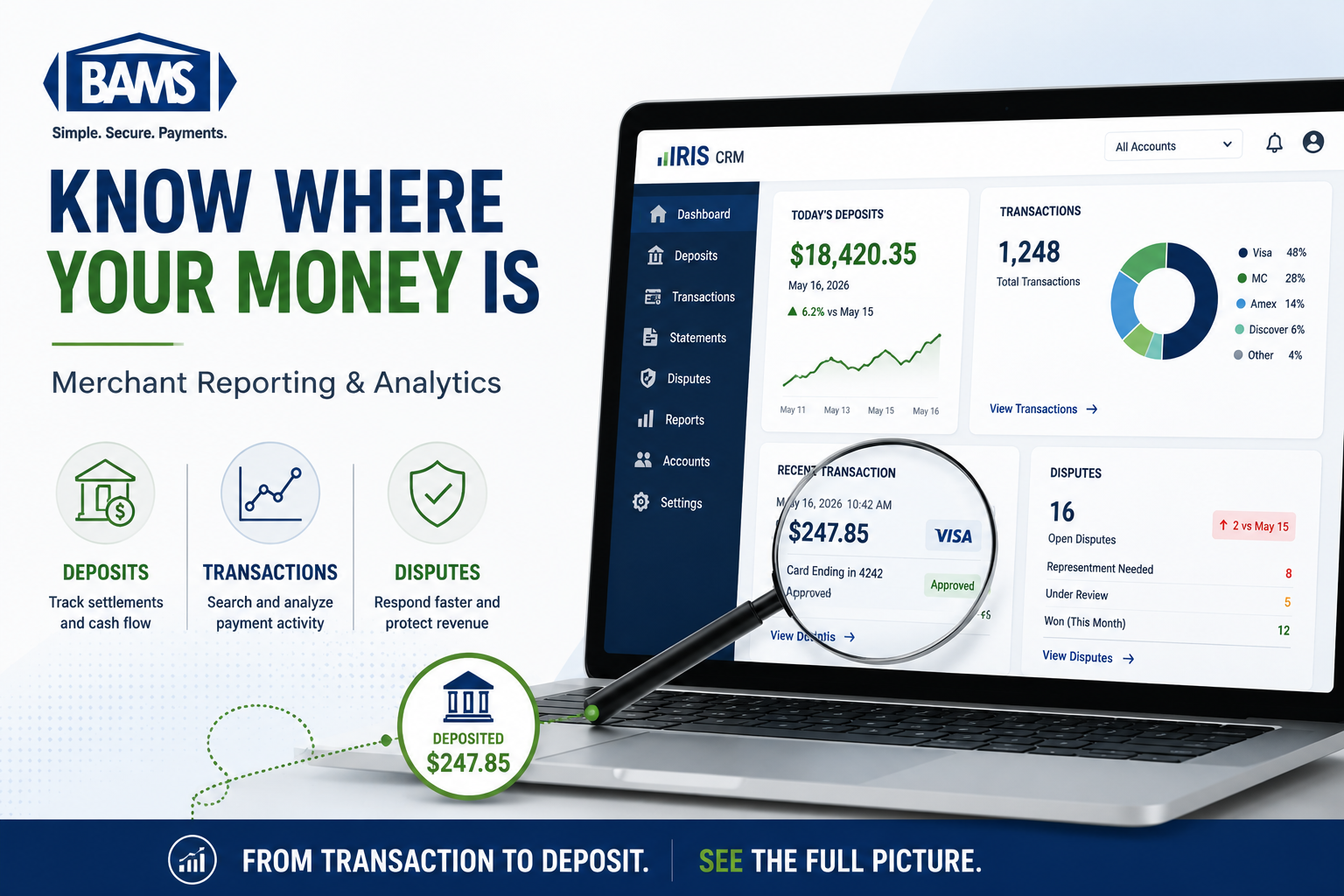
Merchant reporting tools like those offered by BAMS provide businesses with access to in-depth, CRM-quality reporting that can be sorted and searched in seconds and presents key data in a clear, concise manner, often including visualizations that make it easy to get at-a-glance updates on operations and identify key trends. The result is better-informed merchants and, in turn, better performance, a benefit to both merchants and payment processors alike.
2026 update: BAMS currently provides merchants with free access to IRIS CRM, which combines merchant account reporting, payment analytics, statements and dispute information inside one centralized dashboard. Businesses with several merchant accounts can also monitor unlimited locations or companies from the same login.
TL;DR
- Merchant reporting should help you make decisions, not just display transactions – The most useful reporting connects deposits, transactions, statements, fees and disputes so merchants can quickly understand what happened and what needs attention.
- Daily settlement visibility makes cash flow easier to manage – BAMS reporting lets merchants review daily deposits, compare them against expected batches and receive settlement summaries by email or SMS so funding issues are easier to spot early.
- Searchable transaction history makes reconciliation faster – Instead of manually reviewing batches, merchants can locate specific payments, refunds and historical transactions and trace sales through batching, settlement and the final bank deposit.
- Historical statements and dispute data help reveal patterns over time – Merchants can compare processing costs from month to month, monitor changes in fees and review dispute history to identify recurring problems before they become larger issues.
- Multi-location reporting gives management one view across the business – BAMS currently lets merchants monitor transactions, deposits, statements and disputes across unlimited businesses or locations from one IRIS CRM login.
Insights Provided by Advanced Merchant Reporting
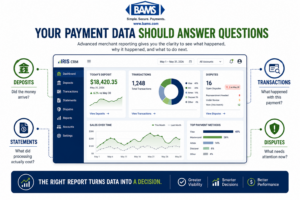
Advanced merchant reporting helps businesses turn payment data into answers about deposits, transactions, fees and disputes.
Advanced merchant reporting tools like the ones included with BAMS merchant accounts provide business owners with wide-ranging sales and payments data. And because the data is accessible through a CRM-style merchant portal, merchants can sort, filter, and search with ease, enabling them to drill down to the exact level they need and find the right information without sifting through mountains of data they aren’t looking for.
Just some of the areas a good merchant reporting tool can provide insight into include daily deposits, transaction history, monthly merchant statements, disputes, and more.
The real value comes from connecting those areas. A deposit may need to be matched against a batch. A customer question may require finding one transaction from months ago. An unexpected fee may send you back to an old statement. A dispute may require records from several different systems.
Keeping that information searchable in one place cuts down on the time spent chasing answers.
Daily Deposits
Merchants can quickly access an at-a-glance view of their daily settlements, and the BAMS merchant reporting tool even sends a summary by email or text each day. The merchant reporting dashboard provides in-depth detail, key overview data like monthly totals by card type, and a graphical visualization of the month’s numbers to make visualizing growth and short-term sales trends easy. Daily deposit reporting ensures merchants are always fully aware of their sales numbers both on a daily and monthly basis, and can easily identify short-term trends and their potential impacts on cash flow.
This is where reporting becomes a cash-flow tool rather than simply a sales dashboard.
The Federal Reserve Banks’ 2026 Small Business Credit Survey found that 50% of employer firms experienced uneven cash flow during the previous year. Paying operating expenses was a challenge for 54%.
Knowing what processed is useful. Knowing what actually settled into the bank is better.
A daily settlement view can help answer questions such as:
- Did yesterday’s expected deposit arrive?
- Does the deposit match the sales batch?
- How much revenue came through each card type?
- Is there an unusual drop or spike that needs attention?
- How much processed revenue is currently available for operating expenses?
For businesses where funding speed matters, qualifying BAMS merchants can also use next day funding. Eligible batches submitted before 9 PM ET can reach the merchant’s bank account by 7 AM the following business day.
Transactions
In-depth transaction reporting enables merchants to both review the key information on each day’s or batch’s transactions, and to quickly and easily pinpoint specific transactions should the need to review them arise, like when disputes or issues pop up. Transaction reporting tools like the one offered by BAMS provide easily searchable, easily sortable data on transaction amounts, types, payment entry methods, card types used, cardholder information, and more.
A transaction search becomes especially useful after the sale.
A customer may ask about a charge from three months ago. Accounting may need to find a refund. A manager might want to verify how a particular transaction entered the system. A chargeback could require evidence connected to the original sale.
Instead of sorting through batches manually, searchable transaction data lets the merchant narrow the result by the information it already knows.
That is also useful during reconciliation. Modern Treasury describes cash reconciliation as comparing expected money movement against the actual transactions that ultimately post. The faster a business can locate and compare those records, the easier it becomes to identify mismatches.
Reporting Should Help You Reconcile Payments, Not Just View Them
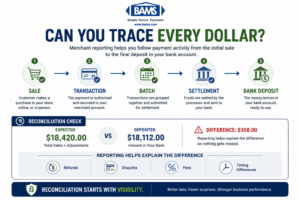
Payment reporting helps merchants trace processed sales through batching and settlement to the final bank deposit.
A dashboard can look impressive while doing very little operational work.
The more useful test is whether the reporting helps you explain where the money went.
Imagine the POS shows $18,000 in card sales for the day. The bank deposit is different. That does not automatically mean something is wrong. Refunds, chargebacks, fees, timing differences and batch cut-offs can all affect what ultimately settles.
Good merchant reporting gives accounting enough detail to work backward from the bank deposit and understand the difference.
The principle is straightforward:
Sales activity → transaction batches → settlement → bank deposit
The easier those pieces are to trace, the less time the business spends manually reconciling them.
Monthly Statements
The ability to quickly access all historical monthly statements is beneficial to merchants for a number of reasons.
- It eliminates the need to store paper copies, freeing up space and making document management easier.
- It makes finding historical information on billing effectively instantaneous, enabling merchants to keep better track of their fees to ensure they’re correct and properly managed.
- It also makes things much easier for bookkeepers and accountants come tax time.
BAMS merchant accounts provide digital access to complete historical statements going back to the day the account was opened, ensuring merchants will always have a complete picture of their billing and fees without ever having to sift through a filing cabinet or wrangle data manually.
BAMS currently makes historical monthly merchant statements available directly through IRIS CRM, including downloadable PDF copies.
Do not treat those statements as documents you only open during tax season.
They are one of the easiest ways to monitor the real cost of payment processing over time.
Compare fees month to month. Watch for changes in processor markup. Look at how your effective processing cost changes as volume or card mix changes.
BAMS’ current merchant account pricing model also emphasizes transparent pricing, making the statement an important tool for verifying what the business is actually paying.
Use Historical Reporting to Spot Changes Earlier
One month’s numbers can tell you what happened. Several months can tell you whether something is changing.
That might be sales growth, a shift toward a particular payment method or a rise in refunds. It could also be a gradual increase in disputes that would be easy to miss when looking at each case individually.
This is where visual reporting and searchable historical data become useful together.
A chart might reveal the pattern. The underlying transaction records let you investigate it.
Do not assume every pattern needs action. Seasonal businesses naturally move up and down. Card mix changes. Promotions create temporary spikes. The dashboard gives you somewhere to start asking questions rather than guessing.
Disputes and Responses
Chargebacks are a part of business every merchant has to accept, but far too many accept losses that could be avoided with an effective response. Merchant reporting tools can provide businesses with the timely information they need to file fast, effective responses to chargebacks and retrievals to stem those losses and plug profitability leaks. The BAMS merchant reporting suite provides instant notification of all new disputes via email or SMS, ensuring chargebacks never slip through the cracks. The system also offers fully searchable and exportable history of all prior disputes and the key details of each, enabling merchants to identify trends, design better dispute management best practices, and easily export to third-party software.
The speed component matters because dispute response windows are limited.
BAMS currently sends immediate SMS and email notifications when a new dispute appears. Its Chargeback Defense tools also provide online document submission, dispute-status tracking, automatic reason-code interpretation and exportable historical dispute data.
That makes the reporting useful in two different ways.
For an active case, the merchant needs to know what happened and respond quickly. Over time, historical dispute data can reveal recurring problems.
A sudden cluster of the same reason code may point toward a billing descriptor, fulfillment issue or customer-service problem. A higher dispute rate on one sales channel may justify a closer look at fraud screening there.
Visa similarly emphasizes data transparency and real-time dispute information as tools for reducing unnecessary chargebacks and making dispute resolution more efficient.
Multi-Location Reporting Changes the Management View
Reporting gets harder when a business operates several locations.
One restaurant or store may be easy to monitor independently. Ten locations create ten deposit streams, ten sets of transactions and potentially ten places to look when something does not reconcile.
BAMS currently lets merchants monitor financials, sales, statements and disputes across unlimited businesses or locations from one IRIS CRM login.
That gives management two useful views at once.
You can look at an individual location when something needs investigation. Then you can step back and look across the entire organization to compare activity.
This can help answer practical questions such as:
- Which location processed the highest card volume this month?
- Is one store generating disproportionately more disputes?
- Did deposits arrive as expected across every account?
- Is payment-method mix changing in one location but not the others?
- Are fees consistent across similar merchant accounts?
Not Every Number Deserves a Dashboard
More data does not automatically create better decisions.
The useful reporting is the reporting tied to something the business can actually act on.
| Reporting Area | Question It Should Help Answer |
|---|---|
| Daily deposits | Did the money we expected actually settle? |
| Transaction history | Can we quickly find and explain a specific payment? |
| Statements | What did payment processing actually cost us? |
| Disputes | Which cases need action and are patterns developing? |
| Multi-location reporting | Where are performance and payment issues occurring? |
| Payment-method trends | How are customers choosing to pay? |
If a report cannot help answer an operational or financial question, it may simply be noise.
What to Look for in Merchant Reporting Software
Reporting should be useful to more than the person who originally configured the merchant account.
A manager should be able to find yesterday’s deposit. Accounting should be able to retrieve old statements. Customer service should be able to locate a transaction. The person handling disputes should know which cases need attention.
When comparing payment processors, look for:
- Searchable transaction history. Finding a specific transaction should take seconds, not a manual batch review.
- Daily settlement reporting. Know what processed and what reached the bank.
- Historical statements. Accounting records should remain easy to access and download.
- Real-time dispute notifications. Time-sensitive cases should not depend on someone checking a mailbox.
- Exportable data. Businesses should be able to move relevant information into accounting or analytical workflows.
- Multi-account support. Growing businesses should not need a separate reporting process for every location.
- Useful visualizations. Charts should reveal trends without hiding the underlying transaction data.
Merchant Reporting Is Really About Better Decisions
The goal is not to spend more time looking at payment data.
It is to spend less time finding the information needed to make a decision.
That might mean catching a deposit mismatch before the end of the month. It might mean noticing that disputes are rising. It might mean giving an accountant a statement immediately instead of searching through archived email.
For a business managing tight cash flow, the timing matters too. The Federal Reserve Banks reported that 50% of employer firms faced uneven cash flow in the prior year. Better reporting cannot solve a cash-flow problem by itself, but it can make the timing of incoming payment revenue much clearer.
In addition to comprehensive merchant reporting, BAMS merchant accounts also offer guaranteed competitive pricing and a wide variety of value-added services like advanced fraud protection, next-day funding, and more.
The reporting side helps merchants understand what happened. The surrounding payment services determine what they can do next.
To find out more about how a BAMS merchant account can slash your company’s monthly merchant statement, improve your profitability, and help you maximize growth, get started with your free five-point price comparison today.
Frequently Asked Questions
What is merchant reporting?
Merchant reporting gives businesses access to information about payment activity such as transactions, deposits, fees, statements and disputes. Advanced reporting platforms can make that information searchable and provide visual analytics for identifying trends.
What reporting does BAMS provide?
BAMS currently provides merchant reporting through IRIS CRM. Merchants can review daily deposits, transaction activity, monthly statements, payment-method trends, chargebacks and activity across multiple accounts or locations.
Can BAMS send daily deposit reports automatically?
Yes. BAMS currently offers daily settlement summaries through email or SMS, allowing merchants to review deposit information without logging into the dashboard first.
Can merchants search historical transactions?
Yes. BAMS’ current reporting tools provide searchable transaction data including transaction amounts, types, payment methods and related information.
Can merchants access old statements online?
Yes. Historical statements are available through IRIS CRM and can be downloaded in PDF format for reconciliation, accounting or tax records.
Does BAMS provide chargeback notifications?
Yes. Merchants can receive real-time email and SMS notifications for new chargebacks and retrievals. BAMS also provides tools for monitoring case status and submitting dispute documentation.
Can reporting help with reconciliation?
Yes. Transaction, batch and deposit information can help a business compare expected payment activity with the money that ultimately settles into its bank account and investigate any differences.
Can BAMS report across multiple locations?
Yes. IRIS CRM currently provides multi-account access so merchants can monitor transactions, financials, statements and disputes across unlimited businesses or locations from one login.