
Reconciliation Best Practices: Why Timing Beats Tidiness
Last Updated on September 17, 2026 by Dimitri Akhrin
Deposit predictability isn’t an accounting chore — it’s the growth lever eCommerce operators actually need
Learn why traditional reconciliation best practices fail fast-moving eCommerce brands. This piece reframes deposit predictability as a forward-looking growth input, not a backward-looking cleanup task, and connects cash timing to reinvestment decisions.
TL;DR
- Your dashboard and bank balance tell different stories – The gap between reported revenue and deposited cash is caused by settlement timing, fees, holds, and chargebacks, not errors in your platform.
- Reconciliation isn’t just accounting cleanup – Treated as a forward-looking practice, it becomes the signal that tells you what you can reinvest and when.
- Deposit predictability drives growth speed – Knowing exactly when funds land lets you restock, scale ads, and negotiate with suppliers from confidence instead of caution.
- Your processor infrastructure matters more than your process – Next-day funding and transparent pricing (like BAMS offers) collapse the timing gap that no spreadsheet can fix.
The Number on Your Dashboard Is a Promise. Your Bank Balance Is the Truth.
You finished a strong weekend. Your eCommerce dashboard says $47,000 in revenue. You open your bank account Monday morning and see $31,200. The gap isn’t a rounding error. It’s the distance between what you sold and what you can actually spend, and that distance is where reconciliation best practices either save you or slowly bleed your growth dry.
This mismatch isn’t rare. It’s the default experience for most online merchants, and the anxiety it creates is quietly shaping every reinvestment decision you make.

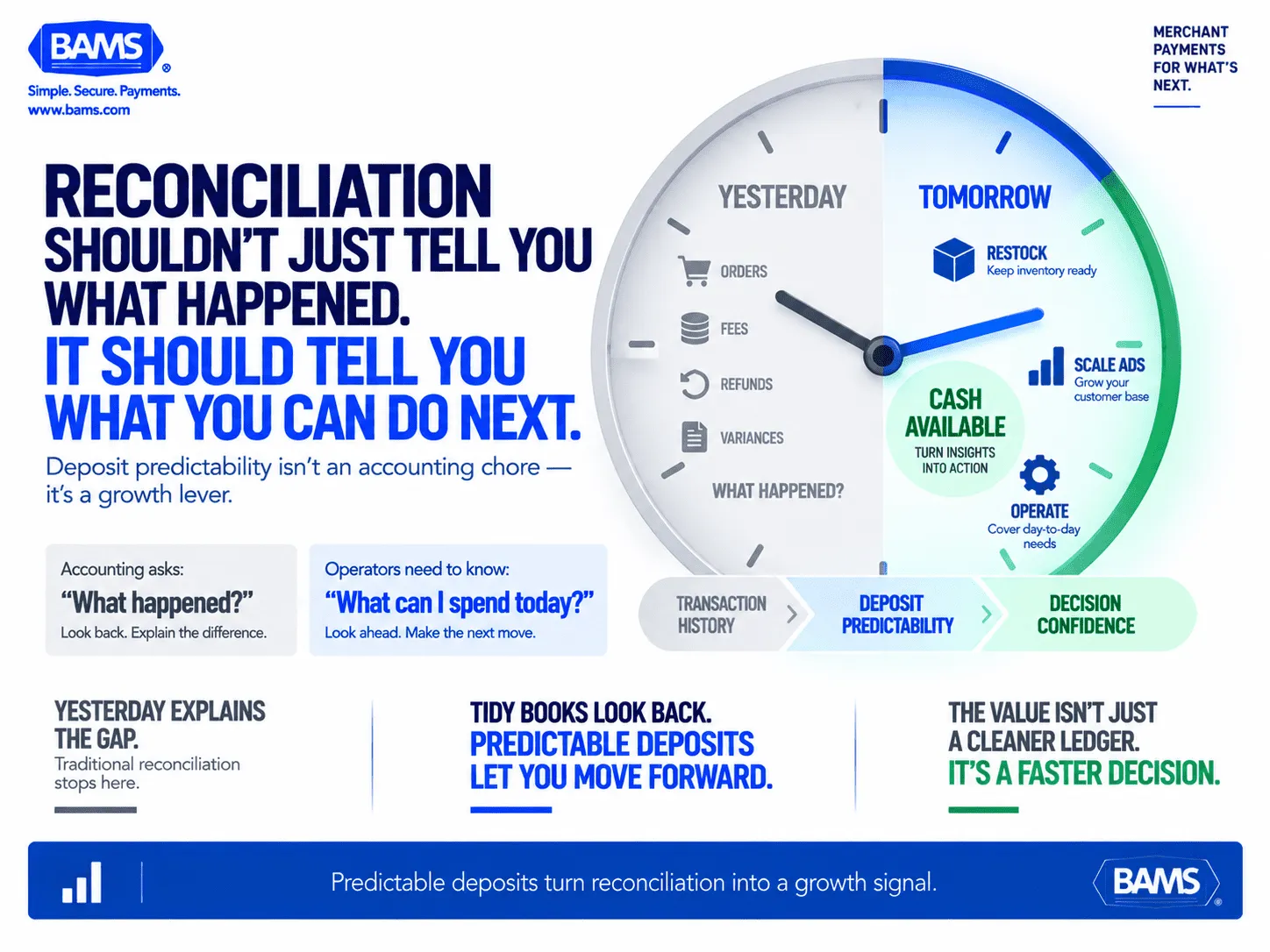
Reconciliation should do more than explain yesterday’s transactions. Predictable deposit timing gives eCommerce operators a clearer view of what they can do next.
The Back-Office Myth: Reconciliation as Cleanup Duty
Most advice about payment reconciliation treats it as an accounting chore. Match transactions. Spot errors. Close the books. The dominant playbook says: reconcile weekly or monthly, flag discrepancies, and hand them to your finance person. It’s tidy. It’s responsible. And it was designed for businesses that don’t need to make spending decisions every 48 hours.
That playbook made sense when eCommerce moved slower. When ad budgets were set quarterly. When inventory lead times were measured in months, not days. But if you’re running a business where Tuesday’s ad spend depends on Monday’s deposit, treating reconciliation as a backward-looking task means you’re always flying with yesterday’s instruments.
The real cost isn’t a messy ledger. It’s the week you didn’t restock a winning SKU because you weren’t sure the cash would land in time.
Deposit Predictability Is the Growth Lever Nobody Talks About
Here’s what we actually believe: the single most underrated input to eCommerce growth isn’t your ad creative, your conversion rate, or your product margin. It’s knowing exactly when your money hits your bank account.
Deposit predictability isn’t a finance team problem. It’s the lever that decides whether you can reinvest in growth this week or wait until next.
Why Automated Reconciliation Changes the Decision, Not Just the Data.
Consider what happens inside a typical 30-person eCommerce operation after a promotional weekend. Orders spike Friday through Sunday. The dashboard updates in near-real time. But the actual deposit? That depends on your processor’s settlement window, the day of the week, your bank’s posting schedule and whether any holds or chargebacks are in the queue. Nacha notes that ACH payments do not currently settle on weekends or federal holidays, which can extend the gap between when sales occur and when funds become available.
By Monday, you’re looking at a number you can’t trust. And because you can’t trust it, you delay. You hold off on the inventory reorder. You pause the campaign that was working. You wait for “the money to clear” before making the call. That delay has a compound cost that never shows up on a P&L.
Now contrast that with a setup where settlement timing is consistent and transparent. Where you know, before you close your laptop Sunday night, that funds will post by Tuesday morning. Suddenly reconciliation isn’t about catching errors after the fact. It becomes a forward-looking signal: here’s what you can deploy, and here’s when.
Modern Treasury documents how reconciliation rules can automate the matching of transactions and expected payments, reducing the amount of manual matching required during reconciliation. That matters because when your numbers are reliable, your decisions get faster. A recent case study on AI-driven reconciliation showed that automated methods achieved about 95.4% reconciliation accuracy compared to 85.6% for manual processes, while cutting performance-obligation matching errors by 79.5%.
Those aren’t abstract improvements.
For a mid-size eCommerce brand, a 10-point accuracy jump in bank deposit matching means fewer hours chasing phantom discrepancies and more hours acting on real numbers. It means your daily reconciliation process stops being a bottleneck and starts being a briefing.
This is where your merchant services setup matters more than most operators realize. If your processor batches settlements unpredictably, adds opaque fees, or holds funds without clear communication, no amount of spreadsheet discipline will give you timing confidence. The problem isn’t your process. It’s your infrastructure. Merchants using BAMS get next-day funding and transparent fee structures, which collapses the gap between dashboard revenue and bankable cash. That’s not a minor operational perk. It’s the difference between reacting to your cash position and planning from it.
For a deeper walkthrough on closing that daily gap, our deposit reconciliation guide for eCommerce breaks down exactly how to map settlement windows, categorize timing variances versus real exceptions, and maintain a rolling cash position you can actually trust.
A strong reconciliation process does more than explain differences between sales and deposits. It creates a reliable view of when cash becomes available for the next business decision.
What You Lose When You Can’t Trust the Timing
If deposit predictability really is a growth input, then the cost of ignoring it is measurable. Every day you wait for settlement clarity is a day your competitors (who have that clarity) are already reinvesting. They’re buying inventory at better rates because they ordered sooner. They’re scaling ad spend into momentum instead of letting it cool.
The implications go beyond cash flow management. Unpredictable settlement timing forces conservative behavior across the entire business. You carry higher cash reserves than necessary. You negotiate shorter payment terms with suppliers because you can’t guarantee when you’ll have liquidity. You build in buffers that erode margin.
And the hidden cost? Your team spends hours on exception management, chasing fee reconciliation discrepancies and payment processing errors, instead of analyzing what’s actually driving revenue. Meanwhile, gateway defaults you’ve never audited may be quietly compounding the problem by raising decline rates and chargeback exposure.
The question isn’t whether you can afford to fix this. It’s whether you can afford the decisions you’re making without fixing it.
Stop Reconciling Backward. Start Funding Forward.
The reframe is simple: reconciliation best practices aren’t about catching what went wrong yesterday. They’re about building confidence in what you can do tomorrow. Think of your settlement process not as a financial audit trail, but as a funding pipeline. Every transaction that clears predictably is fuel. Every opaque delay is friction.
The merchants who grow fastest aren’t the ones with the best accountants. They’re the ones whose payment infrastructure gives them a reliable answer to one question: “How much can I spend today?” When your processor, your bank, and your dashboard all tell the same story at the same speed, reconciliation stops being a task. It becomes a competitive advantage.
Your Dashboard Should Be a Decision Tool, Not a Guessing Game
The gap between your dashboard and your bank balance isn’t a mystery. It’s a design choice, made by processors who benefit from your uncertainty. Choose infrastructure that eliminates the gap instead of tools that help you tolerate it.
The businesses that win the next quarter aren’t waiting for their deposits to clear. They already know.
Frequently Asked Questions
What is deposit reconciliation in merchant services?
Deposit reconciliation is the process of matching the transactions shown on your eCommerce dashboard to the actual funds deposited in your bank account. It accounts for processor fees, chargebacks, refund processing, holds, and settlement timing to explain why your gross sales figure differs from your bank balance.
Why is timing important in merchant deposit reconciliation?
Settlement timing determines when revenue becomes usable cash. If you can’t predict when deposits land, you can’t confidently reinvest in inventory, advertising, or operations, which forces conservative decisions that slow growth.
Which factors can affect the timing of merchant service deposits?
Key factors include your processor’s batch schedule, weekends and bank holidays, chargeback holds, payment processor fees deducted before settlement, and your bank’s posting policies. Each one can introduce timing variance between what you see on your dashboard and what arrives in your account.


