7 Recurring Billing Solutions That Protect Your Revenue
Last Updated on May 12, 2026 by Dimitri Akhrin
How modern payment processing combines faster funding with chargeback defense to stop cash flow leaks
Discover recurring billing solutions that address delayed deposits and chargeback threats together. Learn which platforms offer faster funding, intelligent payment recovery, and proactive dispute prevention for established eCommerce businesses.
TL;DR
- Guaranteed next-day funding with chargeback defense addresses both sides of cash flow addresses both sides of cash flow: getting money faster and keeping it from being clawed back through disputes.
- AI-powered fraud prevention at the billing layer catches suspicious transactions before they process, preventing chargebacks rather than just responding to them.
- Intelligent dunning and payment recovery can reclaim significant revenue from involuntary churn caused by expired cards and temporary declines.
- Multi-gateway routing optimizes approval rates by directing transactions to the best-performing gateway for each card type and geography.
- Start with one or two changes that address your most expensive problems, measure impact over 90 days, then expand scope based on results.
Why Delayed Deposits Are Draining Your eCommerce Business
You made the sale three days ago. The customer got their confirmation email. The product shipped. But the money? Still sitting in limbo, somewhere between your payment processor and your bank account.
For eCommerce managers running established online businesses, delayed deposits create a cascade of operational headaches. You’re juggling payroll timing, negotiating with suppliers who want payment now, and watching inventory opportunities slip away because your cash is locked up in processing queues. The NACHA ACH Network plays a key role in enabling efficient electronic payments, supporting recurring billing models with lower transaction costs.
The problem intensifies when chargebacks enter the picture. Each dispute doesn’t just threaten the original transaction; it can trigger reserve holds that delay even more of your revenue. Traditional payment processing treats these as separate issues. Modern payment processing solutions recognize they’re deeply connected.
This guide examines recurring billing solutions that address both sides of the equation: getting your money faster and keeping it once it arrives.
What This Guide Covers (And What It Doesn’t)
This is for eCommerce managers at businesses with 10 to 50 employees who process enough volume that deposit timing materially affects operations. If you’re processing a handful of transactions weekly, standard processing timelines probably aren’t your bottleneck.
We’re focusing specifically on recurring billing solutions that protect revenue through faster funding, intelligent payment recovery, and proactive chargeback defense. We’re not covering one-time payment gateways, point-of-sale hardware, or cryptocurrency processing.
The goal: help you identify which solution architecture fits your transaction patterns, risk profile, and growth trajectory.
How We Evaluated These Solutions
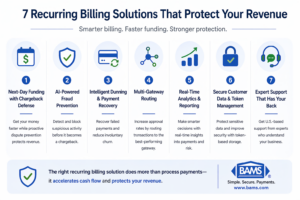
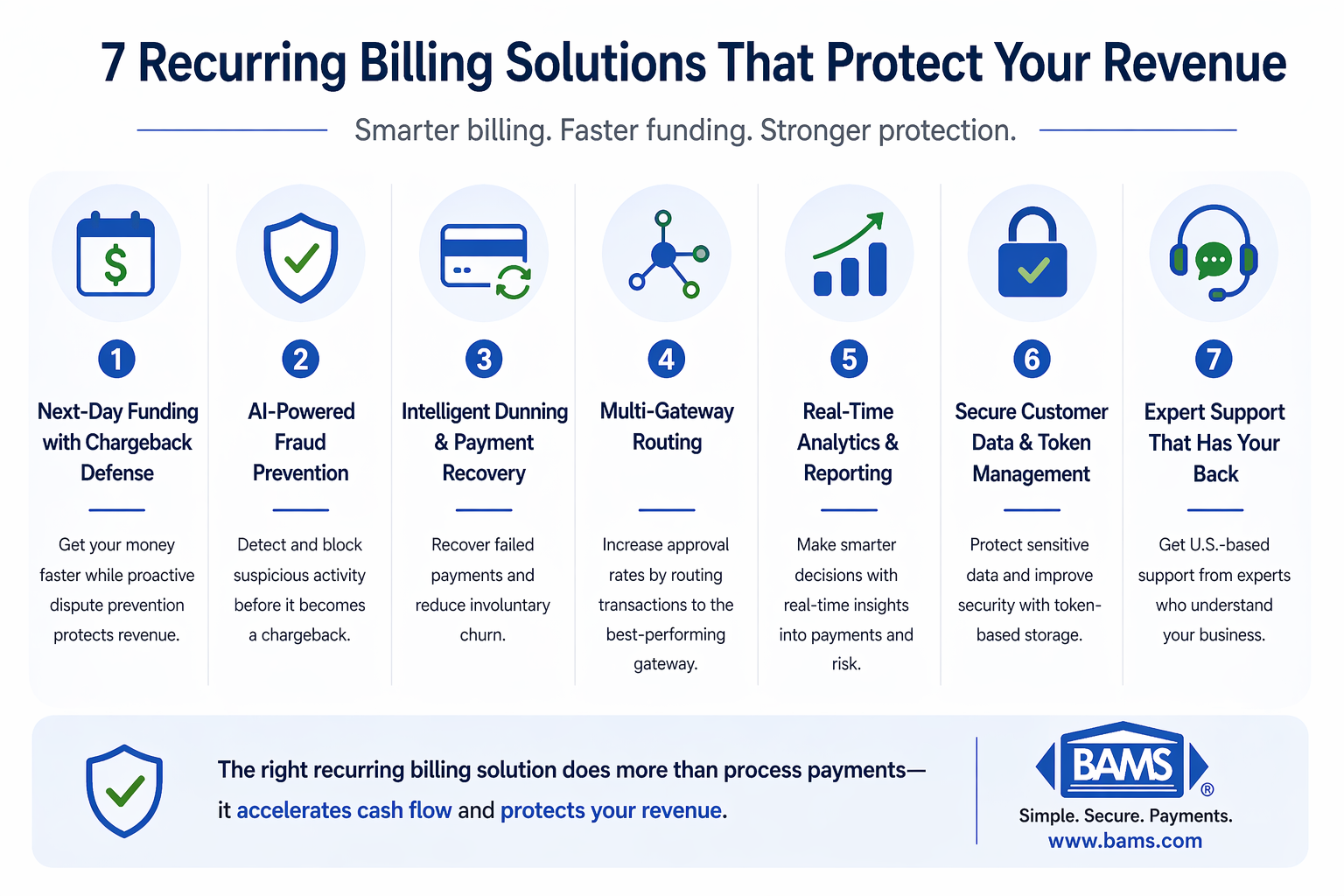
Modern recurring billing solutions protect revenue by combining faster funding, fraud prevention, intelligent recovery, and proactive chargeback defense.
Each solution was assessed on three criteria: funding speed (how quickly you access your money), revenue protection (how effectively it prevents and recovers failed payments), and operational fit (how well it integrates with existing eCommerce workflows).
We prioritized solutions that treat cash flow as a system rather than isolated features.
1. Next-Day Funding With Integrated Chargeback Defense
Why It Matters
Standard payment processors batch transactions and release funds on 2 to 3 day cycles. For subscription businesses with predictable revenue, this creates an artificial gap between when you earn money and when you can use it. Worse, chargeback reserves can extend holds indefinitely.
A chargeback defense program integrated with accelerated funding addresses both problems simultaneously. You get cash faster, and proactive dispute prevention keeps that cash from getting clawed back.
What It Looks Like Today
Modern processors now offer next-business-day funding as a standard feature rather than a premium add-on. The shift came as processors recognized that holding merchant funds creates friction that drives businesses to competitors.
According to Visa, optimized payment systems are designed to improve transaction approval rates while maintaining secure and efficient processing.
Integration with chargeback defense means disputes get flagged before they escalate, reducing the reserve requirements that slow down funding for high-risk merchants.
How to Apply It
Audit your current processor’s funding timeline and reserve policies. Calculate the working capital cost of delayed deposits (what could you do with that money if you had it 48 hours sooner?). Prioritize processors that bundle funding speed with dispute management rather than treating them as separate line items.
2. AI-Powered Fraud Prevention at the Billing Layer
Why It Matters
Card-not-present fraud hits recurring billing especially hard. Fraudulent signups for subscription services often go undetected until chargebacks arrive weeks later. By then, you’ve delivered services, incurred costs, and now face both the chargeback fee and the lost revenue.
Fraud prevention at the billing layer catches suspicious patterns before the first charge processes, not after the damage is done.
What It Looks Like Today
Platforms like Zuora have built integrated fraud management that fights CNP fraud, account takeover, and fraudulent account creation using AI-powered tools. These systems analyze behavioral signals (device fingerprints, velocity patterns, geographic anomalies) to flag high-risk transactions before they complete.
The key differentiator from standalone fraud tools: billing-layer integration means the system learns from your specific customer patterns, not generic industry data.
How to Apply It
Review your chargeback reason codes from the past 12 months. If fraud-related disputes represent more than 15% of total chargebacks, prioritize solutions with native fraud scoring. Request trial periods to test detection accuracy against your actual transaction patterns.
3. Intelligent Dunning and Failed Payment Recovery
Why It Matters
Involuntary churn (customers who wanted to pay but couldn’t because their card expired, got declined, or hit a limit) accounts for a significant portion of subscription revenue loss. Most businesses treat failed payments as a customer service problem. It’s actually a billing infrastructure problem.
What It Looks Like Today
Recurly has built its reputation on best-in-class dunning and failed payment recovery. Their approach uses intelligent gateway routing across multiple processors, automatically retrying failed transactions through alternative paths.
The system learns optimal retry timing (some cards recover better on specific days of the month) and communication sequences (when to email, when to SMS, when to pause).
How to Apply It
Pull your failed payment data and calculate your current recovery rate. If you’re recovering less than 60% of initially failed transactions, your dunning process has room for improvement. Look for solutions that offer A/B testing on retry logic so you can optimize for your specific customer base.
As explained by Modern Treasury, better payment infrastructure and visibility allow businesses to optimize cash flow and reduce operational friction.
4. Usage-Based Billing With Real-Time Revenue Recognition
Why It Matters
Traditional recurring billing assumes fixed monthly charges. But many eCommerce businesses now operate on hybrid models: base subscriptions plus usage fees, overage charges, or consumption-based pricing. When your billing system can’t handle variable charges accurately, you either leave money on the table or create disputes that become chargebacks.
What It Looks Like Today
Orb is the only recurring billing platform purpose-built for usage billing at scale. While competitors like Chargebee and Recurly support basic usage add-ons, they lack true usage-based billing and revenue modeling capabilities.
Orb offers GAAP-compliant revenue recognition with real-time metering, dynamic pricing, and high-volume event processing. For businesses with complex pricing models, this precision prevents the billing disputes that often escalate to chargebacks.
How to Apply It
Map your current pricing model complexity. If you have more than three pricing variables (base fee plus usage plus overage plus discounts), evaluate whether your current system handles edge cases accurately. Billing errors are a leading cause of friendly fraud chargebacks.
5. Multi-Gateway Routing for Payment Resilience
Why It Matters
Single-gateway dependency creates two risks: downtime that blocks all transactions, and suboptimal approval rates because different gateways perform better for different card types and geographies. Both problems delay your deposits, either by preventing sales or by increasing declines that require manual recovery.
What It Looks Like Today
Modern recurring billing solutions route transactions dynamically across multiple payment gateways based on real-time performance data. If Gateway A has higher approval rates for international cards while Gateway B performs better for domestic debit, the system routes accordingly.
This isn’t just about redundancy; it’s about optimizing every transaction for the highest probability of success.
How to Apply It
Request approval rate data segmented by card type, geography, and transaction size from your current processor. If you see significant variance (more than 5% difference between segments), multi-gateway routing could recover meaningful revenue.
6. Transparent Fee Structures With Interchange-Plus Pricing
Why It Matters
Flat-rate pricing (the model popularized by Stripe and Square) simplifies billing but obscures true costs. For established eCommerce businesses processing significant volume, the convenience premium often exceeds 30% compared to interchange-plus pricing. Those extra fees compound the cash flow impact of delayed deposits.
What It Looks Like Today
Interchange-plus pricing separates the card network’s base cost (interchange) from the processor’s markup. This transparency lets you see exactly what you’re paying and negotiate effectively as your volume grows.
Combined with next-day funding, transparent pricing means you keep more of your money and get it faster.
How to Apply It
Request a statement analysis from potential processors. Compare your effective rate (total fees divided by total volume) against industry benchmarks for your business category. If you’re paying more than 2.5% effective rate on card-present transactions or 3.2% on card-not-present, there’s likely room for improvement.
7. Dedicated Account Management for Dispute Resolution
Why It Matters
Automated chargeback responses work for straightforward disputes. But complex cases (friendly fraud, service disputes, authorization issues) require human judgment and documentation expertise. When disputes escalate, having a dedicated contact who knows your business can mean the difference between winning and losing.
What It Looks Like Today
The gap between self-service processors and full-service merchant accounts has narrowed, but meaningful differences remain. Some processors assign dedicated account managers only to high-volume merchants. Others provide human support as a standard feature regardless of processing volume.
How to Apply It
Before signing with any processor, test their support responsiveness. Submit a complex question via their support channels and measure response time and quality. Ask specifically about chargeback support: who handles disputes, what’s their win rate, and how do they communicate throughout the process?
The Pattern: Cash Flow Is a System, Not a Feature
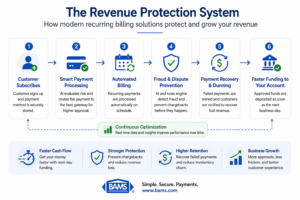
A complete recurring billing system connects payment processing, fraud prevention, recovery, and funding to protect and grow your revenue.
These seven solutions share a common thread: they treat payment processing as an integrated system rather than isolated features. Funding speed connects to chargeback defense. Fraud prevention connects to billing accuracy. Gateway routing connects to approval rates.
The businesses that overcome delayed deposits most effectively don’t just switch processors for faster funding. They audit their entire payment stack for friction points that slow down cash or put revenue at risk.
The tradeoff to acknowledge: more sophisticated solutions require more implementation effort. A platform with AI-powered fraud detection, intelligent dunning, and multi-gateway routing will take longer to configure than a simple flat-rate processor. The question is whether the cash flow improvement justifies the setup investment.
Where to Start: A Realistic Implementation Path
You don’t need to overhaul your entire payment infrastructure at once. Start with the highest-impact change for your specific situation. According to Visa, optimized payment systems are designed to improve transaction approval rates while maintaining secure and efficient processing.
If delayed deposits are your primary pain point, prioritize processors offering next-day funding with transparent pricing. If chargebacks are eating into revenue, focus on solutions with integrated dispute management. If failed payments drive involuntary churn, intelligent dunning should be your first upgrade.
Pick one or two improvements that address your most expensive problems. Measure the impact over 90 days before expanding scope. Payment infrastructure changes carry switching costs, so make each move count.
Frequently Asked Questions
What is a payment gateway and why is it important for eCommerce?
A payment gateway is the technology that securely transmits transaction data between your online store, the customer’s bank, and your merchant account. It encrypts sensitive card information, verifies funds, and authorizes purchases in seconds. For eCommerce businesses, a reliable gateway directly affects checkout completion rates, security compliance, and how quickly you receive deposits.
How do I choose the best payment gateway for my business?
Evaluate gateways based on four factors: funding speed (how quickly you access money), fee transparency (interchange-plus vs. flat-rate), integration compatibility (does it work with your eCommerce platform?), and support quality (who helps when problems arise?). Request a statement analysis to compare your current effective rate against alternatives before switching.
When should I consider switching my payment gateway?
Consider switching when you experience consistent funding delays beyond 48 hours, your effective processing rate exceeds industry benchmarks (above 2.5% for card-present, 3.2% for card-not-present), chargeback disputes lack adequate support, or your business has outgrown flat-rate pricing structures that made sense at lower volumes.
Which payment gateways support international transactions?
Most major gateways support international transactions, but performance varies significantly by region. Look for gateways offering multi-currency processing, local acquiring relationships in your key markets, and dynamic currency conversion. Multi-gateway routing can optimize approval rates by directing international transactions to gateways with stronger regional performance.
How does chargeback defense protect my revenue?
Chargeback defense programs work on two fronts: prevention and response. Prevention includes fraud scoring, clear billing descriptors, and customer communication that reduces disputes before they’re filed. Response involves professional representment with proper documentation to win disputes that do occur. Effective programs also reduce reserve requirements that delay your funding.
What’s the difference between interchange-plus and flat-rate pricing?
Flat-rate pricing charges a fixed percentage (like 2.9% plus $0.30) regardless of card type. Interchange-plus separates the card network’s base cost from the processor’s markup, showing exactly what you pay. For businesses processing over $10,000 monthly, interchange-plus typically saves 20 to 40% compared to flat-rate models.
Sources