Payment Gateway Comparison: Speed vs Security for eCommerce
Last Updated on May 12, 2026 by Dimitri Akhrin
How to choose a PCI-compliant gateway that protects transactions without trapping your cash flow
Compare PCI-compliant payment gateways with rapid funding against standard options. Learn which approach delivers both security and speed for predictable eCommerce cash flow.
TL;DR
- Guaranteed next-day funding beats standard 2-5 day settlement for established eCommerce businesses where cash flow directly impacts operations, inventory, and growth opportunities.
- PCI compliance is non-negotiable given that 20% of cyberattacks targeted payment gateways in 2023. Choose gateways where security is built-in, not an upsell.
- Transparent pricing reveals true costs while tiered or hidden fees obscure them. Request complete fee schedules and calculate actual expected costs before committing.
- Proactive chargeback defense protects revenue and processor relationships better than reactive dispute handling. Look for gateways with built-in defense programs.
- Switching gateways costs less than staying with the wrong one if your current provider delays deposits, overcharges, or provides inadequate support during critical moments.
Payment Gateway Comparison: When Speed and Security Collide
Your eCommerce business processes hundreds of transactions daily, but your cash sits in limbo for 3-5 business days. Meanwhile, payroll looms, inventory needs restocking, and growth opportunities slip away. This is the reality for many online retailers stuck with the wrong eCommerce payment gateway.
The decision you face isn’t just about transaction fees or checkout aesthetics.
It’s about whether your payment processing solutions prioritize both security and speed. According to Visa, optimized payment systems are designed to deliver both secure and efficient transaction experiences, making it possible to balance protection with performance.
For eCommerce managers at established businesses, this payment gateway comparison could mean the difference between predictable cash flow and constant financial firefighting.
We’re comparing two approaches: PCI-compliant payment gateways with rapid funding versus standard gateways that may check the security box but leave your money trapped in processing purgatory.
Quick Verdict: Which Payment Gateway Approach Wins?
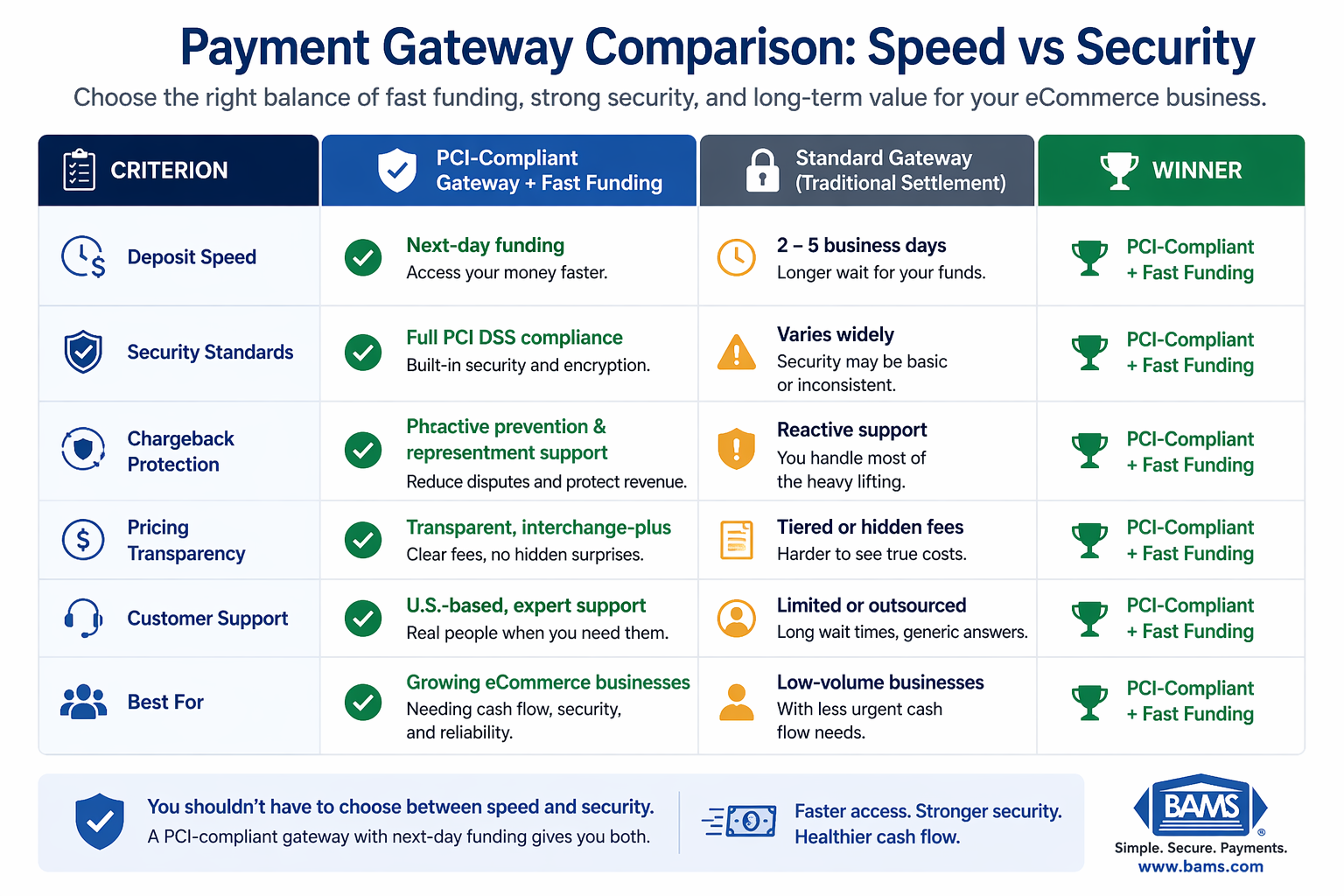
Choosing a payment gateway is no longer about speed or security alone. The best solutions deliver both with fast funding, strong compliance, and transparent pricing.
Choose a PCI-compliant gateway with next-day funding if your business needs predictable cash flow, processes consistent transaction volumes, and values proactive support over self-service troubleshooting. This approach suits retailers, restaurants, and eCommerce brands where delayed deposits directly impact operations.
Choose a standard gateway with traditional settlement if your transaction volume is low, cash flow timing isn’t critical, or you’re comfortable managing security compliance independently. This works for businesses with substantial cash reserves that can absorb multi-day deposit delays.
|
Criterion |
PCI-Compliant + Fast Funding |
Standard Gateway |
Winner |
|---|---|---|---|
|
Deposit Speed |
Next-day funding |
2-5 business days |
PCI-Compliant + Fast |
|
Security Standards |
Full PCI DSS compliance |
Varies widely |
PCI-Compliant + Fast |
|
Chargeback Protection |
Proactive defense included |
Often reactive or extra cost |
PCI-Compliant + Fast |
|
Support Model |
Dedicated account management |
Ticket-based or chatbot |
PCI-Compliant + Fast |
|
Setup Complexity |
Moderate (requires integration) |
Often plug-and-play |
Standard Gateway |
|
Pricing Transparency |
Clear fee structures |
Often tiered or hidden fees |
PCI-Compliant + Fast |
Evaluation Criteria: What Actually Matters for Your Business
Before diving into specifics, let’s establish what dimensions deserve your attention. Not all comparison points carry equal weight for eCommerce managers dealing with delayed deposits and high transaction fees.
Deposit timing ranks highest because cash flow directly affects your ability to operate. Every day your money sits in processing is a day you can’t reinvest in inventory, marketing, or staffing.
Security compliance comes second.
Security compliance remains critical. The PCI Security Standards Council emphasizes that strong data protection standards are essential for safeguarding cardholder information and maintaining trust. It’s the baseline for protecting your customers and your business reputation.
Fee structure transparency matters because hidden costs erode margins. You need to know exactly what you’re paying per transaction, monthly, and for chargebacks.
Chargeback management deserves attention since disputes directly impact your bottom line and processor relationships. Proactive defense beats reactive scrambling.
Integration capabilities determine whether your gateway works with your existing tech stack, including your shopping cart, accounting software, and inventory management.
Support quality becomes critical when something breaks at 2 AM on Black Friday. The difference between a dedicated account manager and a chatbot can mean thousands in lost sales.
Head-to-Head: Deposit Speed and Cash Flow Impact
PCI-Compliant Gateways with Next-Day Funding
The primary advantage here is straightforward: you get your money faster. Next-day funding means transactions processed today hit your bank account tomorrow. For an eCommerce business processing $50,000 weekly, this translates to having $50,000 available to reinvest rather than watching it sit in processing limbo.
This speed comes from streamlined verification processes and direct banking relationships. Providers offering next-day funding have invested in infrastructure that prioritizes merchant cash flow. The limitation? These services sometimes require minimum processing volumes or longer contract terms.
Standard Gateways with Traditional Settlement
Traditional settlement timelines of 2-5 business days remain the industry default.
The appeal is familiarity and easy setup. These platforms work out of the box with minimal configuration. However, the cash flow impact compounds over time. If you’re waiting an average of 3 days for deposits, you’re effectively giving your payment processor a perpetual interest-free loan of 3 days’ worth of revenue.
Verdict on Deposit Speed
For established eCommerce businesses with consistent transaction volume, next-day funding delivers measurable operational benefits. The math is simple: faster access to funds means more flexibility to seize opportunities, manage expenses, and grow. Standard settlement only makes sense if cash flow timing genuinely doesn’t affect your operations.
Head-to-Head: Security and PCI Compliance
PCI-Compliant Gateways
A secure payment gateway with full PCI DSS compliance handles the heavy lifting of data protection. This includes encryption of cardholder data, secure transmission protocols, and regular security audits. For merchants, this reduces liability and simplifies compliance requirements.
Choosing a gateway that treats compliance as foundational rather than optional protects your business from both fraud and regulatory penalties.
Standard Gateways
Security standards vary dramatically among standard gateway providers. Some maintain excellent compliance records. Others treat security as an afterthought, leaving merchants to fill gaps independently. The challenge is that security failures rarely announce themselves until a breach occurs.
Verdict on Security
PCI-compliant gateways win decisively for businesses without dedicated security teams. The cost of a data breach far exceeds any savings from choosing a less secure option. Look for providers that include compliance as standard, not as an upsell.
Head-to-Head: Fee Transparency and Total Cost
PCI-Compliant Gateways with Transparent Pricing
The best payment gateways publish clear transaction fee structures: a percentage plus a fixed amount per transaction, with monthly fees and chargeback costs spelled out upfront. This transparency lets you forecast processing costs accurately and budget accordingly.
Transparent pricing also reveals the true cost of services like chargeback defense, multi-currency processing, and recurring billing solutions. When fees are visible, you can make informed decisions about which features justify their cost.
Standard Gateways with Tiered or Hidden Fees
Many popular gateways use tiered pricing that obscures actual costs. You might see a low advertised rate, only to discover that most transactions qualify for higher tiers based on card type, transaction method, or volume thresholds. Additional fees for international transactions, chargebacks, and monthly minimums add up.
The lack of transparency makes it difficult to compare options accurately. A gateway advertising 2.9% + $0.30 might cost more than one charging 3.2% + $0.25 once all fees are factored in.
Verdict on Pricing
According to the Federal Reserve, interchange structures play a major role in total payment processing costs, making transparency essential when comparing gateway providers.
Transparent pricing wins for planning and budgeting purposes. Request complete fee schedules from any provider before committing, and calculate your actual expected costs based on your transaction mix. Don’t trust advertised rates alone.
Head-to-Head: Chargeback Management
Proactive Chargeback Defense
Some PCI-compliant gateways include chargeback defense programs that identify and address disputes before they escalate. This proactive approach involves monitoring for fraud patterns, providing documentation support, and representing merchants in dispute processes.
For eCommerce businesses, chargebacks represent both direct financial losses and threats to processor relationships. Too many chargebacks can result in higher fees, reserves, or account termination. Proactive defense protects both your money and your processing privileges.
Reactive or Optional Chargeback Handling
Standard gateways typically notify you of chargebacks and provide basic tools to respond, but the burden of defense falls on you. Some offer chargeback protection as an add-on service at additional cost, while others leave merchants to handle disputes independently.
This reactive approach works if you have staff dedicated to dispute management and low chargeback rates. For most eCommerce businesses, it means scrambling to respond within tight deadlines while hoping for favorable outcomes.
Verdict on Chargeback Management
Proactive defense delivers better outcomes for businesses processing significant transaction volumes. The time and money saved on dispute management, plus the protection of your processor relationship, justifies prioritizing gateways with built-in chargeback programs.
Use Case Mapping: Which Gateway Fits Your Situation?
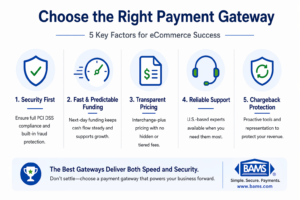
The best payment gateways combine security, fast funding, transparent pricing, reliable support, and proactive chargeback protection to drive long-term growth.
If you process $30,000+ monthly with seasonal peaks, choose a PCI-compliant gateway with next-day funding. Cash flow predictability becomes critical when you need to stock inventory before holiday rushes or manage payroll during slower months.
If you’re scaling from startup to established business, choose a gateway that offers transparent pricing and dedicated support. As transaction volumes grow, hidden fees compound and self-service support becomes inadequate. Make the switch before growth exposes these limitations.
If you sell internationally, choose a gateway with multi-currency payment processing built in. The fees and conversion rates for international transactions vary dramatically between providers. Look for transparent foreign transaction pricing.
If you run a subscription business, choose a gateway with robust recurring billing solutions. Failed payments and subscription management require specialized tools that not all gateways provide effectively.
If you’re a small business testing eCommerce, a standard gateway with easy setup may suffice initially. Just plan your migration path before transaction volumes make switching painful.
What Both Approaches Get Wrong
Neither PCI-compliant gateways nor standard options have solved instant settlement at scale for most merchants. While India’s UPI system demonstrates that real-time processing is technically feasible, processing over 18.6 billion transactions monthly, most Western payment infrastructure still relies on batch processing and banking hours.
Both approaches also struggle with the complexity of payment processors and payment gateways working together seamlessly. Integration challenges persist regardless of which gateway you choose, particularly when connecting to legacy accounting or inventory systems.
Finally, neither approach eliminates chargebacks entirely. Even the best defense programs can only mitigate, not prevent, fraudulent disputes and friendly fraud.
Migration and Switching Considerations
Switching payment gateways isn’t trivial, but it’s also not as painful as many merchants fear. The key costs include integration work (typically 10-40 developer hours depending on your platform), testing time, and potential brief disruptions during cutover.
Data portability varies by provider. Tokenized card data often can’t transfer between gateways, meaning subscription customers may need to re-enter payment information. Plan for some customer friction during transitions.
Contract terms matter. Some gateways lock merchants into multi-year agreements with early termination fees. Others operate month-to-month. Review your current agreement before assuming you can switch freely.
When switching makes sense: If your current gateway costs you more than 0.5% in unnecessary fees, delays deposits by 3+ days regularly, or provides inadequate support during critical issues, the switching costs likely pay for themselves within months.
For Shopify or WooCommerce stores, integration with a new gateway typically takes days, not weeks. These platforms have streamlined the connection process with most major providers.
Final Recommendation: Make the Choice That Fits Your Cash Flow
For eCommerce managers at established businesses dealing with delayed deposits and high transaction fees, the best payment gateways combine PCI compliance, next-day funding, transparent pricing, and proactive chargeback defense. This combination addresses the core pain points that erode profitability and create operational stress.
Standard gateways with traditional settlement serve a purpose for businesses where cash flow timing doesn’t matter. But if you’re reading this because delayed deposits frustrate you, that’s not your situation. The right gateway doesn’t just process payments. It turns your payment processing into a competitive advantage.
Your next step: Calculate your current effective processing rate including all fees, measure your average deposit delay, and document your last three support interactions. These numbers tell you whether your current gateway serves your business or just processes your transactions.
Frequently Asked Questions
What is a payment gateway and why is it important for eCommerce?
A payment gateway is the technology that securely transmits payment information between your online store, the payment processor, and the banks involved in a transaction. It encrypts sensitive card data, verifies the transaction, and returns approval or decline messages. For eCommerce, it’s essential because it enables you to accept credit cards, debit cards, and digital wallet payments online while protecting both your business and your customers from fraud.
How do I choose the best payment gateway for my business?
Start by evaluating deposit speed, security compliance, fee transparency, and support quality. Calculate your expected monthly transaction volume and average order value, then request complete fee schedules from potential providers. Prioritize gateways that offer next-day funding if cash flow matters to your operations. Check integration compatibility with your eCommerce platform, and verify PCI DSS compliance is included rather than optional.
When should I consider switching my payment gateway?
Switch when your current gateway consistently delays deposits beyond 2 business days, charges fees that exceed industry standards by 0.5% or more, provides inadequate support during critical issues, or lacks security features you need. Also consider switching if your business has outgrown your current provider’s capabilities, such as needing multi-currency processing or advanced chargeback defense that your gateway doesn’t offer.
Which payment gateways support international transactions?
Most major payment gateways support international transactions, but the fees and currency conversion rates vary significantly. Look for gateways that offer multi-currency payment processing with transparent foreign transaction fees. Some gateways charge 1-3% additional fees for international cards, while others include this in their standard rates. Request specific pricing for the countries where your customers are located.
How does PCI compliance protect my eCommerce business?
PCI DSS (Payment Card Industry Data Security Standard) compliance ensures that cardholder data is encrypted, stored securely, and transmitted safely. For your business, this means reduced liability if a breach occurs, protection from regulatory fines, and maintained trust with customers. A PCI-compliant payment gateway handles most compliance requirements for you, reducing your security burden and audit complexity.
What’s the difference between a payment gateway and a payment processor?
A payment gateway encrypts and transmits transaction data from your website to the processor. A payment processor actually moves the money between the customer’s bank and your merchant account. Online businesses need both to accept payments. Some providers bundle gateway and processing services together, while others require you to set up separate relationships with each.