Take Your Business to the Next Level by Offering a Loyalty Program
Last Updated on August 18, 2026 by Dimitri Akhrin
Build Repeat Business With a Loyalty Program Customers Want to Use
A customer loyalty program gives people a practical reason to come back. The strongest programs are usually easy to understand, easy to use and valuable enough that the reward actually matters to the customer.
They do not need to be complicated. A simple punch card can work. So can a digital rewards system tied to a customer account. What matters is whether the program fits the way your customers already shop.
Loyalty programs have been around for a very long time, but today, they’re everywhere. Our wallets are now packed with plastic and paper designed to get us some sort of discount from the stores and brands we love, and with good reason: loyalty cards work. They’re extremely popular with customers because people love discounts, and they’re a gold mine for merchants because they offer significant benefits to both the bottom line and the building of customer relationships. In this article, we’ll take a look at some of those benefits, as well as how merchants can get started with their own loyalty programs today.
The Benefits of Offering a Loyalty Program
There are a variety of benefits that a loyalty program can offer to merchants. For customers, the obvious benefit is that being a part of your loyalty program gains them a discount of some type. But to offer up that discount, your company needs to be getting something of value in return, and that value comes in the form of repeat business and improved brand awareness.
Repeat Business
From a financial perspective, the biggest value of a loyalty program to your business is that it keeps people coming back through your doors. A customer without a loyalty card might choose to buy their coffee in the most convenient or cheapest location, but a customer with a loyalty card will happily walk a little further or pay a little more in order to get one stamp closer to a freebie. No matter what form your loyalty program takes, that basic principle still applies. By offering your customers some sort of discount, you give them a reason to choose you over your competitors. The repeat business generated more than pays for the value of the discount (assuming, that is, that you’ve designed your loyalty program carefully.)
The reward does not have to be expensive to create that reason to return. It needs to feel attainable. If customers need dozens of purchases before they see any value, the program can lose its appeal before the reward arrives.
For business owners, that means the economics of the reward matter just as much as the reward itself. Start with a benefit customers will notice, then make sure the margin still makes sense when repeat purchases are included.
Brand Awareness
The second major payoff to your business is that it will improve brand awareness in your customers and target markets. Going back to the coffee example, if a customer is a member of a loyalty program at Coffee Shop X, their constant return visits are going to create an elevated level of awareness of that brand, to the point where the customer will begin to identify that brand as part of who they are. As a result, even on a day the customer accidentally leaves their loyalty card at home, they’ll still walk right past a competitor to go to Coffee Shop X, because that’s just where they get their coffee! That kind of brand loyalty extends far beyond discounts and instead taps into a consumer’s sense of self. The ability to build that kind of relationship is highly valuable to B2C businesses of all types, and loyalty programs are a great way to do it.
Make the Reward Easy to Understand
A loyalty program should not require a customer to study the rules before joining. The value needs to be obvious.
Buy nine coffees and get the tenth free. Earn points with every purchase. Spend a certain amount and unlock a reward. These structures work because the customer can quickly understand what they need to do and what they receive in return.
That simplicity also helps employees explain the program. If staff can describe it in one sentence at checkout, it becomes much easier to introduce consistently.
Choose Rewards That Match How Customers Already Buy
A good loyalty program should support existing buying behavior rather than force customers into an unfamiliar routine.
A coffee shop might reward visit frequency. A salon may reward repeat appointments. A retailer could build rewards around spending thresholds. Businesses with higher-value purchases may prefer a longer-term membership structure instead of a traditional punch-card model.
The right structure depends on what customers buy, how often they return and what type of reward gives them a meaningful reason to choose the business again.
How to Get Started with a Loyalty Program
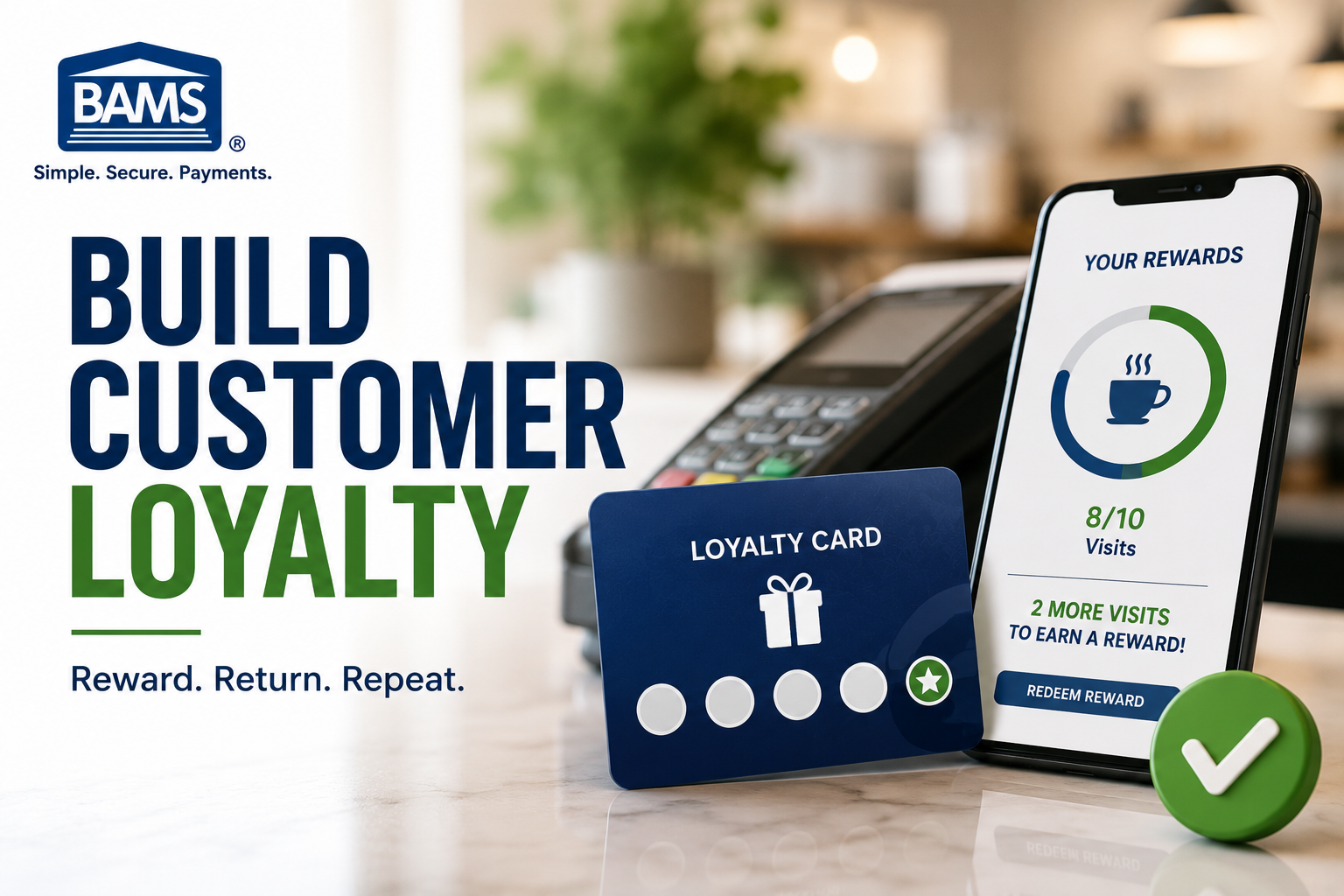
The simplest way to launch a loyalty program is with a standard paper card, but in this digital age, many companies need something a little higher-tech, in the form of scannable or swipeable numbered cards. Such cards make it possible to offer a wide range of loyalty programs ranging from punch or stamp card-style programs to yearly memberships covering and tracking all purchases, and beyond. Getting such a loyalty program off the ground isn’t overly difficult, but getting an electronic loyalty card setup does require a little bit of leg work up-front. Luckily, your payment processor likely has the expertise, software, and equipment you need. BAMS, for instance, offers complete loyalty and gift card services to its merchants, including fully customizable, professionally designed cards that can be used both in-store and online. Getting started is as simple as reaching out and expressing interest in developing a program, and the expert team at BAMS can guide you every step of the way from there.
Physical, Digital or Both?
You do not necessarily have to choose one format.
A physical card is easy to understand and works well for businesses with a strong in-store customer base. Digital loyalty can make more sense when customers already interact with the business through an online account, mobile checkout or another digital touchpoint.
Some businesses benefit from supporting both. The customer can earn rewards whether they shop in person or online while the business keeps the experience connected across channels.
When payments and loyalty need to work across those channels, an integrated payment gateway can help connect online and in-person payment activity within a broader commerce setup.
Visa’s current small business resources also emphasize the role of digital tools in helping businesses compete in an evolving marketplace. A loyalty program is more useful when the technology behind it fits naturally into the way customers already interact with the business.
Do Not Ignore the Customer Experience After Signup
Getting someone to join is only the first step. The program still needs to work smoothly after enrollment.
Customers should be able to understand how close they are to a reward. Employees should know how to apply it. If the program works online, customers should not have to start over because they moved from one shopping channel to another.
Small points of friction matter here. A reward that is difficult to redeem does not feel like much of a reward.
Keep Payment Security Separate From the Reward
A loyalty program may collect customer information, but that does not mean the business should collect more data than it needs. If the loyalty system also connects with an environment that stores, processes or transmits payment card data, payment security still requires careful attention.
The PCI Security Standards Council recommends building payment security around people, process and technology. Businesses should understand which systems touch payment data and keep loyalty functionality from creating unnecessary exposure.
BAMS also provides PCI compliance resources for merchants that need help understanding the security requirements connected with their payment environment.
Measure Whether the Program Is Actually Working
A loyalty program should produce something more useful than a growing list of members.
Look at whether members return more often. Compare average purchase behavior before and after enrollment. Watch redemption activity. If customers sign up but rarely return or never use their rewards, the program may need a simpler structure or a more meaningful incentive.
You can also test one change at a time. Adjusting the reward threshold, changing the offer or making redemption easier can tell you more than completely rebuilding the program every few months.
Frequently Asked Questions
What is a customer loyalty program?
A customer loyalty program rewards people for continuing to shop with a business. Rewards can include discounts, free products, points, special offers or other benefits tied to repeat purchases.
Does a loyalty program need to be digital?
No. Paper punch cards can still work for simple programs. Digital systems become useful when a business wants to track activity, support more complex rewards or connect loyalty across several shopping channels.
What makes a loyalty reward effective?
The reward should be easy to understand and realistic to earn. It also needs to provide enough value to matter to the customer without making the program unsustainable for the business.
Can a loyalty program work for a small business?
Yes. A small business can start with a simple structure and expand it later. The program should match how often customers return and what they usually buy.
Should loyalty programs work online and in-store?
That depends on the business. If customers regularly shop through both channels, a connected program can create a more consistent experience. Businesses that operate primarily in one channel may not need the extra complexity.
What should a business track after launching a loyalty program?
Useful measures include repeat visits, purchase frequency, reward redemptions and changes in customer spending. These can show whether members are actually becoming more engaged with the business.
How can BAMS help set up a loyalty program?
BAMS offers gift and loyalty program services including customizable cards and support for merchants building a program around their business. The setup can be designed around the way the merchant wants customers to earn and use rewards.
For more information on BAMS loyalty program services or to request a quote on customized cards, contact us today.