Why Checkout Transparency Matters More Than Speed
Last Updated on April 28, 2026 by Dimitri Akhrin
One-click checkout boosts conversions only when customers trust what they’re clicking
Discover why checkout speed alone won’t fix your cart abandonment problem. Learn how transparent pricing and visible security measures build the trust that actually converts browsers into buyers.
TL;DR
- Speed without transparency backfires – One-click checkout only converts when customers trust what they can’t see
- Hidden fees kill conversions – $260 billion in recoverable orders is lost to checkout friction, much of it from pricing surprises
- Mobile amplifies the problem – 70% of purchases happen on mobile, where trust signals matter more, not less
- Build trust first, then simplify – Show clear pricing and visible security before stripping down your checkout flow
The Checkout Page Is Lying to Your Customers
Here’s a pattern I see constantly: an eCommerce manager spends months optimizing product pages, refining email sequences, and driving qualified traffic. Then watches 70% of shoppers abandon their carts at checkout.
The culprit isn’t usually what they think. It’s not slow load times or missing payment options. It’s something simpler and more damaging: the checkout page feels like a trap.
The Speed Obsession That Backfired
The eCommerce industry became obsessed with checkout speed. Fewer clicks. Fewer fields. One-click checkout emerged as the holy grail, and for good reason.
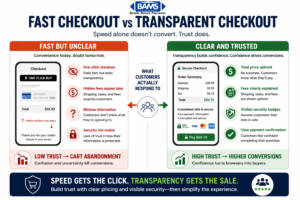
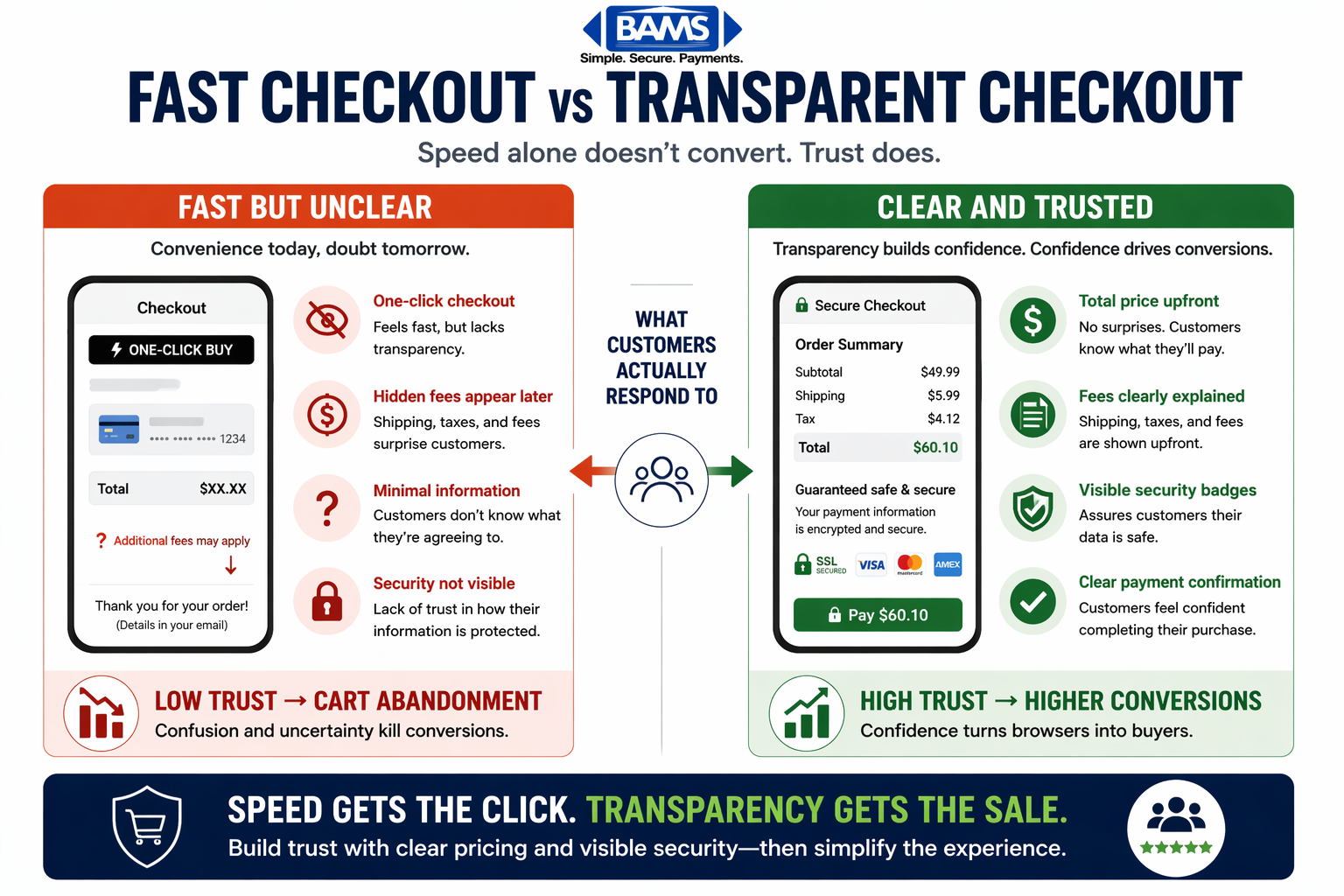
A side-by-side comparison showing why fast checkout without transparency leads to abandonment, while clear and trusted checkout experiences drive conversions.
But somewhere along the way, “fast” became code for “hide the details until it’s too late.” Shipping costs that appear after entering payment info. Processing fees buried in confirmation emails. Security measures so invisible that customers wonder if they exist at all.
Speed without transparency doesn’t build trust. It erodes it. And eroded trust kills conversions more reliably than any slow-loading page. Modern payment experiences are evolving toward faster, more streamlined checkout flows, but conversion still depends on transparency and clarity in transaction details according to Modern Treasury.
Transparency Is the Real Conversion Lever
Here’s what I actually believe: the fastest checkout in the world won’t save you if customers feel deceived. Transparent pricing, visible security, and honest communication convert better than shaving two seconds off your checkout flow.
What the Data Actually Shows
Let’s look at why carts get abandoned.
Here’s the insight most people miss: “complicated” doesn’t mean “has too many fields.” It means “confuses me” or “makes me uncertain.” A checkout with five clear steps can feel simpler than a one-click button that leaves customers wondering what just happened to their payment information.
Clear transaction visibility and secure authentication improve customer confidence and reduce friction during checkout, as outlined by Visa.
The Trust Equation in Practice
I’ve watched businesses implement one-click checkout and see conversions drop. Not because the technology failed, but because customers didn’t trust what they couldn’t see.
Then those same businesses added clear payment processing security indicators, showed the total cost upfront (including all fees), and explained how customer data would be protected. Conversions climbed, even though the checkout technically had more information to process.
The lesson? Customer behavior tracking tells us people want speed, but their actions reveal they want confidence more. They’ll take an extra five seconds if it means knowing exactly what they’re paying and that their information is safe.
Transparent checkout experiences rely on an integrated payment gateway that ensures accurate totals, secure processing, and seamless payment execution without hidden friction.
Mobile Changes Everything
Mobile platforms are expected to account for nearly 55% of one-click checkout market revenue by 2033.
This shift amplifies the transparency problem. Small screens mean less visible information. Customers are often distracted, multitasking, buying during commutes or commercial breaks. The temptation is to strip checkout down to nothing.
But mobile customers aren’t less concerned about security or hidden fees. They’re more concerned, because they can’t easily review what they’re agreeing to. The winning approach shows the essential trust signals clearly, not hides them to save screen space.
What Changes If This Is True
If transparent pricing actually converts better than hidden-fee speed, then most checkout optimization advice has it backwards. You shouldn’t ask “how do I remove steps?” You should ask “how do I remove uncertainty?”
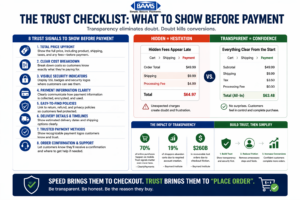
A checklist of essential trust signals to show before payment, helping reduce uncertainty and increase checkout conversion rates.
This means showing total costs before requesting payment information. It means displaying security badges where customers actually look, not buried in footers. It means building trust signals directly into your checkout flow rather than hoping brand reputation carries the weight.
Visible payment security standards help build customer trust and protect sensitive data during checkout, as defined by the PCI Security Standards Council.
For eCommerce managers dealing with delayed deposits and high transaction fees, this reframe matters. Your payment processor’s transparency becomes your transparency. If you can’t explain your processing costs clearly, customers sense that uncertainty in your checkout experience.
True checkout transparency starts with transparent interchange plus pricing, allowing businesses to clearly communicate costs without relying on hidden fees or vague pricing structures.
A Better Mental Model: Checkout as Conversation
Stop thinking of checkout as a funnel to push people through. Think of it as a conversation where you’re asking someone to trust you with their money.
In that conversation, speed matters, but honesty matters more. You wouldn’t rush a friend through a financial decision while hiding the details. Don’t do it to your customers.
The businesses winning at checkout optimization aren’t the ones with the fewest clicks. They’re the ones where customers feel informed at every step. Where pricing is transparent, security is visible, and nothing surprises them after they click “buy.”
The Checkout You’d Actually Trust
One-click checkout isn’t the problem. Opacity is. The technology works brilliantly when customers already trust the merchant and understand what they’re agreeing to.
Build that trust first. Show your pricing clearly. Make your payment processing security visible. Then simplify. That sequence converts. The reverse doesn’t.
Frequently Asked Questions
How can I reduce cart abandonment during the checkout process?
Show total costs (including shipping and fees) before requesting payment information. Display security badges prominently and offer guest checkout options, since 19% of shoppers abandon carts when forced to create accounts.
What are the key features of an effective payment gateway?
Look for transparent pricing structures, robust payment processing security, and clear communication about fees. Next-day funding and proactive chargeback defense also reduce operational friction for your business.
Which payment methods should I offer to optimize checkout?
Digital wallets are now used in over half of all online transactions globally. Combine these with traditional card payments and consider buy-now-pay-later options based on your customer demographics.
Sources