Payment Gateway Solutions: Traditional vs Modern Compared
Last Updated on April 28, 2026 by Dimitri Akhrin
How next-day funding and mobile-first checkout separate outdated processors from solutions built for today’s eCommerce
Compare traditional payment gateways against modern solutions across funding speed, mobile checkout optimization, and fee transparency. Learn which approach fits your business based on transaction volume and cash flow needs.
TL;DR
- Modern payment solutions outperform traditional gateways on funding speed, mobile checkout, pricing transparency, chargeback support, and customer service for mid-market eCommerce businesses.
- Next-day funding transforms cash flow management compared to the 2-5 day delays common with legacy processors, letting you pay suppliers faster and avoid credit line dependence.
- Mobile checkout optimization is now essential with 49% of global eCommerce transactions happening through digital wallets and 61% of customers abandoning carts when preferred payment methods are unavailable.
- Transparent pricing protects your margins by eliminating hidden fees and letting you forecast processing costs accurately each month.
- Switching costs are real but recoverable through ongoing benefits like faster funding, lower fees, and reduced chargeback losses. Run the numbers for your specific situation before deciding.
The Payment Gateway Decision Your Business Faces Right Now
You need a payment gateway that works. But the gap between traditional processors and modern payment gateway solutions has widened dramatically. One path leads to delayed funds, rigid checkout experiences, and support tickets that vanish into queues. The other offers operational flexibility and cash flow you can actually plan around.
This comparison breaks down what matters for eCommerce managers running established online businesses. We focus on funding speed, mobile checkout optimization, fee transparency, and the support you get when things go wrong. No fluff, just the factors that affect your bottom line.
Quick Verdict: Which Path Fits Your Business?
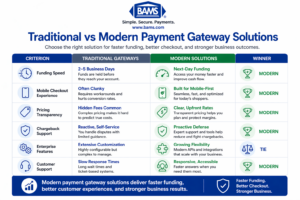
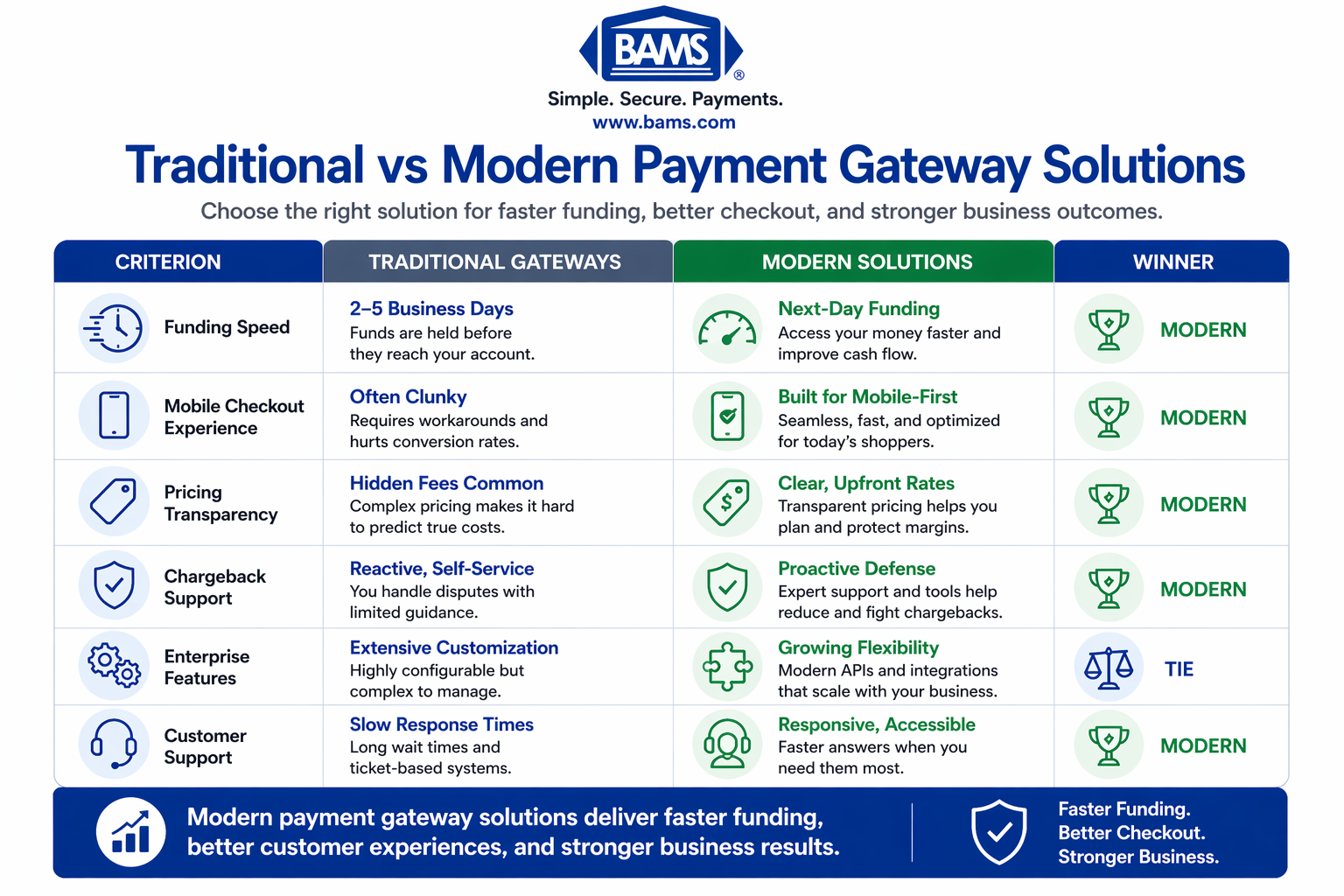
Modern payment gateway solutions outperform traditional systems with faster funding, better checkout experiences, and transparent pricing.
Choose a modern payment solution if you need next-day funding, transparent pricing, and guest checkout options that reduce friction. Your cash flow depends on predictable deposits, and your customers expect seamless mobile experiences. According to the Federal Reserve, interchange structures play a major role in overall payment costs, making pricing transparency critical for merchants.
Stick with traditional gateways if you have enterprise-level transaction volumes with negotiated rates, dedicated in-house payment expertise, and no urgency around funding timing. Legacy systems work when you have the resources to manage their complexity.
|
Criterion |
Traditional Gateways |
Modern Solutions |
Winner |
|---|---|---|---|
|
Funding Speed |
2-5 business days |
Next-day funding |
Modern |
|
Mobile Checkout |
Often clunky, requires workarounds |
Built for mobile-first |
Modern |
|
Pricing Transparency |
Hidden fees common |
Clear, upfront rates |
Modern |
|
Chargeback Support |
Reactive, self-service |
Proactive defense |
Modern |
|
Enterprise Features |
Extensive customization |
Growing but limited |
Traditional |
|
Support Access |
Tiered, often automated |
Dedicated account managers |
Modern |
What We’re Comparing and Why It Matters
We evaluate these payment approaches across six dimensions that directly impact your operations and revenue. Each criterion carries weight based on what eCommerce managers at 10-50 employee businesses actually deal with daily.
Funding speed affects your ability to pay suppliers, manage payroll, and invest in inventory. Mobile checkout optimization determines whether you capture the 25% of U.S. consumers now using mobile wallets for shopping. Fee transparency lets you forecast costs accurately instead of discovering surprise charges.
Chargeback management protects revenue you already earned. Payment method variety addresses the reality that most customers abandon carts when their preferred payment option is unavailable. Support quality determines how quickly you resolve issues that cost you money every hour they persist.
Head-to-Head: Funding Speed
Traditional Gateways
Most legacy processors batch transactions and release funds on a 2-5 business day cycle. Some offer faster options, but these typically come with additional fees or volume requirements. Weekend transactions often don’t process until Monday, creating cash flow gaps during your busiest sales periods.
The delay compounds during holidays and promotional events. You run a successful Black Friday campaign, but those funds sit in limbo while you need to restock inventory.
Modern Solutions
Next-day funding changes how you operate. Funds from Monday sales hit your account Tuesday. This predictability lets you manage supplier relationships, take advantage of early payment discounts, and avoid credit line dependence for routine operations.
BAMS and similar modern processors make guaranteed next-day funding standard, not a premium add-on. Your cash flow becomes a planning tool rather than a constant uncertainty.
Verdict
Modern solutions win decisively here. For businesses managing tight margins and seasonal inventory needs, the 3-4 day difference in funding represents real operational advantage.
Head-to-Head: Mobile Checkout Optimization
Traditional Gateways
Legacy systems were built for desktop-first eCommerce. Mobile experiences often feel like afterthoughts, with clunky redirects, forms that don’t auto-fill properly, and limited digital wallet support.
The technical debt in older systems makes mobile optimization an uphill battle. You can make it work, but it requires developer time and ongoing maintenance.
Modern Solutions
Built with mobile commerce strategies in mind, modern processors prioritize one-click checkout, native digital wallet integration, and responsive payment forms.
Guest checkout options come standard, removing the account creation barrier that kills mobile conversions. The checkout process analysis tools help you identify exactly where mobile users drop off.
Verdict
Modern solutions lead here, your payment gateway either supports mobile-first shopping or actively works against it.
Head-to-Head: Pricing Transparency
Traditional Gateways
Hidden fees transparency remains a major issue with legacy processors. Statement fees, PCI compliance fees, batch fees, monthly minimums, and early termination penalties often appear after you’ve signed. The pricing structure can include interchange-plus, tiered, or flat-rate models, each with different implications that aren’t always clear upfront.
Negotiating better rates requires volume leverage most mid-size businesses don’t have. You end up paying retail prices for wholesale service.
Modern Solutions
Transparent pricing models show you exactly what you’ll pay before you commit. No hidden fees, no surprise charges on your monthly statement. BAMS and similar providers build trust through clarity, letting you forecast processing costs accurately.
This transparency extends to contract terms. You know what you’re signing, what it costs to leave, and what changes require renegotiation.
Verdict
Modern solutions win on transparency. When you can predict your processing costs within a few dollars each month, you make better business decisions.
Head-to-Head: Chargeback Management
Traditional Gateways
Most legacy processors treat chargebacks as your problem. They notify you, deduct the funds, and provide a portal for you to submit documentation. The burden of proof falls entirely on you, and the process favors the cardholder by design.
Self-service chargeback tools require you to understand the dispute process, gather evidence correctly, and meet strict deadlines. Miss a step, and you lose by default.
Modern Solutions
Proactive chargeback defense changes the equation. Instead of reacting to disputes after they happen, modern processors help prevent them through fraud detection, clear billing descriptors, and customer communication tools. The PCI Security Standards Council emphasizes that strong security practices help reduce fraud risk and improve transaction reliability.
When disputes do occur, dedicated account managers guide you through the response process. They know what evidence wins cases and help you present it effectively. This chargeback management approach protects revenue you’ve already earned.
Verdict
Modern solutions offer meaningful advantage here. The combination of prevention and active support turns chargebacks from a constant drain into a manageable cost.
Head-to-Head: Payment Method Variety
Traditional Gateways
Legacy systems support major credit cards reliably but often lag on emerging payment methods. Adding Apple Pay, Google Pay, or buy-now-pay-later options may require separate integrations, additional contracts, or technical workarounds. Mobile-first checkout experiences have become essential as more customers expect faster, one-tap payment options across devices.
Modern Solutions
Payment method variety comes built in. Apple Pay, Google Pay, and digital wallets integrate through single configurations rather than separate projects. This flexibility matters because customer preferences vary, and the payment options you offer directly affect conversion rate improvement.
Modern platforms also support WooCommerce and BigCommerce integrations that make adding payment methods straightforward rather than technical projects. According to Visa, modern payment systems are designed to streamline transactions while maintaining secure and efficient processing, making optimized checkout experiences critical for conversion.
Verdict
Modern solutions make payment variety achievable. When digital wallets are projected to grow annually through 2027, easy integration matters.
Head-to-Head: Support Quality
Traditional Gateways
Support tiers based on account size mean mid-market businesses often get automated responses and long wait times. Your issue enters a queue, gets assigned to whoever’s available, and you explain your situation from scratch each time you follow up.
Technical problems during peak sales periods become emergencies that traditional support structures aren’t designed to handle quickly.
Modern Solutions
Dedicated account management means you talk to someone who knows your business. They understand your integration, your transaction patterns, and your specific challenges. When problems arise, context already exists.
Human-first support treats your payment issues as urgent because they understand what downtime costs you. This approach turns support from a cost center into a genuine resource.
Verdict
Modern solutions deliver better support experiences. The dedicated relationship model works better for businesses that can’t afford to wait in queue during critical moments.
Which Solution Fits Your Situation
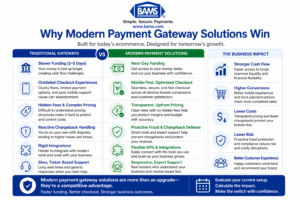
Upgrading to modern payment gateway solutions improves cash flow, reduces friction, and drives higher conversion rates for eCommerce businesses.
If you process high volumes with in-house payment expertise, traditional gateways may offer negotiated rates and customization that justify their complexity. Your team can manage the technical overhead.
If cash flow timing affects your operations, choose next-day funding. The difference between Tuesday deposits and Friday deposits compounds across every transaction cycle.
If mobile commerce drives significant revenue, prioritize mobile checkout optimization. Your payment gateway should make mobile purchases easier, not harder. Implementing strategies to prevent shopping cart abandonment works better when your gateway supports them.
If you’ve been surprised by processing fees, transparent pricing protects your margins. Knowing your costs lets you price products accurately.
If chargebacks eat into your revenue, proactive defense matters more than reactive tools. Prevention beats documentation every time.
What Neither Approach Solves Completely
Both traditional and modern payment gateway solutions face industry-wide limitations. Interchange fees set by card networks remain largely non-negotiable regardless of your processor. International transactions still carry complexity around currency conversion and regional payment preferences.
Switching Costs and Lock-In Factors
Moving from a traditional gateway to a modern solution involves real costs. Technical integration takes developer time, typically 2-4 weeks for straightforward migrations. Customer payment data may need re-collection depending on your current setup.
Watch for early termination fees in existing contracts. Some traditional processors charge significant penalties for leaving before term completion. Review your agreement before starting migration conversations.
The switch makes sense when ongoing benefits outweigh one-time costs. If faster funding saves you $500 monthly in credit line interest, a $2,000 migration cost pays back in four months. Run the numbers for your specific situation.
Data portability varies by processor. Transaction history, customer records, and recurring billing setups may or may not transfer cleanly. Ask specific questions about what moves and what you rebuild.
The Decision That Affects Every Transaction
Your payment gateway touches every sale your business makes. Traditional processors served their era well, but the gap between legacy systems and modern solutions has grown too wide to ignore for most mid-market eCommerce operations.
Next-day funding, transparent pricing, mobile-first checkout, proactive chargeback defense, and dedicated support represent the baseline for competitive payment processing in 2025. If your current gateway doesn’t deliver these fundamentals, the cost of staying exceeds the cost of switching.
BAMS built their approach around what growing eCommerce businesses actually need: predictable cash flow, clear costs, and human support when it matters. That combination turns payments from an operational headache into a competitive advantage you can build on.
Frequently Asked Questions
What is checkout optimization and why is it important?
Checkout optimization means removing friction from the purchase process so more customers complete their orders. This includes faster page loads, fewer form fields, guest checkout options, and multiple payment methods. It matters because even small improvements in checkout completion rates translate directly to revenue. A 5% reduction in cart abandonment on $1 million in annual sales means $50,000 more revenue.
How can I reduce cart abandonment during the checkout process?
Start with the biggest friction points: offer guest checkout so customers don’t need accounts, display all costs upfront including shipping, and provide multiple payment options including digital wallets. Speed matters too. Every additional second of load time costs conversions. Single-page checkout reduces the steps where customers can change their minds.
What are the key features of an effective payment gateway?
Look for next-day funding to improve cash flow, transparent pricing without hidden fees, mobile-optimized checkout experiences, broad payment method support including Apple Pay and Google Pay, proactive chargeback defense, and responsive human support. The best gateways also offer easy integration with major eCommerce platforms like WooCommerce and BigCommerce.
When should I consider implementing a one-page checkout solution?
Consider single-page checkout when your analytics show significant drop-off between checkout steps, when mobile traffic represents a large portion of your sales, or when your current multi-step process takes longer than 60 seconds to complete. One-page checkout works especially well for businesses with straightforward product offerings and standard shipping options.
Which payment methods should I offer to optimize my checkout experience?
At minimum, accept major credit cards, debit cards, Apple Pay, and Google Pay. Consider adding PayPal for customers who prefer it and buy-now-pay-later options like Klarna or Affirm for higher-priced items. The goal is matching your payment options to your customer demographics. Younger customers expect digital wallets. International customers may need local payment methods.
How can I build trust with customers during the checkout process?
Display security badges and SSL indicators prominently. Show clear return policies before customers enter payment information. Use recognizable payment logos. Provide visible customer support contact options. Keep billing descriptors clear so customers recognize charges on their statements. Trust signals reduce the hesitation that causes last-second abandonment.
Sources