Toast POS System Review: Pros, Cons, Costs & Insights
Last Updated on April 28, 2026 by Dimitri Akhrin
Toast POS System Review: Pros, Cons, Costs & What Restaurants Must Know
The Toast POS system has become one of the most widely adopted restaurant point-of-sale platforms in the United States. However, selecting a POS system is not just a technology decision—it directly impacts profitability, operational efficiency, and long-term scalability.
Restaurant owners must evaluate more than features. Payment processing costs, contract terms, system flexibility, and integration capabilities all influence margins. Therefore, understanding how Toast works—and where it may fall short—is essential before committing to a system that could define your operations for years.
This guide provides a comprehensive, merchant-focused analysis of Toast POS, including its advantages, limitations, pricing structure, and how it compares to broader payment infrastructure strategies.
Key Takeaways
- Toast POS system is purpose-built for restaurants with strong operational features.
- Total cost is driven primarily by payment processing and add-ons—not base pricing.
- Mandatory in-house processing limits flexibility and rate negotiation.
- Best suited for mid-sized to high-volume restaurants requiring integrated systems.
- Long-term contracts require careful financial evaluation before adoption.
What Is the Toast POS System?
The Toast POS system is a cloud-based platform designed specifically for restaurants. It combines front-of-house operations, payment processing, and back-office management into a single ecosystem.
Unlike generic POS systems, Toast focuses on restaurant workflows. These include table management, menu customization, kitchen display systems, online ordering, and employee scheduling.
Additionally, Toast integrates payment acceptance directly into its system. According to Visa’s payment processing overview, modern POS systems must seamlessly connect transaction capture, authorization, and settlement. Toast achieves this through a vertically integrated structure.
However, this integration comes with trade-offs—particularly in pricing flexibility and merchant control.
Core Features of the Toast POS System
1. Restaurant-Specific Workflow Optimization
Toast is engineered for restaurant environments. It supports table-side ordering, split payments, modifiers, and real-time kitchen communication. As a result, service speed and order accuracy improve significantly during peak hours.
2. Integrated Payment Processing
Toast includes built-in payment processing, eliminating the need for third-party processors. While this simplifies setup, it also restricts the ability to shop for better rates.
3. Online Ordering and Delivery Integration
The platform allows restaurants to manage direct online orders, reducing reliance on third-party marketplaces. This helps preserve margins and maintain customer relationships.
4. Inventory and Menu Management
Toast tracks ingredient usage, menu performance, and stock levels in real time. Therefore, operators can make informed decisions about pricing and supply chain management.
5. Reporting and Analytics
Restaurants gain access to detailed sales reports, labor tracking, and performance analytics. These insights help improve operational efficiency and profitability.
Pros of the Toast POS System
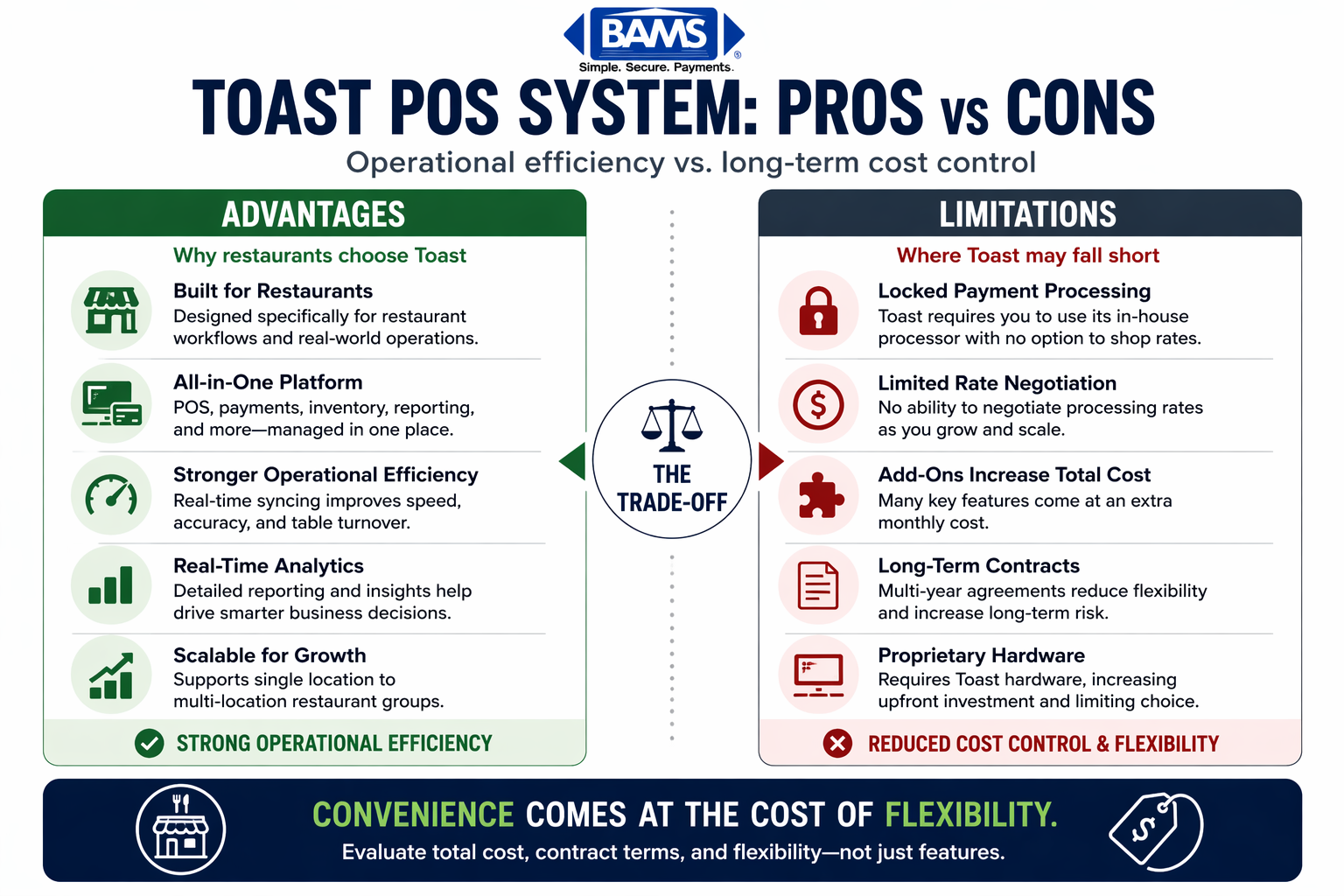
A side-by-side comparison of Toast POS advantages and limitations, showing the trade-off between operational efficiency and long-term cost control.
1. Built Specifically for Restaurants
Toast’s restaurant-first design is one of its strongest advantages. Every feature—from menu structuring to kitchen display integration—supports real-world restaurant workflows.
2. All-in-One Platform
Toast consolidates POS, payments, inventory, and reporting into a single system. As a result, businesses reduce reliance on multiple vendors.
3. Strong Operational Efficiency
Real-time syncing between front-of-house and kitchen systems minimizes errors and improves service speed. This directly impacts customer satisfaction and table turnover rates.
4. Offline Capabilities
Toast can continue processing orders even during internet disruptions, ensuring operational continuity during critical periods.
5. Scalable for Growth
The system supports multi-location operations, making it suitable for expanding restaurant groups.
Cons of the Toast POS System
1. High Long-Term Costs
While initial pricing may appear attractive, long-term costs increase due to payment processing fees and add-ons. According to the Federal Reserve, interchange fees alone represent a significant portion of transaction costs. Toast builds on top of these base costs with its own pricing structure.
2. Locked Payment Processing
Toast requires merchants to use its proprietary payment processor. Therefore, businesses cannot negotiate rates or switch providers as they scale.
3. Add-On Pricing Structure
Key features such as loyalty programs, advanced reporting, and payroll are often sold separately. As a result, total costs increase quickly.
4. Long-Term Contracts
Many merchants report multi-year agreements, which reduce flexibility. This creates risk if business needs change or better solutions become available.
5. Hardware Limitations
Toast relies on proprietary hardware, increasing upfront investment and limiting customization.
Toast POS System Cost Breakdown

A breakdown of Toast POS total cost, showing how processing fees, hardware, and add-ons combine to impact long-term restaurant margins.
| Cost Category | Typical Range | Impact on Business |
|---|---|---|
| Software Subscription | $0–$69+/month | Entry-level cost |
| Payment Processing | 2.49%–3.69% + $0.15 | Largest long-term expense |
| Hardware | $800–$1,300+ | Upfront capital investment |
| Add-On Features | $30–$100+/feature | Scales with complexity |
Cost Control vs. Convenience: A Strategic Trade-Off
The Toast POS system prioritizes convenience through integration. However, this often comes at the expense of cost control.
In contrast, many restaurants adopt a more flexible approach by using an integrated payment gateway. This allows businesses to maintain control over processing rates, negotiate fees, and adapt as transaction volume grows.
Additionally, maintaining security standards is critical. According to the PCI Security Standards Council, merchants must implement strong controls to protect cardholder data. Systems aligned with PCI compliance solutions help reduce risk and ensure regulatory adherence.
Decision Framework: Is Toast POS Right for You?
| Business Type | Recommendation | Reasoning |
|---|---|---|
| Single-location startup | Evaluate alternatives | High costs and contracts may limit flexibility |
| Mid-sized restaurant | Consider Toast | Strong operational features justify cost |
| Multi-location group | Good fit | Scalability and centralized control |
| Cost-sensitive business | Proceed cautiously | Processing fees impact margins |
Operational Impact: What Restaurants Often Overlook
Many restaurants focus on front-end features when selecting a POS system. However, backend economics often determine long-term success.
Processing fees compound over time. Even small percentage differences can translate into thousands of dollars annually. Additionally, contract limitations can restrict the ability to adapt to market changes.
Therefore, evaluating total cost of ownership—not just monthly pricing—is critical.
Conclusion
The Toast POS system delivers a powerful, restaurant-specific solution with strong operational capabilities. However, its integrated model introduces trade-offs in cost flexibility and long-term scalability.
Restaurants should evaluate not only features, but also payment processing costs, contract terms, and the ability to adapt over time. A strategic approach to POS selection ensures better financial control, operational efficiency, and sustainable growth.
Frequently Asked Questions
1. How much does Toast POS cost monthly?
Monthly costs typically range from $300 to over $1,000 depending on processing volume, add-ons, and hardware requirements.
2. Does Toast charge processing fees?
Yes. Toast requires merchants to use its built-in processor, with fees typically between 2.49% and 3.69% per transaction.
3. Is Toast PCI compliant?
Yes. Toast adheres to PCI DSS standards to ensure secure payment processing and protect cardholder data.
4. Can Toast help reduce chargebacks?
Toast provides reporting tools, but merchants must still implement structured chargeback management practices.
5. Is Toast suitable for small restaurants?
It can be, but smaller businesses should carefully evaluate long-term costs and contract terms before committing.