7 Credit Card Processing Optimization Signals to Watch
Last Updated on September 30, 2026 by Dimitri Akhrin
How to diagnose whether your payment processor is quietly stalling your cash flow and costing you money
Learn seven observable signals that your payment processor is creating cash flow bottlenecks through funding delays and fee opacity. This diagnostic framework helps eCommerce operators identify processor accountability gaps before compounding costs erode margins.
TL;DR
- Funding delays are a choice, not a default – If your deposits take 48+ hours with no written SLA, your processor is using your float. Next-day funding exists and shouldn’t cost extra.
- Your effective rate is the only rate that matters – The gap between your quoted rate and what you actually pay reveals hidden downgrades, undisclosed fees, and markup layers that erode margins silently.
- Accountability requires a named human – If you can’t reach a dedicated account manager who knows your business when a deposit goes missing or a chargeback lands, you have a vendor, not a partner.
- Fee opacity is a feature, not a bug, for underperforming processors – New line items, undisclosed rate changes, and no interchange qualification reporting are structural signals that your processor profits from your confusion.
- Start with two signals – Calculate your effective rate and audit your deposit timing this month. Those two data points will tell you whether your processor relationship is fixable or needs replacing.
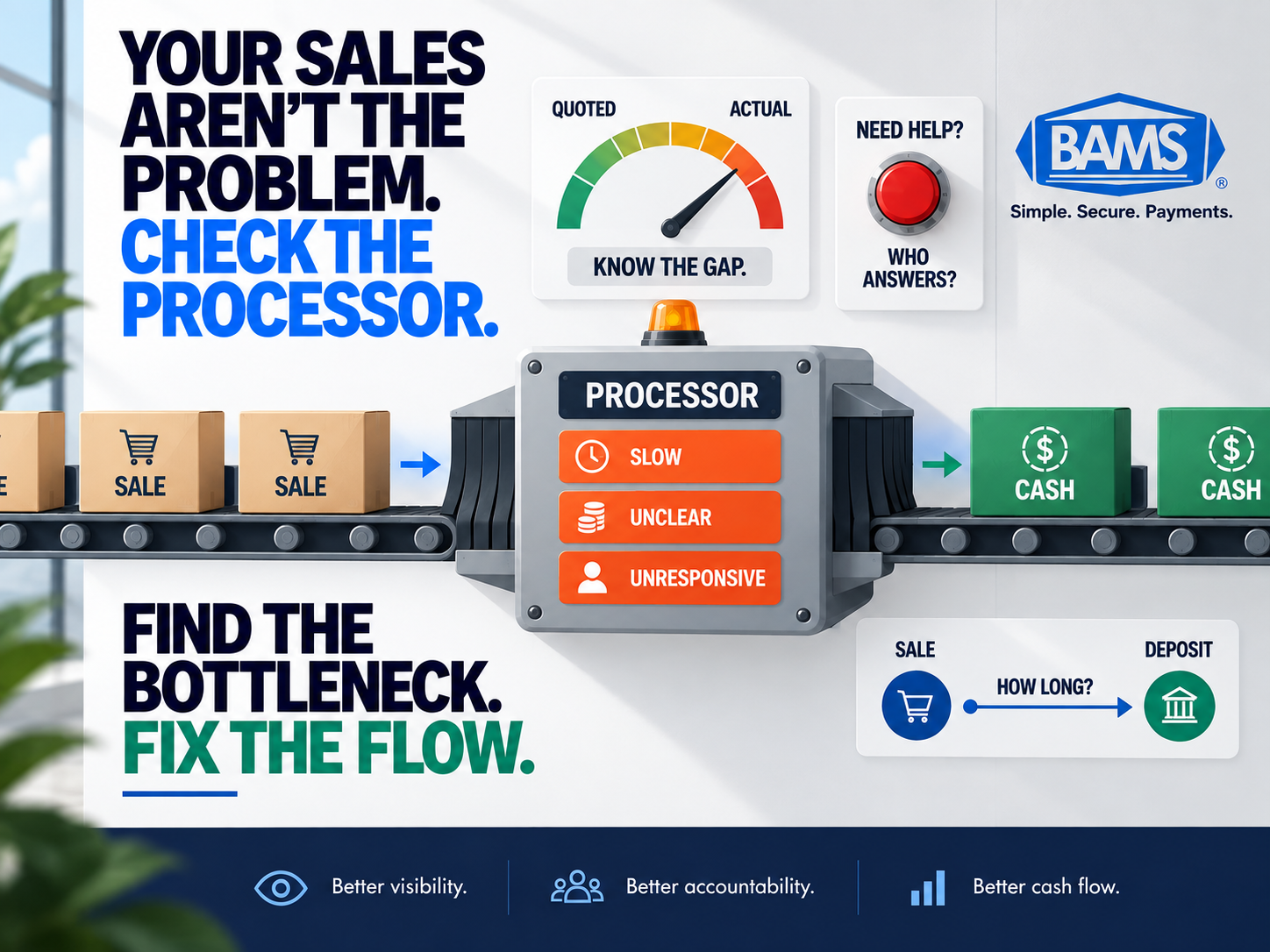
Strong sales do not guarantee smooth cash flow. Funding delays, unclear fees and weak processor accountability can create friction between revenue and usable cash.
Your Sales Aren’t the Problem. Your Processor Might Be.
Revenue is climbing. Orders are steady. Yet your operating account keeps running thin between deposit cycles. If this sounds familiar, the bottleneck likely isn’t your sales volume or your margins. It’s your payment processor.
Credit card processing optimization is rarely treated as a cash-flow discipline. Most eCommerce operators evaluate processors at signup, then never revisit the relationship until something breaks visibly (a missing deposit, a surprise fee, a chargeback nightmare with no one to call). By then, the damage has compounded for months.
U.S. merchants paid $187.20 billion in card processing fees in 2024, up 8.7% from 2023. That’s not a rounding error. That’s a structural cost that demands structural accountability from the partner collecting it.
Who This Is For (and What This Isn’t)
This guide is for eCommerce managers at established online businesses (roughly 10 to 50 employees) who process enough volume that a two-day funding delay or a 30-basis-point fee discrepancy actually moves the needle on payroll timing and reinvestment capacity.
This is not a processor comparison chart. It’s not a feature matrix. It’s a diagnostic framework: seven signals that your current payment partner has an accountability gap, and what to look for in a replacement that doesn’t.
How These Signals Were Selected
Each signal below meets two criteria. First, it’s observable from your existing statements, dashboards, or support interactions without requiring an external audit. Second, it correlates directly with cash-flow drag, not just inconvenience. These are the patterns that separate a vendor you tolerate from a partner you can hold accountable.
7 Signals Your Payment Processor Is Stalling Your Cash Flow
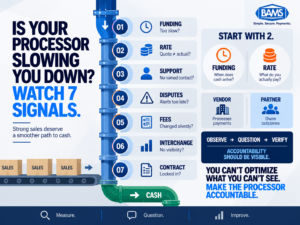
Funding speed, effective cost, support responsiveness and payment transparency can reveal whether your processor is helping your business or quietly creating friction.
1. Your Deposits Take 48+ Hours With No Clear Explanation
Why it matters: Every day your revenue sits in a processor’s holding account is a day you can’t deploy it toward inventory, payroll, or ad spend. A two-day or three-day funding window might seem standard, but “standard” is often just what processors default to when they have no incentive to move faster.
What it looks like today: Many processors batch settlements once daily with a 48- to 72-hour deposit window. Some hold funds longer for “risk review” without notifying you. Meanwhile, next-day funding is technically available across the industry, but few processors offer it without surcharges or volume thresholds.
How to apply it: Ask your processor for a written funding SLA. If they can’t provide one, or if the answer is “it depends,” that’s the signal. Compare your actual deposit timestamps against their stated timeline for three consecutive months. Document every gap.
2. Your Effective Rate Doesn’t Match Your Quoted Rate
Why it matters: The rate you were quoted at signup and the rate you actually pay are often different numbers. The gap comes from interchange downgrades, assessment fees, PCI non-compliance charges, and batch fees that don’t appear in the headline pricing. Visa and Mastercard credit card swipe fees averaged 2.91% in 2024, but your blended effective rate could be higher depending on how your processor routes and categorizes transactions.
What it looks like today: Tiered pricing models bundle costs in ways that obscure where your money goes. Even interchange-plus pricing can hide markups if the “plus” isn’t itemized clearly. Your processing statement may be leaking margins through line items you’ve never questioned.
How to apply it: Calculate your effective rate: divide total fees by total volume processed for the month. If it’s more than 20 to 30 basis points above your quoted rate, request a line-by-line breakdown. A processor that can’t (or won’t) explain the difference is one you can’t hold accountable for payment processing fees reduction.
3. You Can’t Reach a Named Human When a Deposit Goes Missing
Why it matters: When $14,000 doesn’t land in your account on a Friday morning, the difference between a named account manager and a 1-800 queue is the difference between resolving it before payroll and scrambling for a bridge loan. Accountability requires a person, not a ticket number.
What it looks like today: Most mid-market processors route support through tiered call centers. Your issue gets triaged by someone who doesn’t know your business, your volume patterns, or your integration stack. Escalation takes days.
How to apply it: Test your support channel before a crisis. Call during business hours with a specific question about your last statement. Time the response. Note whether the person who answers can pull up your account without transferring you. If you can’t get a direct line to someone who knows your name, that’s a structural gap, not a staffing issue.
4. Chargeback Notifications Arrive After the Response Window Closes
Why it matters: Chargebacks cost you the transaction amount, the merchandise, and a fee on top. But the hidden cost is the ones you lose by default because your processor didn’t notify you in time to respond. Every uncontested chargeback also raises your chargeback ratio, which can trigger reserve holds or account termination.
What it looks like today: Some processors send chargeback alerts via email with no urgency flagging. Others bury them in a portal you check weekly. The response window is typically 7 to 20 days depending on the card network, and late notification compresses that to zero.
How to apply it: Audit your last ten chargebacks. How many did you learn about within 24 hours? How many did you have time to contest with documentation? A proactive processor pushes alerts the same day and provides representment support. If yours doesn’t, your win rate is artificially suppressed.
5. Your Fee Structure Changed and Nobody Told You
Why it matters: Interchange rates adjust twice a year (April and October for Visa and Mastercard). Assessment fees shift. But some processors layer on their own increases without disclosure, buried in a statement addendum or a terms-of-service update email you didn’t open. Credit cards accounted for 79.34% of all merchant processing fees in 2024, so even a small undisclosed markup on credit transactions compounds fast.
What it looks like today: Fee increases often appear as new line items (“technology fee,” “regulatory compliance fee”) rather than rate changes. They’re technically disclosed in fine print but practically invisible unless you compare statements month over month.
How to apply it: Compare your January and July statements side by side. Flag any new line items or rate changes. Then ask your processor to confirm, in writing, every fee increase applied in the past 12 months. If they can’t produce a clear changelog, your ability to lower credit card processing fees starts with finding a partner who doesn’t hide them.
6. You Have No Visibility Into Interchange Qualification
Why it matters: Not all transactions cost the same to process. A card-present debit transaction costs less than a manually keyed corporate rewards card. When your transactions “downgrade” to a more expensive interchange category (because of missing data fields, late settlement, or incorrect merchant category codes), you pay more. If your processor never flags downgrades, they have no incentive to help you qualify for lower rates.
What it looks like today: Mastercard explains that each interchange rate has qualification requirements and that factors can include merchant category, authorization-to-clearing timing, enhanced transaction data and transaction volume. When transactions fail to meet the criteria for a more favorable rate, your processing cost can increase. That’s money you’re leaving on the table if no one is monitoring qualification performance.
How to apply it: Ask your processor how many of your transactions qualified at the lowest available interchange tier last month. If they can’t answer, or if the answer is “we don’t track that,” you’re paying a premium for their indifference. A partner invested in business cost savings will flag downgrades proactively and help you fix the root cause.
7. Contract Terms Lock You In Without Performance Guarantees
Why it matters: Long-term contracts with early termination fees create a one-sided accountability structure. Your processor can underperform for 36 months, and you pay to leave. That’s not a partnership. That’s a penalty clause disguised as stability.
What it looks like today: Many processors still use three-year contracts with liquidated damages clauses or equipment leases that auto-renew. The cancellation fee can run $295 to $500 or more, plus remaining lease payments. These terms are designed to make switching expensive, not to earn your continued business.
How to apply it: Review your current agreement for termination clauses, auto-renewal windows, and equipment lease terms. When evaluating a new partner, prioritize month-to-month or annual agreements with no early termination fees. A processor confident in their service doesn’t need a contract to keep you. Companies like BAMS pair transparent pricing with dedicated account managers precisely because accountability replaces lock-in as the retention mechanism.
The Pattern Behind These Signals
These seven signals share a common root: information asymmetry. Your processor knows more about your fee structure, your interchange qualification, your chargeback exposure, and your funding timeline than you do. And most of them are not incentivized to close that gap.
The processors that stall your cash flow aren’t necessarily malicious. They’re simply built around scale economics that treat your account as one of thousands, with no dedicated human responsible for your outcomes. The result is a slow bleed: a few basis points here, a day of float there, a chargeback you never got to contest.
When you stack these signals together, the pattern becomes clear. Accountability isn’t a feature you can buy. It’s a structural property of how your processor is organized, staffed, and compensated. A partner with transparent pricing and responsive support treats your cash flow as their problem to solve, not your problem to diagnose.
Where to Start: Prioritizing Your Next Move
You don’t need to address all seven signals at once. Start with the two that have the most direct cash-flow impact for your business: funding speed (Signal 1) and effective rate accuracy (Signal 2). These are measurable within a single billing cycle and give you concrete data for any conversation with your current processor or a prospective replacement.
If your processor can’t answer basic questions about your interchange qualification or fee changes, that tells you everything about their accountability posture. From there, evaluate whether the relationship is fixable or whether it’s time to find a partner whose business model depends on keeping you informed, funded, and in control.
Frequently Asked Questions
How do I calculate my effective credit card processing rate?
Divide your total processing fees for the month by your total card volume processed that month. For example, if you paid $2,900 in fees on $100,000 in volume, your effective rate is 2.9%. Compare this to your quoted rate. A gap of more than 20 to 30 basis points warrants a line-by-line statement review to identify hidden markups, downgrades, or undisclosed fees.
What is next-day funding and why does it matter for eCommerce?
Next-day funding means your processed transactions are deposited into your bank account by the following business day instead of the typical two- to three-day window. For eCommerce operators managing inventory purchases, ad spend, and payroll on tight cycles, even one extra day of float can create cash-flow gaps that force unnecessary borrowing or delayed reinvestment.
Why do my processing fees keep increasing even though my rates haven’t changed?
Card networks adjust interchange rates twice a year, and processors may add their own fees (technology fees, PCI compliance fees, regulatory surcharges) without prominently notifying you. Additionally, if your transactions are downgrading to more expensive interchange categories due to missing data or late batch settlements, your costs rise even when your base rate stays the same.
What should I look for in a merchant services contract?
Prioritize month-to-month or annual agreements with no early termination fees. Review auto-renewal clauses, equipment lease terms, and any liquidated damages provisions. A processor that relies on contract penalties to retain you is signaling that their service alone isn’t compelling enough to keep your business.
How can I reduce chargebacks as an eCommerce business?
Start with timely notification. A processor that alerts you to chargebacks within 24 hours gives you the full response window to gather documentation and submit representment. Beyond that, use clear billing descriptors, send shipping confirmations with tracking, and maintain accessible customer service. Proactive chargeback defense from your processor (including alerts and representment support) can significantly improve your win rate.
When should a business consider switching payment processors?
Consider switching when you identify multiple accountability gaps: deposits consistently arriving late without explanation, fee increases you weren’t notified about, inability to reach a named support contact, or no visibility into interchange qualification. If your processor can’t answer basic questions about your own account economics, the relationship is costing you more than the switching effort.