How to Cut Payment Processing Costs Before Peak Season
Last Updated on October 1, 2026 by Dimitri Akhrin
Audit your rates, renegotiate terms, and lock in savings before holiday volume amplifies every fee
Learn how to calculate your true effective processing rate, identify fees vulnerable to seasonal inflation, and negotiate better processor terms. This pre-season audit guide helps eCommerce managers prevent small rate differences from becoming major expenses when volume spikes.
TL;DR
- A 0.3% rate difference costs real money at peak volume — On $500K in seasonal sales, that’s $1,500. Over a full peak season, it can exceed $4,000 in avoidable fees.
- Audit your effective rate before peak season, not after — Your quoted rate and your actual cost are rarely the same. Calculate total fees divided by total volume to find the real number.
- Negotiate with data, not hope — Use your volume forecast to show processors the revenue opportunity, then request volume-based pricing, interchange-plus structure, or reduced per-transaction fees in writing.
- Notify your processor about expected volume increases — Failing to do this is the most common cause of surprise reserve holds and funding delays during peak season. One email four weeks out can prevent tens of thousands in frozen funds.
- Monitor weekly during peak season — Track your effective rate, deposit timing, and fee anomalies every week so you catch drift early instead of discovering it on a post-season statement.
Guide Orientation: What This Covers and Who It’s For
This guide is about reducing payment processing costs before seasonal volume spikes turn small rate differences into significant expenses. It walks you through a concrete, pre-season audit and negotiation process designed for eCommerce managers at established online businesses running between 10 and 50 employees.
By the end, you’ll understand how to calculate your true effective processing rate, identify which fee categories are most vulnerable to seasonal inflation, negotiate better terms with your processor before peak months, and prevent the cash flow disruptions that come with delayed deposits during your highest-revenue period.
This guide does not cover payment gateway selection, checkout UX optimization, or fraud prevention strategy in depth. It focuses specifically on the cost side of the equation: the rates, fees, and processor terms that quietly compound when transaction volume doubles or triples.

Small processing cost differences become much larger when seasonal volume increases. Reviewing your effective rate before peak season gives you time to identify unnecessary costs and negotiate better terms.
Why Seasonal Volume Optimization Matters Now
U.S. merchants paid $187.20 billion in fees to accept $11.902 trillion in card payments in 2024. That represents a significant cost base for merchants and makes even small differences in effective processing rates more meaningful as seasonal volume grows.
These aren’t abstract industry figures. They represent the compounding cost of doing nothing. When your monthly card volume jumps from $200K to $500K during a holiday push, a rate difference of 0.3% that felt invisible in a slow month suddenly costs you $1,500. Over a full peak season spanning two or three months, that’s $3,000 to $4,500 in avoidable expense from a single line item.
The cost problem is compounded by a timing problem. Most processors hold deposits for two to three business days. During peak season, when you’re spending aggressively on inventory, advertising, and fulfillment, that delay creates a cash flow gap at the worst possible moment. Growing eCommerce brands also face a less-discussed risk: processors flagging sudden volume increases as suspicious activity, triggering reserve holds or funding delays that can freeze tens of thousands of dollars without warning.
The businesses that control these costs treat peak season planning as a financial exercise, not just a marketing one. The window to act is before volume ramps, not after the statements arrive.
Core Concepts: Understanding What You Actually Pay
Effective Rate vs. Quoted Rate
Your processor might quote you 2.4% plus $0.10 per transaction. But your actual cost, your effective rate, is almost always higher. The effective rate is your total processing fees divided by your total processing volume. It includes interchange, assessments, processor markup, PCI compliance fees, batch fees, and any other charges buried in your monthly statement.
The average U.S. credit card processing fee was 2.24% in 2024, but your actual cost depends on your transaction mix and pricing structure. Mastercard explains that interchange qualification can depend on factors including product type, merchant category, authorization-to-clearing timing, enhanced transaction data and transaction volume. Knowing your effective rate is the starting point for any cost reduction effort.
The Three Layers of Processing Fees
Interchange fees go to the card-issuing bank. These are set by Visa, Mastercard, and other networks. They vary by card type (rewards cards cost more), transaction method (card-not-present costs more), and merchant category. You can influence these, but you can’t negotiate them directly.
Assessment fees go to the card networks themselves. These are small, fixed percentages. They’re non-negotiable.
Processor markup is where your leverage lives. This is what your payment processor charges on top of interchange and assessments. It can be structured as a flat rate, tiered pricing, or interchange-plus pricing. The structure determines how much seasonal volume amplifies your costs.
Why Seasonal Volume Changes the Math
During peak season, your transaction mix shifts. You likely see more new customers using rewards credit cards (higher interchange), more card-not-present transactions, and higher average order values. Each of these factors pushes your effective rate upward. On a flat-rate pricing model, you absorb this silently. On interchange-plus, you can at least see it happening. The first step to controlling seasonal costs is understanding which layer of fees is actually growing.
The Pre-Season Cost Reduction Framework
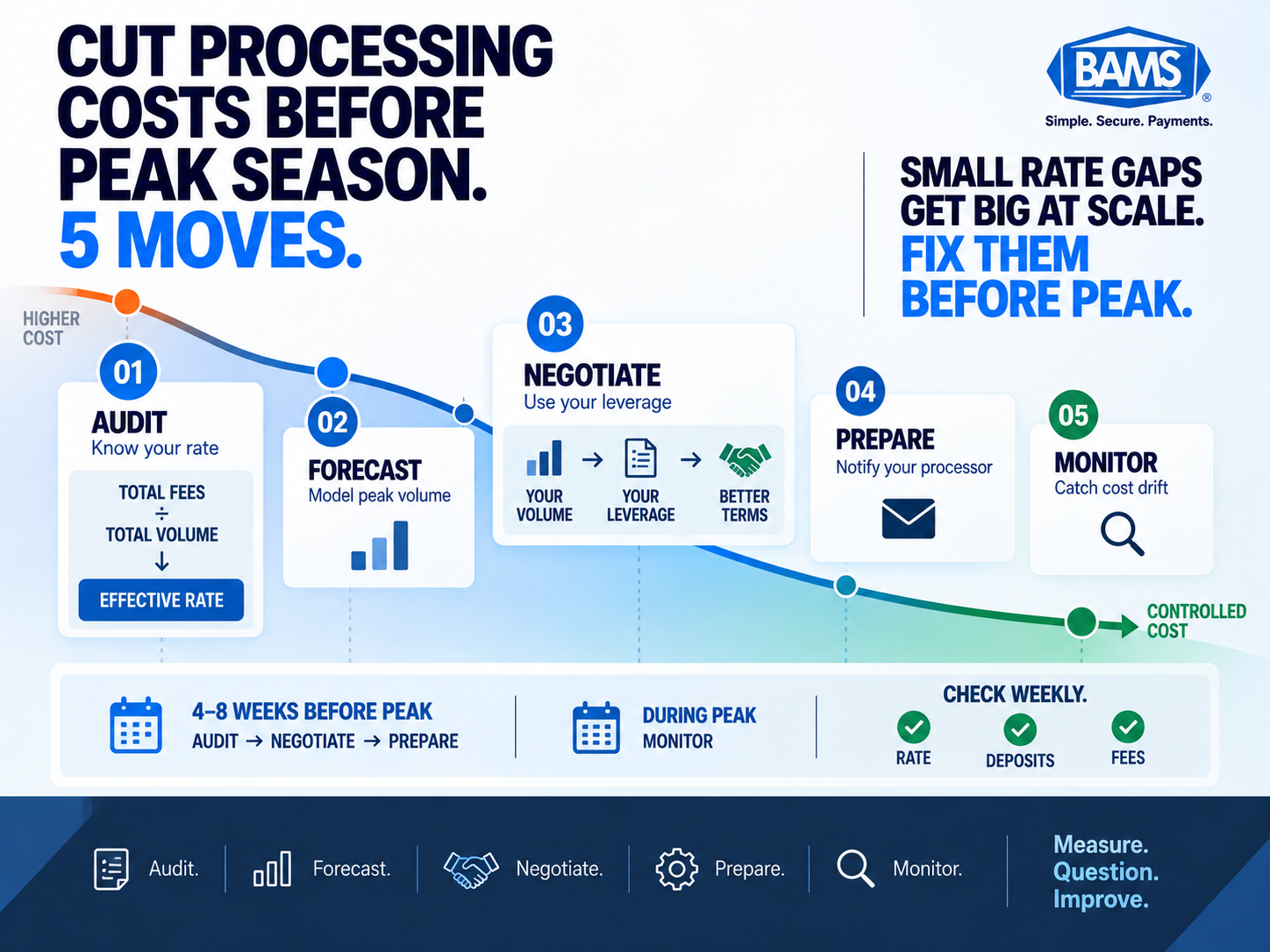
Peak-season processing cost control starts before volume rises. Audit your current costs, forecast the impact, negotiate with data, prepare your account and monitor for changes.
This guide follows a five-stage framework designed to be executed four to eight weeks before your peak season begins. The stages build on each other sequentially, but each produces standalone value even if you don’t complete every step.
- Stage 1: Audit — Establish your true baseline costs using real transaction data.
- Stage 2: Forecast — Project peak-season volume and model how your current rates will scale.
- Stage 3: Negotiate — Use your audit and forecast to renegotiate processor terms or evaluate alternatives.
- Stage 4: Prepare — Notify your processor, adjust account settings, and prevent surprise holds.
- Stage 5: Monitor — Track costs in real time during peak season and correct drift immediately.
The interconnection matters. Your audit data fuels your forecast. Your forecast gives you negotiating leverage. Your negotiation results determine what you need to prepare. And your preparation determines whether monitoring catches problems early or too late.
Step-by-Step Breakdown: Reducing Payment Processing Costs Before Peak Season
Step 1: Audit Your Current Effective Rate
Objective: Know exactly what you’re paying per dollar processed, broken down by fee category, before you attempt any optimization.
Pull your last three months of processing statements and your last peak season’s statements (if available). Calculate your effective rate for each month: total fees divided by total volume. Then break the fees into their component parts. Most statements separate interchange, assessments, and processor markup, though some bundled pricing models obscure this deliberately.
If you’re on a flat-rate model (e.g., 2.9% + $0.30), your effective rate is straightforward but likely higher than necessary for your volume. If you’re on tiered pricing, look at how many transactions fall into the “mid-qualified” or “non-qualified” buckets, as these are where hidden costs accumulate. If you’re on interchange-plus, you’re in the best position to see exactly where your money goes.
For a detailed walkthrough of this calculation, including how to identify specific fee categories draining your margin, see this guide to lowering credit card processing fees.
Anti-patterns: Don’t rely on the rate your processor quoted when you signed up. Don’t average your fees across all months without separating peak from off-peak periods. Don’t ignore small line items like PCI non-compliance fees, statement fees, or batch fees, as they add up fast at high volume.
Success indicators: You can state your effective rate to two decimal places for both peak and off-peak months. You know the dollar amount of interchange, assessments, and processor markup separately. You’ve identified any fees that seem inconsistent or unexplained.
Step 2: Forecast Peak-Season Volume and Model Fee Scaling
Objective: Project how your current rate structure will perform under peak-season transaction volume and mix, so you can quantify the cost of inaction.
Start with last year’s peak-season data. If you grew 20% year-over-year, apply that growth to your peak projections. Factor in any planned promotions, product launches, or marketing spend increases that will drive additional volume. Align your product launch calendar with your transaction volume forecast so you’re not surprised by spikes within the spike.
Now model the fees. Take your current effective rate and apply it to projected volume. Then adjust for the transaction mix changes that peak season brings. If your average order value increases, per-transaction fixed fees (like $0.10 or $0.30 per transaction) become a smaller percentage of each sale, which helps. But if more customers use premium rewards cards, interchange rates climb, which hurts. The net effect depends on your specific business.
Build a simple spreadsheet with three scenarios: conservative (10% above last peak), expected (your best estimate), and aggressive (25% above). Calculate total fees for each. The gap between your conservative and aggressive scenarios is your exposure range. This number is what gives you negotiating power in the next step.
Anti-patterns: Don’t assume your off-peak transaction mix will hold during peak season. Don’t ignore the impact of higher chargeback rates during promotional periods. Don’t treat forecasting as a one-time exercise; update it as you get closer to peak season and have better data.
Success indicators: You have a dollar figure for projected processing costs under three scenarios. You can articulate how much a 0.1%, 0.2%, or 0.3% rate reduction would save across the peak period. You’ve identified which fee components are most sensitive to volume changes.
Step 3: Negotiate Processor Terms or Evaluate Alternatives
Objective: Secure better rates, fee structures, or contract terms before peak volume locks you into your current arrangement.
Armed with your audit and forecast, contact your processor’s account management team (not general support). Present your projected volume increase as an opportunity for them: more transactions means more revenue for the processor, which justifies a lower per-transaction markup. Specifically ask about volume-based pricing tiers, reduced per-transaction fees at higher volumes, and whether your current pricing model is the most cost-effective for your projected mix.
If you’re on flat-rate pricing and processing more than $20,000 per month, you’re almost certainly overpaying. Interchange-plus pricing gives you transparency and typically saves 0.3% to 0.8% for mid-volume merchants. This is the single highest-impact change most eCommerce businesses can make, and it should be explored well before peak season, not during it.
If your current processor won’t negotiate meaningfully, this is the time to evaluate alternatives. A merchant services partner like BAMS offers interchange-plus pricing with transparent fee breakdowns and dedicated account managers who can model your peak-season costs before you commit, removing the guesswork from rate comparisons.
Anti-patterns: Don’t negotiate during peak season when switching costs are highest and your leverage is lowest. Don’t focus exclusively on the percentage rate while ignoring per-transaction fees, monthly minimums, or early termination clauses. Don’t accept verbal promises; get rate changes in writing before peak season begins.
Success indicators: You have a written confirmation of your rates and fee structure for the upcoming peak period. You’ve compared your effective rate under the new terms against your forecast. You understand exactly what triggers any volume-based pricing changes.
Step 4: Prepare Your Account and Prevent Surprise Holds
Objective: Ensure your processor is ready for your volume increase so that sudden spikes don’t trigger risk flags, reserve requirements, or funding delays.
This is the step most eCommerce managers skip, and it’s the one that causes the most acute pain. Payment processors use risk algorithms that flag unusual activity. If your average monthly volume is $150K and you suddenly process $400K in a week, your processor’s risk team may place a hold on your funds, require a rolling reserve (typically 5-10% of volume held for 6 months), or delay deposits until they’ve reviewed your account.
The fix is straightforward but requires proactive communication. Contact your processor four to six weeks before peak season. Provide your volume forecast in writing. Ask them to adjust your account’s expected volume thresholds. Request confirmation that your funding schedule won’t change during high-volume periods. If your processor offers next-day funding, confirm that this applies during peak season without volume caps.
For a comprehensive checklist covering pre-season processor notification, authentication settings, and retry logic configuration, see this pre-season payment setup guide. For managing the chargeback and reserve risks that follow peak season, this peak season planning guide covers the 30-to-90-day window after major sales events.
Anti-patterns: Don’t assume your processor will automatically accommodate volume increases. Don’t wait until you see a hold on your account to address this. Don’t ignore the chargeback ratio implications of peak-season promotions, as a spike in disputes can trigger additional reserves even if you’ve pre-notified about volume.
Success indicators: You have written confirmation from your processor that your account thresholds have been adjusted. Your funding schedule is confirmed for peak season. You’ve reviewed your chargeback ratio and have a plan to keep it below your processor’s threshold (typically 1%).
Step 5: Monitor Costs in Real Time and Correct Drift
Objective: Catch fee anomalies, rate changes, or unexpected charges during peak season while you still have time to act.
Set up a weekly review cadence during peak season. Every Monday, pull the prior week’s processing data and calculate your effective rate. Compare it to your forecast. If your effective rate is climbing, identify which fee category is responsible. Is interchange higher because of a shift in card mix? Are you seeing new line items? Did a pricing tier change kick in that you weren’t expecting?
Real-time analytics matter here.
If your processor provides a dashboard, use it. If not, build a simple tracking sheet that captures daily volume, daily fees, effective rate, and any flagged transactions. The goal isn’t perfection; it’s catching a 0.2% drift in week one of peak season rather than discovering it on your January statement when you’ve already processed $1.5 million at the higher rate.
Also monitor your deposit timing. If deposits that normally arrive next-day start taking two or three days, contact your processor immediately. Delayed deposits during peak season can create a cash flow gap that forces you to draw on credit lines or miss supplier payments, turning a processing issue into an operational crisis.
BAMS offers next-day funding specifically designed to prevent this timing gap, giving you access to revenue the next business day so your cash flow keeps pace with your sales velocity during the periods that matter most.
Anti-patterns: Don’t wait until the end of peak season to review your statements. Don’t ignore small rate increases, as they compound across high volume. Don’t treat deposit delays as normal during busy periods; they’re a signal that something has changed on your account.
Success indicators: Your weekly effective rate stays within 0.1% of your forecast. Deposits arrive on their expected schedule throughout peak season. You can identify and explain any fee variances within 48 hours of their occurrence.
Practical Examples: How the Numbers Play Out
Scenario A: The Cost of a “Small” Rate Difference
An online retailer processes $180K per month during off-peak and $480K per month during their three-month peak season. Their current effective rate is 2.65%. A competitor quote comes in at 2.35%. During off-peak months, the difference is $540 per month. Noticeable, but not urgent. During peak season, that same 0.3% gap costs $1,440 per month, or $4,320 across the peak period. Over a full year, the rate difference costs $10,800. That’s a meaningful line item, recovered entirely by switching before peak season begins.
Scenario B: The Hidden Cost of Deposit Delays
A growing ecommerce brand processes $60K in sales during a Black Friday weekend. Their processor holds deposits for three business days. That $60K doesn’t arrive until Thursday. Meanwhile, the brand needs to reorder inventory Monday morning and has committed $25K to a retargeting campaign launching Tuesday. They draw $30K from a business line of credit at 12% APR to cover the gap. The interest cost is modest for a single event, but this pattern repeats across the entire peak season, adding up to hundreds or thousands in unnecessary financing costs that could have been avoided with next-day funding.
Scenario C: The Surprise Reserve Hold
A DTC brand doubles its monthly volume from $200K to $420K during a seasonal push without notifying its processor. The processor’s risk system flags the account. A 10% rolling reserve is applied, holding $42,000 for six months. The brand suddenly has $42K less in working capital during its most important growth period. The reserve was entirely preventable with a single phone call and a volume forecast email sent four weeks earlier.
Common Mistakes and Pitfalls
Treating processing fees as fixed costs. They’re not. Interchange varies by card type and transaction method. Processor markup is negotiable. Even small optimizations compound at peak-season volume.
Optimizing too late. Switching processors takes two to four weeks minimum. Negotiating rate changes requires leverage, which means presenting forecasts before peak season, not during it. If you start this process in November for a holiday peak, you’re already behind.
Ignoring the cash flow dimension. Cost-per-transaction is only half the picture. When deposits are delayed during your highest-spend period, the effective cost includes whatever you pay to bridge the gap: credit line interest, missed early-payment supplier discounts, or deferred inventory orders that cause stockouts.
Focusing only on rate and ignoring structure. A processor quoting 2.2% on a flat-rate model may cost you more than one quoting interchange-plus with a 0.25% markup, depending on your card mix. The pricing model matters as much as the number.
Neglecting post-peak exposure. Chargebacks from peak-season sales arrive 30 to 90 days later. If your chargeback ratio spikes above 1%, your processor may impose penalties or reserves retroactively. Plan for this during peak season, not after.
What to Do Next
Start with one action: calculate your effective rate for the last three months. Pull your statements, divide total fees by total volume, and write down the number. That single data point tells you whether your current setup is competitive or quietly draining margin.
If your peak season is more than four weeks away, you have time to work through the full framework. If it’s closer, prioritize Steps 1, 4, and 5: know your rate, notify your processor about expected volume, and set up weekly monitoring.
Revisit this guide each year as your business grows. What works at $500K in annual peak-season volume may not be optimal at $1.5M. Processing costs are a moving target, and the businesses that treat them as a recurring optimization rather than a set-and-forget decision consistently pay less over time.
Frequently Asked Questions
When should businesses review their payment processing setup before peak seasons?
Four to eight weeks before your expected volume increase is the ideal window. This gives you enough time to complete a full audit, negotiate rate changes, notify your processor about volume projections, and switch providers if necessary. If your peak season starts in November, begin the process no later than early September.
What is a seasonal volume playbook in merchant services optimization?
A seasonal volume playbook is a documented plan that covers your projected transaction volume, expected card mix changes, processor notification timeline, negotiated rate terms, deposit schedule confirmation, and monitoring cadence for peak periods. It turns reactive cost management into a repeatable pre-season process that you refine each year based on actual results.
How can businesses use data to forecast transaction volume for seasonal planning?
Start with last year’s peak-season transaction data as your baseline. Apply your year-over-year growth rate, then adjust for any planned promotions, product launches, or marketing spend increases. Build three scenarios (conservative, expected, aggressive) and model your processing fees under each. Update the forecast as you get closer to peak season and have fresher data from recent months.
Why do payment processors place holds on accounts during high-volume periods?
Processors use automated risk algorithms that flag unusual activity. A sudden spike in volume, especially if it exceeds your account’s established processing thresholds, can look like fraudulent activity or a business in distress. The processor may place a temporary hold on funds, impose a rolling reserve (typically 5-10% of volume), or delay deposits until their risk team reviews the account. Proactively notifying your processor with volume forecasts prevents most of these issues.
What’s the difference between flat-rate and interchange-plus pricing for seasonal businesses?
Flat-rate pricing charges the same percentage on every transaction regardless of card type. It’s simple but typically more expensive for businesses processing over $20K per month. Interchange-plus pricing separates the non-negotiable interchange fee from the processor’s markup, giving you transparency into where your money goes and a lower effective rate in most cases. For seasonal businesses, interchange-plus is especially valuable because it lets you see exactly how card mix changes during peak season affect your costs.
How can next-day funding help during peak sales seasons?
Standard deposit timelines of two to three business days create a cash flow gap during peak season, when you’re spending heavily on inventory, marketing, and fulfillment. Next-day funding closes that gap by getting revenue into your account the next business day. This reduces or eliminates the need to draw on credit lines to cover operating expenses while waiting for deposits, which saves on interest costs and keeps your working capital available for growth activities.