How to Structure Funeral Home Pricing Transparency
Redesign preneed payment options to control cash flow timing without sacrificing compliance or family trust
Learn how installment terms, dual pricing configurations, and payment method acceptance directly control when preneed revenue reaches your operating account. This guide helps funeral home operators restructure payment options to close funding gaps while maintaining full pricing transparency.
TL;DR
- Payment structure is a cash flow tool, not just a consumer convenience – How families pay on preneed contracts (card, ACH, check) and on what schedule directly determines when that money becomes usable in your operating account.
- Dual pricing recovers processing costs transparently – Displaying both a cash price and a card price on your General Price List lets you offset credit card fees on installment payments without surcharging compliance risk, while maintaining funeral home pricing transparency.
- Shift your payment mix toward card on file with next day funding – Moving from check heavy collections to card on file can reduce your weighted average settlement time from 8+ days to under 3 days, freeing thousands in working capital annually.
- Weekly reconciliation catches gaps before they compound – A 15 minute weekly check of scheduled vs. actual collections and settlement times prevents small missed payments from becoming significant cash flow shortfalls.
- Review payment structures annually, not once – Processing rates, settlement speeds, state regulations, and your own cost structure all change over time. An annual review ensures your preneed payment system stays aligned with your actual cash flow needs.
Guide Orientation: What This Covers and Who It’s For
This guide examines how the payment structures you offer families on preneed contracts directly control when cash arrives in your operating account. If you run a family owned funeral home (one to ten locations) and you’ve ever felt a gap between the services you’ve committed to deliver and the funds available to cover those commitments, this is for you.
By the end, you’ll understand how to evaluate installment terms, dual pricing configurations, and payment method acceptance as cash flow timing instruments. You’ll be able to restructure your preneed payment options to close funding gaps without sacrificing funeral home pricing transparency or violating FTC Funeral Rule requirements.
This guide does not cover preneed trust or insurance investment strategy, state specific preneed licensing, or at need collections. It focuses exclusively on the operatorside cash flow consequences of how you structure preneed payments.
Why Preneed Payment Timing Matters More Than Most Operators Realize
Preneed contracts represent committed future obligations. Every contract you sign locks in service delivery at a fixed or partially fixed price. But the revenue from those contracts arrives on a schedule you designed (or inherited) years ago, often without analyzing how that schedule interacts with your actual operating costs.
The problem compounds quietly. A funeral home running 200 preened contracts with 36 month installment plans may have $400,000 or more in committed future revenue trickling in at $50 to $150 per family per month. Meanwhile, the costs those contracts will eventually trigger (staff, facilities, merchandise) don’t wait for installments to finish.
FTC enforcement activity also reinforces the importance of accurate pricing disclosures. In the agency’s first undercover Funeral Rule phone sweep, FTC staff determined that 39 funeral homes violated the Rule. On 38 calls, providers either refused to answer pricing questions or provided inconsistent pricing for identical services.
The cost of inaction is a slow erosion of working capital. You don’t notice the gap until a month arrives where three at need cases hit simultaneously, your installment deposits haven’t cleared, and you’re covering casket invoices out of reserves. Structuring preneed payments well prevents that scenario from becoming routine.
Core Concepts: Payment Structure as a Cash Flow Lever
Preneed Payment Timing vs. Preneed Funding
Most funeral home operators think about preneed in terms of funding vehicles: trust funded vs. insurance funded. That distinction matters for regulatory compliance and longterm growth. But it obscures a more immediate question: when does money move from the family’s account to yours, and how long does it sit in transit?
Payment timing is the interval between a family authorizing a payment and that payment becoming usable cash in your operating account. This interval varies dramatically based on payment method (card vs. ACH vs. check), processor settlement speed, and whether you’ve structured installments to align with your cost cycles.
Dual Pricing vs. Surcharging
Dual pricing for funeral services generally means presenting different prices based on the payment method, while surcharging involves adding a fee when an eligible credit card is used. These approaches can involve different disclosure and payment network requirements. Mastercard, for example, permits surcharging on eligible credit cards subject to its rules but prohibits surcharges on Mastercard debit and prepaid cards. Merchants must also comply with applicable state and federal law.
For preneed contracts, the distinction matters because recurring card payments can create processing costs throughout the installment period. Before changing your pricing structure, confirm the configuration with your payment provider and review the applicable card network and state requirements.
The General Price List Connection
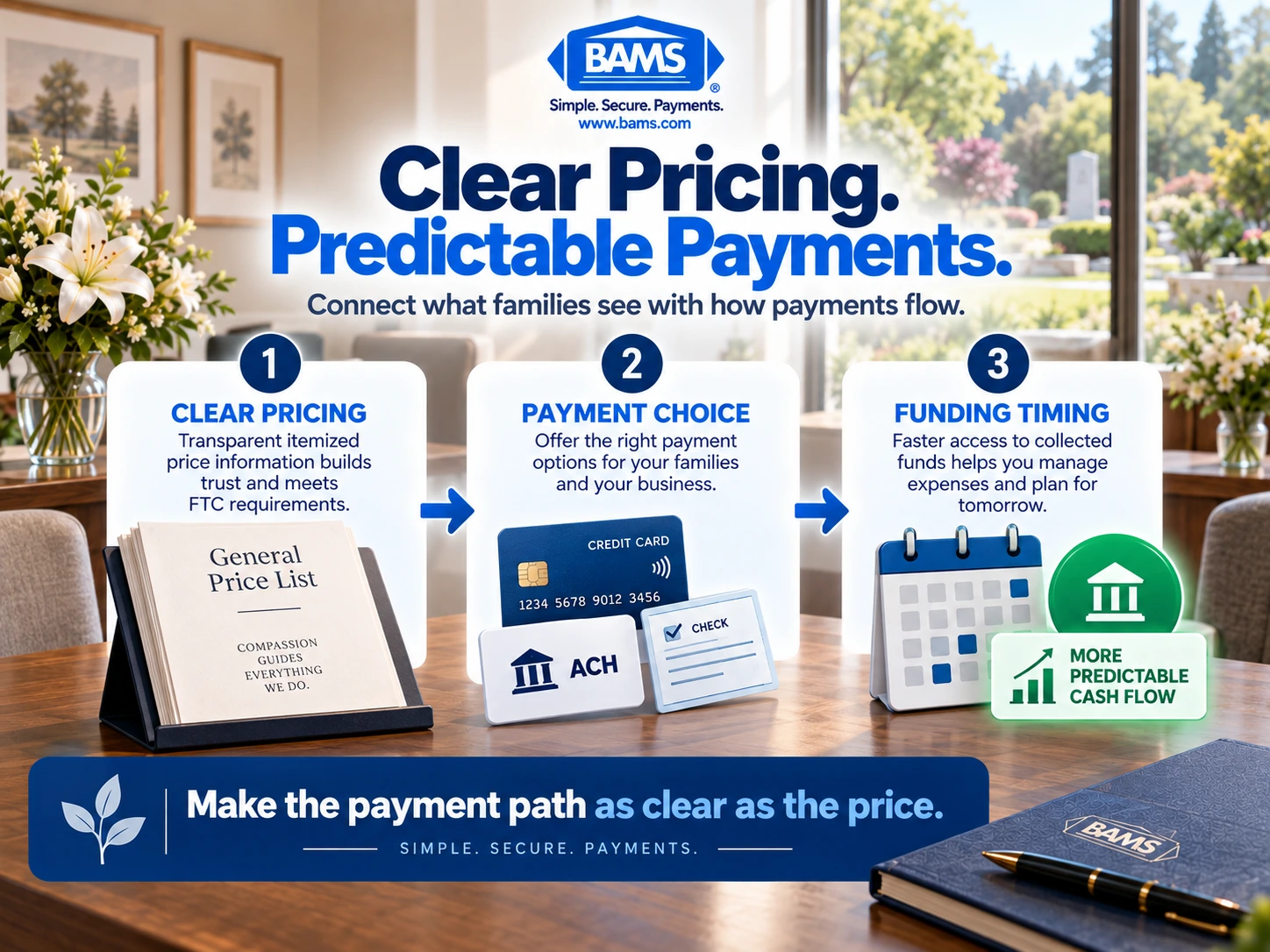
The FTC Funeral Rule requires funeral providers to give consumers accurate, itemized price information. The General Price List is a central part of that disclosure framework, and consumers who inquire in person about funeral goods, services or prices generally must receive a GPL they can keep. Funeral providers must also provide accurate price information when consumers ask about offerings or prices by telephone.
Your payment and pricing practices should therefore be reviewed alongside your required funeral pricing disclosures. If different payment methods affect what a family will ultimately pay, review the arrangement with appropriate compliance resources to determine how those amounts should be communicated consistently.
The Framework: Map, Structure, Accelerate
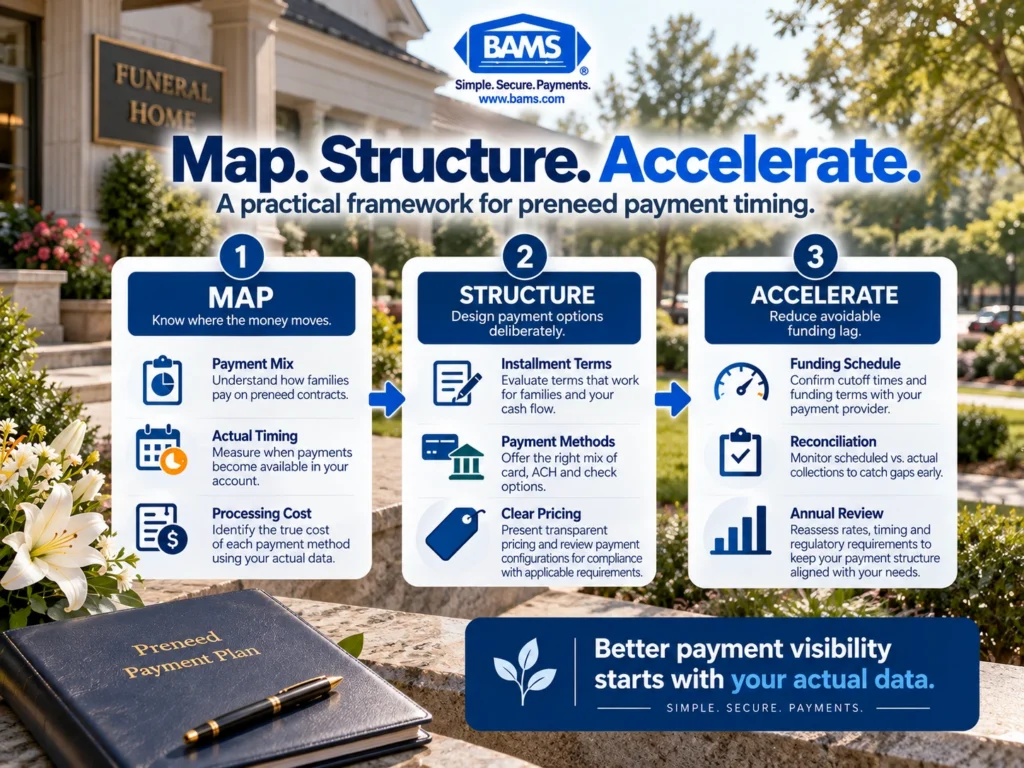
This guide follows a three phase approach to redesigning preneed payment structures for better cash flow timing:
- Map your current preneed payment flows to identify where cash sits idle, where processing costs compound, and where timing gaps emerge between collections and obligations.
- Structure your payment options (installment terms, payment methods, dual pricing) as deliberate cash flow instruments rather than default consumer conveniences.
- Accelerate the movement of collected payments into your operating account by aligning processor settlement, funding speed, and reconciliation practices.
These phases interconnect. You can’t structure effectively without mapping first, and acceleration without proper structure just moves the same problems faster. The steps below walk through each phase in detail.
Step 1: Audit Your Current Preneed Payment Mix
Objective
Identify exactly how families are paying on active preneed contracts and how long each payment method takes to become usable cash.
Execution Guidance
Pull your active preneed contract list and categorize each contract by payment method: credit card on file, ACH/bank draft, check, or paid in full. For each category, document the average settlement time from payment authorization to cleared funds in your operating account. Most operators have never done this exercise and are surprised by what they find.
Settlement timing can vary by payment method, processor, account configuration, cutoff time and banking schedule. Map each payment method against your actual bank statements for the past 90 days rather than relying on a generic industry timeline. Record the time between payment initiation and available funds so you can compare the real performance of card, ACH and check collections.
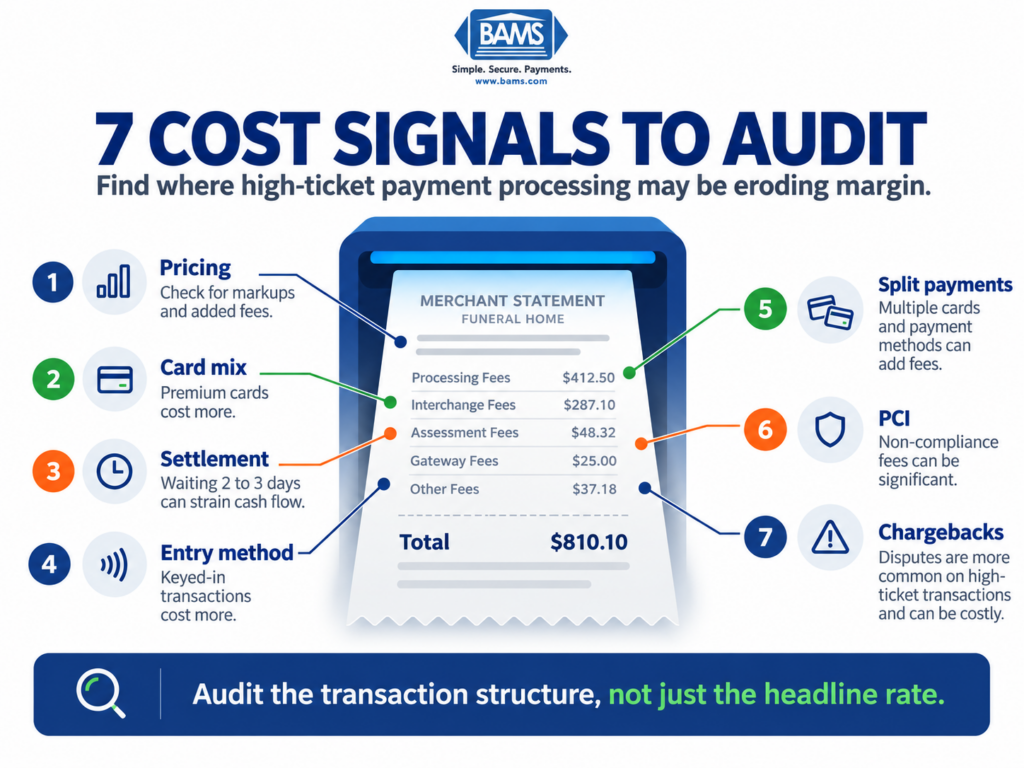
While you’re auditing, note the processing cost associated with each payment method. Even a relatively small per payment processing cost can compound across recurring installments and a large preneed book. Use your actual merchant statements to calculate the effect rather than relying on advertised rates. For guidance on identifying hidden processing costs, review these payment processing cost signals funeral homes should audit.
Anti Patterns
Don’t assume your processor’s stated settlement time matches reality. Don’t ignore contracts where families are paying by check simply because “that’s what they prefer.” Don’t treat all payment methods as equivalent in your cash flow planning.
Success Indicators
You have a spreadsheet or report showing every active pre need contract, its payment method, actual average settlement time, and per-transaction processing cost. You can calculate your total monthly pre need collections and the weighted average time those collections take to become available cash.
Step 2: Redesign Installment Terms Around Your Cost Cycles
Objective
Align installment payment schedules with your operating expense timing so that preneed collections arrive before (or concurrent with) the costs they’ll eventually fund.
Execution Guidance
Most funeral homes offer installment plans based on what feels reasonable to families: 12, 24, or 36 monthly payments. But the length and timing of those installments should also reflect when you need cash. If your major fixed costs (facility lease, vehicle payments, insurance premiums) hit on the first of the month, structure installment due dates for the 20th to 25th of the prior month. This ensures collections clear before obligations arrive.
Consider shortening default installment windows. A 24 month plan collects the same total revenue as a 36 month plan but concentrates cash flow into a tighter window. Families often accept shorter terms when you present them alongside a small incentive, such as a modest discount for paid in full or a 12 month option. The key is presenting options rather than defaulting to the longest available term.
For higher value preneed contracts, evaluate whether a larger initial payment and a shorter remaining installment period would improve collection timing while remaining appropriate for the family and compliant with applicable preneed requirements. Use your historical payment data to compare completion rates across different installment structures.
Anti-Patterns
Don’t offer 48 month or 60 month installment plans without modeling the cash flow impact. Don’t set all installment due dates on the first of the month if that’s also when your largest expenses hit. Don’t ignore the relationship between installment length and abandonment risk.
Success Indicators
Your installment terms are documented with explicit rationale tied to your cost cycle. You offer two to three installment options with different term lengths. Your default due date is set to precede your major monthly expense dates by at least five business days.
Step 3: Implement Dual Pricing That Protects Margins and Maintains Transparency
Objective
Build processing costs into your preneed pricing structure transparently, so card paying families cover the cost of their payment method without creating compliance risk or eroding trust.
Execution Guidance
Dual pricing for funeral services should be designed so families can clearly understand the price that applies to their chosen payment method. Before implementing different cash and card prices, confirm the structure with your payment provider and review applicable card network, state and funeral pricing requirements.
The FTC Funeral Rule requires accurate, itemized funeral pricing and specified disclosures, but those requirements should not be treated as approval of a particular dual pricing configuration. Payment network rules and applicable state law must be evaluated separately.
Any pricing difference should be reviewed against the rules that apply to your specific payment program. Do not assume that a particular percentage is permissible simply because it approximates your processing cost.
On installment contracts, card processing costs can recur with each payment. That makes it important to understand the cumulative processing cost over the full payment schedule. Use your actual processing agreement and merchant statements to calculate that amount, then determine with your payment and compliance resources how any payment method pricing differences should be disclosed.
Keep your pricing documents and staff explanations consistent. In the FTC’s report on its undercover Funeral Rule phone sweep, the agency emphasized that funeral providers must give required pricing information when consumers ask by telephone.
Anti Patterns
Don’t add a surcharge at the point of sale without verifying state specific legality. Don’t display only one price and then reveal a card fee during the arrangement conference. Don’t set a dual pricing differential higher than your actual processing cost, as this creates both a trust issue and potential regulatory scrutiny.
Success Indicators
Your GPL displays both cash and card prices for every line item. Your preneed contracts specify which price applies based on payment method. Your staff can explain the pricing structure clearly and consistently by phone (a requirement the FTC actively tests).
Step 4: Steer Preneed Payment Methods Toward Faster Settlement
Objective
Shift your preneed payment mix toward methods that settle fastest without forcing families into options they’re uncomfortable with.
Execution Guidance
Payment methods can produce different collection and funding timelines, but actual timing depends on your processor, bank, cutoff schedule and account configuration. Use your own settlement data to rank the payment methods available to your funeral home from fastest to slowest.
- Card on file: Verify your processor’s actual funding schedule.
- ACH/bank draft: Measure initiation to available funds timing.
- Check: Include collection, delivery and deposit time.
Your goal is to make the fastest settlement option the easiest option for families. This means defaulting your preneed contract paperwork to card on file as the primary payment method, with ACH as a secondary option and check as an available but non default choice. The arrangement conference is where this happens: present card on file first, explain the convenience (“We’ll charge your card automatically on the 20th of each month, so you never have to remember to mail a check”), and position it as the standard approach.
For operators whose processors settle in two to three days, switching to a payment processing partner that offers next-day funding can cut your average settlement time in half. On a preneed book generating $30,000 in monthly installment collections, moving from three day to one day settlement means having that cash available two days sooner every month. Over a year, that’s 24 extra days of cash availability.
A merchant services partner for funeral homes can help you review funding schedules, payment acceptance and processing costs together. BAMS offers next day funding for qualifying merchants, which can help shorten the time between eligible card transactions and available funds.
Anti Patterns
Don’t refuse checks entirely, as some families (particularly older clients) strongly prefer them. Don’t store card information insecurely or without PCI compliance. Don’t assume families will object to card on file; most prefer the convenience when it’s presented well.
Success Indicators
Your payment mix is documented, actual settlement timing is measured by payment method and you can identify whether changes in payment acceptance are improving the availability of collected funds.
Step 5: Build a Reconciliation Rhythm That Catches Gaps Early
Objective
Establish a weekly reconciliation process that identifies missed payments, settlement delays, and cash flow variances before they become working capital problems.
Execution Guidance
Cash flow gaps from preneed payment timing don’t announce themselves. They accumulate. A family’s card declines and nobody follows up for three weeks. Your processor holds a batch for “review” and you don’t notice until rent is due. These small delays compound into real shortfalls.
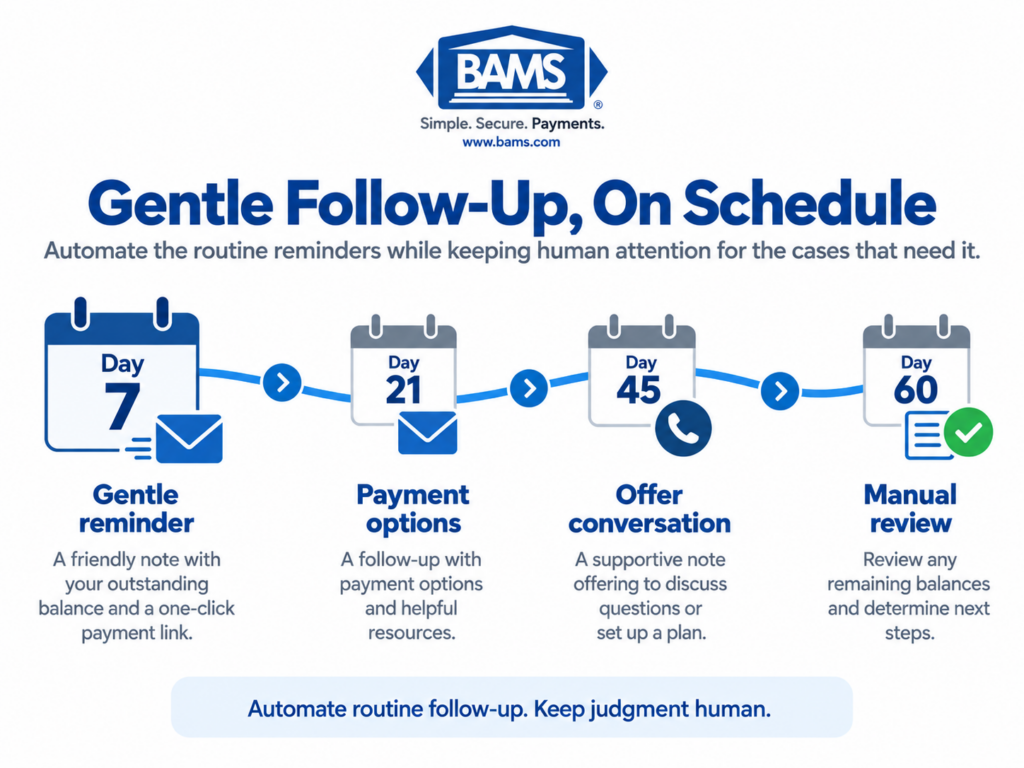
Set a weekly reconciliation checkpoint (15 to 20 minutes, same day each week) where you verify three things: (1) all scheduled installment payments for the prior week were collected, (2) all collected payments have settled into your operating account, and (3) any declined or missed payments have been flagged for follow-up within 48 hours.
Most funeral home management software can generate an installment collection report. Cross reference that report against your bank deposits. If your processor provides a merchant portal, use it to verify batch settlement dates. The goal is catching a $150 missed installment on day three, not day thirty. For a deeper framework on identifying whether your cash gaps are structural or timing related, see this guide on signs your cash gaps are a timing problem.
Assign this task to a specific person. In a family owned operation, it’s often the office manager or bookkeeper. The key is consistency: a reconciliation that happens sporadically catches nothing.
Anti Patterns
Don’t wait until month end to reconcile preneed collections. Don’t rely solely on your processor’s reporting without cross referencing bank deposits. Don’t let declined payments sit unaddressed for more than one billing cycle.
Success Indicators
You have a documented weekly reconciliation checklist. Missed or declined payments are identified promptly and your actual collections are tracked against scheduled collections so material variances can be investigated.
Step 6: Revisit Payment Structures Annually, Not Once
Objective
Treat your preneed payment structure as a living system that evolves with your cost structure, processing rates, and regulatory environment.
Execution Guidance
Most funeral homes set up their preneed payment options when they first start selling preneed contracts and never revisit them. This is the single most common reason payment timing gaps develop. Your costs change. Processing rates change. Card network rules change. State surcharging laws change. Your payment structure needs to keep pace.
Schedule an annual review (tie it to your fiscal year end or your GPL update cycle) where you evaluate four things:
- Processing cost per payment method: Has your effective rate changed? Are you paying more per transaction than last year?
- Settlement speed: Is your processor still delivering the settlement times they promised? Have faster options become available?
- Payment mix shift: Has your ratio of card vs. ACH vs. check changed? If more families are paying by card, your dual pricing differential may need adjustment.
- Regulatory changes: Have your state’s surcharging or dual pricing rules changed? Has the FTC updated its Funeral Rule guidance?
This review connects directly to your broader working capital management strategy. Preneed payment timing is one of three revenue streams (alongside at-need card payments and insurance assignments) that determine your overall cash position. Reviewing them in isolation misses the full picture.
Anti Patterns
Don’t assume that a payment structure that worked five years ago still works today. Don’t skip the review because “nothing has changed” without actually verifying that. Don’t treat your processing contract as a set it and forget it arrangement.
Success Indicators
You have a documented annual review date on your calendar. Each review produces at least one actionable change (even if it’s confirming that current structures are still optimal). Your processing costs and settlement times are benchmarked year over year.
Hypothetical Example: The 200 Contract Preneed Book
Consider a hypothetical funeral home with 200 active preneed contracts. The following example illustrates how changes in payment mix and settlement timing could affect cash availability. The figures are illustrative and do not represent guaranteed BAMS customer results.
Before Restructuring
- 70% of payments by check (average settlement: 10 days)
- 20% by credit card with standard processing (average settlement: 3 days)
- 10% by ACH (average settlement: 4 days)
- No dual pricing (absorbing ~$220/month in card processing fees)
- Monthly reconciliation only
- Weighted average settlement: 7.9 days
After Restructuring
- 65% of payments by card on file with next day funding (average settlement: 1 day)
- 25% by ACH (average settlement: 4 days)
- 10% by check (average settlement: 10 days)
- Dual pricing recovers card processing costs transparently
- Weekly reconciliation catches missed payments within 7 days
- Weighted average settlement: 2.15 days
The result: the same $36,700 in monthly collections becomes available nearly six days sooner on average. Over a year, that’s the equivalent of having an additional $7,000 to $8,000 in accessible working capital at any given time, simply from changing when money arrives, not how much.
Common Mistakes and Pitfalls
The most predictable failure is treating payment structure as a one time administrative decision rather than an ongoing cash flow management tool. Operators set up installment terms during their first preneed training, pick a processor based on whoever the preneed insurance company recommends, and never revisit either choice.
Another common mistake is implementing dual pricing inconsistently. If your GPL shows dual prices but your preneed counselor quotes only one price by phone, you’re creating exactly the kind of discrepancy the FTC actively investigates. Train every staff member who discusses pricing to present both prices consistently.
Finally, operators often focus on reducing processing fees without considering settlement speed. A processor that charges 2.5% but settles in four days may cost you more in cash flow drag than one charging 2.8% with next day funding. Evaluate total cost of payment acceptance, not just the rate.
What to Do Next
Start with Step 1. Pull your active preneed contract list this week and categorize every contract by payment method and actual settlement time. This single exercise will reveal whether your cash flow gaps are a pricing problem, a timing problem, or both.
You don’t need to restructure everything at once. Pick the highest impact change your audit reveals (it’s usually shifting check paying families to card on file) and implement that first. Measure the settlement time improvement over 60 days before moving to the next change.
Revisit this guide quarterly during your first year of restructuring, then annually once your payment structures stabilize. The goal isn’t perfection; it’s building a payment system that delivers predictable cash flow rather than one that creates surprises you have to manage reactively.
Frequently Asked Questions
What is the FTC Funeral Rule and why does it affect payment structure decisions?
The FTC Funeral Rule requires funeral providers to give consumers accurate, itemized price information and specified disclosures. It includes requirements for the General Price List and other price lists and requires providers to give accurate pricing information when consumers ask by telephone. Because payment practices can affect what families ultimately pay, funeral homes should review payment related pricing alongside their required funeral pricing disclosures.
How does dual pricing differ from surcharging for funeral services?
Dual pricing generally presents different prices based on payment method, while a surcharge is an additional charge applied to an eligible credit card transaction. Card-network requirements differ by transaction type. Mastercard, for example, permits qualifying credit card surcharges subject to its rules but prohibits surcharges on Mastercard debit and prepaid cards. Funeral homes should confirm their specific configuration against applicable network, state and funeral pricing requirements.
How can funeral homes optimize their merchant services to comply with the FTC Funeral Rule?
Ensure your processor supports clear, itemized transaction records that match your GPL line items. If you implement dual pricing, your payment system needs to handle two price tiers without manual workarounds that introduce errors. Choose a processor that provides detailed reporting for reconciliation, and confirm that any surcharge or dual pricing configuration complies with both card network rules and your state’s regulations.
What payment methods settle fastest for preneed installment collections?
There is no single settlement timeline that applies to every funeral home. Funding speed varies by processor, payment method, cutoff schedule, bank and merchant account configuration. Compare your actual card, ACH and check deposits over a representative period to determine which methods make collected funds available fastest for your business.
How often should funeral homes review their preneed payment structures?
At minimum, annually. Tie the review to your GPL update cycle or fiscal year end. Evaluate processing costs per method, actual settlement times, payment mix changes, and any regulatory updates. Funeral homes that review payment structures only when problems arise typically discover that gaps have been compounding for months or years before becoming visible.
Which payment methods are affected by surcharging regulations in the funeral industry?
Surcharge requirements depend on the payment network, card type and applicable law. Mastercard permits surcharges on qualifying credit card transactions subject to its requirements but prohibits surcharges on Debit Mastercard and Mastercard prepaid cards. Funeral homes considering a surcharge should confirm the rules for every card brand they accept and review applicable state and federal requirements before implementation.
Sources