

Payment Processor Changes: A Guide to Accountability
Last Updated on October 6, 2026 by Dimitri Akhrin
How to evaluate funding guarantees, support structures, and escalation paths before you switch processors
Learn how to distinguish processors that advertise reliability from those that contractually guarantee it. This guide gives you a framework for evaluating funding commitments, dedicated support access, and real recourse when deposits don’t arrive on time.
TL;DR
- Next-day funding varies wildly — The gap between batch close and bank deposit is the real funding speed. Eligibility often depends on volume, chargeback ratios, and cutoff times that processors don’t always disclose upfront.
- Accountability is structural, not promotional — A dedicated account manager with direct contact and decision-making authority is fundamentally different from a 1-800 support queue. Test the support model before you sign.
- Transparent pricing is non-negotiable — Interchange-plus pricing lets you verify every charge. Tiered pricing hides fee increases in reclassified transaction categories. You can’t optimize costs you can’t see.
- Proactive monitoring prevents crises — Processors that flag chargeback spikes and funding anomalies before they escalate protect your cash flow. Reactive processors freeze your account and send form letters.
- Read the contract, especially the exit — Early termination fees, auto-renewal clauses, and reserve holdback policies determine your real switching cost. Negotiate these terms before you need them.
Guide Orientation: What This Covers and Who It’s For
This guide helps you evaluate payment processor changes through the lens of accountability, not just features. If you manage eCommerce payments for an established online business and you’ve ever waited for a deposit that didn’t arrive on time, this is for you.
By the end, you’ll understand how to distinguish between processors that advertise reliability and those that contractually guarantee it. You’ll have a framework for evaluating support structures, funding commitments, and escalation paths before you sign.
We won’t cover payment gateway integrations, PCI compliance checklists, or platform-specific setup guides. This is about the relationship layer: what happens when something breaks, and whether you have a real person to call when it does.

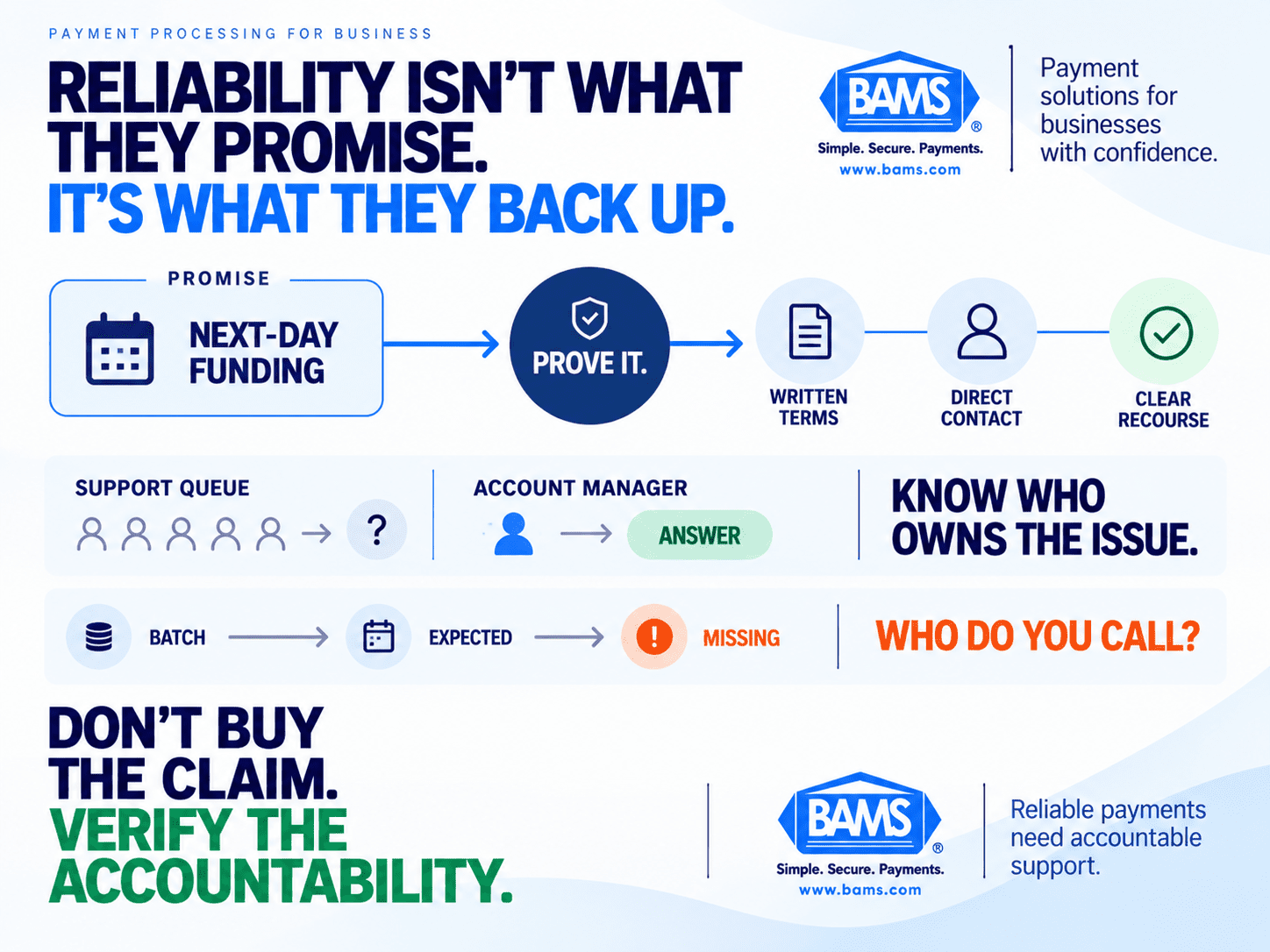
Processor reliability is not defined by what appears on a sales page. The real test is whether funding commitments are clear, support has ownership and someone is accountable when a deposit does not arrive.
Why Accountability in Payment Processing Matters Now
The gap between “next-day funding” as a marketing bullet point and next-day funding as an operational guarantee has real consequences. When your deposit doesn’t land and your processor won’t pick up the phone, that gap becomes a cash flow crisis. You miss payroll windows. You delay vendor payments. You scramble to cover shortfalls that weren’t yours to begin with.
Merchant funding timelines are not universal. The OCC explains that payment timing to merchants is specified in the agreement between the acquiring bank and the merchant and that settlement may be delayed when transactions require fraud review. That makes the written funding terms, including any hold conditions, more important than a processor’s headline funding claim.
The cost of choosing wrong isn’t just a fee problem. It’s an operational exposure. When credit card processing fees quietly climb through opaque surcharges or when a funding hold locks up your weekend revenue, the real question isn’t “what does my rate sheet say?” It’s “who do I call, and will they answer?”
The eCommerce payment landscape has consolidated around a few dominant platforms that prioritize scale over service. That consolidation means your support ticket competes with millions of others. Understanding what accountability actually looks like, structurally, gives you leverage before you need it.
Core Concepts: What Accountability Actually Means in Merchant Services
Funding Speed vs. Funding Reliability
Authorization and merchant funding are separate stages of the payment process. The OCC describes a settlement chain in which the issuer remits funds to the acquirer before the acquirer pays the merchant, with acquiring banks commonly using ACH credits to move funds into merchant deposit accounts. Funding reliability should therefore be measured by when money actually becomes available in your bank account, not by how quickly the card was authorized.
Feature vs. Guarantee
A feature is something a processor can do. A guarantee is something they’re obligated to do, with defined consequences when they don’t. “Next-day funding available” is a feature. “Next-day funding with a 9 PM cutoff, no additional fees, and a named account manager who monitors your settlement” is closer to a guarantee. The distinction matters when you’re building cash flow projections around deposit timing.
Support Tiers: Queue vs. Relationship
Most processors operate on a ticket-queue model. You submit a request, it enters a pool, and someone responds within a service-level window (often 24 to 72 hours). A relationship model assigns you a dedicated account manager who knows your business, your processing patterns, and your risk profile. When a hold appears on your account, the queue model requires you to explain your business from scratch. The relationship model means someone is already investigating before you call.
Interchange-Plus vs. Opaque Pricing
Interchange-plus pricing separates underlying payment costs from the processor’s markup, giving you a clearer view of what you’re paying and why. Nilson Report found that U.S. merchants paid $187.20 billion in processing fees on approximately $11.9 trillion in card purchase volume in 2024, equivalent to roughly $1.57 in fees for every $100 accepted. Your individual cost still depends on your transaction mix and pricing structure.
The Accountability Framework: Five Dimensions to Evaluate
A processor should be evaluated on more than rates and features. Funding commitments, escalation paths, pricing visibility, proactive monitoring and contractual recourse reveal what happens when something actually goes wrong.
When you’re evaluating payment processor changes, you need a structured way to compare what each provider actually delivers under pressure, not just what they promise during the sales process. This framework gives you five dimensions to assess:
- Funding Commitment — What exactly is guaranteed about deposit timing, and what conditions can override it?
- Escalation Architecture — When something goes wrong, how do you reach a decision-maker, and how fast?
- Pricing Transparency — Can you independently verify every line on your statement?
- Proactive Monitoring — Does your processor detect problems before you do?
- Contractual Recourse — If the processor fails to deliver, what are your options?
Each of the following steps maps to one of these dimensions. Together, they form a decision framework you can use to compare any processor, not just on price, but on the structural accountability that determines whether that price holds up when it matters.
Step-by-Step: How to Evaluate a Payment Partner for Real Accountability
Step 1: Audit the Funding Commitment (Not the Marketing Copy)
Objective: Determine whether “next-day funding” is a conditional feature or a binding operational commitment with defined parameters.
Start by requesting the processor’s funding terms in writing, separate from the marketing page. You’re looking for three specifics: the batch cutoff time, the conditions under which funding can be delayed or held and the notification process when a hold is triggered. The OCC notes that merchant payment timing is governed by the acquiring agreement and that acquiring banks may review transactions for fraud before releasing funds. If a processor cannot clearly explain the conditions that affect your funding schedule, that’s a signal.
Ask specifically: “Under what circumstances would my next-day deposit not arrive the next day?” A trustworthy processor will give you a clear, documented list. A processor selling you a feature will hedge or redirect to general terms of service.
Anti-patterns: Accepting a verbal assurance of “we fund next day” without reviewing the written settlement agreement. Assuming your current batch cutoff time will remain the same after onboarding. Ignoring the fine print about reserve holds.
Success indicators: You have a written document specifying cutoff times, hold conditions, and the notification process. You can model your cash flow around these terms with confidence. You understand exactly what triggers a delay.
Step 2: Map the Escalation Architecture
Objective: Understand exactly how you reach a human decision-maker when a deposit is missing, a chargeback is disputed, or an integration breaks.
This is where the difference between a 1-800 number and a dedicated account manager becomes concrete. Ask the processor to walk you through a specific scenario: “My Friday batch didn’t deposit on Monday. What happens?” Listen for whether the answer involves a ticket number and a wait time, or a named person and a direct line.
Document the escalation path. How many layers exist between your initial contact and someone who can actually release a hold or investigate a settlement discrepancy? In queue-based systems, the answer is often three or more tiers, each requiring you to re-explain the situation. In relationship-based models, your account manager is both the first contact and the person with authority to act.
Anti-patterns: Assuming “24/7 support” means 24/7 access to someone who can resolve your issue. Confusing chatbot availability with human escalation capability. Not testing the support line before you sign the contract.
Success indicators: You have a named contact with a direct phone number or email. You’ve confirmed that this person has the authority to investigate and resolve funding or account issues. You’ve tested the response time during your evaluation period.
Step 3: Demand Pricing Transparency at the Line-Item Level
Objective: Confirm that you can independently verify every charge on your monthly statement and identify exactly what you’re paying above interchange.
Request a sample statement from the processor and review it line by line. You’re looking for interchange-plus pricing that separates underlying payment costs from the processor’s markup. Mastercard explains that interchange is only one component of the merchant discount rate and that qualification can depend on factors including merchant category, authorization-to-clearing timing, enhanced transaction data and transaction volume. That is why transparent statement detail matters when you’re trying to identify what changed and why.
Ask for a fee schedule that lists every possible charge: monthly minimums, PCI compliance fees, batch fees, statement fees, early termination fees. Then compare that schedule against the sample statement. If charges appear on the statement that aren’t on the fee schedule, that’s a transparency failure. Merchant account optimization starts with visibility. You can’t reduce credit card processing fees you can’t see.
Anti-patterns: Signing based on a quoted “effective rate” without seeing how it’s calculated. Ignoring ancillary fees that don’t appear in the headline rate. Assuming your rate will remain stable without reviewing the contract’s rate-adjustment clauses.
Success indicators: Every charge on the sample statement maps to a line item on the fee schedule. You can calculate your effective rate independently. You understand the difference between interchange costs (which the processor doesn’t control) and markup (which they do).
Step 4: Evaluate Proactive Monitoring and Chargeback Defense
Objective: Determine whether the processor detects and responds to problems before they escalate, or only reacts after you report them.
Chargebacks are a useful test case. Ask the processor what happens when a chargeback is filed against your account. Specifically: Do they notify you immediately? Do they provide evidence-gathering support? Do they have automated alerts for unusual chargeback patterns that could trigger a hold on your account?
A processor with proactive monitoring watches your chargeback ratio, flags anomalies in transaction patterns, and reaches out before a threshold is breached. A reactive processor waits until your ratio crosses the line, then freezes your account and sends you a form letter. The difference is the difference between a manageable dispute and a cash flow emergency.
Providers like BAMS build proactive chargeback defense into their account management model, pairing automated monitoring with a dedicated account manager who intervenes before ratios hit critical thresholds. This approach treats chargebacks as an operational risk to manage, not just a cost to absorb.
Anti-patterns: Assuming low chargeback volume means you don’t need proactive monitoring. Relying on email-only notifications for time-sensitive chargeback deadlines. Not asking about the processor’s chargeback response window (you typically have 7 to 30 days to respond, and missing the deadline means an automatic loss).
Success indicators: The processor provides real-time or same-day chargeback notifications. They offer evidence templates or representment support. Your account manager proactively contacts you when patterns shift.
Step 5: Review Contractual Recourse and Exit Terms
Objective: Understand what happens if the processor fails to deliver on its commitments, and what it costs you to leave if they do.
Read the contract’s termination clause before anything else. Early termination fees in the merchant services industry can range from a flat fee to a liquidated damages calculation based on your remaining contract term. Some processors lock you into multi-year agreements with auto-renewal clauses that require written cancellation 90 days in advance.
Beyond exit terms, look for service-level commitments. Does the contract specify uptime guarantees? Funding timelines? Response times for support inquiries? If these commitments aren’t in the contract, they’re not commitments. They’re aspirations.
Ask explicitly: “If my deposit is delayed by more than one business day due to a processor error, what remediation do you offer?” The answer tells you everything about how this processor views accountability. A partner that stands behind its funding commitment will have a clear answer. A vendor that treats funding delays as an acceptable cost of doing business will deflect.
Anti-patterns: Skipping the contract because the sales rep assured you “we never enforce the ETF.” Assuming month-to-month terms mean no cancellation penalties (some processors charge equipment return fees or reserve holdbacks). Not asking about reserve account policies that can lock up a percentage of your deposits for months after termination.
Success indicators: The contract specifies service-level commitments with defined remediation. Termination terms are clear, reasonable, and don’t include hidden penalties. You understand exactly what happens to your reserve balance upon exit.
Step 6: Test the Relationship Before You Commit
Objective: Verify that the processor’s sales-stage responsiveness reflects its post-onboarding support reality.
Before signing, run a practical test. Call the support line at an off-peak hour (early morning, late evening, weekend). Email a detailed technical question and measure the response time. Ask your prospective account manager to walk you through a specific scenario relevant to your business, such as how they’d handle a sudden spike in chargebacks during a holiday sale.
Pay attention to the quality of the response, not just the speed. Does the person understand eCommerce-specific issues like recurring billing disputes, digital goods chargebacks, or cross-border transaction fees? Or are they reading from a generic script? The sales process is the best service you’ll ever receive from a processor. If it’s already slow or generic, expect worse after you sign.
This is also the right time to request references from current clients in your industry. A processor confident in its service will connect you. One that deflects or offers only testimonials on its website may not have clients willing to vouch for the post-sale experience.
Anti-patterns: Evaluating support quality based solely on the sales rep’s attentiveness. Assuming enterprise-level case studies translate to your experience as a mid-market merchant. Not documenting pre-sale commitments in writing.
Success indicators: Off-hours support connects you to a knowledgeable human within a reasonable window. Your account manager demonstrates specific knowledge of your business model. You’ve spoken with at least one current client reference.
Practical Examples: What Accountability Looks Like in Action
Scenario 1: The Friday Batch That Didn’t Land
An eCommerce store processes $47,000 in orders between Thursday and Friday. The owner closes the batch at 7 PM Friday, expecting a Monday deposit. Monday morning: no deposit. With a queue-based processor, the owner submits a ticket, receives an auto-reply promising a response within 48 hours, and spends Tuesday calling a general support line that places them on a 90-minute hold. The deposit arrives Wednesday, four days late, with no explanation.
With a relationship-based processor, the owner texts their dedicated account manager Monday morning. The manager investigates within the hour, identifies a batch processing error on the processor’s side, and escalates for same-day manual release. The deposit arrives Tuesday. The manager follows up with a root cause explanation and confirms the issue won’t recur. Same problem, two entirely different outcomes.
Scenario 2: The Creeping Fee Increase
A mid-size eCommerce brand reviews its annual processing costs and discovers its effective rate has climbed from 2.1% to 2.6% over 18 months. On $2 million in annual volume, that’s an additional $10,000 in credit card processing fees. Under a tiered pricing model, the increases were buried in “non-qualified” surcharge adjustments that appeared as single line items on dense monthly statements.
Under interchange-plus pricing with a transparent partner, the same brand would see interchange costs (set by the card networks) separated from the processor’s markup. If interchange rates rise, the increase is visible and verifiable. If the processor’s markup rises, it’s equally visible and negotiable. Merchant account optimization depends on this visibility. You can’t optimize what you can’t measure.
Scenario 3: The Chargeback Cascade
A subscription box company experiences a spike in chargebacks after a shipping delay affects 200 orders. Their processor’s automated system flags the account, places a rolling reserve on 10% of deposits, and sends a form letter warning of potential account termination. The merchant has 10 days to respond but doesn’t receive the letter until day 7 (it was sent to an outdated email address in the system).
A proactive processor with next-day funding and dedicated account management would have flagged the chargeback spike within 48 hours, contacted the merchant directly, helped prepare representment documentation for each dispute, and worked with the merchant to implement a customer communication strategy to prevent further chargebacks. The reserve hold might still apply, but the merchant would know about it before it hit and have a plan to resolve it.
Common Mistakes and Pitfalls
Choosing on rate alone. The lowest quoted rate means nothing if it’s built on tiered pricing that reclassifies transactions into higher-cost buckets. Always compare effective rates after a full month of processing, not quoted rates on a proposal.
Ignoring the support model until you need it. By the time you discover your processor’s support is a ticket queue with a 48-hour SLA, you’re already in a cash flow crisis. Test support before you sign.
Treating the contract as a formality. Auto-renewal clauses, early termination fees, and reserve holdback policies are the mechanisms processors use to retain merchants who want to leave. Read every clause. Negotiate the ones that create asymmetric risk.
Assuming all “next-day funding” is equal. The OCC notes that merchant payment timing is established through the agreement between the acquiring bank and the merchant. Ask for the exact cutoff and funding schedule in writing, confirm what happens when a cutoff is missed and verify which conditions can delay release of funds.
Confusing a vendor with a partner. A vendor sells you a service and moves on. A partner monitors your account, alerts you to changes, and adapts as your business evolves. The distinction is structural, not sentimental.
What to Do Next
Start with one step: request your current processor’s written funding terms and compare them against the five-dimension framework outlined above. Identify the gaps between what you were promised and what you’re actually receiving.
If the gaps are significant, use this guide as a reference when evaluating alternatives. Bring the specific questions from each step into your next conversation with a prospective processor. Document the answers. Compare them not just against each other, but against the accountability standards your business actually requires.
Payment processor changes don’t need to be dramatic. They need to be deliberate. The goal isn’t to find the cheapest processor. It’s to find one you can hold accountable when the stakes are real and the deposit hasn’t arrived.
Frequently Asked Questions
What’s the difference between next-day funding as a feature and next-day funding as a guarantee?
A feature means the processor has the capability to fund next day, but conditions like batch cutoff times, volume thresholds, and chargeback ratios can override it without notice. A guarantee means the processor commits to specific funding timelines in your contract, with defined notification and remediation processes when those timelines aren’t met. Always ask for the written funding terms, not just the marketing page.
How do I know if my credit card processing fees are too high?
Calculate your effective rate by dividing your total monthly processing fees by your total monthly processing volume. Industry benchmarks suggest roughly $1.57 per $100 in card payments as a current average, but your rate depends on your card mix, transaction size, and pricing model. If you’re on tiered pricing, your effective rate is likely higher than what was quoted, because transactions get reclassified into more expensive tiers.
What should I look for in a payment processor’s support model?
Look for a dedicated account manager with a direct contact method (phone, email, or text), not just a general support queue. Test the support line before signing. Ask about escalation paths: how many layers exist between your initial contact and someone who can release a hold or investigate a settlement issue? The fewer layers, the faster your resolution.
When should a business consider switching payment processors?
Consider switching when you experience repeated funding delays without clear explanations, when your effective rate has climbed without corresponding changes in your business, when support interactions consistently fail to resolve issues, or when your contract terms create disproportionate exit barriers. A side-by-side comparison of providers can help clarify whether your current processor is competitive on pricing, support, and accountability.
What is interchange-plus pricing and why does it matter?
Interchange-plus pricing separates the card network’s base cost (interchange) from the processor’s markup. This gives you full visibility into what you’re paying and why. Tiered or bundled pricing obscures these components, making it difficult to audit your statement or negotiate effectively. Interchange-plus is widely considered the most transparent pricing model in merchant services.
How can I protect my business from unexpected funding holds?
Ask your processor for a written list of every condition that can trigger a funding hold, including chargeback ratio thresholds, transaction velocity limits, and manual review triggers. Ensure your contract specifies how you’ll be notified when a hold is placed and what the process is for releasing it. Proactive monitoring from your processor, where they alert you before thresholds are breached, is the strongest protection against surprise holds.


