
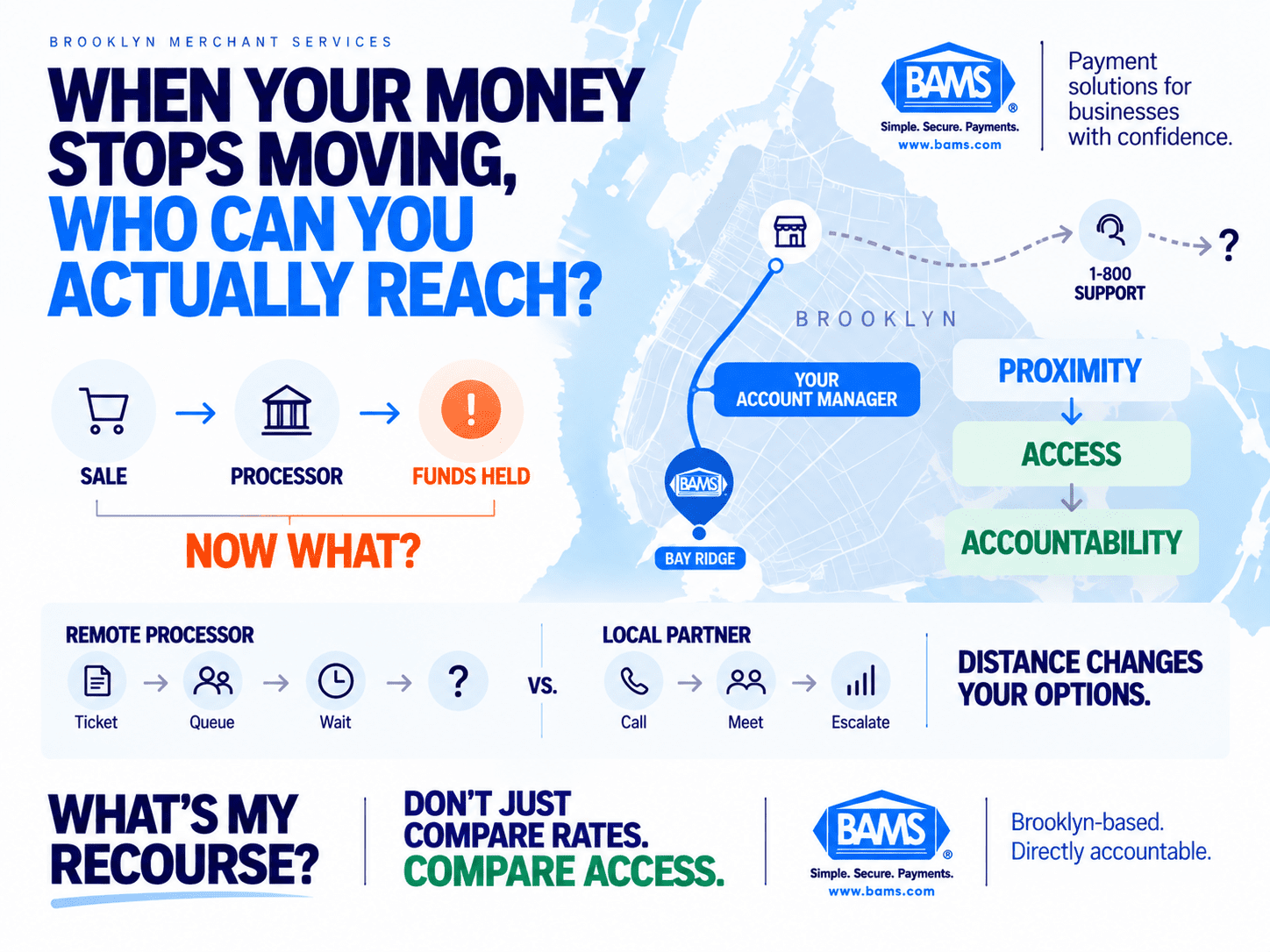
Merchant Service Providers Brooklyn: Why Proximity Is Leverage
When your funds are frozen, a local partner you can confront in person is the only escalation path that works
Learn why physical proximity to your payment processor is an operational advantage, not a convenience. This piece contrasts the escalation power Brooklyn merchants gain from local, accountable partners against the helplessness of remote, faceless processors.
TL;DR
- Your processor holds your money – They’re a counterparty, not a utility. Hundreds of millions in merchant funds sit in processor-controlled accounts at any given time, and your settlement timing is their decision.
- Rates aren’t the real variable – The most expensive processor is the one you can’t reach when your funds are frozen. Escalation paths matter more than basis points.
- Physical proximity is leverage – A local partner like BAMS in Brooklyn gives you face-to-face accountability, faster hold resolutions, and a fundamentally different power dynamic than a 1-800 number.
- Ask “what’s my recourse?” not “what’s your rate?” – That single question reframes how you evaluate every payment partner and protects your cash flow when it matters most.
Your Payment Processor Doesn’t Fear You. That’s the Problem.
Here’s a scenario every eCommerce manager knows but rarely talks about: your processor holds your funds for “review,” and the only recourse you have is a support ticket that disappears into a queue. No face. No phone number that reaches a decision-maker. No leverage. For merchant service providers Brooklyn businesses rely on, this isn’t a hypothetical. It’s the weekly reality that separates partners from vendors.

The real value of a local payment partner appears when something goes wrong. Physical access creates an escalation path that a support queue cannot replicate.
The Myth of the “Best” Processor
The dominant advice for choosing a payment partner goes something like this: compare rates, read reviews, pick the one with the lowest headline fee. Maybe check if they integrate with your cart. Maybe glance at a “best of” listicle that ranks processors by features you’ll never use.
This framework made sense when payment processing was a commodity pipe. Swipe, settle, done. But the modern eCommerce payment stack is not a pipe. It’s a relationship with a company that controls your cash flow, mediates your disputes, and decides (often unilaterally) when your money moves. The rate comparison approach treats this relationship like choosing a phone plan. It ignores the single variable that matters most when things go wrong: can you actually get someone accountable on the line?
Accountability Isn’t a Feature. It’s a Physical Reality.
We believe the most undervalued factor in choosing a payment partner is whether you can look someone in the eye when your revenue is frozen. Not metaphorically. Literally. Proximity is leverage, and leverage is the only thing that accelerates resolution when your settlement is delayed and your payroll is Thursday.
What Brooklyn Merchant Services Look Like When the Money Stops Moving
Rates matter when everything works. Escalation paths matter when it doesn’t. A local payment relationship gives merchants a more direct route from funding problem to accountable contact.
Consider the scale of funds that processors routinely hold. DoorDash reported $335 million sitting at payment processors as of September 2024. That’s not a small business, and even they are subject to settlement timing controlled by someone else. For a mid-size eCommerce operation doing $2M annually, even a 48-hour funding delay can mean scrambling to cover supplier invoices or dipping into credit lines.
The numbers aren’t isolated. Priority Technology Holdings disclosed $109.2 million in merchant funds held at the end of Q1 2024. These are real balances, sitting in accounts merchants cannot touch, governed by risk policies merchants cannot see.
Now imagine that situation with a national processor. You call the 1-800 number. You get a tier-one agent reading from a script. They escalate. You wait. You call again. Different agent. You re-explain. They escalate again. Meanwhile, your cash sits in a custodial account you didn’t know existed.
Now imagine the same situation with a local partner.
You walk into an office. You sit across from your dedicated account manager. You explain the situation once. They pick up an internal line, not a queue, and talk to the underwriting team while you’re in the room. The hold gets reviewed that day, not “within 3-5 business days.”
This isn’t a convenience story. It’s an operational advantage with measurable impact. As payments industry principal Jerry M. Ulrich has noted, the processor relationship is often the most expensive vendor relationship a merchant has. Expensive not just in fees, but in the cost of inaction when something breaks and nobody picks up the phone.
BAMS operates out of Bay Ridge, Brooklyn and provides local merchant services across New York City, with dedicated account managers who handle escalations directly. For eCommerce operators who need next-day funding and proactive chargeback defense, that physical presence translates into faster resolution times and fewer surprises. It’s financial consulting for merchants built on proximity, not just promises.
The pattern we’ve observed is consistent: merchants who switch from remote national processors to local partners don’t just get better support. They get faster settlements, clearer communication during disputes, and a fundamentally different power dynamic. When your processor knows you can show up, they behave differently. That’s not cynicism. That’s how accountability works.
The Cost of Staying Invisible to Your Processor
If this thesis is right, then most eCommerce managers are optimizing for the wrong variable. They’re comparing basis points when they should be comparing escalation paths. They’re reading feature lists when they should be asking: “If my funds are held on a Friday afternoon, who do I call, and will they answer?”
The tradeoff is real. A remote processor might offer a marginally lower rate. But that savings evaporates the first time a funding delay forces you into a short-term credit facility, or a chargeback dispute drags on because nobody at your processor owns your account. The Federal Reserve has noted that faster access to customer payments can help small businesses manage working capital tied up in inventory and reduce their need for short-term financing. The hidden costs of choosing a processor based on rate alone compound quietly until they become a crisis.
For eCommerce businesses running on tight margins and fast inventory cycles, every settlement hour matters. The question isn’t whether you’ll face a hold or a dispute. It’s when, and whether you’ll have any leverage at all when it happens.
Reframe: Your Processor Is a Counterparty, Not a Utility
Stop thinking of your payment processor as infrastructure. Start thinking of them as a counterparty who holds your money. Because that’s exactly what they are. They custody your revenue between the moment a customer pays and the moment you receive settlement. During that window, they have all the power.
The question every eCommerce manager should ask isn’t “what’s your rate?” It’s “what’s my recourse?” A utility you can’t negotiate with. A counterparty you can. But only if they know who you are, where you are, and that you can walk through their door.
That reframe changes everything about how you evaluate Brooklyn merchant services, or any local payment partner. Great customer service in merchant services isn’t a nice-to-have. It’s the mechanism through which you exercise leverage over the company holding your cash.
The Partner You Can’t Visit Is the Partner Who Can Ignore You
We’re not arguing against technology, automation, or scale. We’re arguing that when your revenue is on the line, the ability to show up in person is the oldest and most effective form of negotiation humans have. No chatbot replaces it. No ticket system matches it. Choose accordingly.
Frequently Asked Questions
Why does physical proximity to a payment processor matter for eCommerce businesses?
When funds are held or disputes arise, having a local partner means you can escalate in person rather than waiting in a support queue. That physical access compresses resolution timelines from days to hours, directly protecting your cash flow.
What should I prioritize when comparing merchant service providers in Brooklyn?
Look beyond rates. Ask about your dedicated point of contact, their escalation process for funding holds, and whether you can meet your account manager face to face. The cheapest processor becomes the most expensive one the moment you can’t reach anyone during a crisis.
How do funding delays actually affect mid-size eCommerce operations?
Even a 48-hour delay can force you into short-term borrowing to cover payroll, supplier invoices, or ad spend. Over time, repeated delays erode margins and create cash flow unpredictability that undermines growth planning.


