

7 Price List Spots Where Processing Costs Erode Margins
Last Updated on October 6, 2026 by Dimitri Akhrin
A line-item diagnostic helping funeral directors recover hidden fees without compromising FTC compliance
Learn where processing costs quietly eat into funeral home margins across seven specific price list categories. This guide shows funeral directors how to structure payment acceptance at each line item to stop subsidizing fees on cash advance items and other pass-through costs.
TL;DR
- Cash advance items deserve separate review – When card payments include third-party costs, the funeral home can incur acceptance costs on amounts ultimately paid to outside vendors.
- Your price list can reveal payment-cost exposure – Reviewing individual service and merchandise categories helps show where payment costs have the greatest operational impact.
- High-value items can magnify dollar costs – Larger card transactions can make the cost of payment acceptance more significant even when the pricing structure itself does not change.
- Package pricing requires visibility – Required itemization helps operators understand which portions of an arrangement involve funeral-home services, merchandise and third-party costs.
- Start with your actual merchant statements – Use your own transaction and processing data instead of generic rate assumptions to determine where payment costs are affecting margins.
The Margin Problem Hiding in Plain Sight on Your Price List
Funeral home pricing transparency is required by the FTC Funeral Rule, which mandates itemized disclosure on various price lists. While most funeral directors are aware of this, many are unaware of how each line item affects payment processing costs, subtly reducing margins.
Card payment processing costs, though incremental, can greatly affect the retained amount a funeral home receives on high-value arrangements. Including third-party costs like flowers, death certificates, or clergy honoraria means paying to accept card payments for amounts that go to outside vendors.
In a recent FTC undercover Funeral Rule phone sweep, staff reported difficulty obtaining clear pricing information from some providers and found that at least 37 providers quoted different prices for the same services on different calls. That enforcement attention reinforces the importance of accurate pricing disclosure. At the same time, funeral homes can still examine how different payment methods affect the cost of accepting payment.
Who This Is For (and What It Doesn’t Cover)
This guide is for family-owned funeral service operators with one to ten locations managing transactions over $15,000, who struggle with processing costs. It offers a diagnostic approach to identify where costs are unexpectedly high.
What this list does not cover: FTC compliance checklists, consumer-facing pricing strategy or preneed trust fund management. We’re focused strictly on the intersection of your itemized price list structure and the processing costs attached to each transaction category. Any payment-pricing change should also be reviewed against applicable Funeral Rule, card-network and state requirements.
How We Identified These Seven Spots
We evaluated each line-item category based on three criteria: the frequency of operators misunderstanding processing costs, the dollar magnitude of margin erosion compared to the item’s revenue contribution, and the availability of compliant cost-recovery options under current surcharging and dual-pricing regulations. Items scoring high on all three criteria made the list.
7 Price List Line Items Where Processing Costs Quietly Disappear
1. Cash Advance Items: The Most Misunderstood Cost-Recovery Opportunity
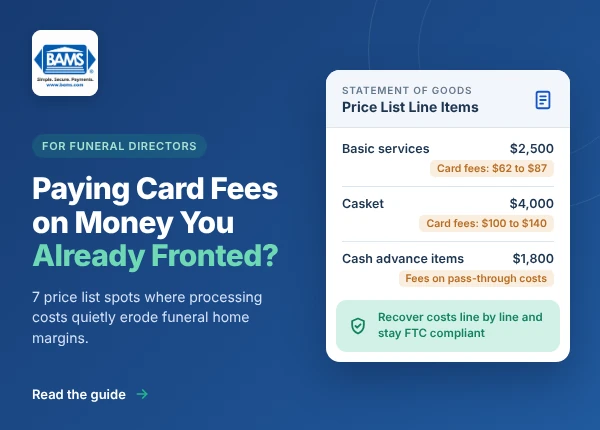
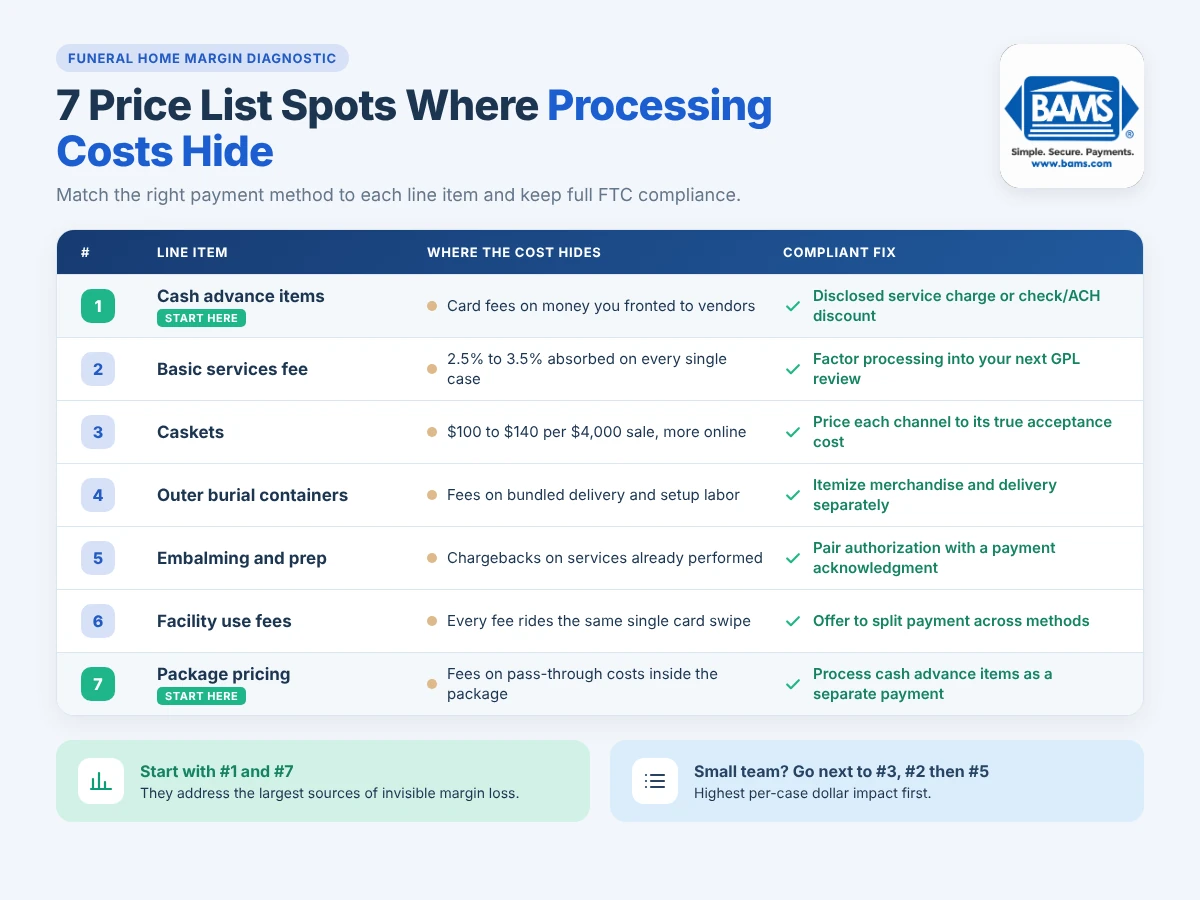
Why it matters: Cash advance items (death certificates, flowers, obituary notices, clergy honoraria, crematory fees) are third-party costs you pay on the family’s behalf. FTC guidance requires these to be listed separately on the Statement of Funeral Goods and Services Selected. Here’s the problem: when a family pays their entire invoice by credit card, you absorb processing fees on money you fronted to vendors. That’s margin loss on pass-through costs.
What it looks like today: Many operators list cash advance items at cost, believing they cannot mark them up. The FTC actually permits a service fee or markup on cash advance items, provided you disclose it in writing on the General Price List. Yet most funeral directors either don’t know this or avoid it out of discomfort.
How to apply it: Review how your funeral home prices cash advance items and how those charges are disclosed. FTC Funeral Rule compliance guidance explains that funeral providers may add a service charge to cash advance items, but when the price differs from the funeral home’s cost, the required disclosure belongs on the Statement of Funeral Goods and Services Selected with the affected cash advance items. State requirements may be more restrictive, so review applicable state law before changing your pricing approach.
2. Basic Services of Funeral Director and Staff (the Non-Declinable Fee)
Why it matters: This is the one fee every family pays regardless of service selection. Because it’s non-declinable, it represents your most predictable revenue line. It’s also the line where processing costs are most consistently absorbed, since it appears on every single transaction.
What it looks like today: Operators may set this fee with overhead and operating costs in mind without separately measuring how payment acceptance affects the amount retained when families pay by card. Across many arrangements, those costs can become material even when they are less visible than other operating expenses.
How to apply it: When you next review your GPL pricing, compare your annual basic-services revenue with the actual processing costs shown on your merchant statements. That gives you a business-specific cost figure rather than relying on a generic processing-rate assumption. Use that information as one input when reviewing your overall pricing structure.
3. Casket Sales: High-Ticket Items with the Largest Dollar-Amount Processing Loss
Why it matters: Caskets can represent one of the larger merchandise line items in an arrangement. As transaction value increases, the dollar cost of card acceptance can also become more significant, making this an important category to review against your actual merchant statement.
Today, if casket prices do not appear on the General Price List, operators must display the Casket Price List before discussing specific caskets or their prices. Some operators have partially moved casket selection online, which can result in different processing economics compared to in-person transactions.
How to apply it: If you accept online casket deposits or full payments through your website, verify whether your processor charges card-not-present rates on those transactions. Many do. Consider whether auditing your processing cost signals reveals a gap between your in-person and online effective rates. Aligning your casket pricing to reflect the actual cost of acceptance for each channel is both practical and compliant.
4. Outer Burial Containers: A Low-Attention Line with Surprising Leakage
Why it matters: Outer burial containers (vaults, grave liners) occupy their own required price list under the Funeral Rule. Because operators tend to focus compliance energy on the GPL and casket list, the OBC list often gets less pricing scrutiny. Processing costs on these $1,000 to $3,500 items accumulate quietly.
What it looks like today: Many operators bundle vault delivery and setup into the container price without separating the labor component. That means you’re paying processing fees on the full bundled amount, including your own labor, rather than just the merchandise cost.
How to apply it: Review the merchandise, delivery and installation components associated with outer burial containers and compare those amounts with the actual cost of accepting each payment method. The goal is to understand where payment costs occur while keeping required price disclosures accurate and giving families clear payment options.
5. Embalming and Preparation Fees: Where Declined Authorization Costs Hide
Why it matters: The Funeral Rule generally requires authorization before a funeral home performs embalming for a fee. Clear documentation of the authorization, services selected and payment can also become important if a transaction is later disputed. A payment dispute can add another layer of administrative and financial exposure to a service that has already been performed.
What it looks like today: Families may encounter detailed preparation costs during the arrangement process while making multiple decisions under time pressure. Clear pricing, service authorization and payment documentation can help reduce ambiguity if questions arise later.
How to apply it: Strengthen your documentation trail by pairing service authorization with a clear payment acknowledgment. Maintain documentation that can support your response if a transaction is later disputed. Funeral homes reviewing payment acceptance more broadly can also evaluate their merchant services for funeral homes to compare funding, support and payment options against the needs of the business.
6. Facility and Equipment Use Fees: The Overlooked Split-Payment Opportunity
Why it matters: Use of facilities for viewing, ceremony or memorial service may appear as separate line items on the GPL. When selecting several together, the combined amount can make payment acceptance costs more meaningful to the business.
What it looks like today: Most operators run the entire arrangement as a single transaction. One swipe, one authorization, one settlement. This means every line item, including facility fees, absorbs the same processing rate. There’s no differentiation.
How to apply it: Review whether the payment options you offer let families choose appropriate methods for different parts of an arrangement. Different methods can carry different acceptance costs, settlement characteristics and administrative requirements. The goal is to understand those differences and offer appropriate choices rather than assuming every part of an arrangement must follow the same payment path.
7. Package Pricing: Where Compliance Risk and Margin Erosion Intersect
The FTC’s phone sweep matters because it found that at least 33% of the funeral providers contacted quoted a package price for at least one service without also providing itemized prices for the components. The Funeral Rule allows package offerings, but they must accompany required itemized pricing. From a payment-cost perspective, packages can also obscure which portions of an arrangement include third-party costs for operators.
What it looks like today: An arrangement package may include both funeral-home goods and services and cash advance items paid to third parties. When the entire amount is paid through one card transaction, processing costs apply to the transaction as configured by the merchant’s processor. Operators should calculate this effect using their own merchant statements rather than relying on a generic example.
How to apply it: Even when you offer packages for marketing simplicity, keep required itemization clear and make sure staff can explain how third-party cash advance items are presented and collected. Review the payment structure against your actual merchant costs rather than assuming one approach will be best for every arrangement.
What These Seven Spots Have in Common
Three patterns emerge across every item on this list. First, the margin erosion is structural, not incidental. It’s built into how funeral transactions flow through generic payment systems designed for retail, not death care. Second, the most effective fixes don’t require raising prices. They require separating what you charge from how you collect payment, matching the right payment method to the right line-item category.
FTC compliance and processing cost recovery can coexist. The Funeral Rule requires itemization, which allows for varied payment strategies across cost categories. This regulation, often seen as a constraint, is actually a structural advantage for those who utilize it effectively.
Operators who review payment timing and acceptance costs alongside pricing can use the price list as more than a compliance document. It can also become a practical way to understand where payment costs affect available cash.
Where to Start Without Overwhelming Your Operation
Start with two moves: First, calculate last quarter’s total processing fees on cash advance items to decide if a service charge or incentive is worthwhile. Second, check if your package pricing separates third-party costs at the payment level, not just on the Statement.
Implement these two changes to tackle the main sources of invisible margin loss. Then, address the remaining five items based on your staff’s capacity and arrangement volume. Small operators should focus on items with the highest per-case dollar impact: caskets (#3), basic services (#2), and embalming (#5), in that order.
Frequently Asked Questions
What is the FTC Funeral Rule and why does it matter for pricing?
The FTC Funeral Rule mandates funeral homes to offer itemized pricing on General, Casket, and Outer Burial Container Price Lists, allowing consumers to compare costs and choose desired services. It also provides a framework for operators to make strategic payment processing decisions.
Can funeral homes add a service charge to cash advance items?
The FTC Funeral Rule allows funeral providers to add service charges to cash advance items but requires disclosure on the Statement of Funeral Goods and Services Selected. State laws may have extra restrictions, so providers should check local regulations.
How does the FTC Funeral Rule affect funeral home pricing transparency for payment processing?
The rule requires itemized disclosure, listing each service and merchandise category with a specific price. This creates boundaries between transaction types, allowing operators to apply different payment strategies (card, check, ACH) to each category, reducing processing costs without bundling or hiding fees.
Are funeral homes allowed to charge surcharges on credit card payments?
Surcharge requirements vary by law, card-network rules, and merchant agreements. Mastercard’s merchant surcharge allows surcharges on eligible credit transactions with specific caps and disclosures but prohibits them on Debit Mastercard and prepaid cards. Funeral homes should check state, card-network, and processor requirements before surcharging.
What are funeral director obligations when offering package pricing?
The FTC Funeral Rule mandates that funeral directors provide itemized pricing for each component of any package offered, allowing families to see individual costs. Separating cash advance items from the package at the transaction level reduces processing fees and enhances transparency.
How can funeral homes reduce chargeback risk on high-ticket transactions?
Strong documentation is key. Pair service authorizations with payment acknowledgments, use a processor with chargeback defense tools, and provide pricing information early to prevent disputes.


