eCommerce Merchant Services: The Data Gap Behind Your Rates
Transparent pricing shows what you paid — not what you should have paid if your gateway passed the right data
Learn why interchange-plus pricing alone can’t reveal the savings your eCommerce stack is silently leaving behind. Discover the hidden data layer between your gateway and the card networks that determines your real interchange cost.
TL;DR
- Transparent pricing is only half the picture – Interchange-plus shows you what you paid, but it can’t reveal whether your gateway dropped the data fields that would have qualified you for a lower rate.
- Missing tax and freight fields cost real money – Default eCommerce gateway plugins often strip Level 2/3 data (tax amounts, freight, line items) before it reaches card networks, triggering automatic interchange downgrades on every transaction.
- Configuration is a financial decision, not a technical one – The biggest savings opportunity for most eCommerce merchants isn’t negotiating processor markup. It’s ensuring their gateway maps the order fields that unlock lower interchange tiers.
- Audit your data, not just your rates – Compare your effective processing rate against published interchange categories to find the gap between what you’re paying and what you should be paying.
Your Pricing Is Transparent. Your Data Isn’t.
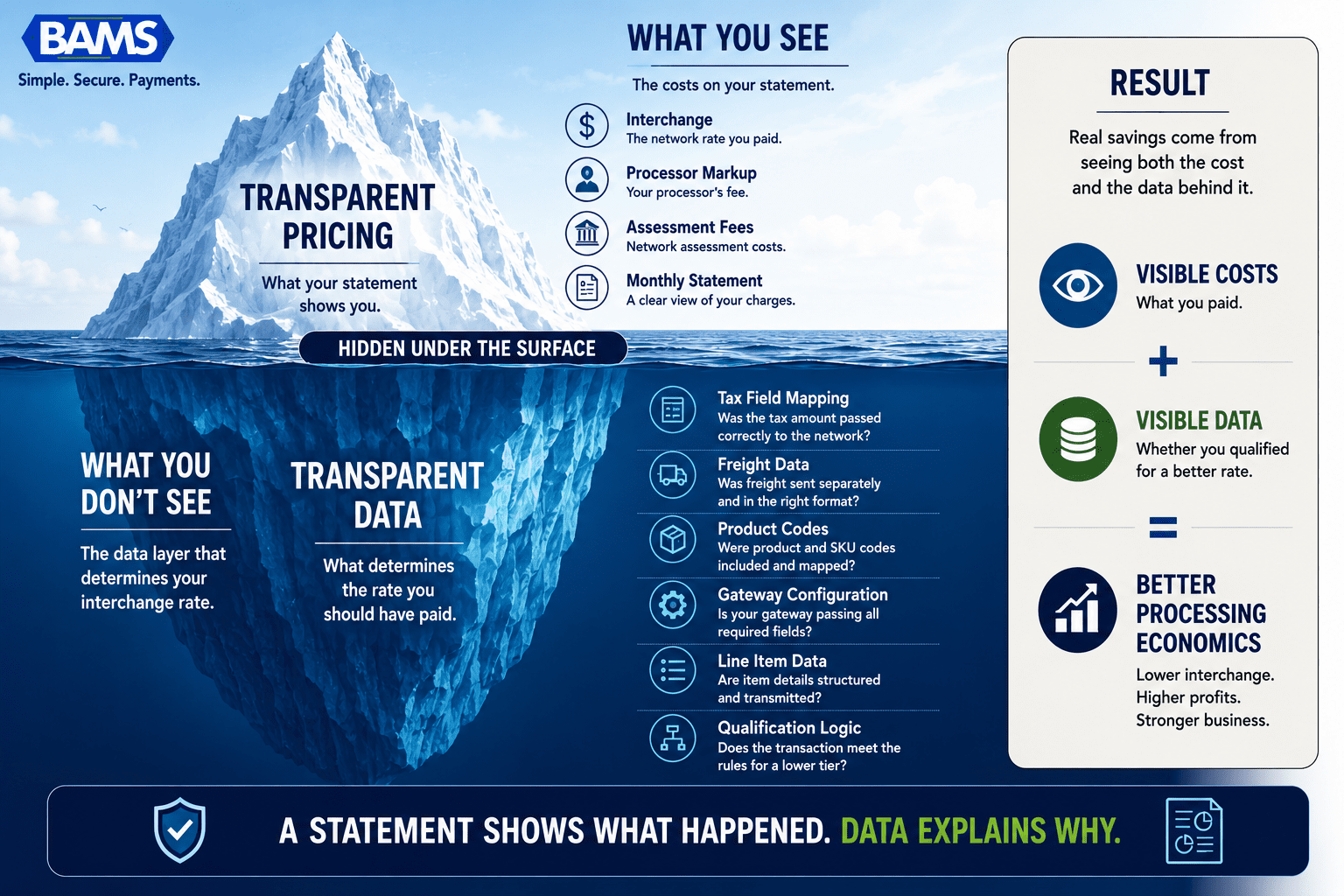
Most eCommerce managers who switch to interchange-plus pricing feel a wave of relief. Finally, they can see the interchange rate, the processor markup, and the assessment fees on every transaction. But here’s the uncomfortable truth: transparent pricing models only reveal what you paid. They can’t tell you whether your gateway quietly dropped the tax and freight fields that would have qualified that transaction for a lower rate in the first place.
The Transparency Trap in eCommerce Merchant Services
The industry has spent years (rightly) pushing merchants toward interchange-plus pricing. And the logic holds up. As BAMS has noted, interchange-plus is “by far the most transparent pricing structure available” because it lets you analyze costs on a granular, per-transaction basis. That’s a genuine improvement over flat-rate or tiered models that bundle and obscure.
But transparency became the finish line when it should have been the starting line. Ecommerce teams celebrate seeing the breakdown, then stop digging. They negotiate the markup down a few basis points, pat themselves on the back, and move on. Meanwhile, the interchange rate itself (the largest component of every swipe) is quietly inflated because their gateway never passed the data that would have earned a better one.
The Layer Nobody Talks About

Seeing your costs is different from knowing whether those costs were necessary.
Here’s what we actually believe: the real savings gap for eCommerce merchants isn’t in rate negotiation. It’s in the transaction data your gateway silently drops before the card networks ever see it.
Visa’s payment processing guidance emphasizes the importance of complete and accurate transaction data throughout the payment lifecycle, reinforcing why field mapping has a direct impact on transaction qualification.
Interchange-plus shows you the rate. It doesn’t show you that the rate was higher than it needed to be because your platform failed to map a tax field, stripped a freight amount, or skipped a product code. That’s the second layer of transparency, and almost nobody is talking about it.
How to Optimize Transaction Routing Starts With What You Send, Not Where You Send It
Let’s make this concrete. Visa and Mastercard publish hundreds of interchange categories. The rate your transaction lands on depends partly on the card type and partly on how much data accompanies the authorization. For card-not-present transactions (which is every eCommerce sale), the networks offer lower “Level 2” and “Level 3” rates when specific fields are populated: tax amount, freight cost, ship-to postal code, line-item detail, customer code.
When those fields are present and formatted correctly, the transaction qualifies for a lower interchange tier. When they’re absent, the transaction downgrades to a higher rate. Simple as that.
The Visa Commercial Enhanced Data Program highlights the role of enhanced transaction data in supporting commercial card qualification and more favorable interchange treatment.
Now here’s where it gets painful. Most eCommerce platforms collect this data. Your Shopify, WooCommerce, or BigCommerce store already knows the tax amount on an order. It knows the shipping cost. It has the line items. But the default gateway plugin often doesn’t pass those fields through to the processor. The data exists in your system and evaporates before it reaches the network.
We’ve seen merchants running effective processing rates a full percentage point higher than necessary, not because their processor was overcharging, but because their gateway integration was misconfigured. On a business doing $2 million in annual card volume, that’s $20,000 in fees that didn’t need to exist.
And the kicker? Their interchange-plus statement showed every penny of it, line by line, in perfect detail. The transparency was flawless. The configuration was broken.
This is why the question “how do I optimize transaction routing” needs to expand beyond choosing between processors or toggling network preferences.
The most impactful routing optimization for most eCommerce merchants is ensuring the right data fields are populated on every transaction before it leaves the gateway. You can’t route your way to a lower interchange tier if the data that qualifies you for that tier never makes it into the authorization message.
The seven most common missing Level 3 fields each map to a specific downgrade category. Tax amount alone is responsible for a significant share of preventable downgrades on B2B and high-ticket consumer transactions. Freight is another. These aren’t obscure edge cases. They’re standard order fields that your platform already captures.
A partner like BAMS can audit your gateway configuration to identify exactly which fields are dropping and where the interchange leakage is happening, pairing interchange-plus visibility with the configuration layer that makes that visibility actionable. That combination (transparent pricing plus transparent data) is what actually moves the needle.
The most expensive part of a transaction is often the information that never arrives.
What This Means for Your Processing Costs
If this thesis is right, then a huge number of ecommerce merchants on interchange-plus pricing are overpaying without any visible signal that something is wrong. Their statements look clean. Their rates look competitive. But their effective rate is inflated by downgrades they never knew to look for.
It also means that the standard advice (“negotiate your markup,” “shop for a cheaper processor”) addresses the smallest component of the fee stack. Gateway integration decisions that seem purely technical, like which plugin you install or how your checkout maps order fields, are actually financial decisions with basis-point consequences on every transaction.
For merchants processing at scale, the compounding effect is significant. Hidden qualification failures, interchange downgrades, and incomplete transaction data can quietly increase payment acceptance costs over time. According to the Federal Reserve’s 2025 Small Business Credit Survey, managing operating expenses remains a significant challenge for many businesses, making payment cost optimization an important operational priority.
A New Way to Think About “Transparent”
We need a better definition. Transparent pricing means you can see the cost. Transparent configuration means you can see whether the cost was necessary.
Think of it this way: your interchange-plus statement is a receipt. Your gateway’s data-passing behavior is the menu. If the menu is wrong (if your system is ordering the expensive version of every transaction because it forgot to mention the coupon), the receipt will faithfully document the overcharge. It won’t fix it.
Transparency without configuration awareness is just a well-lit room where you watch money leave.
The merchants who actually reduce processing costs aren’t the ones with the best-negotiated markup. They’re the ones who treat their gateway’s field mapping as a financial control, not a developer checkbox.
The Stack Is the Strategy
Every eCommerce manager knows their pricing model. Very few know what their gateway sends. That asymmetry is where the money goes. Close it, and you stop paying interchange rates you were never supposed to pay. Ignore it, and no amount of rate shopping will close the gap.
Your pricing is already transparent. Now make your data transparent too.
Frequently Asked Questions
How does optimizing transaction data affect processing fees?
When your gateway passes complete Level 2 and Level 3 data (tax amounts, freight costs, line-item details) to the card networks, transactions qualify for lower interchange tiers. Missing fields trigger automatic downgrades to higher rates, inflating your effective processing cost even on an interchange-plus plan.
Why is interchange-plus pricing more beneficial than flat-rate pricing?
Interchange-plus separates the card network’s published interchange from your processor’s fixed markup, so you can see exactly what each transaction costs and why. This visibility is essential for identifying interchange downgrades caused by missing data fields, something flat-rate pricing completely hides.
How can I audit my payment processing statements for hidden fees?
Start by calculating your effective processing rate (total fees divided by total volume) and comparing it against the interchange rates published by Visa and Mastercard for your transaction types. If your effective rate is significantly higher, the gap likely points to interchange downgrades from missing transaction data, not just processor markup.


