Best Payment Gateways for eCommerce: Fees, Speed, Support
Last Updated on May 15, 2026 by Dimitri Akhrin
How deposit timing, pricing transparency, and real human support affect your eCommerce cash flow
Compare top payment gateways on what actually matters: how fast you get paid, what you really pay in fees, and whether support answers when problems hit. Find the right fit for your 10-50 employee eCommerce operation.
TL;DR
- Deposit speed varies dramatically – Stripe takes 2-7 days standard while dedicated merchant partners offer next-day funding, directly impacting your cash flow and supplier relationships.
- Flat-rate pricing costs more for established businesses – Interchange-plus pricing from Helcim or dedicated partners typically saves 0.3-0.5% per transaction compared to Stripe’s 2.9% + $0.30
- Support quality matters during crises – Self-service platforms leave you waiting during disputes and technical failures, while dedicated account managers provide direct access and proactive assistance
- Chargeback management protects revenue – Proactive defense programs from dedicated partners outperform self-service dispute tools, especially for businesses in higher-risk categories
- Match your choice to your priorities – Choose Stripe for customization, PayPal for brand trust, Helcim for transparent pricing, or dedicated partners for next-day funding and human support
The Real Cost of Waiting for Your Money
If you manage payments for an established Commerce business, you already know the frustration. You made the sale three days ago, but the funds still sit somewhere in processing limbo. Meanwhile, you need to pay suppliers, run payroll, and keep inventory stocked.
Choosing among the best payment gateways comes down to more than just transaction fees. Deposit timing, pricing transparency, and support quality directly impact your cash flow and daily operations. This comparison helps eCommerce managers at businesses with 10-50 employees evaluate which eCommerce payment gateway delivers real value, not just promises.
According to Visa, modern payment systems are designed to balance speed, security, and reliability in transaction processing.
We focus on what matters most to you: getting paid faster, understanding exactly what you pay, and having someone pick up the phone when problems arise.
Quick Verdict: Which Gateway Fits Your Business?
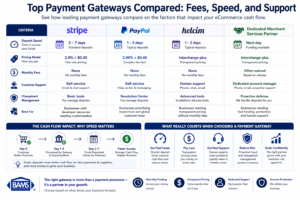
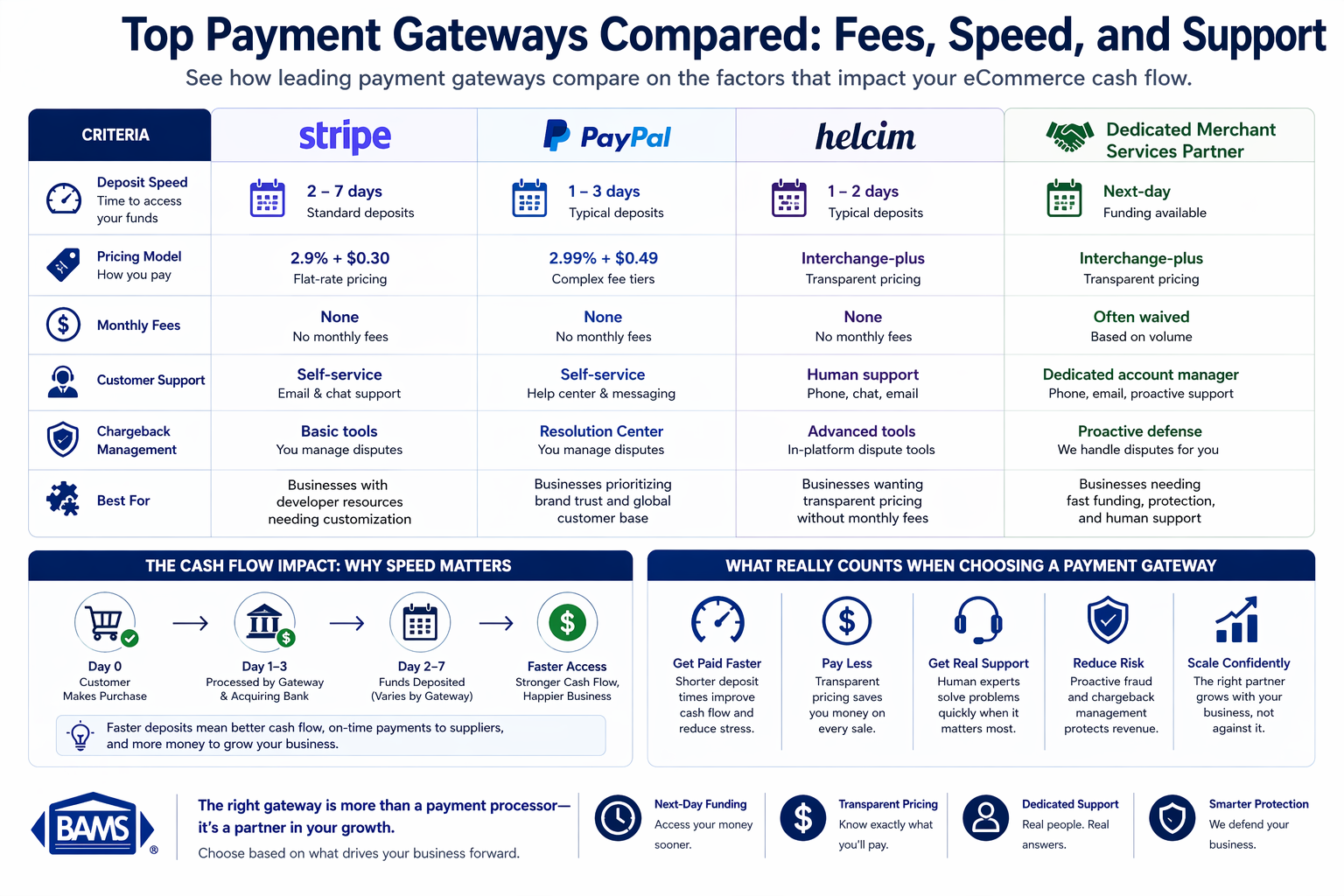
Comparing payment gateways side by side highlights how deposit speed, pricing models, and support quality impact eCommerce cash flow.
Choose Stripe if you have developer resources, need extensive customization, and can wait 2-7 days for deposits. Choose PayPal if brand recognition matters more than fees and you sell internationally to consumers. Choose Helcim if you want transparent interchange-plus pricing without monthly fees. Choose a dedicated merchant services partner if next-day funding, proactive chargeback defense, and human support drive your priorities.
No single gateway wins across every dimension. Your choice depends on transaction volume, technical capabilities, and how urgently you need access to your funds.
|
Criterion |
Stripe |
PayPal |
Helcim |
Dedicated Partner |
|---|---|---|---|---|
|
Deposit Speed |
2-7 days standard |
1-3 days |
1-2 days |
Next-day funding |
|
Pricing Transparency |
Flat rate |
Complex tiers |
Interchange-plus |
Interchange-plus |
|
Monthly Fees |
None |
None |
None |
Varies |
|
Transaction Fees |
2.9% + $0.30 |
2.99% + $0.49 |
2.38% + $0.25 online |
Custom rates |
|
Chargeback Support |
Self-service |
Self-service |
Limited |
Proactive defense |
|
Human Support |
Email/chat |
Phone (limited) |
Phone/email |
Dedicated manager |
Evaluation Criteria: What Actually Matters for Payment Gateway Fees
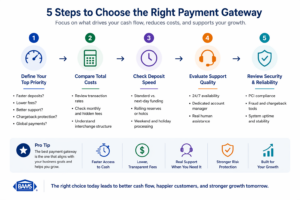
A simple framework helps businesses choose the right payment gateway based on priorities, costs, deposit timing, and support needs.
Before diving into specifics, understand which factors deserve the most weight for your situation. Not all criteria matter equally to every business.
Deposit timing ranks highest for businesses managing tight cash flow. A two-day difference in funding can mean the difference between making payroll or scrambling for a credit line.
Total cost of processing goes beyond advertised rates. Payment gateway fees include transaction percentages, per-transaction charges, monthly fees, PCI compliance costs, and chargeback fees. Calculate your true monthly cost, not just the headline rate.
Integration complexity determines how much developer time you need. Some gateways offer plug-and-play solutions for Shopify or WooCommerce. Others require custom API work.
Support quality matters when transactions fail or chargebacks pile up. The difference between email-only support and a dedicated account manager becomes obvious during a crisis.
Chargeback management protects your revenue and merchant account standing. Proactive defense beats reactive dispute handling every time. The PCI Security Standards Council emphasizes that strong compliance and fraud controls are essential to reduce disputes and protect merchant revenue.
Head-to-Head Breakdown: Comparing the Best Payment Gateways
Deposit Speed and Cash Flow Impact
Stripe offers standard payouts in 2-7 business days, with Instant Payouts available for an additional 1% fee. For a business processing $100,000 monthly, that instant payout option adds $1,000 in fees just to access your own money faster.
PayPal typically releases funds in 1-3 business days, though new accounts or flagged transactions can trigger holds lasting weeks. The unpredictability creates planning headaches.
Helcim processes deposits in 1-2 business days with no additional fees for faster access. This represents solid middle ground for most businesses.
Dedicated merchant services partners often provide next-day funding as a standard feature. You sell today, see funds tomorrow. For eCommerce managers tracking cash flow daily, this removes a major operational constraint.
Verdict: If deposit speed drives your decision, dedicated merchant accounts with next-day funding win clearly. Stripe’s standard timing creates cash flow gaps that flat-rate simplicity cannot offset.
Pricing Structure and True Costs
Stripe charges a flat 2.9% + $0.30 per transaction with no setup or monthly fees. This simplicity appeals to businesses that value predictability over optimization. However, flat-rate pricing means you overpay on debit cards and large transactions where interchange rates run lower.
PayPal uses tiered pricing that varies by transaction type, payment method, and merchant category. International payments incur particularly high fees. The complexity makes true cost calculation difficult.
Helcim uses interchange-plus pricing. Automatic volume discounts reward growth.
Dedicated merchant services partners typically offer interchange-plus pricing with custom rates based on your volume and transaction profile. Higher-volume merchants often negotiate rates significantly below flat-rate alternatives.
Verdict: Interchange-plus pricing (Helcim or dedicated partners) delivers better value for established businesses. Flat-rate pricing only makes sense for very low volumes or businesses that cannot track actual costs.
According to the Federal Reserve, interchange fee structures significantly influence total payment processing costs, making pricing transparency critical when comparing providers.
Integration and Technical Requirements
Stripe provides the most extensive developer tools and documentation. Their API supports complex customization, subscription billing, and marketplace payments. However, this power requires technical resources to implement and maintain.
PayPal offers the easiest integration for basic needs. Most eCommerce platforms include PayPal as a default option. The tradeoff: limited customization and checkout experiences that redirect customers away from your site, which can increase cart abandonment.
Helcim provides solid integrations with major platforms including Shopify, WooCommerce, and QuickBooks. Their technical requirements fall between Stripe’s complexity and PayPal’s simplicity.
Dedicated merchant services partners vary widely in integration capabilities. The best providers offer integrated payment solutions that connect with your existing platforms while keeping checkout on your site.
Verdict: Match integration complexity to your technical resources. Stripe wins for developer-heavy teams. For most eCommerce managers without dedicated developers, Helcim or well-integrated merchant services partners provide sufficient flexibility with less overhead.
Support Quality and Responsiveness
Stripe relies primarily on documentation, email, and chat support. Phone support exists but remains difficult to access for standard accounts. When transactions fail or accounts get flagged, resolution can take days of back-and-forth.
PayPal offers phone support, but wait times and resolution quality vary dramatically. Their automated systems often create circular support experiences that frustrate merchants dealing with urgent issues.
Helcim provides phone and email support with generally positive reviews for responsiveness. However, support remains reactive rather than proactive.
Dedicated merchant services partners differentiate through human-first support models. Dedicated account managers learn your business, proactively identify issues, and provide direct phone access when problems arise.
Verdict: If support quality matters to your operations, dedicated merchant services partners with assigned account managers outperform self-service models significantly. The difference becomes critical during disputes or technical failures.
Chargeback Management and Revenue Protection
Stripe provides basic chargeback tools and documentation but leaves dispute management largely to merchants. Their Radar fraud prevention helps reduce chargebacks but costs extra for advanced features.
PayPal offers Seller Protection on eligible transactions, but coverage limitations and complex eligibility rules create gaps. Many merchants discover protection does not apply only after losing a dispute.
Helcim includes basic chargeback handling but lacks proactive defense capabilities. Merchants must manage disputes manually with limited guidance.
Dedicated merchant services partners often include proactive chargeback defense programs. These services monitor for disputes, gather evidence automatically, and respond on your behalf, protecting both revenue and your merchant account standing.
Verdict: For businesses experiencing regular chargebacks or selling in high-risk categories, proactive defense from dedicated partners delivers measurable ROI. Self-service tools cannot match dedicated chargeback management.
Use Case Mapping: Which Gateway Fits Your Situation?
If you process under $10,000 monthly and lack technical resources, PayPal or Stripe’s simplicity may outweigh their higher effective costs. The overhead of optimizing payments does not justify savings at low volumes.
If you process $50,000+ monthly and need predictable cash flow, next-day funding from a dedicated merchant services partner pays for itself through reduced financing costs and better supplier terms.
If you sell internationally across multiple currencies, Stripe’s support for 135+ currencies and 125+ payment methods including Pix and UPI provides genuine advantages. PayPal’s international fees often negate its brand recognition benefits.
If you experience frequent chargebacks from fraud or disputes, prioritize providers with proactive defense programs. The cost of lost disputes, fees, and potential account termination far exceeds any processing savings.
If you run a subscription business with recurring billing, evaluate each provider’s subscription management tools carefully. Stripe excels here, while some merchant services partners require additional software.
What All Payment Gateways Get Wrong
No gateway solves every payment problem. Industry-wide limitations affect all options.
Interchange fees remain opaque. Card networks set these rates, and no gateway can eliminate them. Even transparent interchange-plus pricing passes through costs that merchants cannot negotiate directly.
Fraud prevention creates friction. Every security measure, from 3D Secure to address verification, adds checkout steps that can reduce conversion. Balancing security against user experience remains an unsolved challenge.
Platform dependency persists. Whether you use Stripe, PayPal, or a merchant account, you depend on a third party for a critical business function. Account freezes, policy changes, and technical outages can disrupt operations regardless of provider.
Migration and Switching Considerations
Switching payment gateways involves real costs beyond the obvious technical work.
Technical migration requires updating checkout flows, testing thoroughly, and potentially maintaining parallel systems during transition. Budget 20-40 hours of developer time for straightforward migrations, more for complex setups.
Subscription and recurring billing creates the biggest switching barrier. Migrating stored cards requires customer re-authorization or careful token migration. Some customers will churn during this process.
Historical data may not transfer completely. Transaction histories, customer payment profiles, and reporting continuity can break during migration.
When switching makes sense: If your current provider costs more than $500/month extra compared to alternatives, switch. If deposit delays cost you supplier discounts or financing charges, switch. If support failures have cost you sales or customers, switch. If your chargeback rate threatens account standing, switch immediately.
Consider providers that offer migration assistance, including alternatives to Stripe and PayPal that help manage the transition process.
Making the Right Choice for Your Ecommerce Operations
The best payment gateway for your business depends on your specific priorities, not generic feature comparisons.
Choose Stripe if you have developers, need extensive customization, sell globally, and can absorb standard deposit timing. Their tools and documentation remain industry-leading for technical teams.
Choose PayPal if consumer trust and brand recognition drive conversions in your market, and you accept higher fees as the cost of that trust.
Choose Helcim if transparent pricing matters most and you want solid features without monthly fees or contracts.
Choose a dedicated merchant services partner if next-day funding, proactive chargeback defense, and human support align with your operational priorities. For eCommerce managers at established businesses managing cash flow actively, these benefits often outweigh the simplicity of self-service platforms.
Your payment gateway should work for your business, not create additional problems to manage. Evaluate based on your actual transaction patterns, support needs, and cash flow requirements. The right choice saves money, reduces stress, and lets you focus on growing your business instead of chasing deposits.
Frequently Asked Questions
What is a payment gateway and why is it important for eCommerce?
A payment gateway securely transmits transaction data between your online store, the customer’s bank, and your merchant account. It encrypts sensitive card information, verifies funds, and authorizes purchases in seconds. Without a reliable gateway, you cannot accept online payments, and poor gateway choices lead to failed transactions, security vulnerabilities, and lost sales.
How do I choose the best payment gateway for my business?
Start by calculating your true monthly processing costs across different providers using your actual transaction data. Then evaluate deposit timing against your cash flow needs, integration requirements against your technical resources, and support quality against your tolerance for self-service. The best gateway balances all these factors for your specific situation rather than optimizing any single feature.
What are the real differences in payment gateway fees?
Flat-rate pricing (like Stripe’s 2.9% + $0.30) simplifies calculations but often costs more than interchange-plus pricing for established businesses. Interchange-plus passes through actual card network costs plus a fixed markup, typically saving 0.3-0.5% per transaction. Also factor in monthly fees, PCI compliance costs, chargeback fees, and any charges for faster deposits when comparing total costs.
When should I consider switching my payment gateway?
Switch when deposit delays hurt your cash flow, when fees exceed alternatives by $500+ monthly, when support failures cost you sales, or when chargeback rates threaten your account. Also consider switching if your current provider lacks features you now need, like multi-currency support or subscription billing. Calculate migration costs against ongoing savings to determine if switching makes financial sense.
Which payment gateways support international transactions?
Stripe supports 135+ currencies and 125+ global payment methods. PayPal operates in 200+ markets but charges higher international fees. Helcim focuses primarily on US and Canadian merchants. Dedicated merchant services partners vary in international capabilities. If international sales represent significant revenue, prioritize providers with competitive cross-border fees and local payment method support.
How do integrated payment solutions improve eCommerce operations?
Integrated solutions connect your payment gateway directly with your eCommerce platform, accounting software, and inventory systems. This automation reduces manual data entry, speeds reconciliation, and provides unified reporting. Look for native integrations with your existing tools rather than relying on third-party connectors that can break or add costs.