
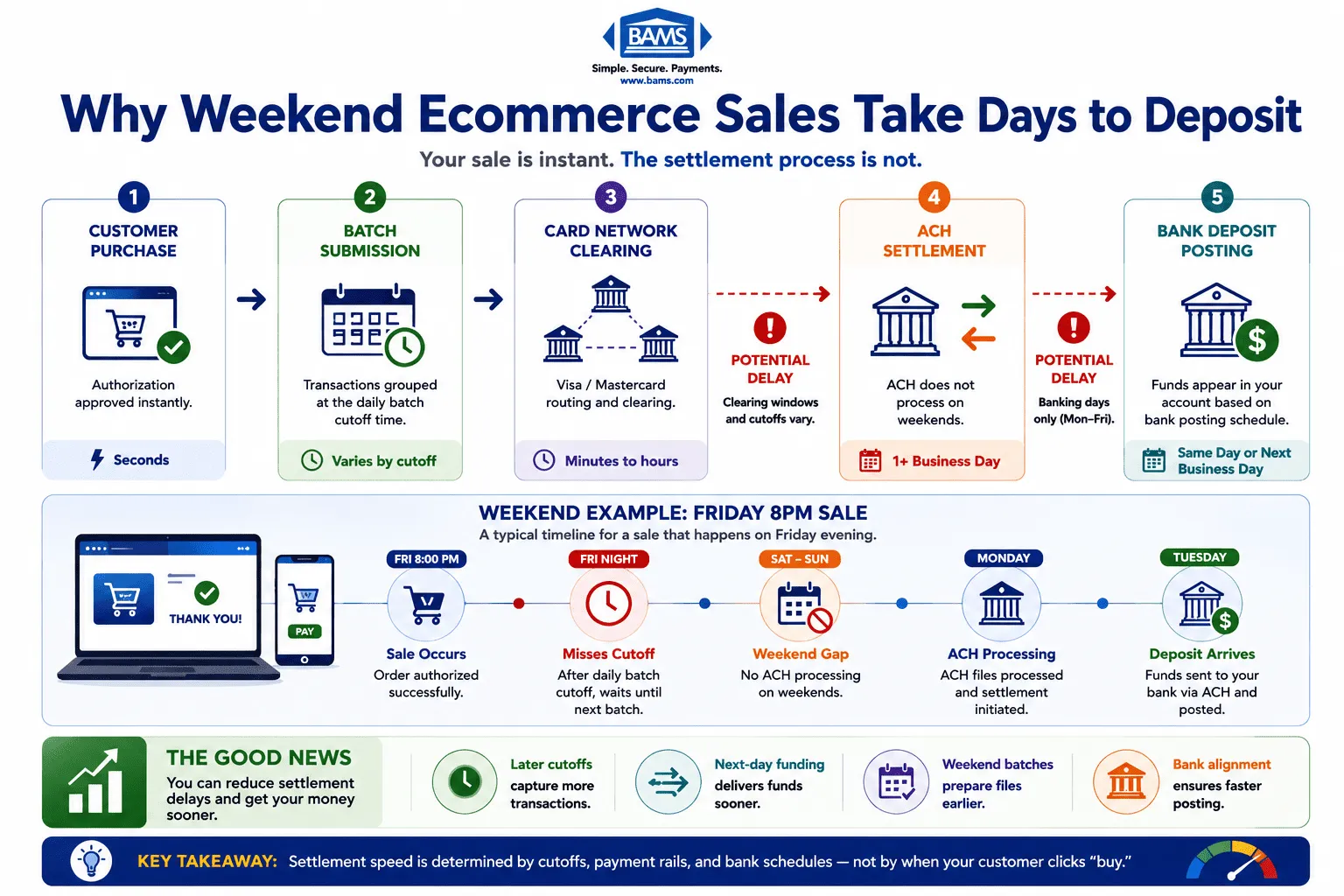
Payment Processing Speed: Why Weekend Sales Take Days to Deposit
Last Updated on May 18, 2026 by Dimitri Akhrin
How settlement mechanics, cut-off times, and bank relationships create hidden delays — and how to fix them
Learn why your weekend eCommerce revenue doesn’t hit your bank account until midweek. This guide breaks down the settlement pipeline, identifies where delays occur, and shows you how to audit and optimize your setup for faster funding.
TL;DR
- Weekend deposits are slow by design, not by accident — The ACH network doesn’t process on weekends, so Saturday sales can’t even begin moving to your bank until Monday, and most setups add another day or two on top of that.
- Your batch cut-off time is the biggest lever — The difference between a 4:00 PM and 9:00 PM cut-off can shift an entire day’s deposits forward or backward, and for weekend sales, that translates to a two-to-three-day swing.
- Funding speed is a four-link chain — Your platform, gateway, processor, and bank each add their own timeline. Optimizing only one while ignoring the others won’t fix the problem.
- Next-day funding is negotiable, not automatic — Many merchants already qualify but were never offered it. Ask your processor directly, and compare cut-off times, weekend batch policies, and fees before committing.
- Build a cash buffer sized to your weekend exposure — Even with optimized funding, keep at least 1.5x your average weekend revenue as a rolling reserve so settlement gaps never disrupt Monday operations.
Guide Orientation: What This Covers and Who It’s For
This guide explains exactly why your weekend eCommerce sales take days to land in your bank account, and what you can do about it. We break down the settlement mechanics, payment rails, cut-off times, and bank relationships that create hidden delays in your payment processing speed.
It’s written for eCommerce managers at established online businesses who already process meaningful volume but can’t figure out why Monday’s bank balance never reflects Saturday’s sales. If you run a 10-to-50-person operation and your weekend revenue feels trapped in limbo, this is for you.
By the end, you’ll understand the specific points in the funding pipeline where delays occur, how to audit your own setup for bottlenecks, and how to negotiate or configure your way to faster deposits. We won’t cover chargeback mechanics or fraud prevention here. This is purely about the speed at which money moves from your customer’s card to your operating account.
Why Payment Processing Speed Matters More Than You Think
Weekend sales often represent the highest-revenue window for eCommerce businesses. Promotions launch on Fridays. Customers browse on Saturdays. Impulse purchases spike on Sundays. Yet for most online merchants, none of that revenue hits their bank account until Tuesday or Wednesday of the following week.
That gap isn’t just inconvenient. It creates real operational risk. Payroll due Monday morning doesn’t care that your processor batches on a banking-day schedule. Inventory restocks for a flash sale can’t wait for funds that are sitting in a settlement queue. Ad spend that needs to scale over the weekend gets throttled because your available balance doesn’t reflect your actual earnings.
The cost of inaction compounds. Payment settlement timing depends on how transactions move between gateways, processors, card networks, and issuing banks, with batching schedules and processing infrastructure directly affecting deposit speed as outlined by Visa. The payments infrastructure is evolving fast, and businesses that don’t understand how settlement mechanics work will keep leaving cash flow on the table while competitors who’ve optimized their setup operate with two or three extra days of liquidity every single week.
This isn’t about processing volume or business legitimacy. It’s about how the system is wired, and whether your specific configuration is working for you or against you.
Core Concepts: How Money Actually Moves After a Sale
Authorization vs. Settlement vs. Funding
When a customer taps “Buy Now,” three distinct events happen in sequence. Authorization confirms the card is valid and the funds are available. This happens in seconds. Settlement is when your processor submits the transaction to the card network (Visa, Mastercard) and the issuing bank transfers money to the acquiring bank. Funding is when your acquiring bank deposits the settled amount into your business account.
Most merchants conflate these three stages into one. That’s where confusion starts. Authorization is instant. Settlement and funding are not, and each has its own timeline, dependencies, and potential bottlenecks.
Batch Processing: The Hidden Clock
Your transactions don’t settle individually. They’re grouped into batches that your payment gateway or processor submits at a specific time each day, known as the batch cut-off time. If your batch closes at 5:00 PM EST and a customer buys at 5:01 PM, that transaction rolls into the next batch. On a Friday evening, “next batch” might mean Monday.
Payment Rails: The Roads Your Money Travels
Once batched, funds move through payment rails. Traditional ACH (Automated Clearing House) operates on banking days only and processes in windows, not continuously. Newer rails aim to cover over 80% of U.S. deposit accounts with 24/7 real-time settlement. But your processor has to actually use these rails, and most still default to standard ACH.
The Weekend Problem, Defined
Banks don’t process ACH transfers on weekends or federal holidays. So even if your processor batches Saturday’s sales on Saturday night, the ACH network won’t move those funds until Monday. Add one more business day for your bank to post the deposit, and you’re looking at Tuesday or Wednesday before weekend revenue appears in your account. The delay isn’t a bug. It’s the default architecture.
The Settlement Pipeline: A Five-Stage Framework

Most weekend settlement delays occur between batch submission, ACH processing, and bank posting schedules.
To understand where your weekend deposits get stuck, think of the funding process as a five-stage pipeline. Each stage has its own clock, and delays at any stage cascade forward.
- Stage 1: Transaction Capture — Your gateway records the sale and queues it for batching.
- Stage 2: Batch Submission — Your processor groups transactions and submits them at the cut-off time.
- Stage 3: Network Clearing — Card networks (Visa, Mastercard) route funds between issuing and acquiring banks.
- Stage 4: Settlement Transfer — Your acquiring bank receives funds via the applicable payment rail (ACH, same-day ACH, or real-time).
- Stage 5: Deposit Posting — Your business bank posts the funds to your available balance.
Weekend delays typically stack between Stages 2 and 5. The rest of this guide walks through each stage with specific actions you can take to compress the timeline.
Step-by-Step: How to Audit and Optimize Your Funding Speed
Step 1: Map Your Batch Cut-Off Time
Objective: Know exactly when your daily transaction batch closes so you can identify how many hours of sales are rolling into the next cycle.
Your batch cut-off time is the single most impactful variable in your funding speed, and most eCommerce managers don’t know what theirs is. This is the moment each day when your payment processor stops accepting transactions for the current batch and starts queuing them for the next one. Every sale that comes in after this cut-off gets pushed to the following settlement cycle.
Log into your payment gateway dashboard and look for “batch settings” or “settlement schedule.” If you can’t find it, call your processor and ask directly: “What time does my daily batch close, and in what time zone?” Some processors set this as early as 3:00 PM EST. Others allow cut-offs as late as 9:00 or 10:00 PM. That six-hour difference can mean an entire extra business day of delay on your deposits.
For weekend sales, the cut-off time determines whether Friday evening transactions make it into Friday’s batch or roll to Saturday’s (which then sits idle until Monday). If your peak sales hours are 6:00 PM to 11:00 PM and your batch closes at 5:00 PM, you’re systematically pushing your highest-revenue window into the next day’s settlement cycle every single day.
Anti-pattern: Assuming your cut-off time is “end of day.” It’s not. It’s a specific minute, and it varies by processor, by plan, and sometimes by account configuration. Don’t guess.
Success indicator: You can state your batch cut-off time, in the correct time zone, from memory. You’ve compared it against your peak sales hours and know how many transactions typically fall after the cut-off.
Step 2: Identify Which Payment Rail Your Processor Uses
Objective: Determine whether your funds travel via standard ACH, same-day ACH, or a real-time rail, and understand how that choice affects weekend deposits.
The payment rail is the infrastructure your money travels on after your batch is submitted. Standard ACH processes in scheduled windows on banking days only. Same-day ACH adds additional processing windows but still doesn’t operate on weekends. Real-time rails like FedNow and RTP (Real-Time Payments by The Clearing House) operate 24/7/365, settling transactions in seconds regardless of the day.
Here’s the problem: most merchant services agreements default to standard ACH. Even if your processor advertises fast funding, the actual rail they use determines whether “fast” means next business day or truly next day. Ask your processor two specific questions: “Which ACH rail do you use for merchant deposits?” and “Do you submit settlement files on weekends?”
The global trend is moving decisively toward real-time. EU instant payment transactions are forecasted to grow from 3 billion in 2024 to 30 billion in 2028 under the Instant Payments Regulation, which mandates 10-second settlements. In the UK, the Faster Payments system processed 4.4 billion transactions worth £3.4 trillion in 2023, enabling real-time bank transfers that prevent weekend settlement stalls entirely. The U.S. is catching up, but adoption depends on your specific processor and bank.
Anti-pattern: Assuming “next-day funding” means your processor uses real-time rails. Many next-day funding programs still rely on same-day ACH with early morning submission. They’re faster than standard, but they don’t solve the weekend gap.
Success indicator: You know the exact rail (standard ACH, same-day ACH, RTP, or FedNow) your processor uses for deposits and whether they submit settlement files on Saturdays and Sundays.
Step 3: Check Your Acquiring Bank’s Posting Schedule
Objective: Confirm when your bank actually makes settled funds available, since even fast settlement doesn’t help if your bank holds deposits.
Your acquiring bank (the bank that holds your merchant account) receives settled funds from the card networks. But “received” and “available” are not the same thing. Some banks post incoming ACH deposits at 6:00 AM. Others post at noon. Some hold deposits from certain merchant category codes (MCCs) for an additional review period, especially for eCommerce businesses classified as higher risk.
This is a frequently overlooked bottleneck. You might have a processor that batches at 10:00 PM and submits via same-day ACH first thing Monday morning, but if your bank doesn’t post until Tuesday, you’ve gained nothing. Contact your bank’s business banking team and ask: “What is the posting schedule for incoming ACH credits to my merchant account? Are there any holds or review periods applied to deposits from payment processors?”
If your bank routinely adds a day of float, consider whether a different business banking relationship would serve you better. Some banks are optimized for merchant deposits and post same-day for incoming ACH credits. Others treat merchant deposits the same as any other incoming transfer, adding unnecessary delay.
Anti-pattern: Blaming your processor for slow funding when the delay is actually at the bank level. These are two separate entities with two separate timelines. Diagnose before you escalate.
Success indicator: You have written confirmation from your bank about their ACH posting schedule and any holds that apply to your account type or MCC.
Step 4: Evaluate Your Platform and Gateway Configuration
Objective: Ensure your eCommerce platform and payment gateway aren’t introducing delays before transactions even reach your processor.
If you sell on Shopify, WooCommerce, BigCommerce, or a similar platform, there’s often an intermediary layer between the customer’s payment and your processor. Some platforms aggregate transactions before passing them to the gateway. Some gateways queue transactions rather than forwarding them immediately. These micro-delays add up, especially over a weekend when multiple layers of queuing interact.
Review your gateway settings for “auto-capture” vs. “manual capture.” If your gateway is set to manual capture (common for businesses that ship physical goods and want to capture payment only at fulfillment), weekend orders may sit in an authorized-but-not-captured state until someone manually triggers capture on Monday. That alone can add two or more days to your funding timeline.
Also check whether your platform introduces its own settlement layer. Some platforms (particularly marketplaces) hold funds in an internal ledger before releasing them to your processor. This creates a “settlement within a settlement” that can add 24 to 72 hours before the standard pipeline even begins.
Anti-pattern: Running manual capture without a weekend fulfillment process. If nobody captures payments on Saturday, Saturday’s sales don’t enter the settlement pipeline until Monday at the earliest.
Success indicator: Your gateway is set to auto-capture (or you have a weekend capture process), and you’ve confirmed there’s no intermediary holding layer between your platform and your processor. An integrated payment gateway helps reduce settlement friction by streamlining transaction capture, batching, and processor communication across your ecommerce stack.
Step 5: Negotiate or Switch to a Next-Day Funding Program
Objective: Secure a funding arrangement that compresses the settlement-to-deposit timeline to one business day or less.
Next-day funding is not a universal feature. It’s a specific program offered by certain processors, often with eligibility requirements around processing volume, business type, and chargeback history. But it’s also more negotiable than most merchants realize.
When evaluating next-day funding options, ask these specific questions: What is the batch cut-off time for next-day eligibility? Does next-day funding apply to weekend batches (i.e., will Saturday’s batch fund on Monday)? Are there per-transaction or per-batch limits? Is there an additional fee, or is it included in your processing rate?
Some processors, like BAMS, offer Some processors offer guaranteed next day funding with later batch cut-off times, allowing ecommerce businesses to capture more evening sales within the same settlement cycle. with a 9:00 PM batch cut-off and no additional fees, which captures significantly more of the evening sales window that most eCommerce businesses depend on. The difference between a 5:00 PM and 9:00 PM cut-off can represent 20% to 35% of a typical eCommerce merchant’s daily transaction volume.
If your current processor doesn’t offer next-day funding, or charges a premium for it, this is a legitimate reason to evaluate alternatives. The impact on eCommerce cash flow is substantial. Getting Saturday’s sales deposited Monday morning instead of Wednesday changes how you manage inventory, payroll, and ad spend for the entire week.
Anti-pattern: Accepting your current funding speed as fixed without ever asking your processor about faster options. Many merchants qualify for next-day funding but were never offered it because they didn’t ask.
Success indicator: You have a next-day funding agreement in writing, you know the exact cut-off time, and you’ve verified that weekend batches are included in the program.
Step 6: Build a Cash Flow Buffer That Accounts for Settlement Gaps
Objective: Create an operational cash reserve that prevents weekend settlement delays from disrupting business operations, even after you’ve optimized your pipeline.
Even with the fastest funding arrangement available, there will always be some gap between earning revenue and accessing it. Federal holidays, processor maintenance windows, and occasional bank delays mean you can’t plan operations around perfect, uninterrupted funding. The solution is a cash flow management buffer sized specifically to your weekend exposure.
Calculate your average weekend revenue (Friday evening through Sunday night). Multiply by 1.5 to account for promotional spikes. That number is your minimum operating buffer. Keep it in your primary business account at all times so that Monday morning obligations (payroll, supplier payments, ad spend) never depend on funds that haven’t posted yet. Card payment systems include interchange fees, network assessments, and processor charges that determine how revenue moves through the payment ecosystem and impacts merchant cash flow as outlined by the Federal Reserve.
This isn’t about hoarding cash. It’s about decoupling your operating rhythm from your settlement rhythm. Combining faster funding with smarter cash management gives you both speed and resilience.
Anti-pattern: Spending every deposit the day it arrives with no reserve for settlement gaps. One holiday weekend or processor glitch can cascade into missed payments and overdraft fees.
Success indicator: You maintain a rolling cash buffer equal to at least 1.5x your average weekend revenue, and you review this number quarterly as your sales volume changes.
Practical Examples: How Setup Differences Create Funding Gaps

Funding speed depends on batch timing, payment rails, gateway settings, and bank posting schedules.
Scenario A: The Default Configuration
An eCommerce store running on a standard Shopify setup with a generic processor. Batch cut-off is 4:00 PM EST. Gateway is set to manual capture. Processor uses standard ACH. Bank posts incoming ACH next business day.
A customer buys at 8:00 PM Friday. The order sits in authorized-but-not-captured status until the team manually captures on Monday morning. Monday’s batch closes at 4:00 PM. The processor submits via standard ACH on Tuesday. The bank posts Wednesday. Total delay: 5 days.
Scenario B: The Optimized Configuration
The same store switches to auto-capture, negotiates a 9:00 PM batch cut-off, and moves to a processor with next-day funding. Their bank posts incoming same-day ACH credits by 10:00 AM.
The same 8:00 PM Friday purchase is auto-captured immediately. It makes Friday’s 9:00 PM batch. The processor submits for settlement Saturday morning. With next-day funding, the deposit posts Monday morning. Total delay: 2 days (and that’s only because banks don’t process on weekends).
The Global Contrast
In markets with mature real-time payment infrastructure, this problem barely exists. Australia’s New Payments Platform handled over 1 billion transactions in 2023, with 99% of bank accounts accessible via PayID for instant payments, operating 24/7. Brazilian merchants using PIX, which processed over 41 billion transactions in 2023, receive funds immediately regardless of the day. The U.S. is moving in this direction, but for now, optimization at the merchant level is the fastest path to closing the gap.
Common Mistakes and Pitfalls
Treating funding speed as your processor’s problem alone. Your funding timeline is a chain with at least four links: platform, gateway, processor, and bank. A weak link anywhere breaks the whole chain. Audit all four.
Ignoring cut-off times because they seem like a minor detail. A four-hour difference in batch cut-off can shift an entire day’s worth of deposits. For weekend sales, it can shift them by three days. This is not a minor detail.
Optimizing for rate alone when switching processors. A processor that saves you 0.1% on interchange but funds two days slower costs you far more in operational friction, missed opportunities, and emergency borrowing than the rate difference saves.
Assuming your current setup is the only option. Funding speed is negotiable. Rails are selectable. Cut-off times are configurable. Most merchants never ask, so they never learn what’s possible. The merchants who ask tend to get better terms, because processors want to retain established, low-risk accounts.
What to Do Next
Start with Step 1. Today, find your batch cut-off time. Write it down. Compare it to your peak sales hours. That single data point will tell you whether your current setup is costing you one day of float or three.
From there, work through the remaining steps at whatever pace makes sense. You don’t need to overhaul your entire payments stack in a week. But each step you complete removes a specific, measurable source of delay from your funding pipeline.
Modern payment infrastructure improves settlement visibility and operational control, enabling eCommerce businesses to identify funding delays and cash flow bottlenecks earlier according to Modern Treasury.
Revisit this guide after any major change to your eCommerce platform, payment gateway, processor, or bank relationship. Each change can shift your settlement timeline in ways that aren’t obvious until you map the full pipeline again. Treat your funding speed as an ongoing optimization, not a one-time decision.
Frequently Asked Questions
What is next-day funding in merchant services?
Next-day funding means your processor deposits settled transaction funds into your bank account by the next business day after the batch closes. For example, if your batch closes at 9:00 PM on Tuesday, you’d see those funds in your account Wednesday morning. The key phrase is “business day,” which means weekends and federal holidays don’t count. A Friday batch typically funds on Monday.
Why do weekend sales take so long to reach my bank account?
Three factors converge. First, most batch cut-off times fall in the late afternoon, pushing evening sales to the next cycle. Second, the ACH network (the most common payment rail for merchant deposits) doesn’t process transfers on weekends or holidays. Third, your bank may add an additional business day to post the incoming deposit. Combined, a Saturday sale can easily take until Wednesday to appear in your account.
How can my business qualify for next-day funding?
Eligibility varies by processor, but common requirements include a minimum monthly processing volume, a low chargeback ratio (typically under 1%), an established processing history (usually 3 to 6 months), and a business type that isn’t classified as high-risk. Many merchants already qualify but haven’t been offered the option. Contact your processor and ask specifically about next-day funding eligibility for your account.
What’s the difference between next-day funding and same-day funding?
Next-day funding deposits your batched transactions into your account the following business day. Same-day funding aims to deposit funds on the same day the batch closes, which typically requires real-time payment rails like FedNow or RTP. Same-day funding is less widely available and may carry additional fees, but it eliminates the overnight delay that next-day funding still has. For most eCommerce businesses, next-day funding with a late cut-off time provides the best balance of speed and cost.
Which factors affect how fast I get paid after a transaction?
Five primary factors: your batch cut-off time, the payment rail your processor uses (standard ACH, same-day ACH, or real-time), your acquiring bank’s deposit posting schedule, your gateway’s capture settings (auto vs. manual), and whether your eCommerce platform introduces an intermediary holding period. Each one independently adds or removes hours from your funding timeline.
When should a business consider switching processors for faster funding?
Consider switching when your current processor can’t offer next-day funding, imposes an early batch cut-off time that misses your peak sales hours, charges a premium for faster funding that erodes your margins, or uses standard ACH when same-day or real-time options are available. If weekend deposit delays are regularly forcing you to carry excess cash reserves or delay operational spending, the cost of slow funding likely exceeds any switching friction.
Sources


