7 Ways Delayed Deposits Block Supplier Discounts
Last Updated on September 29, 2026 by Dimitri Akhrin
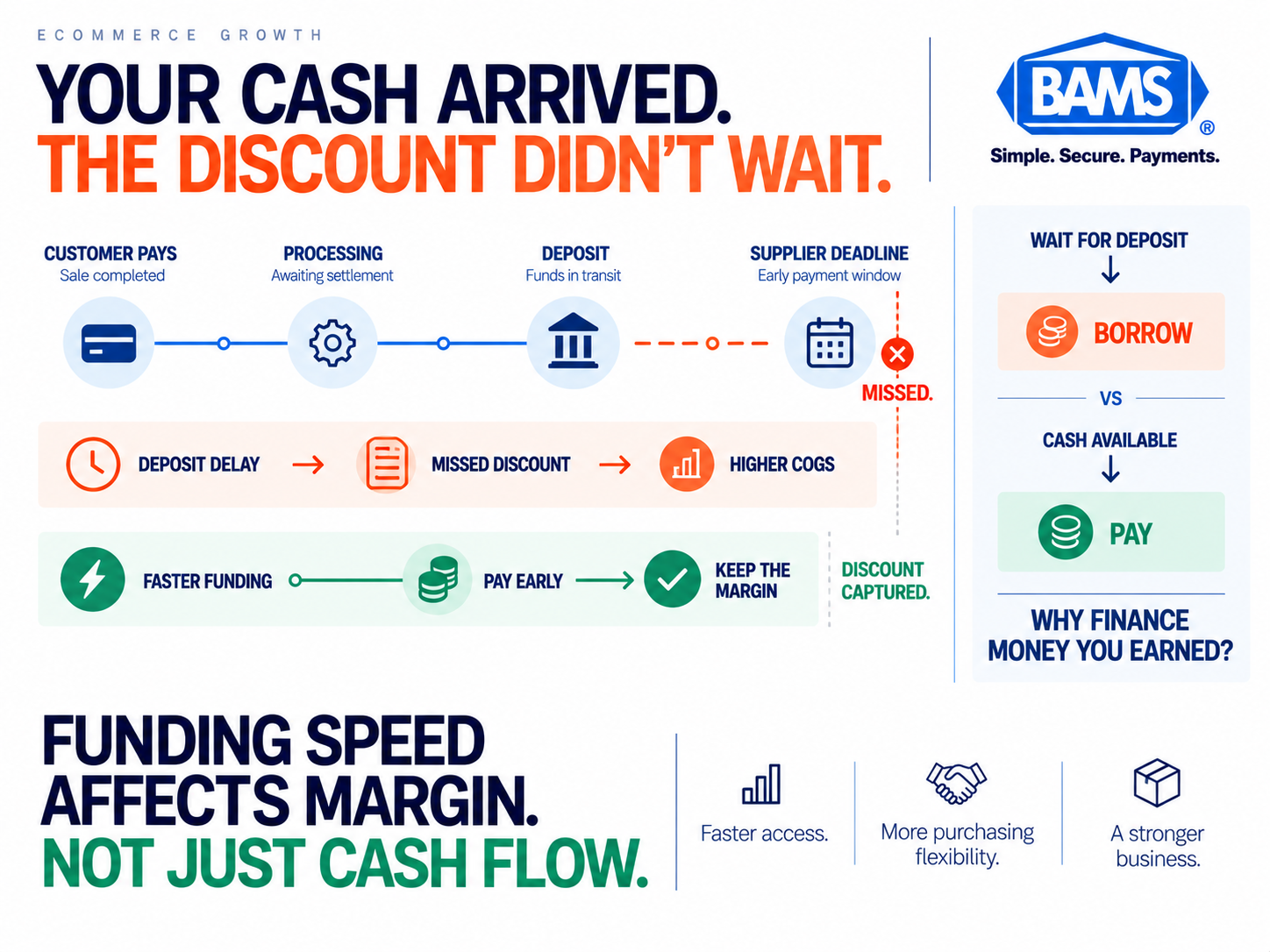
How standard 2-3 day deposit lags quietly inflate COGS and kill early-payment leverage for ecommerce brands
Learn how the cost of delayed deposits erodes supplier negotiation power and inflates cost of goods sold. This audit framework helps ecommerce managers at 10-50 person brands reclaim margin lost to deposit timing gaps.
TL;DR
- Deposit delays cost more than you think – The real cost of delayed deposits isn’t the processing wait. It’s the supplier discounts you miss, the credit line interest you pay, and the inventory decisions you defer because cash isn’t available when you need it.
- Chargebacks disrupt cash flow in three ways – Direct losses (transaction amount plus fees), rolling reserve holds (5-10% of volume locked for months), and extended settlement timelines. Most brands only track the first one.
- Batch timing is a free optimization – Aligning your ecommerce platform’s batch close with your processor’s cutoff time can move an entire day’s revenue forward by 24 hours in settlement, at zero cost.
- Next-day funding can replace short-term credit – If you carry a revolving credit line to bridge deposit gaps, the annual interest cost may exceed the cost of switching to a processor with next-day funding.
- Start with two audits – Calculate your true deposit-to-disbursement gap and the supplier discounts you’re missing. These two numbers will tell you whether your payment processing setup is a margin problem worth fixing.
The cost of a delayed deposit is not just waiting for cash. Slow funding can close supplier discount windows, increase borrowing needs and quietly raise the effective cost of inventory.
Why the Cost of Delayed Deposits Goes Far Beyond Processing Inconvenience
Most ecommerce managers understand that deposit delays are annoying. Fewer realize those delays are quietly destroying their negotiating position with suppliers, inflating their cost of goods sold, and forcing reliance on short-term credit they shouldn’t need.
The Federal Reserve has noted that faster access to customer payments can reduce small businesses’ need for short-term financing when working capital is tied up in inventory and other goods. When your processor holds funds for two or three business days, those delays can reduce the cash available for supplier payments, inventory purchases and other operating needs.
This isn’t a payments problem. It’s a margin problem disguised as a processing timeline.
Who This Is For, and What This List Won’t Cover
This guide is built for ecommerce managers at established online businesses with 10-50 employees who already process meaningful volume and need predictable cash flow to make working capital decisions. If you’re pre-revenue or running a marketplace with escrow structures, the dynamics differ.
We won’t cover basic payment gateway setup or generic chargeback definitions. Instead, each item below targets a specific structural blocker that sits between your daily revenue and the supplier terms, inventory timing, or credit decisions that actually move your margins. The goal: give you an audit framework you can run against your own COGS this week.
How We Selected These Items
Every item was evaluated on three criteria. First, does it address a cost signal that most 10-50 person ecommerce brands can verify in their own data within 48 hours? Second, does it connect deposit timing or chargeback disruption to a downstream financial decision (not just an operational annoyance)? Third, is the fix structural rather than one-time?
7 Ways to Protect Cash Flow Predictability From Chargeback and Deposit Disruptions
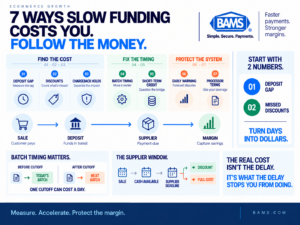
Deposit delays create costs beyond payment processing. These seven areas show where settlement timing, chargebacks and funding structure can interfere with supplier terms and working capital.
1. Audit Your True Deposit-to-Disbursement Gap
Why it matters: Most processors quote “2-3 business days” for deposits, but the actual gap between when a customer pays and when you can deploy that cash is often longer. Weekends, holidays, batch cutoff times, and chargeback holds all extend it. You can’t negotiate supplier terms you can’t fund.
What it looks like today: Many ecommerce brands track revenue daily but reconcile deposits weekly or monthly. The gap between “revenue recognized” and “cash available” stays invisible until a supplier discount window closes or a credit line gets drawn.
How to apply it: Pull 90 days of deposit records from your processor. Map each deposit date against the transaction dates it covers. Calculate the median and worst-case lag. If your median exceeds 2 business days, you have a structural problem worth quantifying in dollars, not just days. This framework for auditing funding timelines walks through the step-by-step process.
2. Quantify the Supplier Discounts You’re Currently Missing
Why it matters: A standard 2/10 net 30 early-payment discount means a supplier gives you 2% off when payment is made within 10 days instead of the full amount being due in 30 days. Nacha notes that Same Day ACH can be used for time-sensitive supplier payments, allowing funds to reach the supplier on the same business day. If your own deposit lag prevents you from funding payments within a supplier’s discount window, you’re paying full price on inventory you could otherwise buy at a discount.
What it looks like today: Ecommerce managers often treat supplier payment terms as fixed. In reality, many suppliers offer tiered discounts (1-3%) for early payment. Brands with predictable daily deposits can consistently capture these. Brands waiting 3-5 days for funds cannot.
How to apply it: List your top five suppliers by annual spend. Ask each one about early-payment discount terms. Then calculate whether your current deposit timeline allows you to hit those windows. If a $500,000 annual supplier offers 2/10 net 30 and you consistently miss it by two days, that’s $10,000 in annual margin left on the table.
3. Isolate Chargeback-Driven Funding Holds From Normal Processing Delays
Why it matters: Chargebacks don’t just reverse the disputed transaction amount. Mastercard reports that merchants incur an average of $128 per chargeback in internal and third-party costs, excluding the potential loss of the merchandise or service itself. Elevated dispute activity can also affect how processors assess merchant risk, making chargeback prevention important for both direct costs and cash flow predictability.
What it looks like today: A single month with a chargeback ratio above 1% can trigger reserve requirements that lock up 5-10% of your processing volume for 90-180 days. That’s working capital you earned, sitting in a reserve account you can’t touch, precisely when you need it for inventory replenishment.
How to apply it: Separate your chargeback costs into three buckets: direct losses (transaction amount plus fees), reserve holds (capital locked by your processor), and deposit timing degradation (additional days added to your settlement cycle). Most brands only track the first bucket. The second and third are where the real margin erosion hides. This payment optimization guide covers chargeback prevention strategies that protect deposit predictability.
4. Align Batch Timing to Your Platform’s Settlement Cycle
Why it matters: Your batch cutoff time determines when your processor starts moving your money. If your ecommerce platform closes batches after your processor’s cutoff, you lose an entire business day of settlement. Over a year, that’s 250+ days where you’re one day further from your cash than you need to be.
What it looks like today: Shopify, WooCommerce, and BigCommerce each handle batch timing differently. Some default to end-of-day Pacific time. Others let you configure it. Most ecommerce managers never change the default, which means their batch timing is optimized for the platform’s convenience, not their cash flow. For WooCommerce stores specifically, gateway selection directly affects deposit speed.
How to apply it: Check your processor’s batch cutoff time. Then check your platform’s default batch close. If the platform closes after the processor’s cutoff, adjust it earlier. Even a one-hour shift can move an entire day’s revenue forward by 24 hours in settlement.
5. Replace Short-Term Credit Lines With Next-Day Funding
Why it matters: Many ecommerce brands carry revolving credit lines specifically to bridge the gap between earning revenue and receiving deposits. At current interest rates, even a modest $50,000 line used intermittently costs $2,000-4,000 per year in interest. That’s a direct cost created by slow deposits, not by business need.
What it looks like today: Brands processing $1-5M annually often maintain credit lines they wouldn’t need if deposits arrived next-day instead of in 3-5 days. The interest cost gets buried in financial overhead rather than attributed to payment processing, so it never shows up in processor evaluations.
How to apply it: Calculate the annual interest cost on any credit facility you use to bridge deposit gaps. Then compare it to the cost of switching to a processor that offers next-day funding. BAMS, for example, provides next-day funding paired with proactive chargeback defense, which addresses both the deposit lag and the chargeback-driven holds that make cash flow unpredictable. This comparison of same-day vs. next-day funding breaks down the real operational impact for ecommerce brands.
6. Build a Chargeback Early Warning System Tied to Cash Flow Forecasts
Why it matters: Cash flow forecasts are only useful when they reflect when funds are actually available. The Federal Reserve has highlighted the importance of immediate access to customer payments for businesses managing working capital and inventory needs. Chargebacks create the opposite effect by removing revenue you may already have treated as available cash. If your forecast doesn’t account for chargeback probability by product category or channel, you’re planning with incomplete data.
What it looks like today: Most brands react to chargebacks after they hit. Proactive brands track leading indicators (customer complaint velocity, refund request patterns, delivery confirmation gaps) and adjust their cash flow projections before disputes are filed.
How to apply it: Tag your last 12 months of chargebacks by product SKU, sales channel, and reason code. Identify which categories carry the highest dispute rates. Then build a simple reserve estimate (disputed amount × win rate × average resolution time) into your weekly cash flow forecast. Even a spreadsheet-level model reduces surprise.
7. Negotiate Processor Terms Based on Your Chargeback Profile, Not Just Volume
Why it matters: Processors price risk. If your chargeback ratio is low and your dispute win rate is high, you have leverage to negotiate faster settlement, lower reserves, and better per-transaction rates. Most ecommerce managers negotiate on volume alone and leave the chargeback profile card unplayed.
What it looks like today: Brands with chargeback ratios below 0.5% and win rates above 60% are low-risk accounts that processors want to retain. But unless you present this data proactively, your processor treats you like the average merchant in your category.
How to apply it: Compile a one-page summary: monthly volume, chargeback ratio (last 12 months), dispute win rate, and average transaction value. Present it to your processor (or prospective processors) and ask specifically for reduced rolling reserves, faster settlement windows, and lower per-dispute fees. If your current processor won’t negotiate, that’s a signal about how they value your business. Partners like BAMS pair dedicated account management with proactive chargeback defense precisely because low-risk merchants deserve terms that reflect their profile.
The Pattern Across All Seven Items
Every item on this list shares a common thread: the cost of delayed deposits and chargeback disruptions isn’t the fee on the statement. It’s the second-order financial decision you couldn’t make (or made poorly) because cash wasn’t where it needed to be, when it needed to be there.
Supplier discounts, credit line interest, reserve holds, and batch timing gaps are all symptoms of the same structural problem. Your revenue cycle and your cash deployment cycle are misaligned. Fixing any one item helps. Fixing the system (deposit speed, chargeback prevention, and batch optimization together) compounds.
The brands that treat payment processing as a cash flow planning tool, rather than a back-office utility, consistently operate with lower COGS, less debt, and more flexibility to invest in growth.
Where to Start
You don’t need to tackle all seven items simultaneously. Start with the audit in item 1 (your true deposit-to-disbursement gap) and the supplier discount calculation in item 2. These two exercises take less than a day and produce a dollar figure you can act on immediately.
If the numbers reveal a meaningful gap, move to items 4 and 5 (batch timing and next-day funding evaluation). Save items 6 and 7 for after you’ve stabilized your baseline. The goal is predictable cash flow first, then optimization. Every ecommerce brand operates under real resource constraints. Prioritize the changes that convert directly to margin improvement.
Frequently Asked Questions
What is next-day funding in merchant services?
Next-day funding means your payment processor deposits the previous day’s credit card transactions into your bank account by the next business day. Instead of waiting 2-5 business days for settlement, you access your revenue within roughly 24 hours of the batch closing. This directly improves your ability to plan cash flow, pay suppliers on time, and avoid short-term borrowing.
How does next-day funding improve cash flow planning for online retailers?
When deposits arrive on a predictable daily schedule, you can forecast available cash with much higher accuracy. This lets you time inventory purchases to capture early-payment supplier discounts, reduce or eliminate revolving credit lines used to bridge deposit gaps, and make ad spend decisions based on actual cash rather than projected revenue. The shift from “revenue earned” to “cash available” becomes nearly seamless.
How do chargebacks affect deposit timing and funding predictability?
Chargebacks create three layers of cash flow disruption. First, you lose the disputed transaction amount plus processor fees. Second, elevated chargeback ratios can trigger rolling reserves where your processor holds 5-10% of your volume for 90-180 days. Third, some processors extend settlement timelines for accounts with higher dispute rates. The reserve holds and timing degradation often cost more than the chargebacks themselves.
How can I optimize my batch timing for faster funding?
Check your payment processor’s daily batch cutoff time, then verify when your ecommerce platform (Shopify, WooCommerce, BigCommerce) closes its batch by default. If your platform’s batch close happens after your processor’s cutoff, you lose a full business day of settlement. Adjusting your batch close time by even one hour can shift an entire day’s deposits forward by 24 hours.
When should an ecommerce business consider switching to next-day funding?
Consider switching when you notice any of these signals: you’re using a credit line primarily to bridge deposit gaps, you’re consistently missing supplier early-payment discount windows, your processor has increased rolling reserves due to chargeback activity, or your actual deposit-to-disbursement gap exceeds two business days on a regular basis. Each of these signals represents a quantifiable cost that next-day funding can reduce or eliminate.
Which factors influence the speed of funding in merchant services?
Several factors determine how quickly you receive deposits: your processor’s settlement schedule, batch cutoff timing, your chargeback ratio and risk profile, the payment methods accepted (credit cards typically settle faster than ACH), your bank’s processing speed, and whether your account is flagged for manual review. Weekend and holiday schedules also extend settlement windows. Optimizing the factors within your control (batch timing, chargeback prevention, processor selection) can meaningfully compress the gap.