

Deposit Structuring: A Compliance-First Guide for Funeral Homes
Last Updated on September 29, 2026 by Dimitri Akhrin
How to sequence deposits, installments, and trust funding without triggering FTC Funeral Rule violations
Learn how to build a compliant deposit and installment framework for pre-need and at-need funeral contracts. This step-by-step tutorial covers payment sequencing, state trust requirements, and front-office workflows that keep every collected dollar legally sound.
TL;DR
- State law comes first – Your deposit structure, trust-funding percentage, and refund terms are dictated by your state’s pre-need statute, not by a one-size-fits-all template. Identify your state’s requirements before designing anything.
- FTC disclosure is a prerequisite – The Funeral Rule requires itemized pricing and written terms before you collect a deposit. Build your disclosure into the contract, not a separate document families might miss.
- Separate your money streams – Use distinct merchant accounts (or rigorous daily reconciliation) to keep pre-need trust-obligated funds away from at-need operating revenue. Commingling is the most common and most avoidable compliance failure.
- Settlement timing matters for trust deadlines – If your state requires trust deposits within 30 days, a slow processor settlement can push you dangerously close. Next-day funding shortens the gap and gives you more margin.
- Train and audit relentlessly – Your compliance framework fails the moment a staff member skips a disclosure or routes a charge to the wrong account. Use a one-page checklist for every arrangement and audit quarterly.
What You’ll Achieve: A Compliant Deposit and Installment Framework
By the end of this tutorial, you’ll have a step-by-step deposit structuring framework built specifically for pre-need and at-need funeral home contracts. You’ll know exactly how to sequence deposits, insurance assignments, and installment payments so that every dollar collected before services are rendered stays compliant with the FTC Funeral Rule and your state’s trust requirements.
Your success criteria are clear: a documented payment intake workflow you can hand to your front-office staff, a checklist that maps your state’s trust or insurance-funding mandate to your contract language, and a processing configuration that gets collected funds into your operating account as fast as legally possible. No guesswork, no gray zones.
Prerequisites and Setup Checklist
Before you start, gather the following. Missing any one of these will stall you mid-process.
- Your state’s pre-need statute or regulation (e.g., trust percentage, insurance-funding requirements, refund rules). If you don’t know where to find it, your state funeral board website is the starting point.
- A copy of your current pre-need and at-need contract templates, including any disclosure addenda.
- Your merchant services agreement, specifically the sections on recurring billing, card-on-file authorization, and settlement timing.
- Access to your payment terminal or virtual terminal so you can configure saved-card and installment features.
- 30 minutes with your compliance attorney or state association advisor to confirm your state-specific trust or insurance-funding obligations.
Time estimate: 3 to 5 hours to complete all steps, spread over one to two weeks (the attorney consultation and processor configuration steps require lead time).

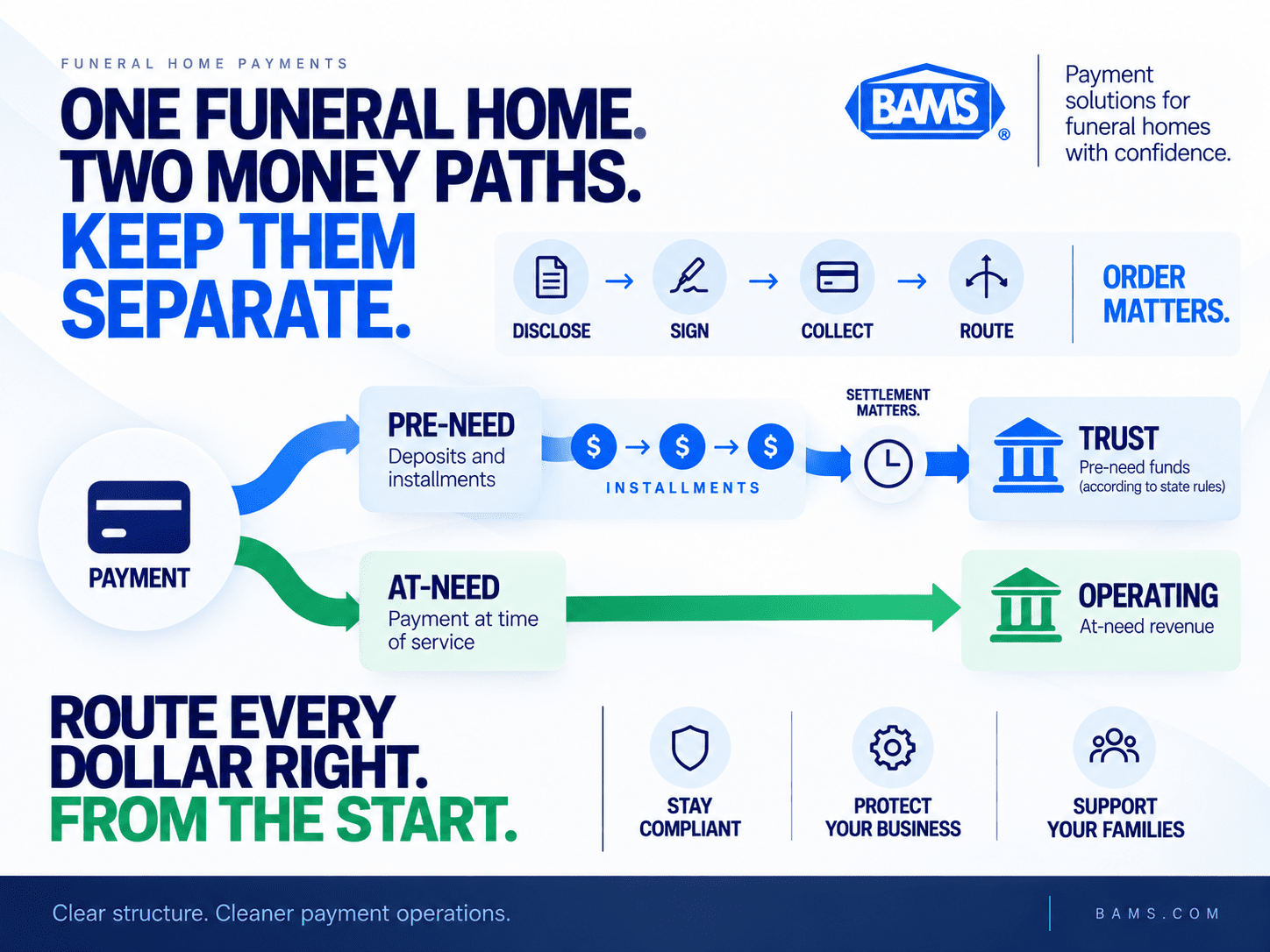
Funeral payment structure starts before collection. Separating pre-need trust obligations from at-need operating revenue creates a clearer path from contract to deposit.
Why Compliance-First Deposit Structuring Matters
Most payment advice online treats installment plans as a checkout optimization problem: split the total, charge a card monthly, done. Funeral homes operate in a fundamentally different reality. The FTC Funeral Rule applies the moment a consumer seeks pricing information, including during pre-need arrangements. Collecting money before services are rendered triggers state trust and insurance-funding laws that vary dramatically from state to state.
Get the sequencing wrong and you face regulatory exposure on two fronts: federal disclosure violations and state trust mishandling. Get it right and you create flexible payment options that families appreciate, that your cash flow depends on, and that regulators won’t question. This tutorial treats the problem in that order: compliance first, then payment execution.
Step 1: Identify Your State’s Pre-Need Funding Mandate
Open your state’s funeral or cemetery pre-need statute. You’re looking for one critical answer: does your state require collected pre-need funds to be held in trust, funded through insurance, or both?
For example, Virginia requires that within 30 days of receipt, a funeral provider deposit all consideration for pre-need contracts into a special account, or 90% if the price is guaranteed. Georgia law says deposits from pre-need funds must remain in trust or escrow until services are performed. Texas requires a trust-funded or insurance-funded permit before selling prepaid services at all.
Action: Document your state’s requirement in a simple table with three columns: Funding Method Required, Percentage Held in Trust, and Refund Conditions. This becomes your reference for every step that follows.
Checkpoint: You should be able to answer in one sentence: “In my state, pre-need deposits must be [held in trust at X% / funded via insurance policy / either, with these conditions].”
Common failure: Assuming your state matches a neighboring state. It often doesn’t. Tennessee’s pre-need rules require contracts to state whether funds are revocable or irrevocable, and irrevocable funds are not refundable. Illinois requires disclosure of whether funding is via trust, insurance, or annuity, and grants purchasers the right to demand termination and refund of trust funds for undelivered merchandise after final payment. Always verify your own state.
Step 2: Audit Your Contract Language Against FTC Disclosure Rules
Pull your pre-need contract template. The FTC’s consumer guidance and the Funeral Rule itself require that consumers receive an itemized General Price List before discussing arrangements. Your deposit and installment terms must appear in writing before you collect any money.
Action: Confirm your contract includes these elements:
- Itemized prices for every selected service and merchandise item (not bundled totals).
- A clear statement of the total contract price.
- The deposit amount, when it’s due, and what it covers.
- Whether the contract is guaranteed-price or non-guaranteed (and how price increases are handled).
- Trust or insurance funding disclosure as required by your state (from Step 1).
- Cancellation and refund terms.
Checkpoint: Hand the contract to someone unfamiliar with funeral operations. Can they tell you, without asking, how much the deposit is, where the money goes, and what happens if they cancel? If not, revise.
Common failure: Burying installment terms in a separate rider that families don’t always receive. Keep deposit and payment schedule terms in the primary contract document.
Step 3: Design the Deposit Amount and Timing
This is where most funeral homes improvise, and where compliance risk concentrates. Your deposit amount must satisfy two constraints simultaneously: it needs to be large enough to signal commitment and cover your administrative costs, but it must comply with your state’s trust-percentage rules.
Action: Use this decision framework:
- If your state requires 100% of pre-need funds in trust (like Georgia), your deposit goes directly into the trust account. You cannot use it as operating cash until services are rendered. Set the deposit at a level that covers your trust-administration costs, typically 10% to 20% of the contract total.
- If your state allows a percentage to be retained (like Virginia’s 10% on guaranteed contracts), structure the deposit to match or fall below the retainable percentage. This gives you immediate operating cash for the retainable portion.
- If your state mandates insurance funding, the “deposit” is actually the first premium payment on an assigned policy. Coordinate with your insurance partner on minimum initial premium amounts.
Checkpoint: Write out one sentence: “Our standard deposit is $[amount], of which $[amount] goes to [trust/insurance/operating account] within [X] days of collection.” If you can’t complete that sentence cleanly, your structure needs more work.
Step 4: Build the Installment Schedule
With your deposit locked in, design the remaining installment plans for the balance. The key constraint: every installment collected before services are rendered is subject to the same trust or insurance-funding rules as the deposit.
Action: Choose a payment cadence based on contract size and family preference:
- Under $5,000 total: 6 to 12 monthly installments. Shorter timelines reduce your administrative burden and trust-reporting cycles.
- $5,000 to $15,000: 12 to 24 monthly installments. Offer autopay to reduce missed payments.
- Over $15,000: 24 to 36 monthly installments, or coordinate with insurance-funded structures where the policy matures to cover the balance.
Document the installment amount, due date, accepted payment methods, and late-payment terms in the contract. If your state requires trust deposits within a specific window (Virginia’s 30-day rule, for example), your installment collection and trust-deposit schedule must align.
Common failure: Offering installment plans without configuring automatic trust deposits. If you collect $200 monthly but only sweep to trust quarterly, you may violate your state’s timing requirements.
Step 5: Configure Your Payment Processing for Recurring Collection
Your merchant services setup must support three capabilities: card-on-file storage for recurring billing, clear transaction descriptors so families recognize the charge, and settlement timing that matches your trust-deposit obligations.
Action:
- Enable card-on-file with written authorization. Collect a signed (physical or electronic) recurring payment authorization form at contract signing. This protects you from chargebacks and satisfies card network rules.
- Set your transaction descriptor to include your funeral home name and “Pre-Need” or “Installment” so the charge is immediately recognizable on a family’s bank statement. Unclear descriptors are a top cause of friendly fraud chargebacks in this industry.
- Confirm your settlement timing. If your processor batches once daily and settles in two to three business days, you have a built-in delay before funds reach your trust account. For operators who need to meet tight state-mandated deposit windows, next-day funding eliminates that gap. BAMS, for instance, offers next-day funding that can help funeral homes move collected installments into trust accounts within the required timeframe, reducing the risk of a timing violation.
Checkpoint: Run a test transaction on your terminal or virtual terminal. Verify the descriptor reads correctly, the card-on-file stores properly, and you can schedule a future recurring charge.
Step 6: Separate Pre-Need Trust Funds from At-Need Operating Revenue
A compliant payment workflow connects disclosure, contract terms, collection, routing and verification. The destination depends on the type of arrangement and applicable state requirements.
This step is non-negotiable and frequently botched. Pre-need deposits and installments that must go into trust cannot be commingled with at-need revenue in a single merchant account settlement.
Action: Work with your processor and your bank to establish one of these configurations:
- Option A: Two separate merchant accounts, one for at-need payments (settles to your operating account) and one for pre-need installments (settles to your trust account or a holding account you sweep to trust).
- Option B: A single merchant account with manual daily reconciliation, where you identify pre-need transactions in your batch report and manually transfer the required percentage to trust within your state’s deadline.
Option A is cleaner and audit-proof. Option B works for smaller operations but requires disciplined daily bookkeeping.
Common failure: Letting pre-need installment revenue sit in the operating account “until the end of the month.” In states with 30-day trust-deposit windows, a single holiday weekend can push you past the deadline.
For a deeper look at managing these separate revenue streams, see Working Capital Management for Funeral Homes, which breaks down the at-need, insurance assignment, and pre-need cash flow timing problems individually.
Step 7: Handle Insurance Assignment Gaps
When a family assigns a life insurance policy to your funeral home at time of need, you face a different cash flow problem: you’ve agreed to accept the policy as payment, but the insurance company may take 30 to 60 days (or longer) to pay. Meanwhile, you’ve already rendered services and incurred costs.
Action:
- Verify the policy before rendering services. Call the insurance company to confirm the policy is active, the face value covers the contract amount, and there are no contestability issues. Document the call (date, representative name, confirmation number).
- Collect the family’s portion upfront. If the contract total exceeds the policy’s face value, collect the difference as a deposit via card or check at the arrangement conference. Do not wait until after services.
- Set a follow-up schedule. Mark your calendar to follow up with the insurance company at 14, 30, and 45 days. Many delayed assignments result from missing paperwork, not intentional slow-payment.
Checkpoint: You should have a written insurance verification record for every assignment, and the family’s out-of-pocket portion should be collected before the service date.
Step 8: Document and Train Your Staff
Your compliance framework is only as strong as your front-office execution. A single staff member who collects a deposit without the proper disclosure, or who runs a pre-need installment through the at-need merchant account, can create a violation.
Action:
- Create a one-page payment intake checklist that staff follow for every pre-need and at-need arrangement. Include: disclosure delivered (checkbox), contract signed (checkbox), deposit amount and method (fill-in), merchant account used (pre-need or at-need), and trust-deposit deadline (date).
- Role-play the arrangement conference. Have staff practice presenting flexible payment options to families, including the deposit amount, installment schedule, and what happens if they cancel. Comfort with the script reduces errors under pressure.
- Schedule quarterly audits. Pull your merchant account batch reports, cross-reference against trust account deposits, and verify every pre-need installment reached the trust within your state’s required window.
Checkpoint: Your newest staff member should be able to walk through the checklist without assistance.
Configuration and Customization
Variables You’ll Need to Adjust
- Deposit percentage: Ranges from 10% to 25% depending on your state’s retainable amount and your administrative cost recovery needs. Start at the state-allowed retainable percentage as your default.
- Installment cadence: Monthly is standard, but some families prefer bi-weekly (especially if paid on a bi-weekly payroll cycle). Your recurring billing tool must support both.
- Late-payment grace period: 5 to 10 days is standard. Beyond that, your contract should specify whether the plan accelerates (full balance due) or simply adds a late fee. Check your state’s consumer lending rules before adding fees.
- Transaction descriptor text: Must include your business name. Add “PreNeed” or “Installment” to distinguish from at-need charges. Most processors allow 20 to 25 characters.
Safe Defaults vs. Must-Change Settings
Safe defaults: Monthly billing on the 1st or 15th, 7-day grace period, email receipt for every charge.
Must-change: Your trust-deposit timing (must match state law), your merchant account routing (must separate pre-need from at-need), and your contract disclosure language (must reflect your specific state requirements).
Verification and Testing
Before going live with your new deposit and installment structure, run this verification sequence:
- Test transaction: Process a $1.00 card-on-file charge on your pre-need merchant account. Confirm it settles to the correct bank account (trust or holding) within the expected timeframe.
- Recurring billing test: Schedule a $1.00 recurring charge for the next day. Confirm it fires on schedule, generates a receipt, and the descriptor reads correctly.
- Contract review: Have your compliance attorney review the final contract template with deposit, installment, trust-funding, and cancellation language. Get written sign-off.
- Staff walkthrough: Have two staff members independently complete the payment intake checklist using a mock arrangement scenario. Compare their outputs for consistency.
Edge cases to verify: What happens when a card on file declines on a scheduled installment? Does your system retry automatically, and does it notify you and the family? What happens when a family cancels mid-plan? Can you process the refund from the trust account within your state’s required refund window?
Common Errors and Fixes
Error: “Chargeback filed on a recurring pre-need installment”
Symptom: A family’s bank reverses a monthly installment charge. Cause: The cardholder didn’t recognize the transaction descriptor or forgot they authorized recurring billing. Fix: Update your descriptor to clearly include your funeral home name and “PreNeed.” Ensure you have a signed recurring authorization form on file. Submit the authorization as evidence in your chargeback response. Proactive chargeback defense from your processor can flag disputes before they escalate.
Error: “Trust deposit missed the state deadline”
Symptom: An audit reveals installment funds sat in your operating account past the trust-deposit window. Cause: Settlement delay from your processor combined with manual transfer lag. Fix: Switch to next-day funding to shorten the settlement gap. Automate the trust-account transfer via your bank’s ACH scheduling. Set a calendar reminder 5 days before each state deadline.
Error: “Pre-need and at-need funds commingled in batch report”
Symptom: You can’t distinguish which settled funds are pre-need trust obligations versus at-need operating revenue. Cause: Both transaction types processed through a single merchant account. Fix: Set up a separate merchant account for pre-need transactions (Step 6). If that’s not immediately possible, tag every pre-need transaction with a unique invoice prefix (e.g., “PN-0001”) and reconcile daily.
Error: “Family disputes deposit amount after signing”
Symptom: A family claims they weren’t told the deposit was non-refundable or argues the amount was different. Cause: Deposit terms weren’t clearly stated in the contract or weren’t verbally reviewed. Fix: Add a standalone deposit acknowledgment section to your contract with a separate signature line. Train staff to read the deposit terms aloud during the arrangement conference.
Next Steps and Extensions
With your deposit and installment framework in place, you can extend it in several directions:
- Add online pre-need enrollment. Build a web form that collects the initial deposit via your pre-need merchant account, generates the disclosure, and emails the contract for e-signature. This expands your reach beyond walk-in arrangements.
- Explore POS financing for at-need families. For families who need to cover the gap between insurance assignment and total cost, point-of-sale financing can offer a structured option. Learn more in POS Financing: What Is It and Why Should Merchants Consider Getting Onboard.
- Benchmark your authorization rates. If recurring installment charges are declining at a rate above 2% to 3%, investigate card updater services that automatically refresh expired card-on-file details. Your processor should offer this or be able to enable it.
Frequently Asked Questions
Does the FTC Funeral Rule apply to pre-need deposit collection?
Yes. The FTC Funeral Rule applies whenever a consumer seeks information from a funeral provider, including pre-need arrangements. You must provide an itemized General Price List and meet all disclosure requirements before collecting any deposit. The Rule doesn’t prescribe deposit amounts, but it does require pricing transparency that directly affects how you present your deposit and installment terms.
How do I know what percentage of a pre-need deposit must go into trust?
This is determined entirely by your state’s pre-need statute. There is no single federal standard. OCC trust guidance confirms that state law dictates the percentage of pre-need funeral funds held in trust versus released to the funeral home. Check your state funeral board’s website or consult your compliance attorney for the exact figure. Some states require 100%, others allow 10% to be retained immediately.
Can I offer installment plans on at-need contracts, or only pre-need?
You can offer installment plans on at-need contracts, and the compliance picture is simpler because services have already been rendered. The trust-funding requirements that make pre-need deposits complex generally don’t apply to at-need balances. However, you still need a signed payment authorization, clear terms in writing, and a recurring billing configuration that generates receipts and handles declines gracefully.
What happens if a family cancels a pre-need contract with remaining installments?
Your state law governs refund obligations. For example, Illinois guidance states that after final payment, the purchaser may demand termination and a refund of trust funds for undelivered merchandise and unperformed services. Some states allow you to retain an administrative fee. Your contract must clearly disclose these cancellation and refund terms before you collect the first dollar.
How do I reduce chargebacks on recurring pre-need installments?
Three steps make the biggest difference. First, use a clear transaction descriptor that includes your funeral home name and “PreNeed” so the charge is recognizable. Second, keep a signed recurring payment authorization form on file for every plan. Third, send a payment reminder email or text 3 to 5 days before each charge. These steps address the most common causes of friendly fraud chargebacks in recurring billing scenarios.
Should I use a separate merchant account for pre-need and at-need transactions?
Strongly recommended. Separating pre-need and at-need transactions into distinct merchant accounts ensures that funds settle into the correct bank accounts (trust versus operating) without manual sorting. This simplifies your reconciliation, makes audits straightforward, and reduces the risk of accidentally commingling funds that must be held in trust.
Sources
- https://www.ftc.gov/news-events/topics/truth-advertising/funeral-rule
- https://law.lis.virginia.gov/vacodefull/title54.1/chapter28/article5/
- https://law.justia.com/codes/georgia/title-10/chapter-14/section-10-14-7/
- https://www.dob.texas.gov/cemetery-prepaid-funeral-services
- https://regulations.vlex.com/vid/tenn-comp-r-regs-961555616
- https://law.justia.com/codes/illinois/2023/chapter-225/act-225-ilcs-45/
- https://consumer.ftc.gov/articles/planning-your-own-funeral
- https://www.bams.com/blog/pos-financing-what-is-it-and-why-should-merchants-consider-getting-onboard/
- https://www.occ.treas.gov/publications-and-resources/publications/comptrollers-handbook/index-comptrollers-handbook.html
- https://illinoiscomptroller.gov/constituent-services/public-services-community-programs/place


