Card-Not-Present Fraud Prevention: Insights from Microblink CEO Hartley Thompson
Last Updated on March 5, 2026 by Dimitri Akhrin
The Growing Challenge of Card-Not-Present Fraud
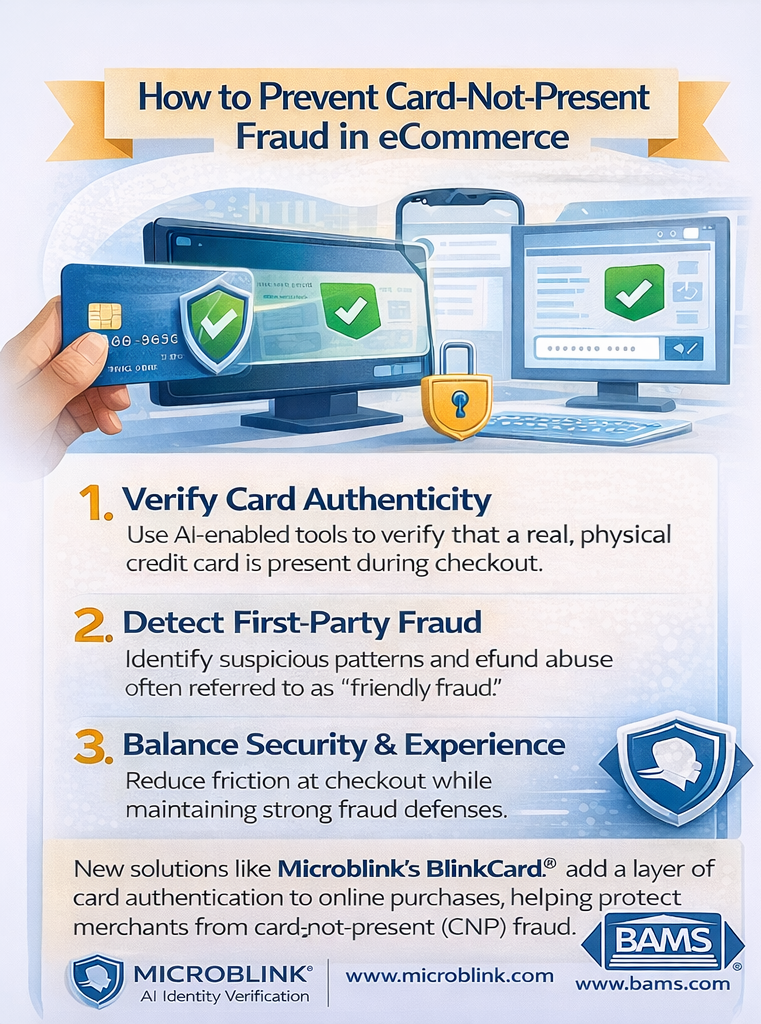
At BAMS, payments are central to everything we do and card-not-present fraud prevention is important to us. That is why we closely track emerging threats across the payments ecosystem. One of the most significant challenges facing merchants today is the rise of card-not-present (CNP) fraud and first-party fraud, sometimes referred to as “friendly fraud.” Card-not-present fraud is one of the fastest growing threats in eCommerce, making identity verification and fraud detection tools critical for modern payment systems.
Preventing card-not-present fraud requires stronger identity verification, fraud detection tools, and secure checkout systems for online merchants.
First-party fraud occurs when legitimate customers dispute valid charges or exploit refund policies to obtain refunds after receiving products or services. At the same time, traditional fraud schemes involving stolen card credentials continue to rise in online environments where verifying a customer’s identity is more difficult.
Together, these trends are creating new pressure for merchants operating in eCommerce and digital payments. According to the Federal Trade Commission, online payment fraud and identity theft remain among the fastest-growing categories of consumer complaints in the United States.
To better understand how businesses can fight back, we spoke with Hartley Thompson, CEO of Microblink, a global leader in AI-powered identity verification technology. Microblink’s platform helps financial institutions, payment providers, and merchants verify identities across digital transactions.
One of the company’s newest innovations, BlinkCard, introduces a powerful approach to combating CNP fraud by verifying that a physical card is present during online transactions.
Q&A with Hartley Thompson, CEO of Microblink
Why Fraud Has Become a Critical Issue for Merchants
Merchants evaluating fraud risks should also understand how payment infrastructure affects both security and transaction costs. Our guide on reducing eCommerce payment processing fees explains how merchants can optimize payment systems while protecting margins.
BAMS: Let’s start with the big picture. Why has first-party fraud and card-not-present fraud become such a critical issue for merchants today?
Hartley Thompson:
Fraud is evolving faster than the defenses designed to stop it.
Traditional in-person payments became far more secure thanks to chip cards, contactless payments, and tokenization. But those improvements shifted fraud activity online, where verifying identity is significantly harder.
What’s changed recently is the rise of first-party fraud. Real customers are increasingly disputing legitimate transactions or exploiting refund policies. Many don’t even consider it fraud. They simply see it as a way to get their money back.
When surveys show that a significant portion of younger consumers believe disputing a charge is acceptable if they are unhappy with a purchase, even when the product arrived, it highlights how widespread the issue has become.
How Microblink Approaches Fraud Prevention Differently
BAMS: How is Microblink approaching this challenge differently than traditional fraud-prevention vendors?
Hartley:
We started by recognizing that traditional rules-based fraud systems are no longer enough.
Fraudsters are now using automation, AI tools, and even social media strategies to bypass static defenses. So we asked a different question: how can we make a digital transaction as trustworthy as an in-person one?
That thinking led to BlinkCard, a technology designed to bring “card-present confidence” into card-not-present environments.
How BlinkCard Helps Prevent Fraud
BAMS: Tell us more about BlinkCard. How does it work?
Hartley:
BlinkCard originally began as a convenience feature. Customers could simply scan their credit or debit card with their phone camera rather than manually typing in the numbers.
But we quickly realized the camera could do much more.
By combining our card-capture engine with liveness detection technology, BlinkCard can verify that a real, physical card is present at the time of purchase rather than a screenshot or stolen credential.
The entire process takes only a fraction of a second and is as simple for customers as snapping a photo. But for merchants, it creates an additional layer of verification that significantly reduces fraud risk.
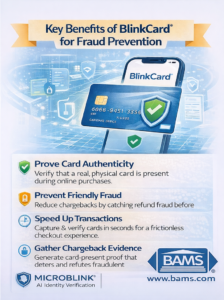
BlinkCard technology verifies the presence of a physical payment card during online checkout to reduce fraud and chargebacks.
Preventing Chargebacks with Transaction Evidence
BAMS: So it’s not just about preventing fraud—it also creates evidence?
Hartley:
Exactly.
One of the most frustrating aspects of first-party fraud is how difficult it can be for merchants to prove what happened during a transaction.
With BlinkCard, merchants can demonstrate that a physical card was present during checkout. That evidence can help resolve disputes before they escalate and can even be used during chargeback investigations.
In many cases, simply showing customers that proof exists discourages disputes from moving forward. That alone can significantly reduce chargeback rates.
Merchants dealing with high chargeback volumes often discover that fraud prevention is closely tied to their payment infrastructure. Understanding how payment processing costs and risk factors interact can also help businesses strengthen their defenses while improving operational efficiency. Businesses exploring these strategies may benefit from reviewing our guide on key factors impacting eCommerce payment processing costs.
Balancing Fraud Prevention with Customer Experience
BAMS: Fraud prevention often conflicts with customer experience. How do you maintain that balance?
Hartley:
That balance is incredibly important.
The best fraud prevention systems are the ones customers barely notice.
BlinkCard does not require additional hardware or complex authentication steps. The entire process adds only a moment to checkout while significantly improving transaction verification.
For merchants, that means stronger protection without introducing friction that might cause legitimate customers to abandon their purchase.
Businesses that optimize both checkout experience and payment infrastructure tend to see stronger customer trust and improved long-term profitability. Our article on how to reduce eCommerce payment processing fees explores how payment systems influence both cost and customer experience.
The Future of Fraud Prevention
BAMS: Looking ahead, what does the future of fraud prevention look like?
Hartley:
Fraud is constantly evolving, which means fraud prevention must evolve as well.
Our focus is on building AI-powered identity verification systems that adapt as quickly as fraud tactics change.
The ultimate goal is to create scalable digital trust. By capturing the right data signals safely and ethically, businesses can transform risky online transactions into verified, trustworthy interactions.
Advice for Merchants Facing Rising Fraud
BAMS: What advice would you give to merchants feeling overwhelmed by the pace of fraud today?
Hartley:
Start small, but start strategically.
Look closely at your checkout process. Identify where fraud typically occurs and where legitimate customers experience friction.
Those areas represent your greatest opportunity for improvement.
You don’t need to overhaul your entire system overnight. Even introducing one tool that shifts your fraud strategy from reactive to proactive can dramatically improve outcomes.
The key is to stay ahead of the problem rather than waiting until fraud losses force you to act.
Why Fraud Prevention Matters for Modern eCommerce
Online commerce continues to grow rapidly, but so do the risks associated with digital payments. Global card fraud losses are projected to exceed $40 billion annually as eCommerce transactions continue expanding worldwide.
According to research from the Federal Reserve, card-not-present transactions account for a disproportionate share of payment fraud compared to in-person purchases. This is largely because verifying identity remotely is significantly more complex.
At the same time, merchants must maintain a smooth and convenient checkout experience. Excessive security steps can lead to abandoned carts and lost revenue.
Modern fraud-prevention technologies aim to solve this challenge by combining identity verification, AI-driven analysis, and behavioral signals to detect fraud without disrupting legitimate customers.
As digital payments continue expanding, solutions that strengthen trust while preserving convenience will play a critical role in the future of eCommerce.
Frequently Asked Questions
What is card-not-present (CNP) fraud?
Card-not-present fraud occurs when a transaction is completed without the physical card being present, such as during online or phone purchases. Because the card cannot be physically verified, these transactions carry a higher fraud risk.
What is first-party or friendly fraud?
First-party fraud happens when legitimate customers dispute valid charges or misuse refund policies to obtain refunds after receiving goods or services.
Why is CNP fraud increasing in eCommerce?
As in-person payments became more secure with chip cards and contactless technology, fraudsters shifted their focus online where identity verification is more challenging.
How does identity verification technology help prevent fraud?
Identity verification tools use signals such as biometric data, document verification, and behavioral analysis to confirm that the person completing a transaction is the legitimate cardholder.
Can fraud prevention tools impact customer experience?
Yes, poorly designed fraud systems can create checkout friction. Modern solutions focus on minimizing disruptions while still verifying transaction authenticity.
Sources
-
Federal Trade Commission – Identity Theft and Fraud Reports
https://www.ftc.gov -
Federal Reserve – Payments Fraud Data Report
https://www.federalreserve.gov -
Nilson Report – Global Payment Fraud Trends
https://nilsonreport.com